Just after finishing the visit of the Alhambra within the Palacios Nazaries complex, when you come out through the turnstiles you’ll find yourself on the opposite side to the entrance, directly facing the Palacio del Partal (or rather, what remains of it). The beauty of the Palacio de los Leones will still be fresh in your eyes, but the surprises of the Alhambra don’t end there: here’s what awaits you outside the Nasrid palaces.
Contents
El Partal
You have come to admire El Partal, the oldest of the palaces of the Alhambra, at least among those of which a part still stands, dating from the time of Sultan Muhammad III (1302-1309). As you will notice, the layout is very similar to that already seen in the Palacio de Comares: a large rectangular basin at whose far end stands a portico giving access to the main hall. The latter lies beneath what is called the Torre de las damas (Tower of the Ladies).
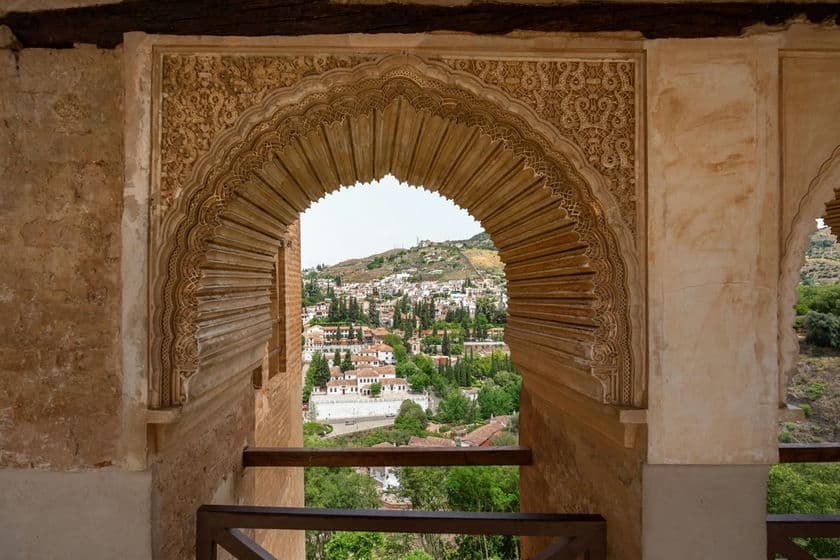
Although it is not the most significant palace in terms of size or decorative elements, the Partal remains one of the most atmospheric in the entire Alhambra, thanks to its unique location. Resting against the outer walls, on the cliff edge of the hill, it is one of the best vantage points from which to admire the Sacromonte: what to this day is the most distinctive and enigmatic neighbourhood of the city of Granada. You certainly won’t miss the chance to peer out from the tower windows and snap one of the iconic photos of your visit to the Alhambra.
One of the most noteworthy areas of the complex is the gardens, the result of natural development following landscape and architectural planning begun in the 1930s. In the mid-20th century the expropriations of small private properties in this area were completed, which gradually led to the completion of the archaeological excavations. Over the years the area has thus been brought back to life by integrating the plantings with the architectural elements and the archaeological remains that have re-emerged.
The Oratory and the Casitas of the Partal
Beside the portico of the Partal we find a small rectangular building which, because of its decorations, has been attributed to the time of Yusuf I. It is an oratory, well oriented with its Mihrab, the niche that indicates the direction in which Mecca lies. Its position on the outer walls was intended to favour the sultan’s meditation on nature, creation and prayer.
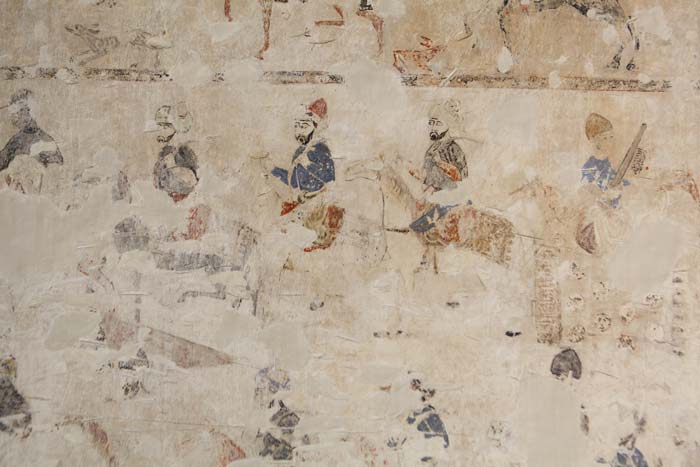
The four small dwellings near the portico of the Partal are known as Casitas del Partal – casa de Gonzàlez Pareja, casa de Villoslada, casa de los Balcones, casa de las Pinturas. All are two-storey and preserve plaster decorations and mural paintings inside. According to some experts, they represent the only example of Nasrid painting in the whole monumental complex, given that the paintings in the Palacios Nazaries were the work of Christian painters.
Palace of Yusuf III
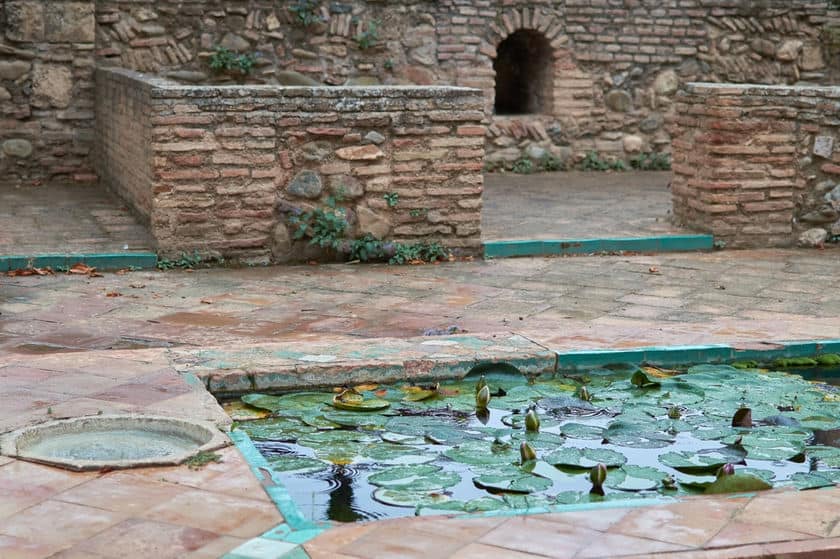
There is not much left of this palace that we encounter as we stroll through the Partal gardens. The large pool, however, is the main evidence of the location of the building’s central courtyard. At the far end of the patio we can see the base of what was the principal residence: a tower opposite which stood an arcaded gallery. The remains uncovered during excavations have led to the palace being attributed to Yusuf III – hence the name given to it – but it may be that he altered an earlier structure, attributed to Sultan Muhammad II (1273–1302).
Rauda
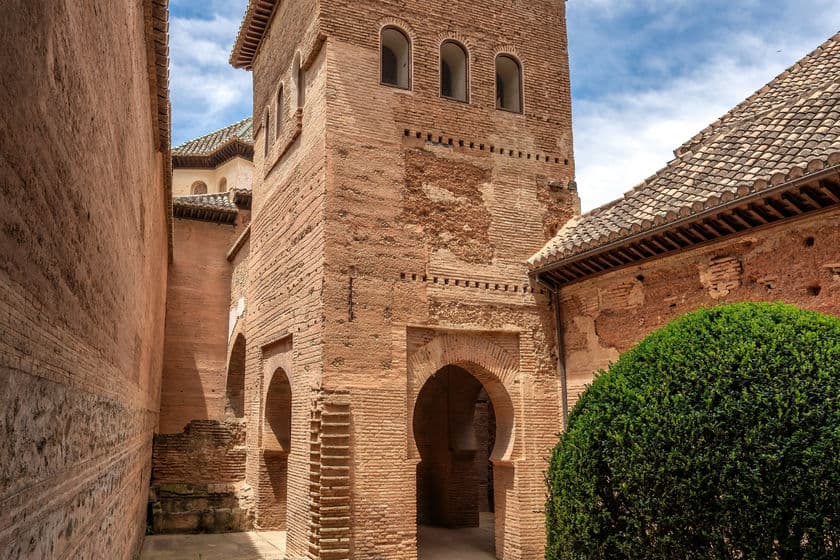
Rauda means cemetery. Although it is not part of the two palaces described above, it is in this area and along this section of the visit that we encounter this structure. It is here, behind the Palacio de los Leones, that the royal family buried their dead. Of particular interest, however, is what is known as the Puerta de la Rauda, owing to its proximity to the cemetery.
This quadrangular building, with its typically Arabesque arches, houses a magnificent dome decorated in the traditional red-brick and white-striped pattern. The building is open on three sides with large arches, while the fourth serves as the communicating entrance to the Palacios de los Leones, into which it was incorporated despite being of an earlier period.
Promenade of the Towers
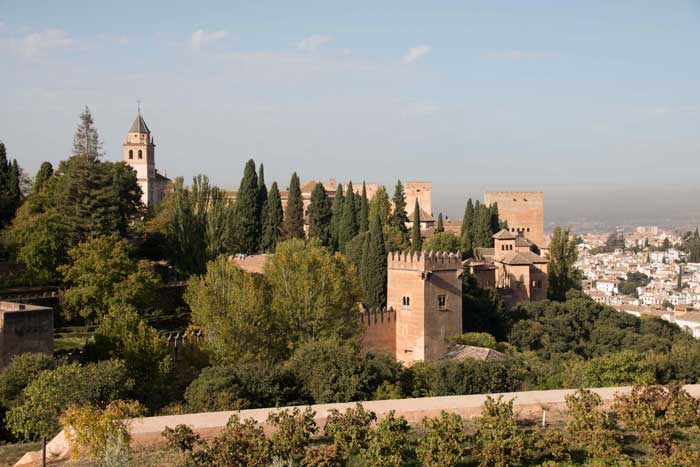
From the remains of the Palacio de Yusuf III we can access what is known as the Paseo de las Torres, the path that allows us to reach the various watchtowers of the fortress. By taking this walk we can enjoy one of the best views over the Generalife estate.
There are four main towers that we come across:
- Torre de los Picos: built at the end of the 13th century or the beginning of the 14th, it is so named for the battlements that adorn its summit. It stood as a defence for one of the fortress entrances that communicated with the Generalife. Its interior is divided into three parts forming a distinctive complex, which inspired Washington Irving in his description of Judìo Almamen, who hid in these parts while seeking a way to take revenge on his daughter’s seducer.
- Torre de la Cautiva: it is actually a hybrid between a tower and a palace, characterised by Nasrid-style decoration. The tower features a small patio and a main room where, together with the Throne Hall of the Palacio de Comares, we find the most complete decorative programme in the Alhambra.
- Torre de las Infantas. Similar in structure to the previous one, here too there is a central patio, which was once covered by a dome decorated with muqarnas, while now it is protected by a more modern wooden ceiling. This tower is the scene of the legend of the three princesses (hence the tower’s name) Zaida, Zorayda and Zorahaida, recounted by Irving in the “Tales of the Alhambra”.
- Torre del Agua. As you might guess, it is water that gives this tower its name, so called because it stands at the point where the aqueduct coming from the Generalife enters the Alhambra. It is one of the largest towers in the entire fortress and was destroyed by bombardments from the Napoleonic army: only the base remained. In the 20th century the outer walls were rebuilt. The original had three storeys but, having been of a purely military character from the outset, it had no decorations.
Where to stay?
In our article on where to stay in Granada you will find recommendations for the various hotels located on the Alhambra hill and other accommodation options available in the city.
Other useful links
- Tips on the. places to visit in Granada
- Tips on where to eat in Granada
- How to book tickets for the Alhambra + information on opening times and tours
