The visit to the large arabesque complex of Granada usually starts at the Alcazaba, the point furthest from the ticket office and also the least Moorish part of the entire Alhambra, where the oldest and the most recent buildings are concentrated: in this article I want to explain to you why.
Map of the Alcazaba
Contents
The Alcazaba
Being the oldest part of the fortress, it is not certain that the Alcazaba was founded by the Arabs, but it certainly enjoyed its greatest splendour under them. The name itself proves this: as you will already have guessed from other pages on our site, all places whose name begins with Al share the same origin, the particle being the article in the Moorish language. If “Al-Hamra” means “The Red”, “Al-Qasaba” could be translated as “The Rock” or “The Citadel”.
The military area, therefore, enclosed by defensive walls which, in the case of Granada, are truly impregnable. The best view of this imposing curtain of walls is from the Albaycìn quarter, from which we can fully appreciate how, by siting the structure on the crag it occupies, it was made unassailable by its design along the whole long flank sheer above the Darro river. Here’s a photo.
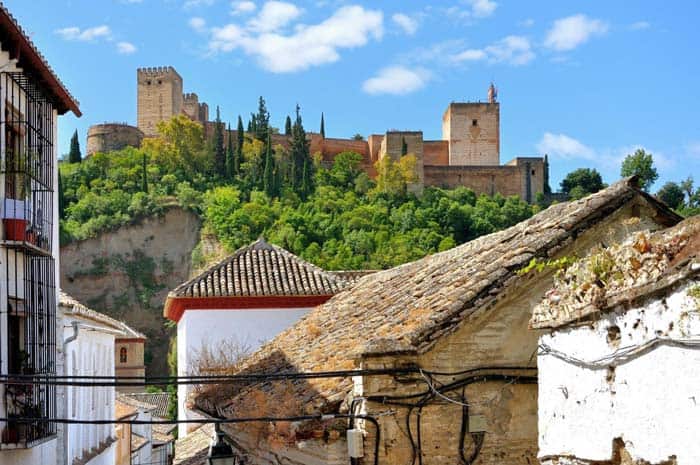
Unfortunately, little remains of the original structure, now limited to the walls and a few towers, such as the Torre de la Vela which I’ll talk about shortly. I recommend starting your tour right here because, from this position, you’ll have the best view over the city below you and over the Sierra Nevada that encircles the valley. I had fun here putting away the map of the complex and exploring the ruins, climbing the towers, strolling along the battlements. By following my example, you’ll be able to appreciate the sensation of power felt by those who ruled Granada in centuries past.
The Torre de la Vela
In Spanish, the vela is simply the candle. The name of the most imposing tower in the entire Alhambra (but not the tallest, which is in the Palacio de Comares) refers to the role it fulfilled: the soldiers’ watch. It was, in fact, the principal observation point for the defence of the fortress, as evidenced even today by the bell, which was rung in case of alarm.
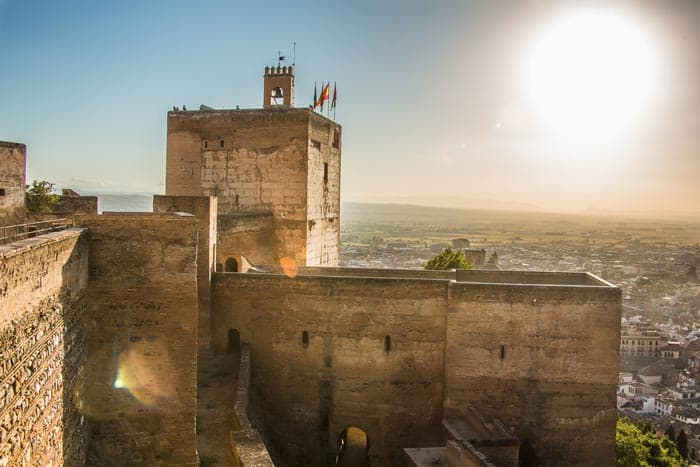
Today, four enormous flags fly from the tower, clearly visible even from a distance: the European Union, Spain, Andalusia and Granada. The latter, which those less familiar with it may confuse with the flag of Portugal — both are red and green, but the division between the bands is central in the Granadan flag and shifted to the left in the Portuguese one, while the coat of arms is completely different — deserves particular attention.
Over the centuries, the city had various symbols, but in 1980 this banner was chosen because it appears to have been the one most widely used in different periods, starting with the Sala de los Caballeros XXIV in the Madraza. The people of Granada are very attached to their flag, so much so that in 2008 a major controversy arose when the Patronato de la Alhambra decided to remove it from the tower, leaving only the other three. The mayor immediately called for the flag to be returned to the tower, declaring the gesture unacceptable to any Granadan.
The Jardìn de los Adarves
Since the Christian reconquest of Granada, l’Alcazaba – which in the meantime had assumed predominantly military purposes – was used in various ways. For long periods, including the French occupation, it served as the state prison. It was precisely when the Alcazaba lost its military role that the Jardìn de los Adarves came into being, the lovely garden that you will walk through to reach the towers and bastions from the entrance courtyard – where you will also find access to the Palacio de Carlos V and the complex of Palacios Nazaries.
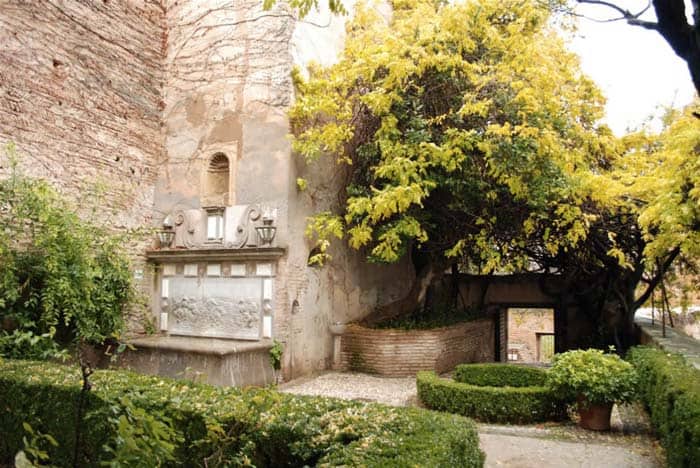
Once the Moors had been expelled and with the Turkish threat gone, the Spanish Empire had no enemies left in this area and an artillery platform here was no longer necessary. It was therefore around 1628 – the date on which the construction of one of the two existing pillars is documented, where the sea genii are depicted on the dolphins – that the Marquis of Mondéjar decided to turn this area into a garden.
Where to stay?
Don’t forget to read our guide to the neighbourhoods where to stay in Granada! You’ll find tips specifically for visiting the complex, whether you plan to enjoy a dream experience in a hotel within the citadel, or are happy to stay in the central neighbourhoods.
Other useful links
- Tips on the places to visit in Granada
- Tips on where to eat in Granada
- How to book tickets for the Alhambra + information on opening times and tours
