The itinerary through the marvellous Nasrid Palaces is compulsory, and not without reason: you are in the royal residence where the sultans lived, and every building has its own role and specific characteristics. After visiting the “institutional” and religious spaces of the Mexuar, you will begin to enter the most intimate heart of the Nasrid palace: the Palacio de Comares (Comares Palace).
The splendour of the decorations and the care lavished on every single structural detail will strike you at once, so much so that explanations may seem superfluous; nevertheless, a closer look at the various rooms that form part of this fairytale palace of the Alhambra of Granada can be useful. Here they are in detail:
Contents
Map of the Palacio de Comares
Patio de los Arrayanes or Patio de Comares
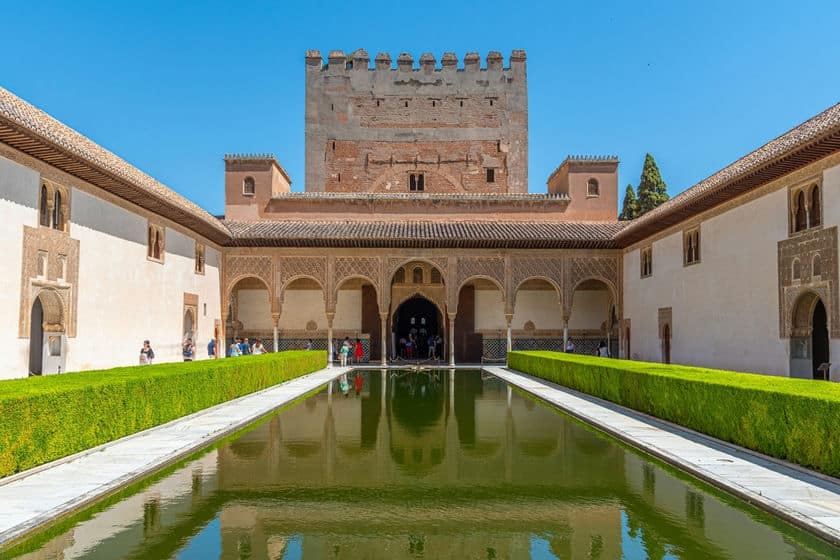
This is the largest courtyard that you will find during the visit to the Alhambra, which vies in beauty with the Court of the Lions. In the history of Muslim architecture, it is from the courtyard that one gauges a family’s wealth and power. Well, here, as in the open spaces of the Generalife, it is not hard to grasp the might of those who ruled Granada. All around the courtyard are the rooms where the palace’s former residents once lived.
The main feature of this rectangular courtyard is the huge central fountain, flanked by myrtle hedges (arrayanes, indeed). At one time the variety of shrubs in this patio, as in the other parts of the Alhambra, was greater, but sadly time has led to the loss of the original plants. However, it is the fountain itself, with the mirror effect produced by the water, that provides the principal decoration of the place, reflecting the two façades: the one with the double arcade on two levels and that with the imposing Torre de Comares. If you pause to listen, you will notice that the water is silent: the fountain has been designed so that, despite the abundant outflow of water, it is gently guided into the basin so as not to make a splashing noise.
Sala de la Barca
Running parallel to one long side of the patio is what used to be the antechamber to the throne room, the Sala de la Barca. Because of the shape of the ceiling, which might resemble an upturned boat, many believe this is what gave the room its name. In truth, the name derives from the Arabic word Baraka, which means ‘blessing’, and is repeated several times on the plasterwork.
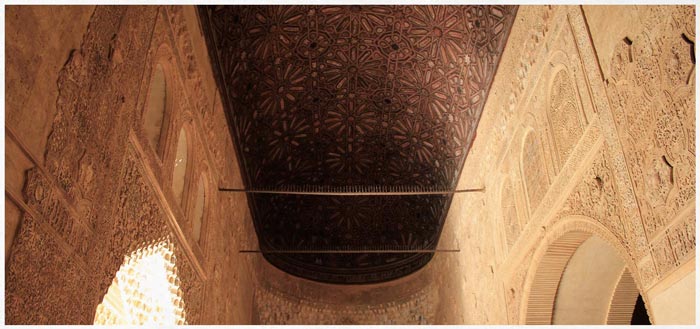
As with other areas of the Alhambra, this roof is not original either. A fire destroyed it almost completely in 1980. The restoration was only completed in 1965 thanks to drawings, photographs and recovered pieces. The windows are also a relatively recent addition: they were added in the 17th century, a further testament to the renovations carried out on a palace that was home for many centuries to different occupants.
Salòn de Comares or Salòn de los Embajadores
Inside the Torre de Comares (which at 148 ft high is the tallest in the Alhambra, even standing out above the far better-known Torre de la Vela in the Alcazaba) is also the largest room of the complex: the throne room, called Salòn de Comares or Salòn de los Embajadores, not to be confused with that of the Alcázar of Seville. While the latter name, the Ambassadors’ Hall, is understandable (as it was the room where the sovereign received delegations), it’s easy to be puzzled by “De Comares”. Naively, the first time I visited the Alhambra and read the names of the various palaces, I thought that the “de Comares” one was where the women lived, associating it with the word “comari”. Nothing could be further from the truth: this room, the most important in the building, was full of stained-glass windows, called in Arabic “Qamriyya”, a term the Spaniards over time turned into “Comares”. These colourful panes were located where we now see nine alcoves, three on each side.

The large square room is decorated down to every centimetre: walls, floor and ceiling. It is one of the rooms in which most of the original pieces are still preserved, but even here you have to make a small effort to imagine it completely coloured as it was originally. The effect of the walls, with decorative interlacings so detailed and once multicoloured, gave the impression of large carpets, meticulously woven by decorative craftsmen.
Looking up, another particular ceiling. No fewer than 8017 distinct pieces of wood, each different from the next, compose a masterly geometric design representing the seven heavens the soul must pass through before reaching the eighth, where God’s throne is in Paradise. This ceiling, with the symbols it bears, was intended to legitimise the sultan who sat on the throne in this hall. Indeed, all the room’s epigraphy is full of lofty texts on politico-religious themes, asserting divine supremacy above all. One can read, for example, phrases such as “Eternity is an attribute of God” or “To God alone belong greatness, glory, eternity, dominion and power”.
Baño de Comares
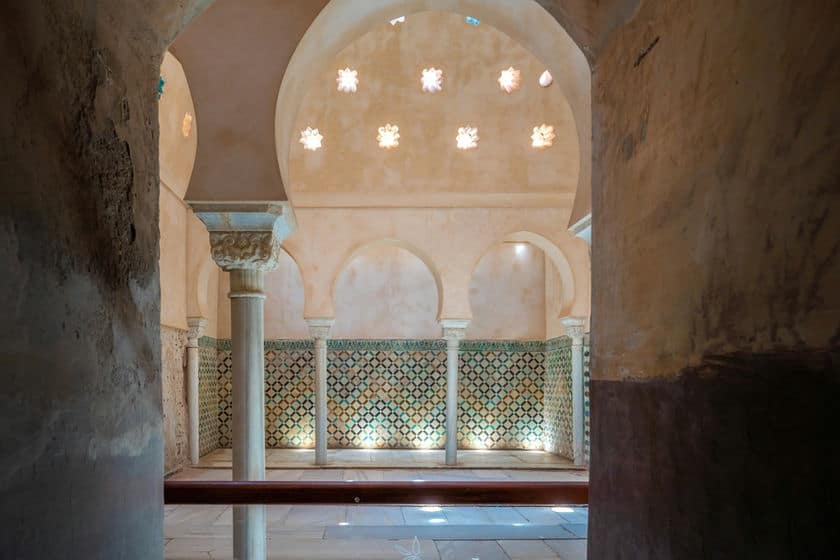
The hammam is one of the main features of Arab palaces. Originally, all the palaces that make up the Alhambra had one. This is the only medieval Islamic bath that survives completely intact in the West. The feature that most attracts attention is the roof, through whose star-shaped openings light enters to illuminate the bath. But the function of these particular holes was not only to provide light: covered with glass on the outside, the servants opened and closed them to regulate the amount of steam inside the rooms and ensure the comfort of the guests.
Where to stay?
In our guide where to stay in Granada you’ll find tips and links to the splendid properties located within the Alhambra, as well as to the other distinctive neighbourhoods of Granada.
Hotels on the hill of the Alhambra
Other useful links
- Tips on attractions in Granada
- Tips on the best places to eat in Granada
- How to book tickets for the Alhambra + information on opening times and tours
