Whether you began to visit the Alhambra from the Generalife or from the defensive battlements of the Alcazaba, you will know that sooner or later the time comes to visit the sumptuous palaces for which the Alhambra is famous. The first building you will encounter during your visit to the Palacios Nazaries of Granada is the Mexuar, the area where public and administrative life took place.
In fact, this name does not refer only to the room used for Council meetings, but also to other adjacent buildings: the oratory, the courtyard and the gilded room, known as the Cuarto Dorado.
Let’s explore in detail the characteristics and role of these spaces, which represent the first close-up encounter with the beauty and refinement of the Palaces of the Nasrid Sultans.
Contents
Map of the Mexuar
The Mexuar
The first large room you come to is the one called Mexuar, although, as noted, that name refers to the whole palace. The name Mexuar comes from the Arabic Maswar, the place where the Sura or the Council of Ministers met: indeed, this room was used in the past for important meetings, audiences and judgements. It was here that the sultan, seated on a raised platform, administered justice.
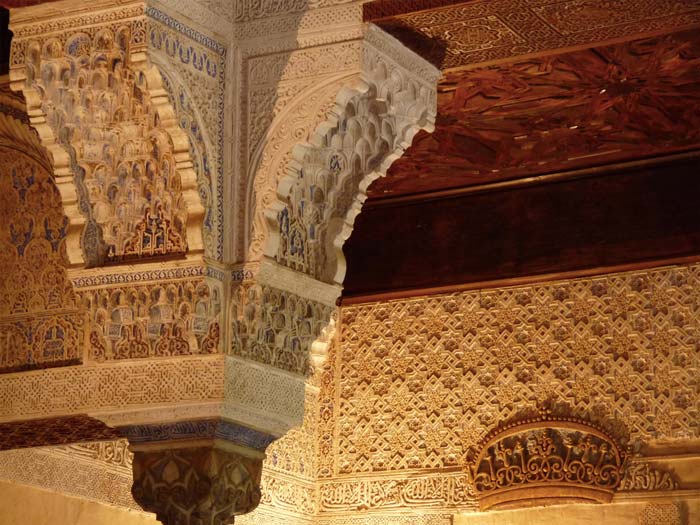
The Mexuar is thought to have belonged to a building that predated the Palacio de Comares and the Palacio de los Leones, most likely built by Isma’Il, Sultan of Granada from 1314 to 1325, the year of his death. The room’s decoration was later taken up and perfected by Yusuf I and Muhammad V, the Nasrid sultans who were also largely responsible for the two rooms that have been best preserved within the Alhambra complex.
Compared with other rooms of the Alhambra, this room has changed greatly over the centuries in both its functions and the decorations that adorn it. Only the four columns we see remain as evidence of the lantern that once illuminated the room at its centre. The most substantial change came in the 16th century, when the room was converted into a chapel with the addition of a mezzanine.
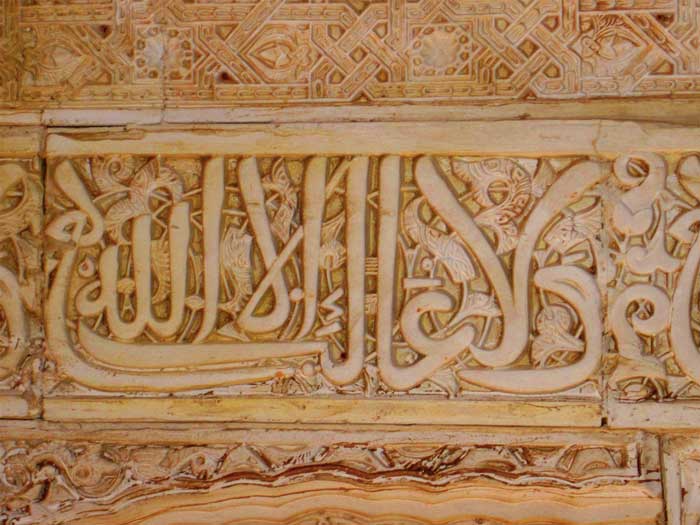
One of the most interesting and symbolic alterations concerns the inscription «The kingdom of God, the power of God, the glory of God», previously placed on the portico of the Patio de Machuca and later moved into the Mexuar by Moorish craftsmen, who in doing so replaced the traditional elaborate decoration. That inscription took the place of the Christian acclamation «Christus regnat. Christus vincit. Christus imperat».
The oratory
Connected to the Mexuar’s main chamber is the oratory. It is not the only Islamic place of prayer within the complex, but it is certainly one of the principal ones. Originally it was accessed directly from the galerìa de Machuca, and the windows allowed the worshipper – seated on the floor with their arm resting on the windowsill – to admire the view and meditate on the greatness of divine creation: the small balconies number four and feature arches surmounted by pairs of little windows. The mihrab – the space devoted to prayer – is finely decorated and presents a typical horseshoe-shaped arch embellished with inscriptions carrying various passages from the Qur’an and hymns of thanksgiving to Muhammad V.
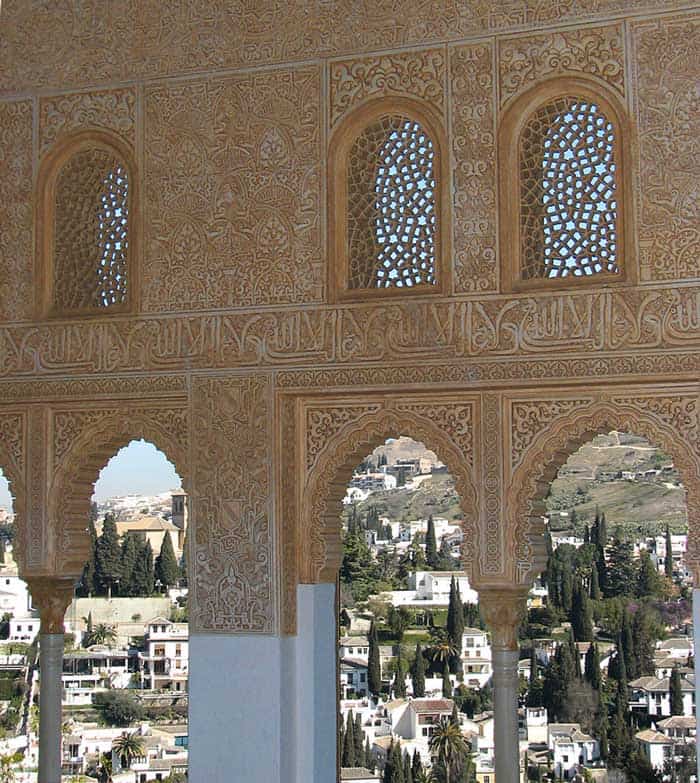
You may find it hard to imagine this, but at one time the floor was much higher: it was lowered to make visiting easier. Unfortunately, an explosion in 1590 ruined the entire room, which was restored in 1917.
The Patio and the Cuarto Dorado
It was here that the sultans received their subjects, and it is no coincidence that the door is so narrow. Allowing only one person through at a time made it easy for the guards to monitor entry: once checked, one entered the stanza dorata, nothing more than a waiting room.
The name comes from the painted wooden ceiling, dating from the period after the Reconquest by the Catholic Monarchs, as can also be seen from the heraldic and decorative motifs. The golden room, called the Cuarto Dorado, was used for executive purposes: it was here that the sultan’s sentences were recorded and carried out. This hall, moreover, is essentially a connecting space between the Mexuar and the Palacio de Comares.
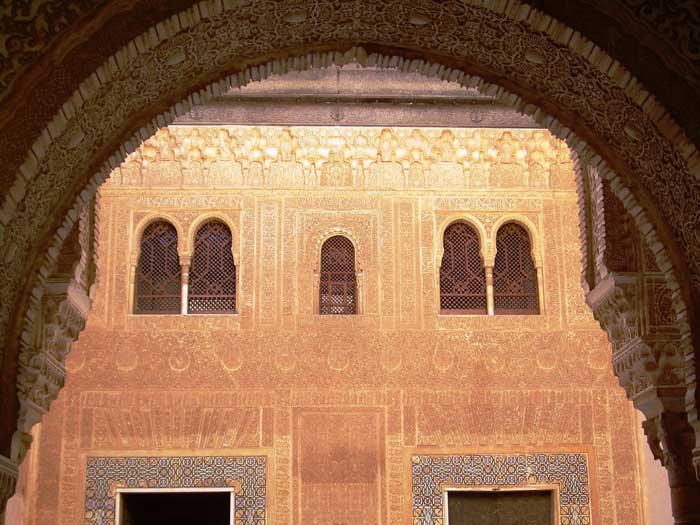
From here, to reach the sultan’s residence, you cross the patio, at the centre of which you will see the fontana de Lindaraja: this is actually a replica, the original is in the Museum inside the Palacio de Carlos V. In this patio, particularly on the arch behind you and on the façade opposite you (which is that of the Palacio de Comares), you will begin to appreciate more than you have so far the stucco decorations of the walls and arches, attended to in the smallest detail.
The inscriptions, for example, bear the motto “Only God is victorious”, while on the carved wooden frieze you can read some verses that the poet Ibn Zamrak composed specifically to enrich the Nasrid palace. It would take hours to study everything in detail, and we have still not reached the most beautiful rooms of the visit.
Where to stay?
Don’t forget to check out our recommendations on where to stay in Granada You can choose to do so in the luxury hotels of the Alhambra, or, alternatively, settle for the nearby neighbourhoods.
Other useful links
- Tips on things to see in Granada
- Tips on the best places to eat in Granada
- How to book tickets for the Alhambra + information on opening times and tours
