Esmeralda, the young protagonist of the famous Notre Dame de Paris, came “from the hills of Andalusia”. Victor Hugo may well have been referring precisely to the Sacromonte di Granada when he wrote about the origins of that group of gypsies. This neighbourhood is famous for two things (although calling it that is limiting): the gypsies and the caves in which they live.
The Sacromonte is one of the most distinctive things to do in Granada, and is certainly the best area to savour the folkloric flavour of guitars and flamenco, but that’s not all: let’s discover it together!
Contents
The Sacromonte Caves (Las Cuevas de Sacromonte)
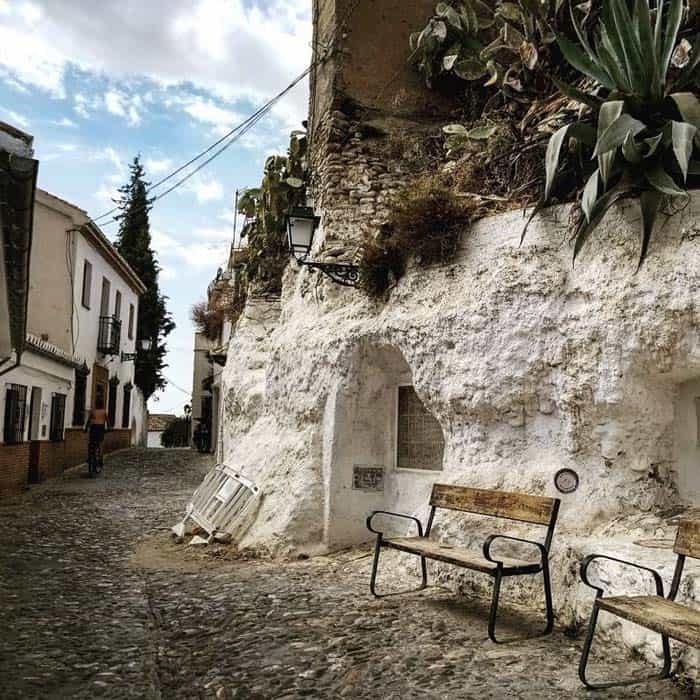
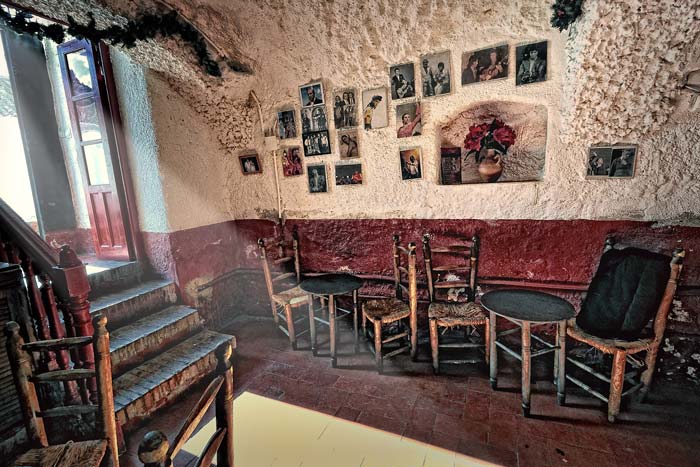
Las cuevas, the caves that dot the entire valle de Valparaíso, are the first thing that strikes you on arriving in this area of Granada. They are not natural cavities, but genuine cave-houses, specially dug into the hillside. Mostly nomadic families live here, but we can easily divide the area into two sectors.
In the part closest to the town centre – roughly from the Albayzin up to the Sacromonte abbey – the Cuevas have been adapted into more or less regular dwellings. It is here that you will easily find bars and restaurants carved into the caves, and from some windows you might be able to catch a glimpse of the interior of a home. Beyond the abbey, however, the excavated dwellings increasingly resemble shelters rather than houses: no services or utilities: a wilder environment, where it is also inadvisable for a tourist to venture.
It is very uncertain how and when the custom of living in these large hollows carved into the mountainside began. The most widely accepted theory is that in the 16th century, when Jews and Muslims were expelled from their homes, they joined the gypsies and a neighbourhood of outcasts sprang up outside the city walls.
There are many legends about this place, the most famous of which is that of the Barranco de los Negros (Ravine of the Blacks). According to this story, when the Catholic Monarchs reconquered Granada, many Arab nobles returned to Africa. Fearing they would be robbed along the way, they hid their treasures on this hill. The slaves — mostly Black — of the wealthy Arabs were freed, as it would have been too expensive to take them on the journey across the Mediterranean. One of the characteristics of slaves was that they listened in silence to what their masters talked about: they therefore knew that they had gone to hide their riches on the hill. Finding themselves free and without work, they went to look for them: they dug so much — unsuccessfully — into the side of this ravine that they created the caves, where they eventually settled.
Things to do in Granada’s Sacromonte
As with the Albayzin, I suggest you take a leisurely stroll around the Sacromonte, allowing yourself plenty of time to settle into the microcosm that characterises this neighbourhood. From the centre, the quickest way to reach the Sacromonte on foot is, starting from Plaza Nueva, to follow the Darro river with the Albayzin on your left, until the road turns uphill onto Cuesta del Chapiz.
Casa del Chapiz
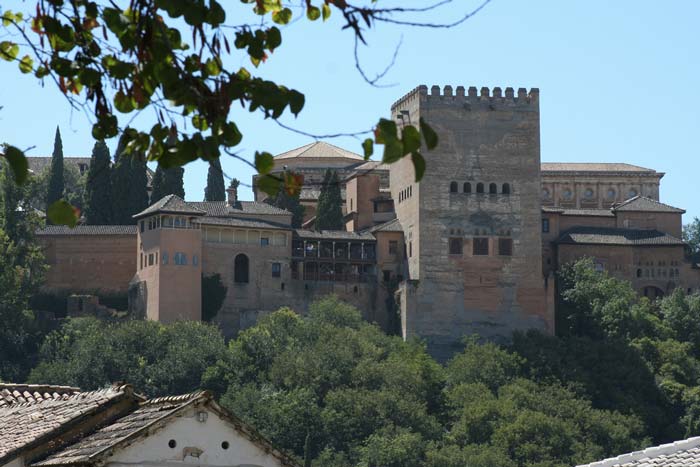
Climbing the Cuesta del Chapiz, you’ll find the Casa del Chapiz, a complex of two Moorish dwellings from the 16th century. It is considered the largest Moorish house in Granada and I recommend stopping by because it’s worth a quick visit: it now houses the School of Arabic Studies. From the beautiful garden of the house you can enjoy a splendid view of the Alhambra. Do go! It’s usually not at all crowded.
- From 1 March to 31 October: Monday to Friday, 09:00–20:00; Saturday, 10:00–14:00 and 15:30–19:00; Sundays and public holidays, 10:00–15:00. From 1 November to 28 February: Monday to Friday, 09:00–19:00; Saturday, 10:00–19:00; Sundays and public holidays, 10:00–15:00. Closed on 25 December, 1 January and 6 January. Admission: €2.
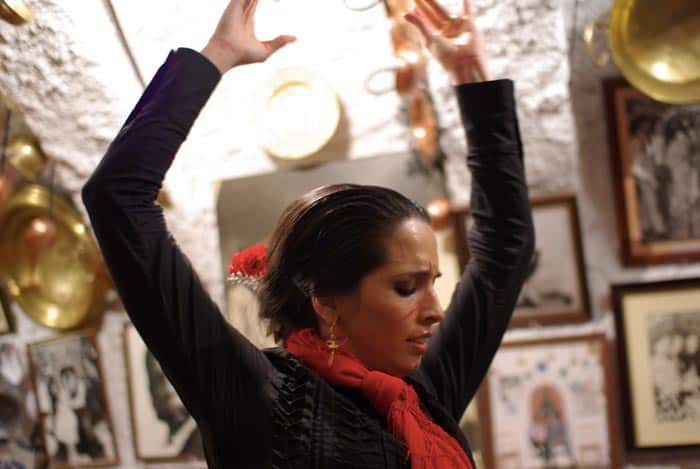
Best Flamenco in Sacromonte Granada
Immediately afterwards, turn right into the Camino del Sacromonte. This is the neighbourhood’s main thoroughfare, and also one of the few that tourists can usually walk along. You’ll soon realise it isn’t easy to reach the upper streets. Even along this road, though, your craving for caves and gypsy guitars will be satisfied. In addition to various bars and restaurants set into the caverns, you’ll come across the Cueva Zambra la Faraona, Cueva La Rocio and the Cueva de los Tarantos (right in front of the Casa del Chapiz): three theatres where you can see Gypsy flamenco in Granada, enchanted by music and dances that blend Andalusian and Gypsy traditions.
The museums of the Sacromonte
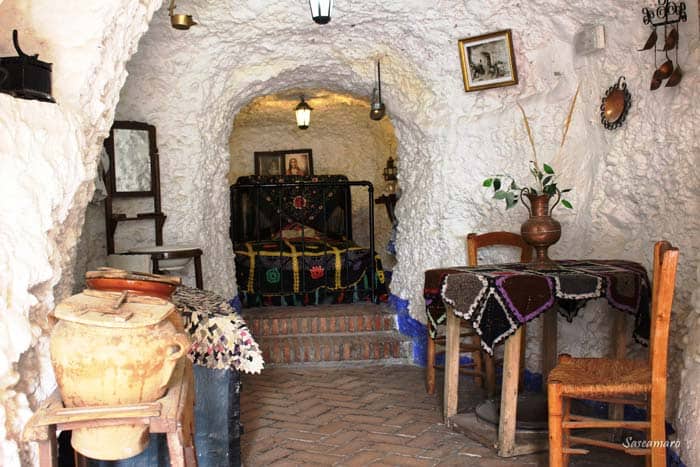
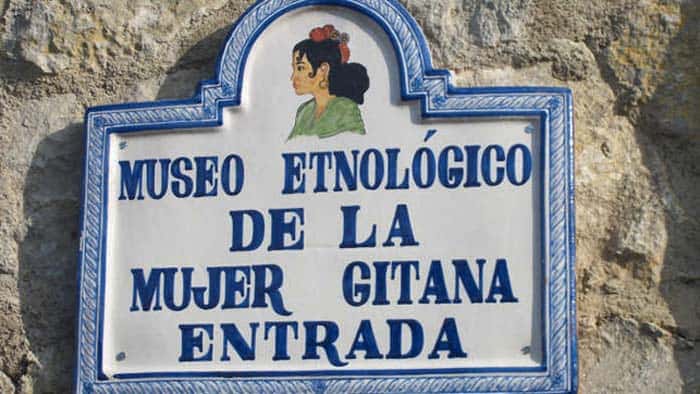
Two proper museums, on the other hand, are the Museo etnologico de la mujer gitana and the Museo Cuevas del Sacromonte. They are both located on Calle Barranco de los Negros, a narrow lane that climbs steeply to the left and appears to be a private road, with a gate at the entrance.
- The Museo Etnologico de la mujer gitana aims to preserve and promote the culture and history of the Romani people, with a particular focus on women. Maintained by the Association of Romani Women, it hosts a variety of educational, social and cultural activities. Given the imprint that nomadic culture has left on Granada over the past 500 years and continues to exert today, this place — often overlooked by tourists — holds considerable historical and cultural interest.
- The Museo Cuevas del Sacromonte also offers cultural and educational activities, centred on the living conditions and habits of the inhabitants of the caves. There are ten Cuevas forming part of the complex, where you can learn about the history of the place and about flamenco in its broader sense — as a culture as well as strictly a musical form. At the top of the museum you will find another excellent viewpoint, which offers you a panorama of the Alhambra from a different perspective to the Albayzin.
- This museum is open daily from 10:00 to 18:00 (from 26 October to 28 March; last admission at 17:40) and from 10:00 to 20:00 (from 29 March to 25 October; last admission at 19:40). Closed on 25 December and 1 January.
- General admission is €6 per person. Self-guided group visits cost €5 per person and must be booked at least 72 hours in advance; guided group visits cost €7 per person. A family guided tour costs €70 for 1 to 10 people.
The Sacromonte Abbey
Continuing to walk along Camino del Sacromonte, passing houses with plates and objects hung on their outside walls, you will see the Sacromonte Abbey drawing near. With its 400-year history, this imposing building, together with the Alhambra and the Granada Cathedral, forms a fundamental triangle for understanding Granada’s history. Over the past centuries this abbey has been one of the main spiritual and cultural centres of all Andalusia, and today it continues to be a living place that looks to the future. The tens of thousands of people who come here each year are not only tourists: many are pilgrims who visit this place in prayer.
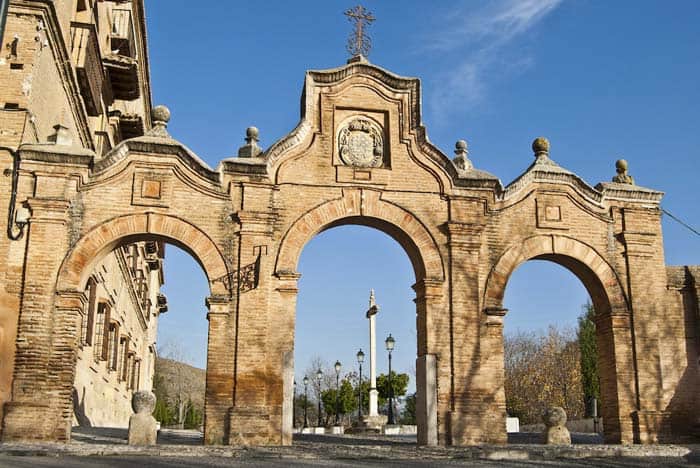
The building stands in this isolated location because, in 1594, the remains of Saint Cecilius, the first bishop of the Roman city of Iliberis — present-day Granada — were found here. The relics immediately attracted large numbers of pilgrims, leading Bishop Don Pedro de Castro to order the construction of the abbey. In addition to the relics, the so-called Libros plúmbeos were also discovered: lead tablets inscribed in a strange form of Arabic, containing legends about the apostolic and Arab origins of Christianity in Granada.
- The abbey can be visited daily during the following opening hours: from 30 March to 25 October, 10:00–14:00 and 15:30–19:00; from 26 October to 28 March, 10:00–14:00 and 15:00–18:00. The ticket office closes at 13:00 in the morning and at 18:00 in the afternoon in summer, and at 17:00 in winter. On Sundays, Mass is celebrated at 12:00, and the church cannot be visited during the service.
- Admission costs €7, reduced to €5 for students aged under 25 with a student card and for people with disabilities. Children under 12 enter free when accompanied by a family member.
Given its location, a sign associated with the gypsies could not be missing from this abbey. The Santisimo Cristo del Consuelo, known to everyone as the Cristo de los gitanos, is a sacred image from 1695 kept in the Abadia del Sacromonte. Particularly linked to the nomadic people, it is nonetheless one of the most beloved and venerated images among the people of Granada. During Holy Week the Christ is visited by the gypsies who, with colour and music, dance and prayer, blend the sacred and the profane in a unique celebration.
Where to eat?
Eating some Granadan specialities in a lively traditional restaurant carved out inside a cueva… is that possible? Of course it is! Here are our tips on best restaurants in Granada (Sacromonte).
Where to stay?
Granada offers numerous opportunities to spend the night, some of which are truly unique and evocative. Sleeping in a Sacromonte cave isn’t an everyday experience: by clicking the link below you can discover how to enjoy this timeless experience.
If, instead, you prefer more traditional accommodation or other neighbourhoods of the city, take a look at the page on where to stay in Granada.
