Together with the Generalife, the complex of Palacios Nazaries is the group of palaces that makes it most worthwhile to visit the Alhambra. Precisely to preserve them and to ensure that all visitors can enjoy them to the full, this area is accessible only at a set time, which you will find printed on your ticket at the time of purchase.
What we can, without a shadow of doubt, call the most beautiful arabesque complex in Europe is made up of three main palaces – the Mexuar, the Palacio de Comares and the Palacio de los Leones – and various ancillary spaces. Let’s discover them in detail.
Contents
Map of the Nasrid Palaces
Patio de Machuca
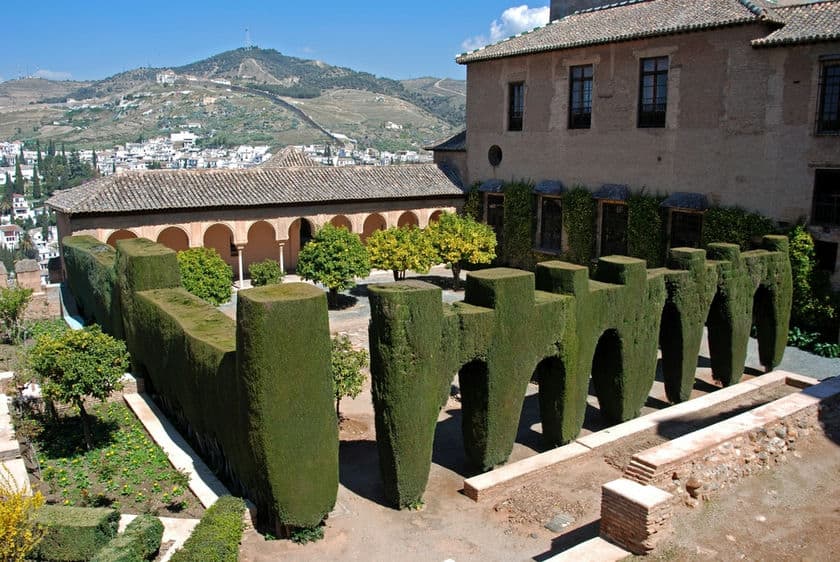
Before you begin the actual visit to the Nasrid Palaces, once you have left the Alcazaba behind you can spend a few minutes in this patio, which is named after the architect of the Palacio de Carlos V. The main feature of this courtyard is a curious pool that closely resembles the nymphaea of Roman residences. Unfortunately, the fountains that once spouted water in this courtyard, as in the others you will see shortly, no longer exist.
As you’ll notice straight away, only one side is adorned with arches. In fact, the opposite side once had the same kind of portico, now lost and replaced by a hedge of intertwined cypresses that itself forms a series of arches.
Mexuar
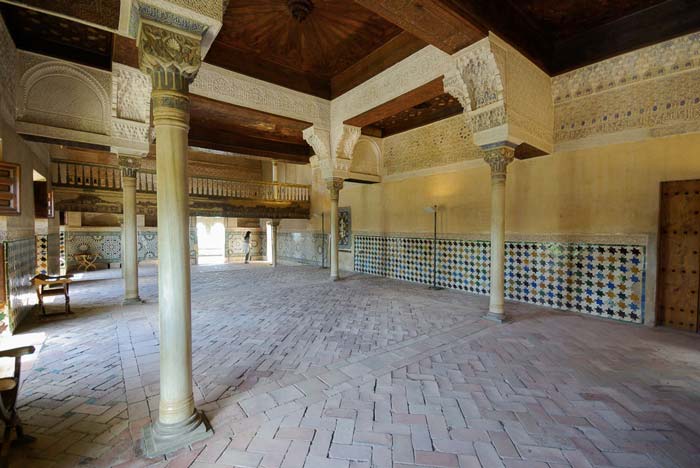
It is no coincidence that, of the three buildings, this was chosen to be the first on the tour. From the very beginning, in fact, this was the public and administrative area, the only part to which anyone could have access. The Mexuar is properly the name by which we know the sumptuous hall in which the sultan delivered his judgments, but, to be precise, the name identifies an entire section of the Palacios Nazaries, which also includes other spaces that are absolutely unmissable:
- Mexuar
- the Oratory
- the Patio del Cuarto Dorado
- the Cuarto Dorado
To learn in detail about the history and features of these spaces, read my dedicated article on the Mexuar of the Alhambra.
Palacio de Comares
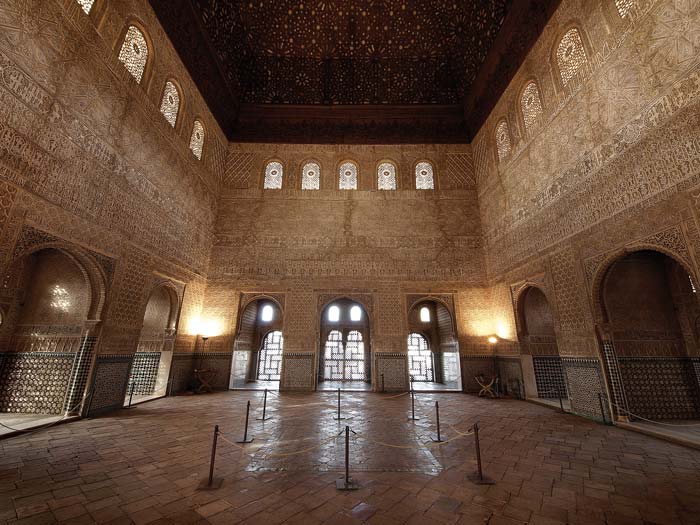
From the façade alone you’ll notice that you are entering a more important area, where attention to detail is greater and the style more refined. If, even as you see it now, the façade already seems incredible, imagine that it was once covered in colours vivid and bright, to further emphasise this perfect synthesis of geometric and epigraphic decorative elements and stylised vegetal motifs.
Here administrative and public life gave way to the private life. The two doors are not accidental: the one on the right led to the family’s service rooms, the one on the left, after following a small curved corridor, leads to the Patio de Comares, the focal point of this palace.
I covered this courtyard and the various halls and rooms that form part of this palace in my dedicated article on the Palacio de Comares of the Alhambra, which, in detail, includes:
- The Patio de Comares or Patio de los Arrayanes
- The Sala de la Barca
- The Salòn de Comares or Salòn de los Embajadores
- The Bath of Comares
Palacio de los Leones
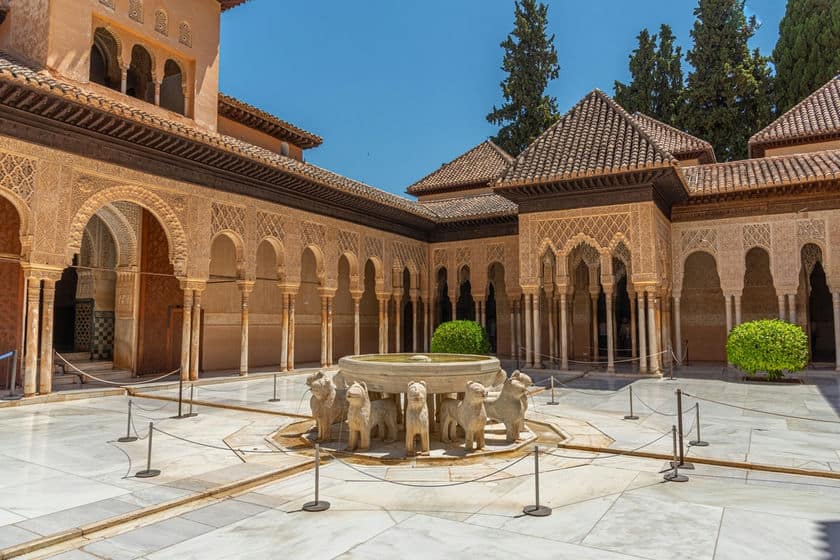
Here we arrive at the most intimate palace, the one into which public life never intruded and where the rulers’ private life enjoyed complete freedom. Here we probably find the most evocative parts of the entire visit. The palace is organised into two residential quarters and two reception areas. Specifically, the following areas can be visited:
- The Sala de los Mocàrabes
- The Patio de los Leones
- The Hall of the Abencerraje
- The Sala de los reyes
- The Hall of the Two Sisters
For a specific description of the various rooms and the famous Patio de Leoni, I also refer you to my in-depth article on the Palacio de los Leones of the Alhambra.
The Emperor’s Rooms
A more recent construction, yet included in the tour of the Nasrid palaces, is this addition to the palace complex commissioned by Emperor Charles V.
The Imperial Apartment and the Queen’s Dressing Room
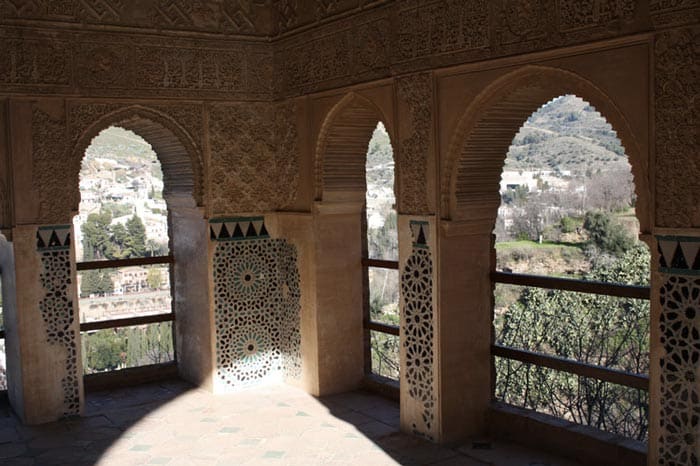
To this day, honeymooners request the suite. The emperor was no different: smitten with the place when he arrived with his wife Isabella of Portugal, he commissioned the construction of six new rooms around the existing ones before the palace that still bears his name was built.
From the antechamber of the emperor’s rooms, you pass into an open gallery that leads to the only tower that breaks the usual pattern of the outer fortification. Inside is a cosy little room to which, in the 16th century, a central stove was added, and on the exterior an Italian-style gallery was built to replace the old lantern with central lighting. From that moment the turret became known as the Peinador de la reina. Imagining the queen here, tending to her beauty while admiring the surrounding panorama, is an experience not to be missed.
The Patio de la Reja and the Patio de la Lindaraja
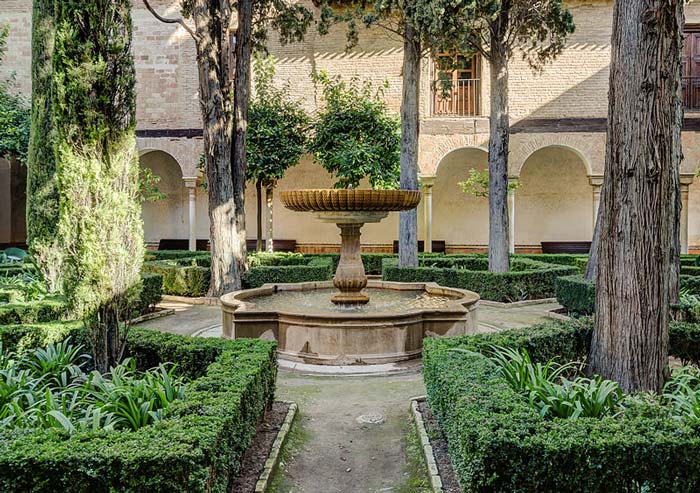
Here too we find two patios. The first is called Patio de la Reja (the grille that protects the raised pedestrian walkway) or of the cypresses (for the trees that grow there). Although pleasant and in a way rather curious, it cannot compete with the grandeur of the Arab patios.
The neighbouring Patio de la Lindaraja is much more like the cloister of a convent than an Arabesque patio. This area, which was originally an open garden, was enclosed when the imperial apartments were built.
Where to stay?
We answered this question in the article on Where to stay in Granada. At the link above and below you’ll find tips and advice on the best neighbourhoods to stay in and on the Alhambra hotels.
Other useful links
- Tips on what to do in Granada
- Tips on where to eat in Granada
- How to book tickets for the Alhambra + information on opening times and tours
