In the article dedicated to the Alcazaba of the Alhambra I mentioned that there is an area of the complex that can be described as “less Arab”: well, it’s not the only one! The Palacio de Carlos V also belongs to this category of monuments, for historical and, consequently, architectural reasons.
You don’t need to be an expert in architecture to realise how this imposing building is the least consistent with its surroundings. The graceful forms of the neighbouring Palacios Nazaries contrast sharply with the Renaissance style of this building. The Tuscan style of the ground floor – recognisable in Florentine palaces – becomes Ionic on the first floor, with greater care for detail and ornamentation. In this article, as well as briefly recounting the history behind this building, I will seek to give an essential description of its architectural features, points of interest and the museum spaces contained within it.
Contents
Map
The Palacio de Carlos V
What is a palace like that doing inside the Alhambra, a stone’s throw from the superb Moorish halls of the Palacio de Comares or the Mexuar? When Emperor Carlos V came to Granada on his honeymoon (there were no intercontinental flights then, but he certainly didn’t make a bad choice!), he fell in love with the city and, in particular, the Alhambra.
He therefore had the idea of settling in the Arab palaces, but then made a different decision: to build beside them, so he could continue to enjoy them, a palace tailored for him, naturally the largest and most imposing he could have. It seems that the architect Pedro Machuca was commissioned to design a building befitting a Roman emperor. Machuca built the palace in Mannerist style, following what would later become a fashion and creating something of a one-off in Andalusia, since the style in vogue at the time was instead the Plateresque.
Work began in 1527 and was continued from 1550, after the architect’s death, by his son Luis. To fund it, part of the taxes levied on the Moriscos — those Muslims who, after the Reconquest, converted to Christianity in exchange for permission to remain in Granada — were used. The paradox is that Charles V was never able to live here, and on his death his son Philip transferred his court to Madrid, which in 1607 became the capital of the Kingdom of Spain.
Originally the project envisaged that Charles V and his wife would reside in the rooms of the Palacio de los Leones: the palace under construction was instead to assume a merely public/administrative role. Charles V, however, preferred that additional rooms be added from scratch, which we discussed in the article dedicated to the Palacio de los Leones.
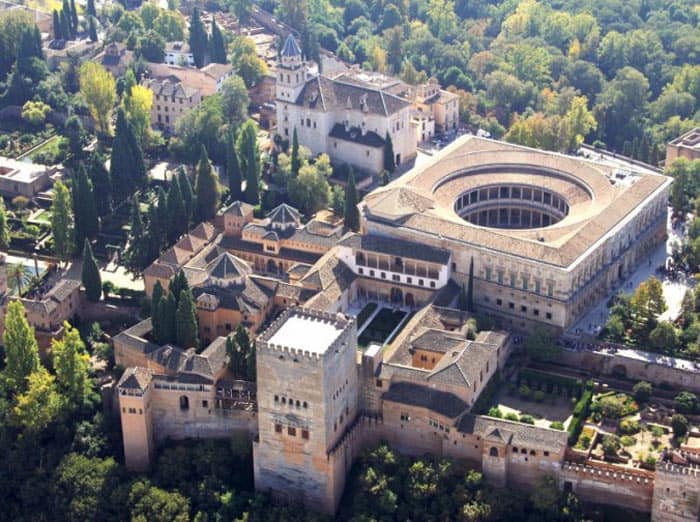
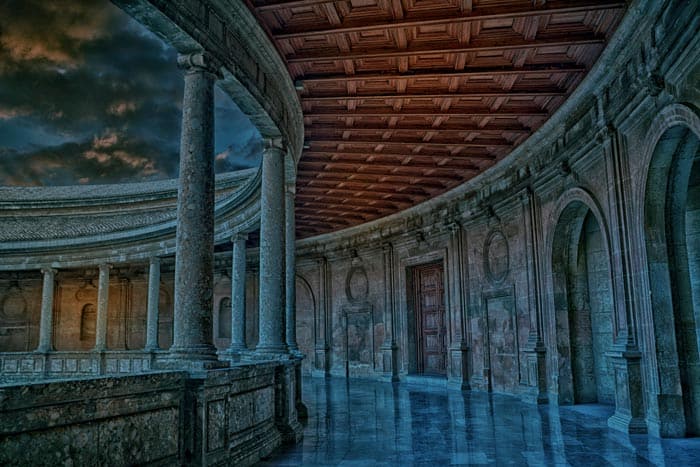
The austerity of the square plan, 297 ft (63 mt) to a side, is completely transformed inside by an extraordinary circular patio, a genuine architectural novelty for the Renaissance period. Split over two levels – the lower with 32 Doric columns and the upper adorned with 32 Ionic columns – the portico encircling the courtyard will leave you open-mouthed and make you appreciate what you probably judged from the outside to be the least interesting attraction of the Alhambra. In the overall design, a domed roof had been planned, which was never executed. In my view, the sky above this one-of-a-kind courtyard makes it all the more atmospheric.
The museums in the Palace of Charles V
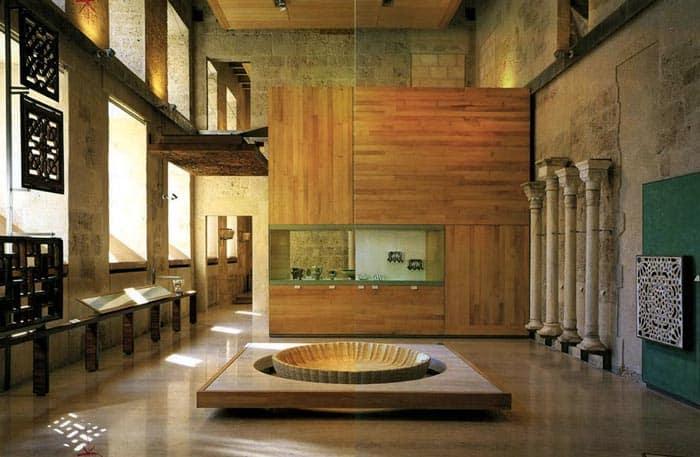
This building houses the Alhambra Museum. Established in 1942 as an archaeological museum and later becoming the National Museum of Hispano‑Muslim Art, since 1994 it has been managed not by the state but by the Patronato of the Alhambra. Formed from finds unearthed during excavations in this archaeological area, it is the largest collection of Nasrid art in the world, and also contains pieces of other Islamic art. A visit to this museum is highly recommended for anyone wishing to deepen their understanding of the importance of Arab culture in the region of al‑Andalus, not least because it sits on the Alhambra hill itself, which presents to the world its best‑known and most spectacular achievement.
In 1958, on the occasion of the celebrations for the 400th anniversary of the death of Charles V, the palace saw the inauguration of the Museum of Fine Arts of Granada, previously housed in the convent of Santa Cruz la Real and subsequently moved over the years to other locations. As early as 1914 the Museum Board had decided to transfer the museum’s collections to the Palace of Charles V, whose rooms were still inexplicably unused. The process, however, took longer than expected: it was almost forty years before the works could be seen in their new home on the palace’s second floor. The museum’s collection is of a lower quality than other Spanish picture galleries (notably the Prado in Madrid) but the Granada museum nevertheless contains works of value. Worth mentioning are, certainly, La Virgen del Lucero by Alonso Cano and Bodegòn con cardo i zanahorias by Juan Sànchez Cotàn.
The Granada International Music and Dance Festival
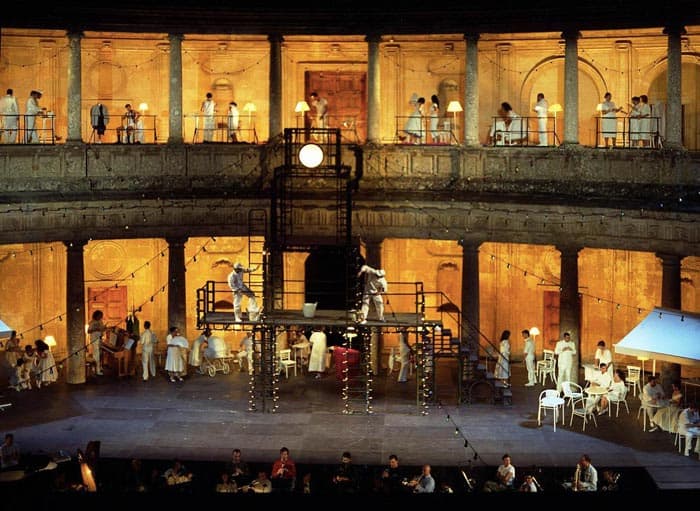
The palace – together with other locations in Granada and the Teatro del Generalife – provides the backdrop for the Festival Internacional de Música y Danza de Granada, an event long associated with the Alhambra: seeing a concert in the Renaissance courtyard of the Palacio de Carlos V beneath the stars of a summer sky is an experience that leaves a lasting impression.
Where to stay?
When planning a visit to the complex, it is worth choosing carefully where yo stay in Granada. At the link above and in the articles below you’ll find tailored advice on staying on the Alhambra hill or nearby.
Other useful links
- Tips on what to see in Granada
- Advice on where to eat in Granada
- How to book tickets for the Alhambra + information on opening times and tours
