Let’s start by dispelling a myth: the Generalife is not the Alhambra’s garden. Many arrive here thinking that the Alhambra of Granada is a royal palace and the Generalife its park. As I explained in the post on the Palacios Nazaries, the Alhambra complex is already, in itself, a collection of palaces, built in different periods by various sultans and emperors who chose Granada as the seat of their realm.
The Generalife itself is another palace, which, like the others, is organised around a patio, with water as a defining element. The main difference from the palaces already seen, and what confuses many visitors, is the gardens: the large, spectacular gardens. The reason? This was the sultans’ summer residence, where, just a stone’s throw from the seat of their government, they could feel as if in paradise while strolling among exotic plants and colourful flowers, in the soothing company of the fountains.
Simply arriving and entering is atmospheric. Built in the 14th century, like the Alhambra it has undergone numerous alterations over the centuries, not all of them negative. One example is the Paseo de los Cipreses (Cypress Avenue), created in 1931 by Francisco Prieto Moreno, who managed to transform a large open space into an architectural work, so that on entering the complex you already feel as though you are in a patio despite still being outdoors.
Contents
Generalife Map
The Palace of the Generalife
As you will already have understood, and appreciated, Granada’s Arab architecture is based on the concept of the Patio as the nerve centre of palace life. This means that patios are often the most distinctive and beautiful places to see.
Patio de la Acequia and Sala Regia
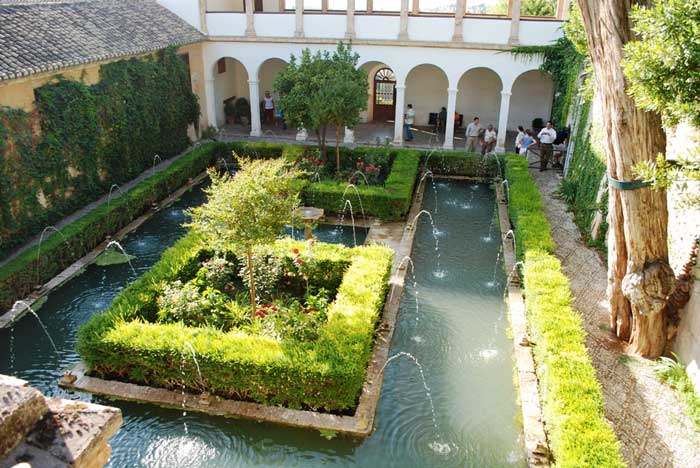
After two small service patios, the first large courtyard at which you’ll pause is the one known as ‘de la Acequia’, that is, the courtyard of the water-supply channel (see also our in-depth article on the Acequia Real here).
The reason for the name is easily guessed: the long central fountain (see cover photo) is not an end in itself, but forms part of the network of channels used to irrigate the gardens and kitchen gardens. With the series of water jets that set its water in motion and the flowerbeds that adorn it, it is the finest example of how to marry utility and beauty. And this is true despite later alterations, or rather thanks to them. The fountains were in fact added in the 19th century: Christian influence on Arab architecture did not always prove detrimental.
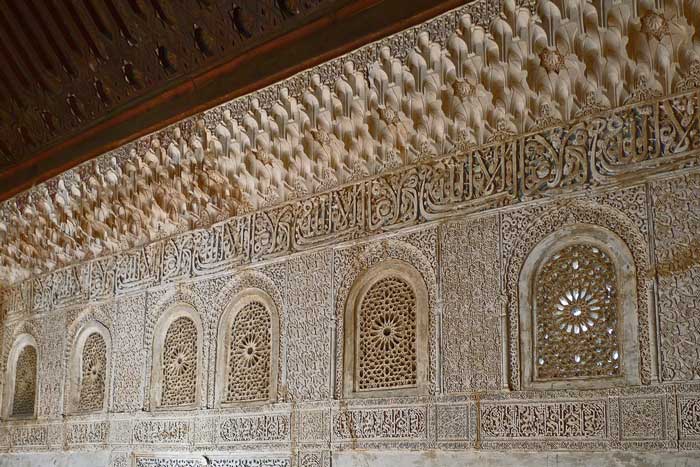
At the far end of the patio sits the Sala Regia. Adorned with the decorative plasterwork typical of the whole Alhambra, it does not have the same richness as the Mexuar, the Palacio de los Leones or the Palacio de Comares. As it was a residence devoted to rest and relaxation, there was no need for splendour in the buildings. We will soon see how, for the same reason, the gardens are instead the most carefully tended area.
Patio del Ciprés de la Sultana
From the Sala Regia, a double Renaissance gallery leads to the Patio del Ciprés de la Sultana. This patio, radically altered during the Christian period, still manages to retain a little of the influence of those who created it, particularly in its fountains and the lush vegetation that enriches it.
The Generalife gardens
It is the gardens, as well as being its main attraction, that give the whole complex its name. From the Arabic Jannat al-‘Arif comes the name Generalife, which means Garden of the Architect. The interesting thing is to ask who the architect could be, so important that a sultan would dedicate his summer villa to him. The answer is none other than God, or rather Allah, the architect of the universe.
If you find yourself in Granada in summer, or better still in spring, my heartfelt advice is to plan your visit to the Alhambra so you arrive here around lunchtime: bring a sandwich and get lost in these gardens to find the best spot for your lunch break. The spray of the fountains, the scent of the flowers, the view from a little window in the walls — there are countless places where you’ll want to spend hours in silence; all that’s left is to choose your own.
Jardines Bajos and the Generalife Theatre
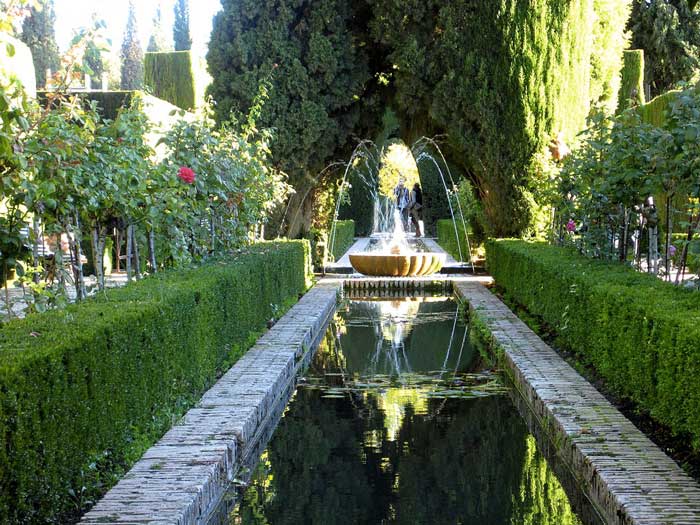
I Jardines Bajos are the gardens you encounter on the visit, even before you reach the palace. Divided into three parts, they are also known as the New Gardens. The section closest to the building dates from 1931 and is characterised by a maze of hedges and arches formed by rose beds and cypresses. The second and third sections – the first you come across when arriving from the Alhambra – date from 1951–1952, where cypress architecture takes centre stage alongside the large open-air theatre, the eponymous Teatro del Generalife, built specifically for the Granada International Festival of Dance and Music, which has been held at this venue and at the Palace of Charles V since 1952.
Jardines Altos
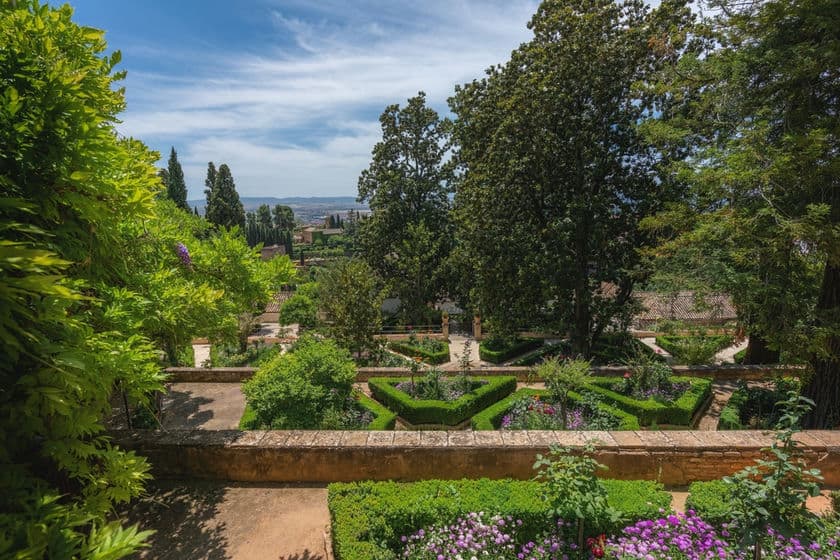
From the palace area, via the Staircase of the Lions, you reach the Jardines Altos, a veritable jewel of plant life. Small fountains, centuries-old magnolias, intimate recesses and aromatic shrubs. Losing yourself in the pathways of this area is one of the most rewarding things to do during a visit to the Generalife, if not in the whole city of Granada.
A small, romantic botanical garden, an example of the European humanist tradition, does not clash with the Arab style of the garden’s oldest areas. On the contrary, it adds that extra touch that makes this place all the more unique.
At one end of the romantic Paseo de las Adelfas (oleanders), one of the paths leading to the upper gardens, we can admire one of the oldest known specimens of Moorish myrtle: one of the garden’s botanical wonders.
La Escalera del Agua and the Romantic Mirador
To reach part of the upper gardens of the palace you pass through one of the most evocative spots in the whole complex: the water staircase. Specifically, this stairway served to link the Generalife palace with a small chapel on the hill, hard to reach especially in summer because of the steep slope and the intense heat. The builder’s ingenuity led him to devise a brilliant and unique solution: not only is the stairway interrupted by landings where you can rest during the ascent, but the handrails are actually channels through which fresh water flows (hence the name of the feature). The running water produces a relaxing sound while humidifying and cooling the surroundings. And when you have to climb feeling hot, dipping your hand into the cool handrail and perhaps wiping your brow with it can be a blessing.
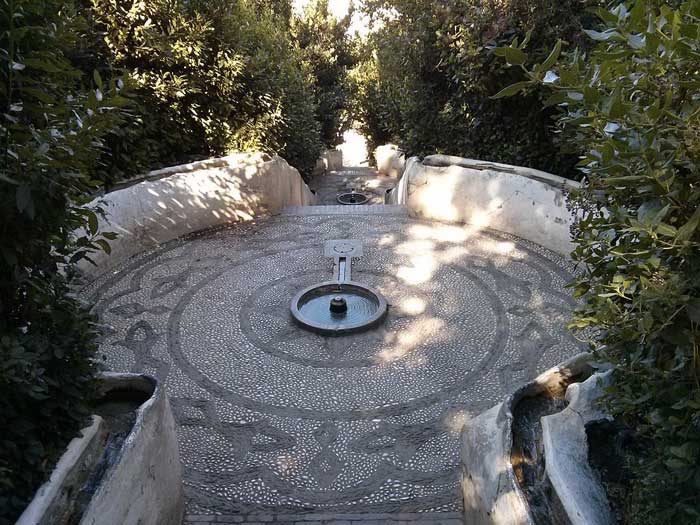
On reaching the summit, we do not find the ancient Islamic prayer chapel. In its place now stands the so-called Romantic viewpoint, a privileged vantage point in neo-Gothic style, built in 1836. Architecturally at odds with its surroundings, its value lies in the panorama it affords.
Where to stay?
The whole visit to Granada centres on visiting the Alhambra, and the most common question concerns accommodation: in our article on where to stay in Granada, we offer advice on the prestigious hotels at the Alhambra and on other options available in the city.
Other useful links
- Tips on what to see in Granada
- Tips on where to eat in Granada
- How to book tickets for the Alhambra + information on opening times and tours
