The Alhambra is a large fortress that tells the story of different eras and kingdoms, expressed through architectural styles and cultural markers that are very distinct from one another. While the Palacios Nazaries are certainly at the centre of tourist interest, the ring of walls on the hill of Granada also encloses other treasures. We have seen this with the Alcazaba, the Palacio de Carlos V and the Partal, but a visit to this wonder of the world does not end here.
Contents
Map of the attractions
Calle Real and the gates of the Alhambra
The Medina, that is the old town, the quarter that formed the hub of city life around the palaces, is traversed by what is called Calle Real. This street, despite having its route altered by the construction of the Convento de San Francisco, remains today the main thoroughfare you will find yourself walking when visiting the Alhambra complex. It is the Calle Real that will lead you to every point of interest in the Alhambra, from the most celebrated to those often overlooked on hurried visits, but which deserve a look during our visit to Granada. In this article we look specifically at these places.
The Puerta de la Justicia and the Pilar de Carlos V
Of the four external gates in the wall that protects the Alhambra, Puerta de la Justicia is certainly the most monumental. Also known as Puerta de la Explanada, for the wide space that once lay before it, it is rich in symbols from various eras: on the outer arch is depicted a hand, the five fingers symbolising the five pillars of Islam (faith in one God, prayer, fasting, alms-giving, pilgrimage to Mecca), but above it the Catholic monarchs placed the statue of the Virgin Mary, to demonstrate the superiority of Christianity over Islam.
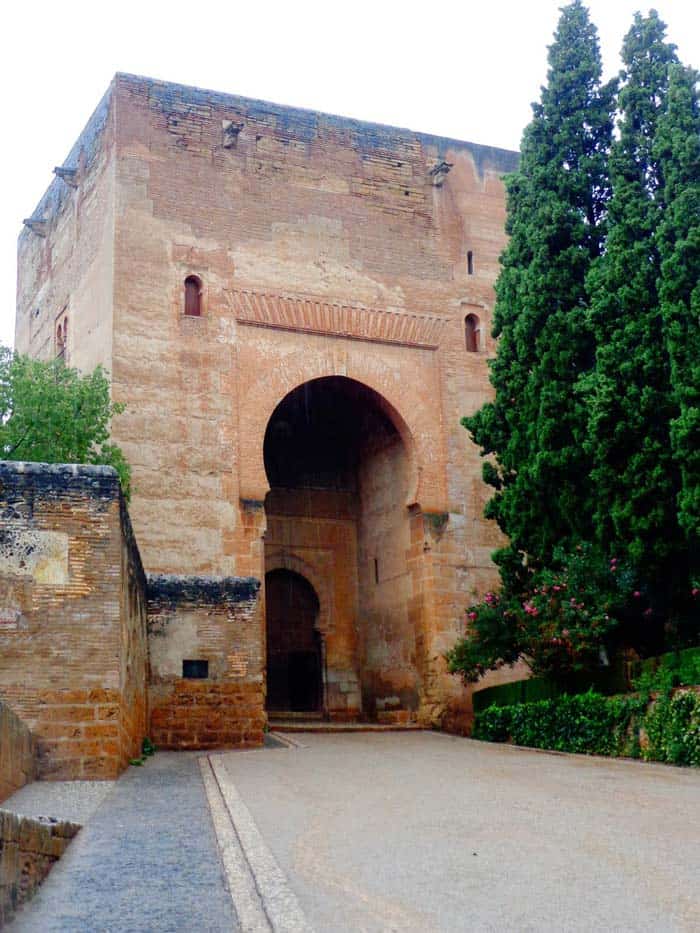
You will probably enter the walls through the Puerta de la Justicia: from here, passing through the Puerta del Vino, you reach the Alcazaba, the Palacio de Carlos V and the Palacios Nazaríes. Before crossing the threshold, take a few minutes to admire the Pilar de Carlos V. This is a wall fountain on which one of Granada’s Renaissance masterpieces was carved. The monumental fountain is characterised by three masks whose meaning remains uncertain. Some associate them with Granada’s rivers — the Darro, Beiro and Genil — while others link them to the seasons of summer, spring and autumn, as the heads are crowned with spikes, flowers and fruit.
A plaque gives the monument its name; it bears an inscription to Charles V and is flanked by pillars displaying the coats of arms of Borgona and Lorena with the Pillars of Hercules. Above, the imperial shield. The wall on which the fountain rests is carved with four medallions depicting mythological figures: Hercules slaying the Lernaean Hydra; the sisters Phrixus and Helle crossing the Hellespont on a ram; Daphne pursued by Apollo; and finally Alexander the Great.
Gate of the Seven Floors, Gate of Arms, Gate of the Arrabal
The other access gates are not as significant as the Puerta de la Justicia, but each has its own charm. Near the ticket office, we can enter via the Puerta de los Siete Suelos. This has always been the main entrance to the Medina, the part of the city characterised by artisan life, and therefore one of the busiest. Built in the 14th century on an earlier structure, it was almost completely destroyed by Napoleonic troops in 1812 and was rebuilt in the 1960s, following photographs taken before its destruction.
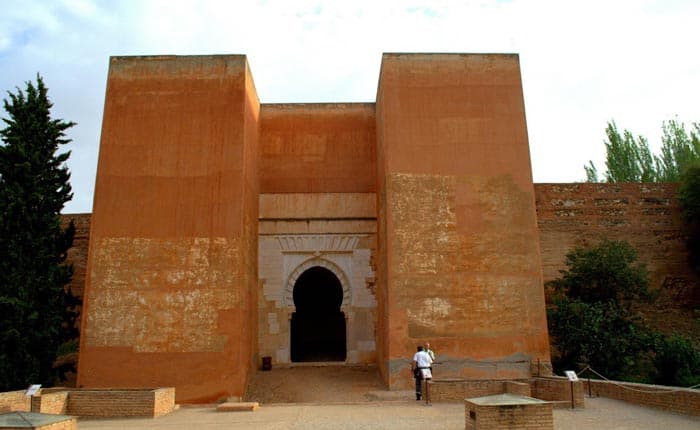
From the Alcazaba, you come to one of the hill’s most spectacular viewpoints, allowing you to admire in all their splendour the lower town of Granada, the Albaicìn and the Sacromonte. Here stands the Puerta de las Armas, which was once the only entrance used by the people of Granada, the other three facing outwards.
Between the Medina of the Alhambra and the Generalife lies the Puerta del Arrabal. Those who exited here could reach the Sacromonte without passing through the city of Granada. After the conquest, an outer bulwark was built to protect the Torre de los Picos, closing the gap with what was called the Iron Gate. The emblems of the Catholic Monarchs are preserved here.
Puerta del Vino (Wine Gate)
After passing through the Puerta de las Justicia, we come to another imposing portal: the main inner gate in the walls. The Puerta del Vino (see cover photo) still fulfils its original function, namely to distinguish the residential quarter from the rest of the fortress. It is one of the oldest buildings in the Nasrid Alhambra, dating from the early 14th century, although its two façades have been enriched over time with decorations from various periods. The western side, of finely worked sandstone, bears a symbolic keystone depicted on the arch. The interior façade, on the eastern side, was finely decorated in colour and some traces can still be seen to the right of the arch.
Other buildings
Church of Saint Mary
There were many public buildings along the Calle Real, some of which have survived through the centuries. One of these is the Church of Santa Maria de la Alhambra, which you will find near the entrance, a few steps from the Palacio de Carlos V. As we know, the arrival of the Catholic Monarchs brought substantial changes to the old Arab citadel. At this spot, in fact, the mosque and the bath once stood. Part of the latter survives in the neighbouring house, whereas there is no trace left of the 14th-century Islamic temple, completely replaced by the new church.
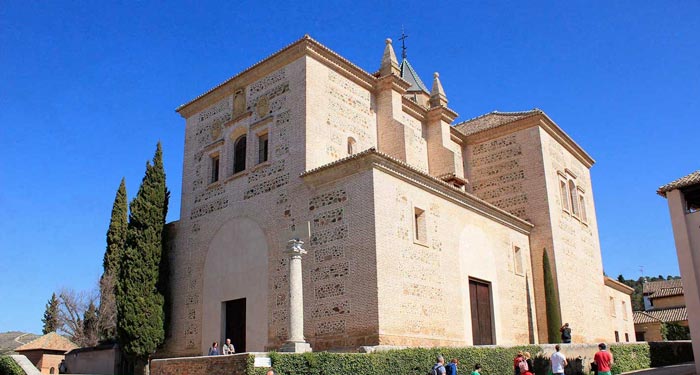
Built from 1581, the church has a Latin cross plan and six chapels flanking the single nave. The plain brick and masonry façade reflects the simplicity of the interior. However, it also houses some interesting works. Among them, the altarpiece designed in 1671 by Juan Lòpez de Almagro and the statue of the patron saint by Torcuato Ruiz del Peral in the style of Alonso Cano. Also very interesting is the baptismal font in the shape of a shell, which was originally a fountain from the Nasrid era.
If you happen to be in Granada in the days leading up to Easter, you may see the statue of Our Lady of the Alhambra carried in procession on a beautiful throne that reproduces in silver the arcades of the Patio de los Leones.
Angel Barrios House Museum
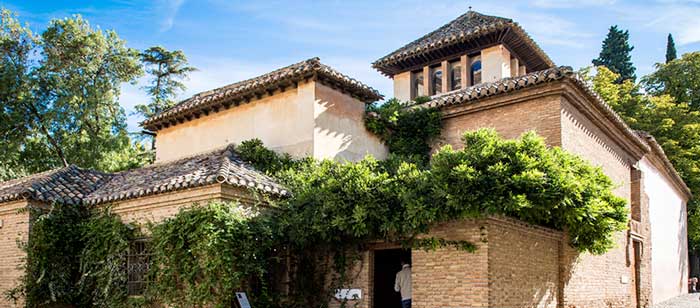
Adjacent to the church stands the house where the musician Angel Barrios lived, now converted into a small museum. Here are gathered drawings, paintings, watercolours, scores and correspondence, all dedicated to the Granadan composer, who died in 1964, and to his father Antonio Barrios, known as El Polinario, one of the last guides of the Alhambra in the early twentieth century. In the tavern of this house, intellectuals and artists would meet for conversation and music, dancing and singing. Composers Ravel and Strauss, poets García Lorca and Machado: countless great names from every cultural and artistic discipline have passed through here and left their mark.
The mosque’s bathhouse
Aside from the collection, the house is well worth visiting for the Arab bath. Although it is only part of the large original bath that was connected to the ancient mosque, the one we see in Barrios’ house is well preserved and rivals those found within the Palacios Nazaries. The owner, in fact, has always placed great importance on the site’s cultural aspect, making it a point of pride and caring for it over the years.
Archaeological area of the Palacio de Abencerrajes
In the upper area of the Alhambra we find a site that today is modest in appearance, but which was certainly inhabited by people of standing, as evidenced by the fact that it lies close to the Medina’s urban axis. This archaeological area is known as Palacio de Abencerrajes, the Spanish name given to the Nasrid family Banu Sarray. In 1501 the building was ceded by the Catholic Monarchs to don Juan Chacòn, chief accountant of the royal council, and from that moment it became known as the Contaduría. At the end of the 19th century the remains of the architectural complex and its urban layout came to light. In the 1930s excavation work began and the importance of the site started to be re-evaluated.
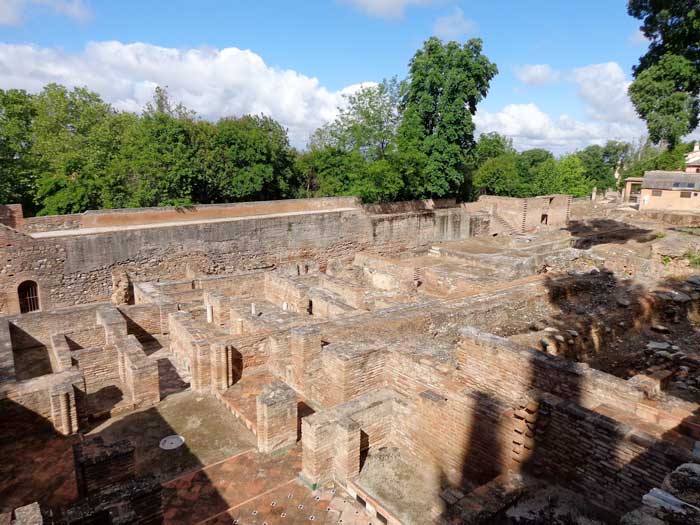
In the central area there was a pool, parallel to the enclosing walls, surrounded by a patio onto which a pavilion opened; the pavilion was made up of three rooms preceding the main hall, which was also tripartite and set within the tower. This architectural solution was later replicated in the Palacio de los Leones. A small house is attached to the main structure on the eastern side: here too we find the basic features of the traditional Muslim house, with a courtyard and a fountain at its centre.
Beside it, we find a double bath, from different periods. The larger and more recent dates to the reign of Yusuf I (1325–1354) and follows the design of the Comares bath: a resting room with a lantern roof, a cold room with side chambers, a warm room with a foot‑washing basin, and a hot room with the boiler area. Many decorative elements are still preserved, including painted tiles that reveal the palace’s style.
Acequia Real (Royal Canal)
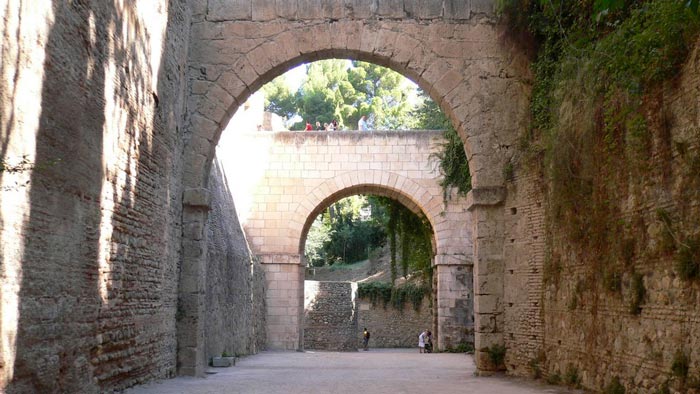
One cannot think of the Alhambra without associating it with water, which gives life to its spectacular fountains, channels and water features that make it so characteristic. But how did water reach the interior of the fortress? The credit goes to the Acequia Real, a watercourse, a canal which, with a sophisticated hydraulic system, made it possible to draw water from the River Darro and carry it to feed the palace fountains and irrigate the gardens, vegetable plots and orchards. One of the most striking viewpoints from which to admire this particular aqueduct is the Cuesta de los Chinos: this avenue running alongside the fortress, in fact, passes directly beneath one of the largest arches that supports the channel.
Where to Stay?
If you’re still trying to work out which neighbourhood or area is best for accommodation in the city, read our article where to stay in Granada, where you’ll find advice on the best places to stay near the Alhambra and in the other neighbourhoods of Granada. For convenience, below I list the direct links.
Other useful links
- Tips on what to do in Granada
- Tips on the best places to eat in Granada
- How to book tickets for the Alhambra + information on opening times and tours
