In this article I want to tell you about the Torre del Oro, one of the two most famous towers of Seville, which in the photo above stand out against the classic Andalusian blue sky. While the Giralda is recognisable by its tall, slender profile, the Torre del Oro instead appears compact and massive, towering imperiously over the Guadalquivir River or, to be more precise, over the river basin, the Canal de Alfonso XIII. Both were built by the Almohads: the first served as a minaret and as such was over 100 metres tall and richly decorated, whereas the second had a military control function and was intended to be robust and massive in its 36-metre height. Today they are both symbols of Seville and of a glorious past that has been preserved and safeguarded through the centuries.
The Torre del Oro is one of the places I recommend you visit to enjoy a breathtaking view of the city: from its terrace you’ll enjoy an excellent view. In addition, the Museo Naval de Sevilla, housed within the tower, is an ideal place for children and adults who enjoy scale modelling and ships.
Contents
History of the Torre del Oro in Seville
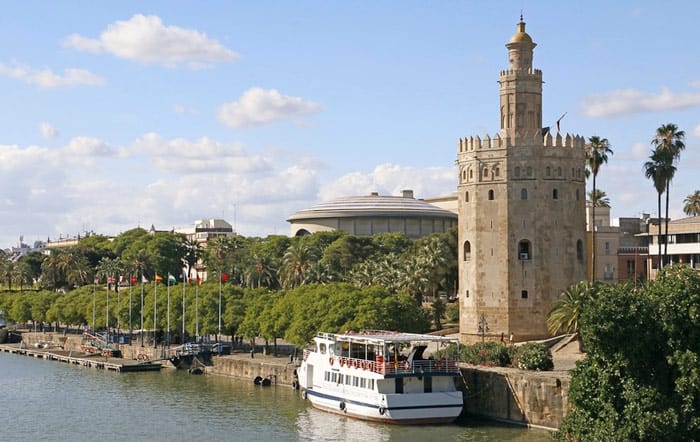
The Almohads decided to position the tower at a strategic point in the city: on the river, to protect the area up to the Puente de Barcas, and along Seville’s city walls, to control access to the city and defend it from possible attacks. Its role was tested on several occasions: among these was the 1248 attack by the Castilian fleet during the Reconquista.
Today we can admire it from afar both from the other side of the river, on which it has for eight centuries been reflected, vaunting its lustre, and from the pedestrian riverside, the famous Paseo Cristóbal Colón. For a long time it was believed that the name derived from the many gold‑coloured azulejos that originally covered it and made it sparkle, aided by the reflections and play of light with the river’s waters. However, in 2005 it was discovered that the sheen was due to a mixture of lime mortar and compressed straw.
From defensive tower to prison, from chapel to museum
Construction work on the Torre del Oro began between 1220 and 1221. The first section was dodecagonal in shape and the work was commissioned by the Almohad governor Abù-I-Ulà. The upper section is also dodecagonal but narrower and was added in 1300 at the request of Peter I of Castile. In 1760 the engineer Sebastian Van der Borcht, who also worked on the construction of the Real Fábrica de Tabacos, designed the third section in a cylindrical form surmounted by a dome.
During the early centuries of its existence, the tower’s function was primarily to control river access and it formed part of the defensive system of the nearby Alcazar. Seville had 166 towers, and the Torre del Oro and the Torre de la Plata were linked on either side of the river by a large chain to block the passage of enemy ships.
The tower soon became part of the city’s heritage and, when in 1755 the earthquake that struck Lisbon and the south of Spain severely damaged the tower and the Marquis of Monte Real requested its demolition, the citizens opposed it to such an extent that the order was revoked.
Since 1931 the Torre del Oro has been a national historic monument and today houses the Museo Naval de Sevilla. Over the centuries the tower has, however, had very different functions: it has been a chapel dedicated to Saint Isidore, a prison for nobles, a gunpowder store and the offices of the Harbour Master. When in the 14th century Peter I had the second level added, many maintained that this work served to house his mistresses. It is extraordinary to think of what the walls of the Torre del Oro have seen and heard during their eight centuries of existence.
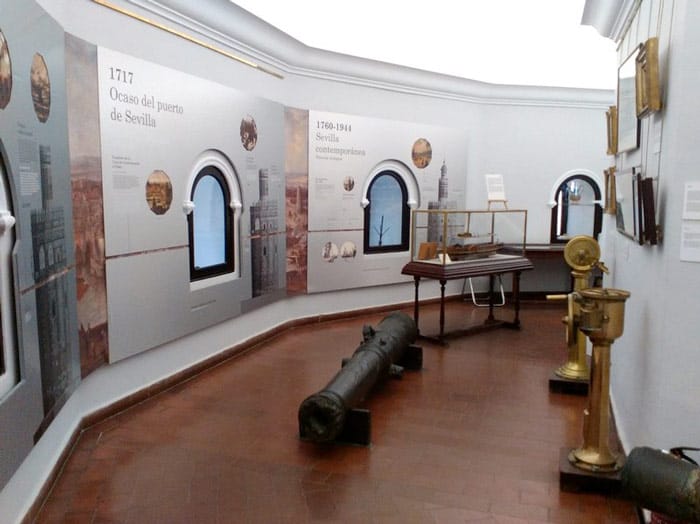
The museum is divided into two floors open to the public. On the first floor there is an exhibition on the history of the tower and its construction, set out in three phases. Particularly interesting is the work by Johannes Janssonius, which shows the tower, the walled enclosure and the view from the tower before the 1760 addition. On the first floor of the Naval Museum adults and children will be delighted to see the model of the first steamship built in Spain, the model “Real Ferdinando”. This vessel took General Espartero into exile in 1843.
On the second floor you’ll find maps, charts and nautical instruments of the Armada española from various eras, as well as a reconstruction of Magellan’s circumnavigation of the globe.
The panoramic terrace is splendid and affords a lovely view over Seville and the river. After seeing ship models, historic nautical charts and nautical instruments, a breathtaking view over one of Andalusia’s most beautiful cities is exactly what you need.
Useful information and tips for your visit
The Torre del Oro is on Paseo Cristóbal Colón, on the dockside of the Guadalquivir River. I recommend strolling through the historic centre to the Paseo: it’s only a 10-minute walk from the Cathedral. Not far from the tower is also the Real Maestranza, the Plaza de Toros of Seville.
Bus C4 will take you directly to the tower. Alternatively, buses 5, 40, 41, 42, C3 and S3 stop at Puerta de Jerez, about a 5‑minute walk away. Puerta de Jerez is also the nearest metro station to the tower.
Torre del Oro: opening hours and ticket prices for the museum

You can visit the Torre del Oro and the Museo Naval de Sevilla from Monday to Friday from 9:30 to 19:00 (last admission at 18:30) and on Saturdays, Sundays and public holidays from 10:30 to 19:00 (last admission at 18:30). On local and national public holidays the museum is closed: it does not open on 1 and 6 January, Good Friday, 1 May and 25 December. On 5 January, 24 and 31 December the opening hours are reduced and the site is open only until 14:00.
The ticket to access the museum costs €3. Children under 6 enter free of charge. There is a reduced ticket of €1.50 for children aged 6 to 14 and adults over 65. The Torre del Oro normally does not require advance booking for individual visitors. Tickets can almost always be purchased directly at the entrance.
On Mondays you can enter the Torre del Oro and the Naval Museum free of charge. The audio guide costs €2.
Where to stay?
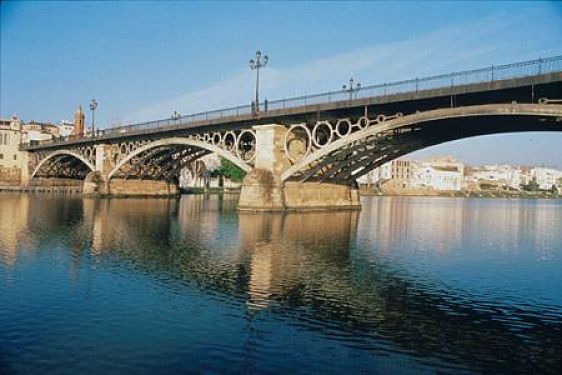
The Torre del Oro is located on Seville’s riverfront, but it’s actually very close to the heart of the city. The nearest neighbourhood is El Arenal, but the recommended option is to find accommodation in El Centro or in Barrio Santa Cruz. If, however, what you’re after is a hotel on the other side of the river, it’s worth keeping an eye on available accommodation in the popular neighbourhood of Triana, where you can also find hotels at more affordable prices.
