What monuments should you visit in Seville? Among museums, churches and gardens, the city preserves buildings that reveal themselves as treasure chests of beauty and hidden gems, with their courtyards and decorated halls. Added to these are iconic bridges, monuments and other historic places that absolutely deserve a place on the list of things to see during a stay in Seville.
Contents
- Real Alcázar
- Casa de Pilatos
- Metropol Parasol
- Plaza de Toros de la Real Maestranza
- Torre del Oro
- Hospital of the Venerable Priests
- Lebrija Palace
- Casa de Salinas
- The Cathedral and other churches of Seville
- Seville City Hall
- Palace of the Dueñas
- Palacio de San Telmo
- Real Fabrica de Tabacos
- Triana Bridge
- Map of Seville’s monuments
Real Alcázar
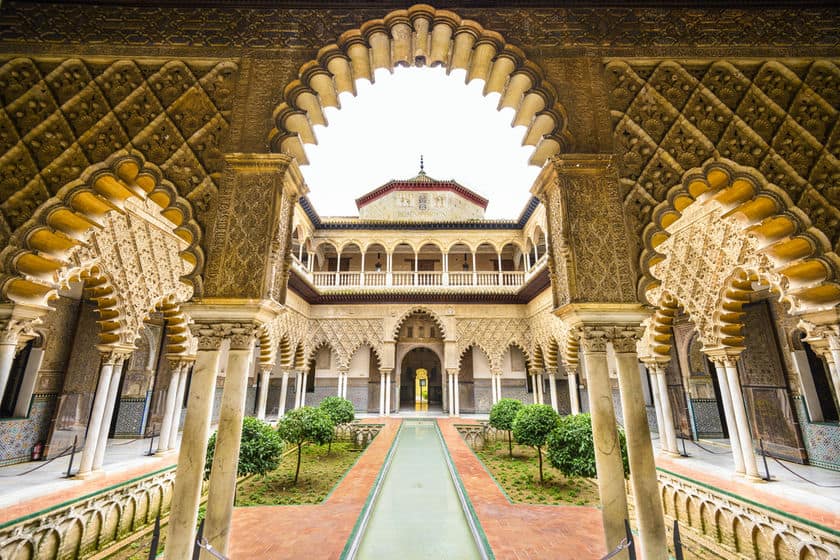
You cannot visit Seville and not see the Royal Alcázar, one of the oldest palaces in Spain and in the whole world. Built in the 8th century and later expanded, it is still one of the finest examples of Mudéjar architecture still standing today. It is safe to say that, as a sumptuous Spanish Arabesque palace, it is second only to the magnificent Alhambra in Granada.
Between one patio and the next, as you visit the palace you walk with your nose in the air, losing yourself among multicoloured decorations, arches and ceilings clad in azulejos or gilded stalactites. Each room has its own distinctive feature that makes it unique, not to mention the wonderful gardens, where you wander through a labyrinth of palm trees, orange trees and splashing fountains.
The ways to visit the Alcázar are various: with a standard ticket, with tourist passes, or by taking part in one of the different guided tours. We have covered this in depth in our dedicated article.
Casa de Pilatos
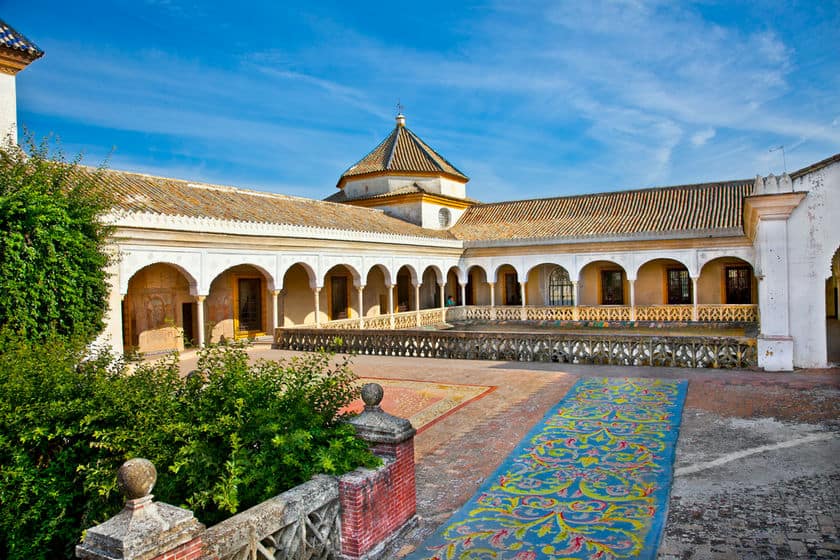
After the Real Alcázar, the Casa de Pilatos is probably perhaps the most beautiful palace in Seville. In this historic building, Moorish, Gothic and Italian Renaissance architecture are blended together, with decorations that are simply breathtaking. A riot of colour makes every interior wall of this iconic Sevillian building unique, and it is truly well worth a visit.
The name immediately brings Pontius Pilate to mind, and indeed there is a link with the gospel figure. It seems that the owner of the house discovered that the distance between the building and the Cruz del Campo church was the same as that between Pontius Pilate’s house and Calvary. So he changed the name of the palace and created a Via Crucis through the streets of the city, starting right here.
Did you also know that several films have been shot at Casa de Pilatos? We talk about these curiosities too, as well as the things to see and how to visit, in our dedicated article.
Metropol Parasol
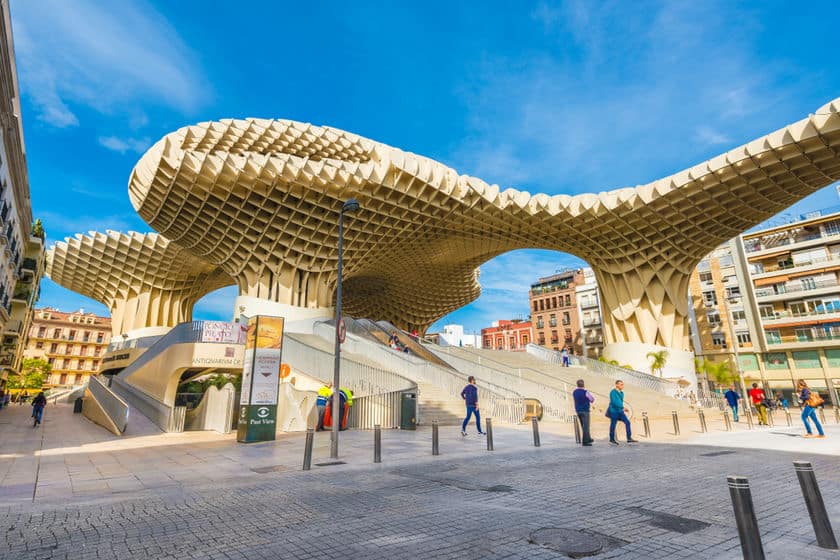
Raise your hand if you knew that the largest wooden structure in the world is in Seville! Indeed, the Andalusian capital is not only a treasure trove of history and art, but also offers visitors a few architectural surprises, such as this important example of sustainable architecture. I am talking about the Metropol Parasol, a lattice structure covering over 800 sqm of surface area and which has revitalised the Plaza Mayor since 2010.
But this large and curious structure is not just a shelter from Seville’s sweltering sun. First and foremost, the food market takes place beneath it once again; it had ceased to exist in 1973 after more than a century of life, but thanks to this project it has returned to enliven the square. You can go up to the market roof via stairways that lead to an elevated square, where you can stand in the shade of the imposing structure.
There are then two levels, respectively above and below. In an underground floor we find the archaeological museum: the Antiquarium, where archaeological finds from the Roman era can be seen. Above the Parasol, on the other hand, the walkways of the Mirador wind their way. Rising to a height of 28.5 metres, you can enjoy a splendid panoramic view over the city.
Plaza de Toros de la Real Maestranza
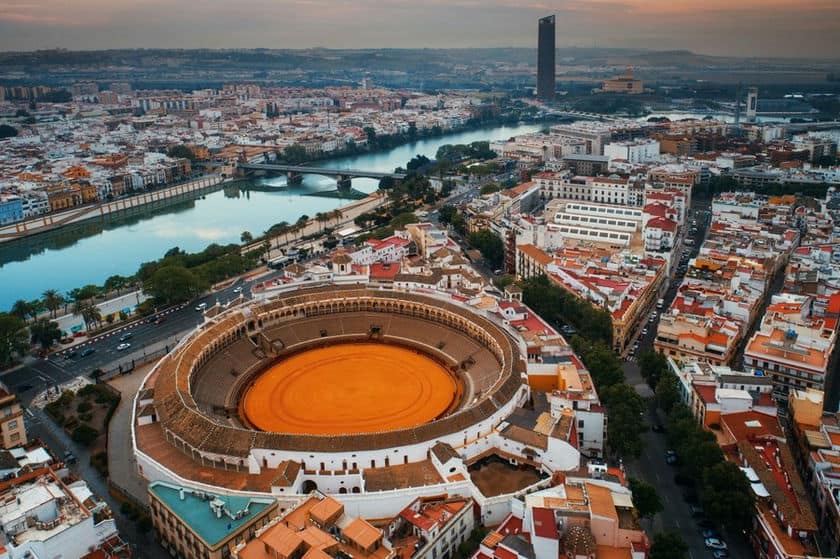
Regardless of how one views the Spanish bullfighting tradition, the historical and architectural importance of the Plaza de Toros de la Real Maestranza de Caballería de Sevilla cannot be denied: the oldest in Spain. This vast arena, which holds over twelve thousand spectators, was built in several phases, beginning in 1733. Visiting it feels a little like being in a stadium ante tempore, or an evolution of the Roman amphitheatres: certainly a place that leaves no one unmoved, even when empty. Moreover, its museum allows visitors to trace the history of bullfighting, in order to understand the close bond between the Spanish people and this controversial custom.
Torre del Oro
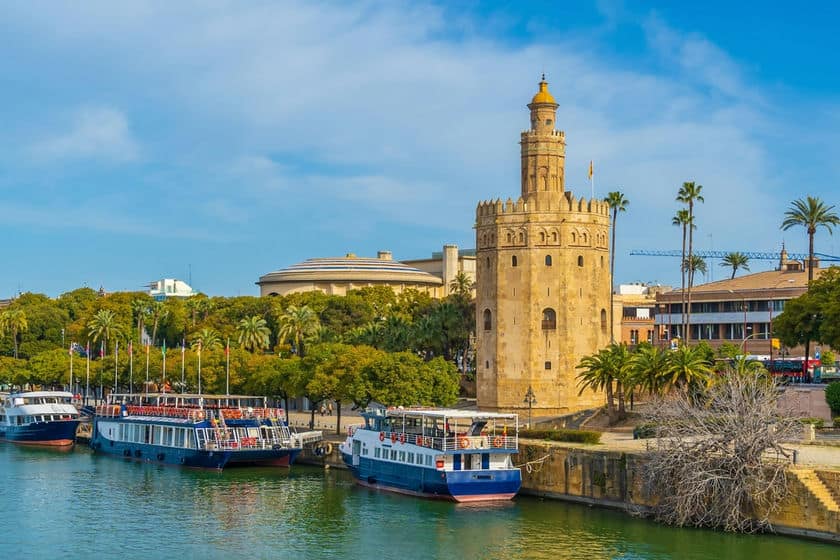
Among Seville’s iconic landmarks, we find the Torre del Oro, a defensive bastion on the riverbank, erected in 1220 to defend the city. Standing 36 metres tall and with a massive, sturdy structure, precisely because of the role it played, it was later used as a prison, as a chapel and finally as a museum. Today, in fact, it houses the Museo Naval de Sevilla, which tells the history and maritime events of the city: among other things, it preserves the model of the first steam-powered boat built in Spain, as well as dozens of maps, objects and nautical instruments.
The Torre del Oro is also today one of the most beautiful viewpoints in Seville, since it is possible to go up to its summit to admire the city from above. It also proves to be very photogenic in its own right, thanks to its riverside location, just a stone’s throw from the Puente de San Telmo.
Hospital of the Venerable Priests
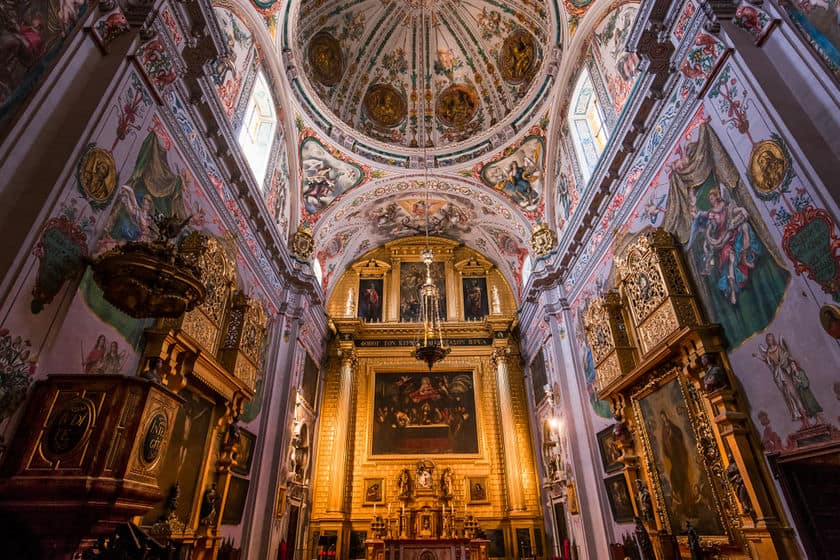
Among the hidden gems in the centre of Seville is the Hospital de los Venerables Sacerdotes, in the Barrio Santa Cruz. Founded in 1676 as a place of refuge for elderly or sick priests, in addition to the residential section it has a beautiful courtyard, in the centre of which there is a fountain surrounded by concentric circles.
On the ground floor of the building there is also the Velázquez Centre, where numerous works by the Sevillian artist are kept. But the one that truly leaves you speechless is the Iglesia de San Fernando. This small Baroque gem, decorated with Juan de Valdés Leal’s frescoes, is really worth a stop and is worth the price of admission.
Hospital de los Venerables: our guide
Lebrija Palace
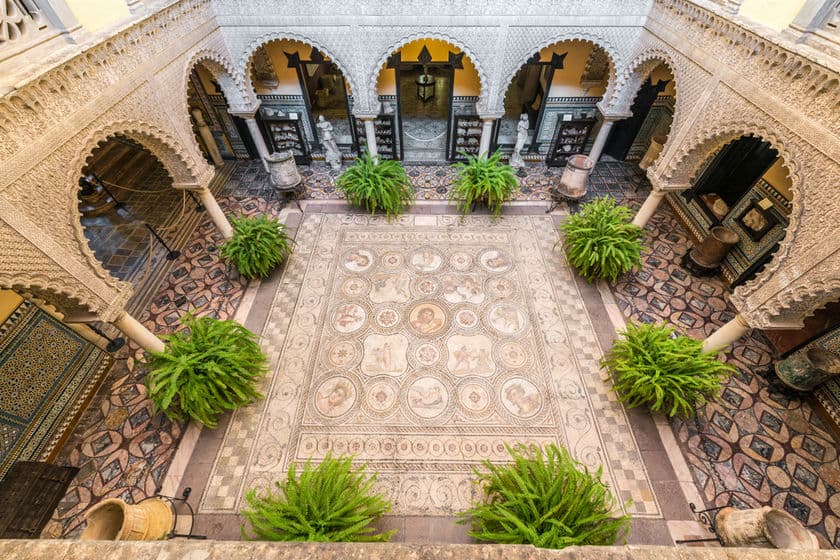
Seville is brimming with historic buildings of great architectural value, but some stand out in a particularly special way. Such is the case of the Palacio de Lebrija (to be precise, the Palace of the Countess of Lebrija), famous above all for its mosaic floors, among the most beautiful to be seen in a private residence. Although the building dates from the sixteenth century, we owe its current appearance to the Countess of Lebrija. She bought it in 1901 and carried out artistic and architectural improvements for 13 consecutive years, filling it with artistic treasures from every age.
The mosaic floor is from the Roman era: the wealthy collector bought it and had it installed in her residence, together with period furniture and objects from all over the world. From Greek and Roman statues to a painting by the Flemish painter Van Dyck, via splendid azulejos and magnificent examples of Andalusian art. A dream house for art lovers, in short. And among the various rooms, how could one fail to be captivated by the library, containing 4,000 books?
Casa de Salinas
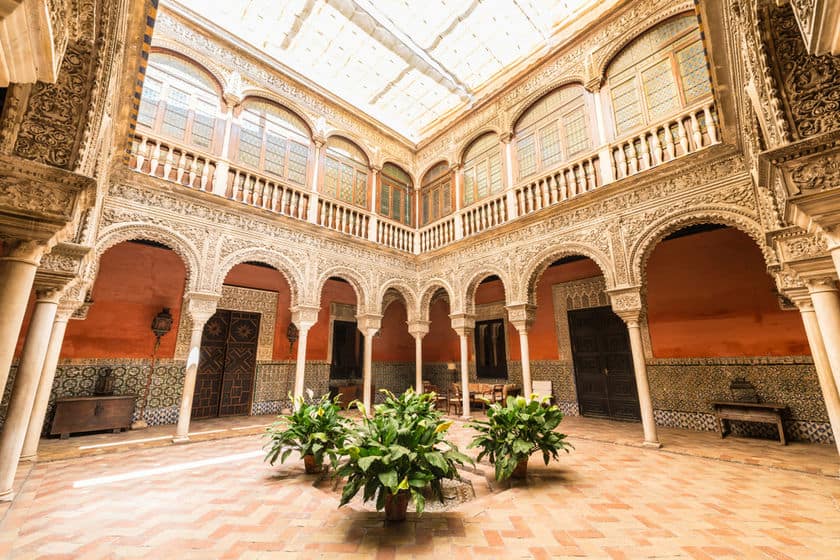
Another incredible house, which is perfectly hidden behind a simple, unassuming façade, is the Casa de Salinas. This residence dates from the second half of the sixteenth century, when the city was at its wealthiest thanks to the discovery of America and colonial success. After the end of the owners’ dynasty in the mid-nineteenth century, the building was used for a long time for all sorts of purposes, but in 1930 it was bought by Don Manuel de Salinas Malagamba, who wanted to restore it to the splendour of bygone centuries.
In the part of the house that can be visited – because it is still inhabited by the same family, so not all of it is open to the public – we find an excellent mix of styles, ranging from Gothic to Moorish to Renaissance. All of this is enhanced by mosaics and wall decorations: a real gem not to be missed.
The Cathedral and other churches of Seville
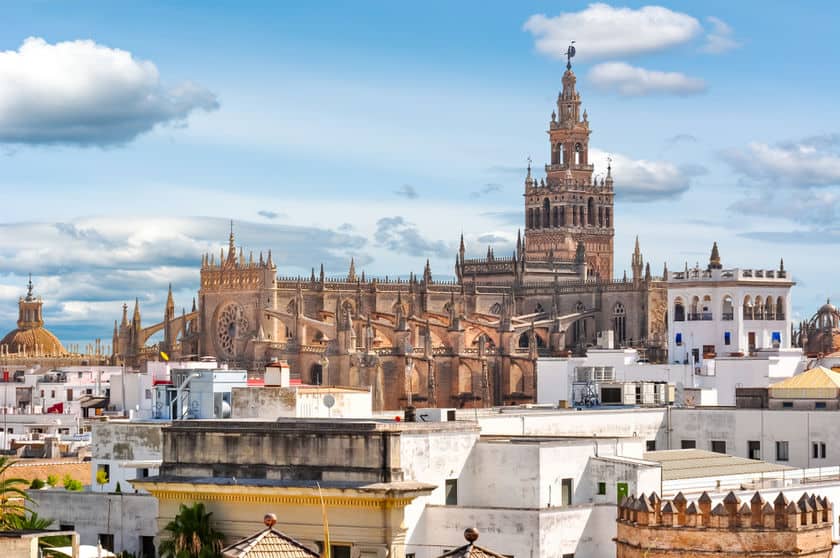
Among the most important monuments in Seville, of course, we cannot fail to mention the churches, above all the Cathedral with the famous Giralda. This majestic Gothic cathedral is among the most imposing in the world, and is said to house the remains of Christopher Columbus. In addition to the Cathedral, there are numerous churches that express the strong popular religious feeling of the people of Seville: the Iglesia del Divino Salvador, the Basilica de la Macarena, the Basílica de Jesús del Gran Poder and many others. Don’t miss our page on the best churches in the city.
Seville City Hall
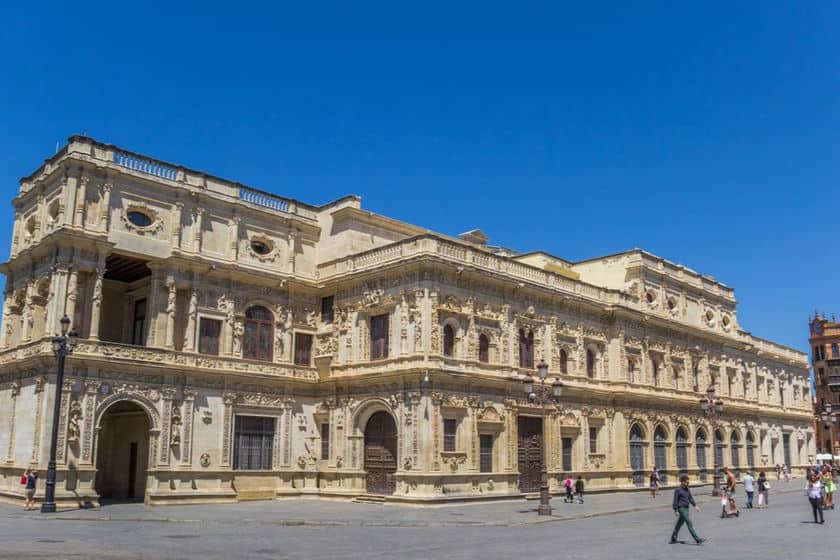
The Seville City Hall is housed in a historic palace in the city centre, in Plaza de San Francisco. This imposing building was commissioned by King Charles V, who intended to grant Seville the status of a great city. Construction took a long time and began in the 16th century, but in the 19th century it was remodelled, changing the orientation of the façade and giving it the neoclassical appearance it has retained to this day on that side. The great peculiarity of this town hall is in fact that the two façades are markedly different from one another.
Inside the city hall are preserved works by various Sevillian artists and valuable pieces donated by collectors over time. Among the most beautiful rooms is the one with a coffered ceiling on which the effigies of the monarchs are carved, which is usually used for public exhibitions.
Palace of the Dueñas
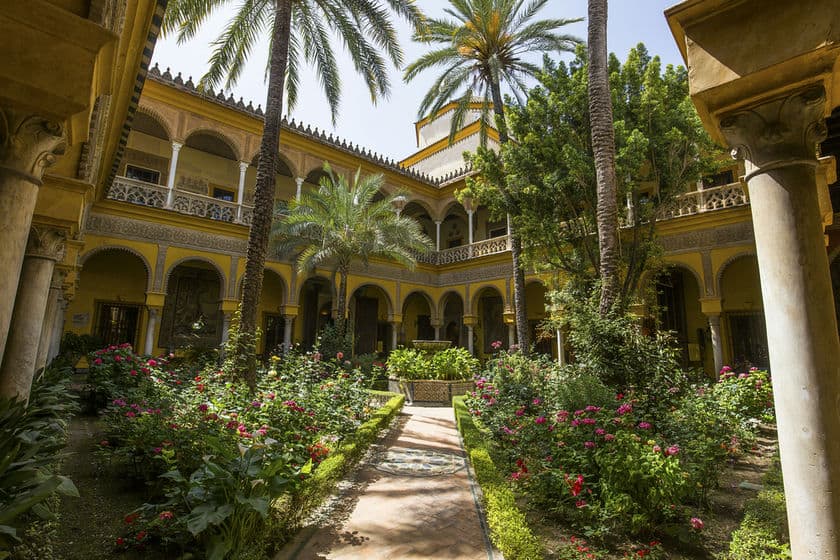
The Palacio de las Dueñas takes its name from the monastery of Santa Maria de las Dueñas, which stood right next to this residence and was demolished in 1868. This majestic residence of the House of Alba is among the city’s most beautiful and richest in works of art. Antique furniture and finely crafted furnishings, paintings and works of art, not to mention the enchanting patios and luxuriant gardens with over 7000 different species of plants.
Here is a preview of what you can see when visiting this beautiful historic residence, within whose walls the famous poet Antonio Machado was born in 1875. In the first half of the twentieth century, this house became a meeting place for royalty from across Europe and for the most important figures in the worlds of art, politics and culture in general. Today it can be visited, losing yourself in the wealth of detail in its rooms and gardens.
Palacio de San Telmo
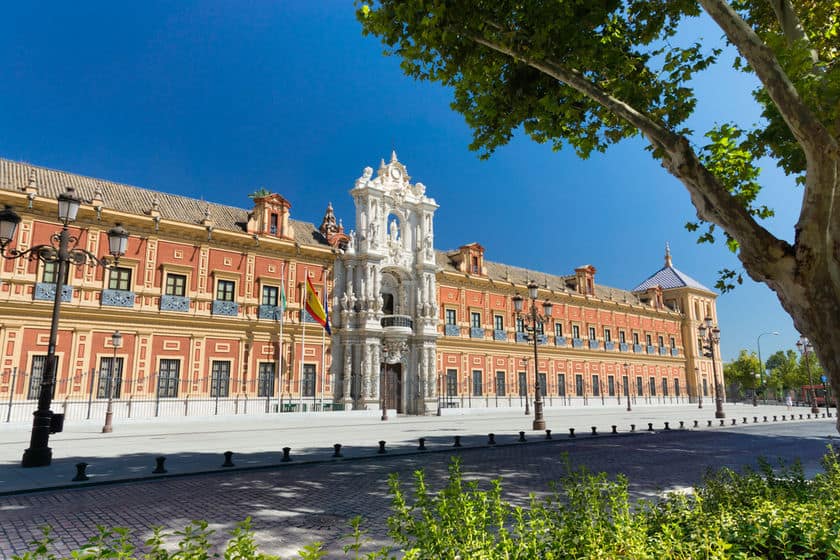
In 1682, the headquarters of the collegio dell’Universidad de Mareantes was built: a school that educated orphaned children, training them as sailors. A couple of centuries later, this grand building, known as the Palacio de San Telmo, was purchased by the Duke of Montpensier, Antonio d’Orléans (the son of King Louis Philippe of France), who made it the private residence of his house. It was embellished and enriched with new architectural elements before being handed over to the Archdiocese of Seville after the death of Luisa Fernanda, with whom the dynasty came to an end in 1897. A century later, in 1989, the diocese transferred the palace to the regional government, which made it the seat of the Presidency of the Council of Andalusia.
Real Fabrica de Tabacos
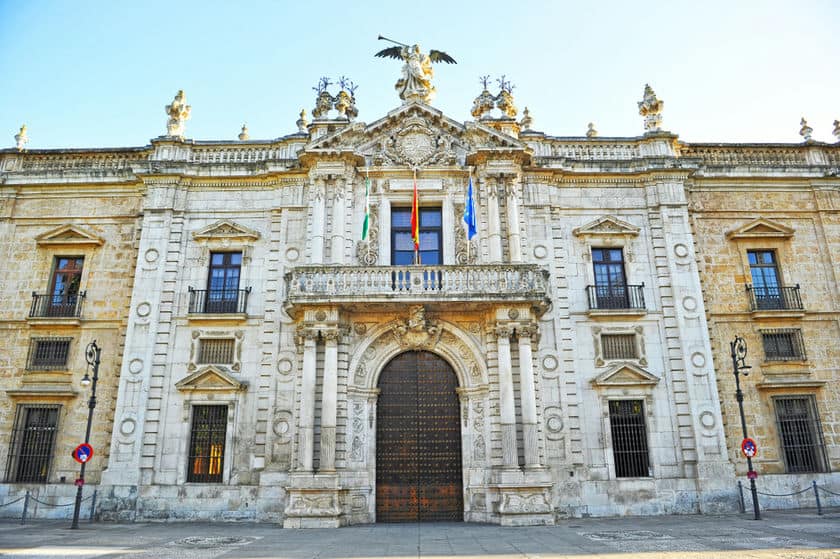
Among the most interesting buildings of the University of Seville — to be precise, the one that houses the rector’s office for the Faculties of Philology, Geography and History — is the one known as Real Fabrica de Tabacos, because it was built in the 18th century as a tobacco factory. Not just any factory, but the first to be established in Europe. What we have before us is one of the largest and most imposing buildings in Spain (without doubt the biggest in Andalusia!): a rectangle measuring 185 x 147 metres.
The main area, which was dedicated to manufacturing, occupied about two thirds of the building, whilst the remaining part was used for warehouses and dwellings. The architectural styles are varied, but the main ones are Renaissance, Neoclassical and Baroque: the latter is particularly evident in the main portal. Worth seeing are the university chapel and the building of the old prisons, as well as the walls that surround the architectural complex.
Triana Bridge
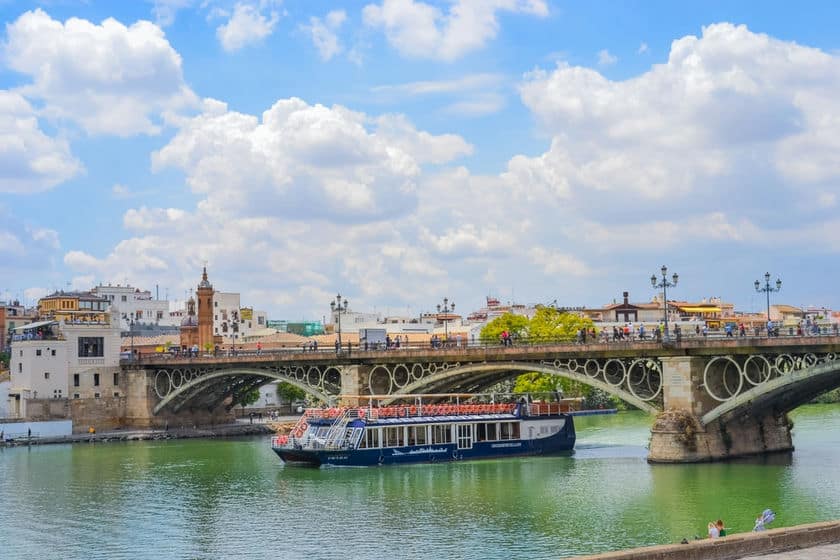
The Puente de Isabel II is known to everyone as the Puente de Triana because it links the city centre with the Triana district, right by the large market in this neighbourhood. It is the oldest of the crossings over the Guadalquivir River (or, to be precise, the Canal Alfonso XIII, the old stretch of the river that was closed off and turned into a canal when the current diversion was made at the beginning of the twentieth century).
Inaugurated in 1852, it was the first permanent bridge, after a long period when there were only a few floating bridges made with boats. It has a long and complex history behind it and was not easy to build, but after nearly two centuries it is still one of Seville’s most significant bridges. It is also the oldest iron bridge in all of Spain.
