The Judería is among the most beautiful and characteristic neighbourhoods of the city of Cordoba. Located in the historic centre – a stone’s throw from the Alcazar of Cordoba – this small corner of the city is a fairytale maze of white alleys with flowers and balconies in wrought iron: losing yourself in its little streets is a delight for the eyes and the soul. I suggest you stroll at leisure and take time to look at every detail: only in this way, for example, will you be able to catch a glimpse through the iron gates of the characteristic patios full of plants and colourful flowers which, despite the summer heat, are always lush and full of life.
In this article you will find some tips on what to see in the Jewish Quarter of Cordoba and on what the main attractions are, as well as some historical information that will help you understand and appreciate even more this magical, timeless quarter.
Contents
Brief history of the Jewish quarter of Cordoba
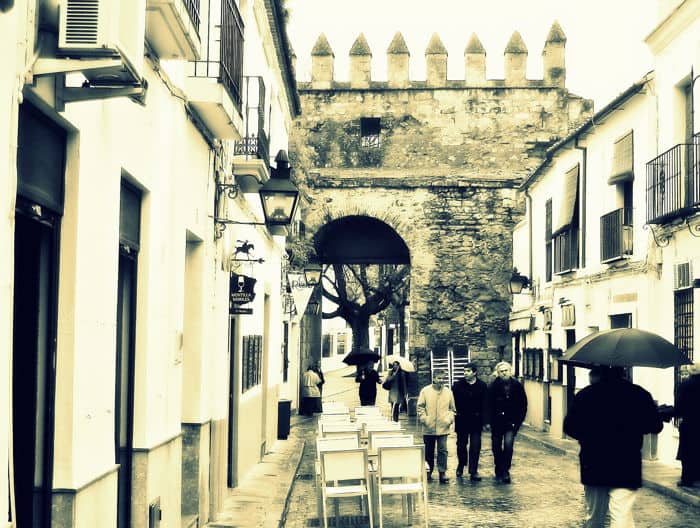
The Judería quarter lies north-west of the Mezquita and once covered a much larger area. Its location in the heart of the historic centre reflects the importance of Córdoba’s Jewish community before 1492, the year in which the Spanish Christian monarchs definitively expelled the Jews from the kingdom.
The earliest evidence of a Jewish presence in Spain dates back much earlier, even to the 2nd century AD. During Arab rule Jews, Christians and Arabs coexisted peacefully and it is for this reason that you can admire – in Cordoba as in the other towns that once belonged to the region called Al-Andalus – buildings of different faiths situated close to one another.
What to see in the Judería of Córdoba
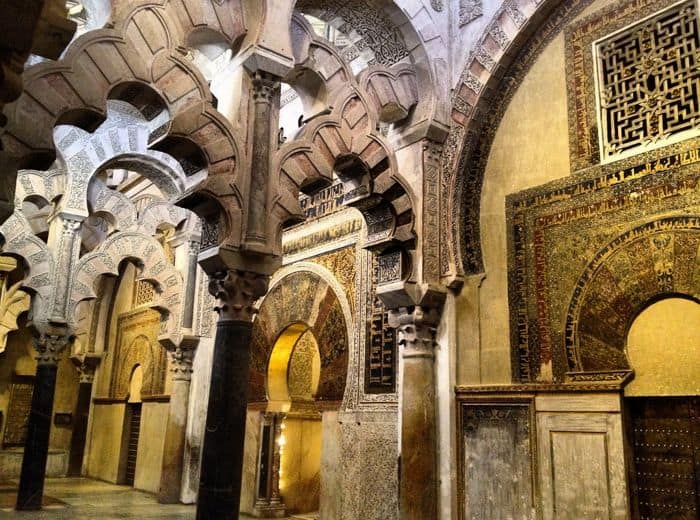
Our itinerary starts at the Mezquita, originally a mosque and today the Cathedral of Cordoba: if you want to get a partial sense of the spectacle that awaits you, read our article about the Mezquita, perhaps the most famous and important among the things to see in Cordoba.
Leaving the Mezquita behind you, you can venture into the Jewish quarter, which will immediately present itself as a hypnotic labyrinth of narrow white alleys. My advice is to trust your sense of direction just enough: take the streets that seem the most beautiful and characteristic, without following a fixed route. That said, there are a few places of interest you simply must not miss. Here is a map and a detailed list of attractions.
Capilla de San Bartolomé
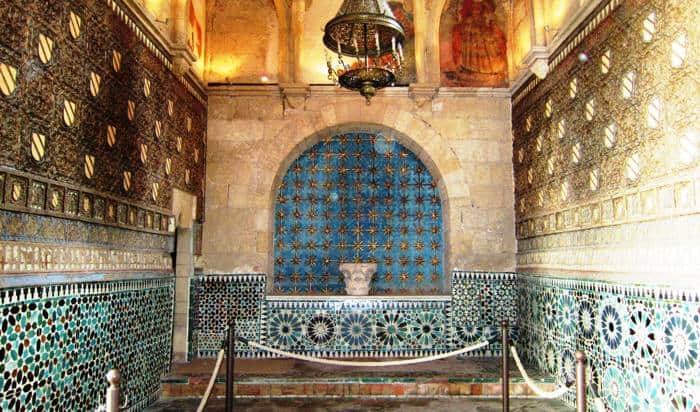
A visit to this chapel in the heart of the Jewish quarter is essential for anyone who considers themselves passionate about architecture and Mudejar art. Built in the late 14th century, this small church is a testament to the coexistence of the three religions, Christian, Jewish and Muslim. The main points of interest? The collection of 35 Nasrid-period azulejos (discovered during the 1935 restoration), the original flooring and the stunning decorations of the chapel, especially those of the patio and the main portico.
Today the church is part of the Faculty of Letters and Philosophy of Cordoba and is situated in the former Hospital del Cardenal Salazar.
From 15 June to 14 September, the chapel is open from Tuesday to Sunday, 10:30–13:30. From 15 September to 14 June, it is open from Monday to Saturday, 10:30–13:30 and 15:30–18:30; on Sundays, 10:30–13:30. Opening times may vary on public holidays.
From Monday to Friday, the admission ticket costs €1.50 per person. On Saturdays, Sundays and public holidays, it costs €2 per person. Children under 8 enter free of charge.
Calleja de las Flores
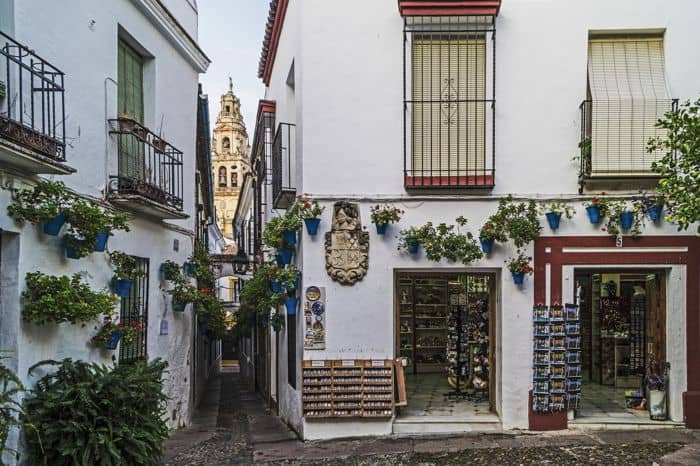
Calleja de las Flores is the most famous street of the Judería and perhaps of Cordoba itself. More than a street, we might call it a narrow little lane adorned with lush pots brimming with flowers in a thousand colours, set against the small balconies and windows of the whitewashed houses. Don’t be surprised to find most people here taking souvenir photos: the lane is truly famous and mentioned in every guide to Cordoba, especially for the splendid view of the Mezquita’s bell tower. Before leaving the neighbourhood, a photo in Calleja de las Flores is a must!
Plaza de Maimónides and surroundings
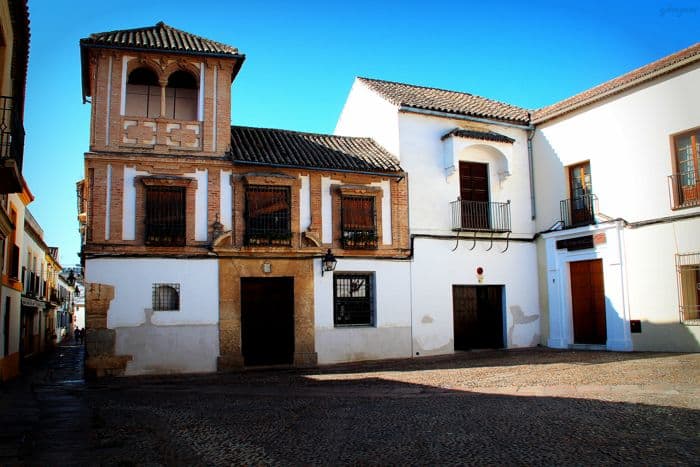
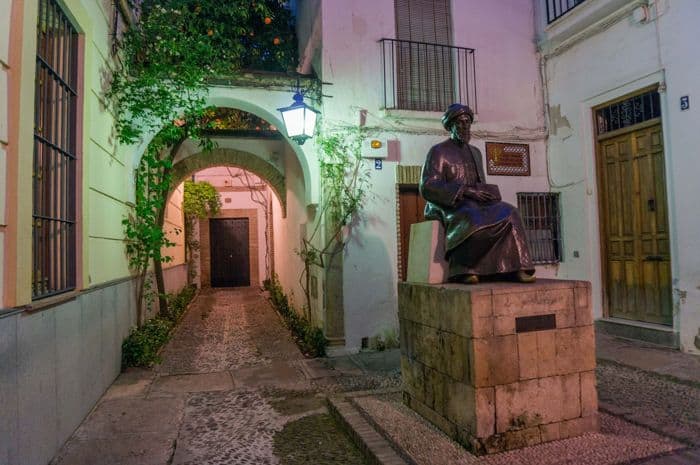
This is one of the first squares you’ll come across walking north-west from the Mezquita. The statue of the Jewish thinker and philosopher Maimónides is life-size and made of bronze: you’ll find it at the start of the famous Calle de los Judíos, one of the most important streets in the neighbourhood. In this area are the main attractions of the Judería. Among them is the Museo Taurino, which overlooks the square.
Museo Taurino de Córdoba.
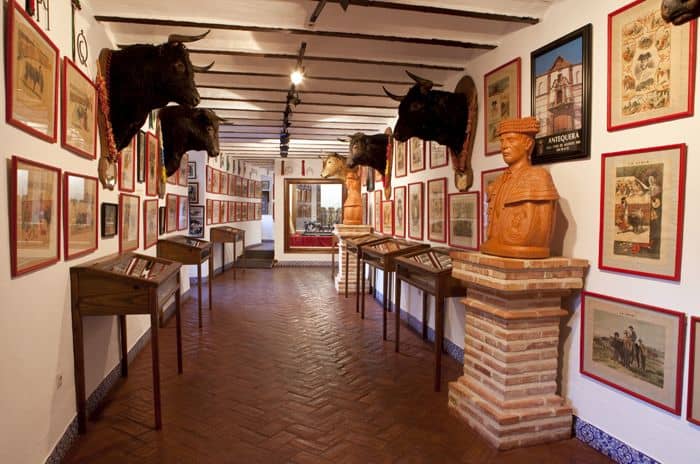
Situated at number 10 Plaza de Maimónides, this museum is one of the most important and richest of its kind. It was in Cordoba, in fact, that the legendary torero Manolete was born in 1917; he later died in an arena in 1947. Another famous bullfighter from the city is known as El Cordobés: the museum also dedicates an entire room to him. Housed in a sixteenth-century Renaissance-style building, this place is, in every respect, ideal for gaining a better understanding of the culture and history of Spain’s bullfighting tradition.
The museum is closed on Mondays. From 16 September to 15 June, it is open from Tuesday to Friday, 08:15–20:15; on Saturdays, 09:30–17:30; and on Sundays and public holidays, 08:15–14:15. From 16 June to 15 September, it is open from Tuesday to Sunday, 08:15–14:15.
General admission costs €4. Students pay €2. The museum is free on Thursdays during the free-entry time slot.
Synagogue of Córdoba
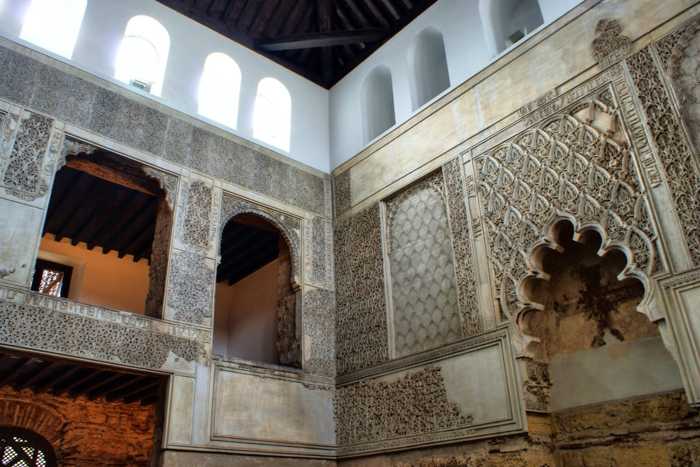
Although not large, this is one of only 3 synagogues remaining in Spain alongside the two in Toledo, after Christians expelled the Jews from the peninsula. The building dates from 1315 and is embellished with stucco, floral mudéjar motifs, stars, symbols and ancient Hebrew inscriptions. Noteworthy on the first floor is the matroneum, the area reserved for women.
The Cordoba Synagogue is located at Calle de los Judíos, 20 and until recently was open as a museum and accessible to the public at certain times, as indicated in the linked article.
Casa de Sefarad
Casa de Sefarad is also located on Calle de los Judíos, a short distance from the Synagogue. In fact, in the 14th century, the building formed part of the complex of Córdoba’s Great Synagogue.
Today it is a museum dedicated to the memory of the Sephardic Jewish community that once lived here. It displays many objects connected with Jewish tradition and religion, and to fully understand its history, it is advisable to take a guided tour.
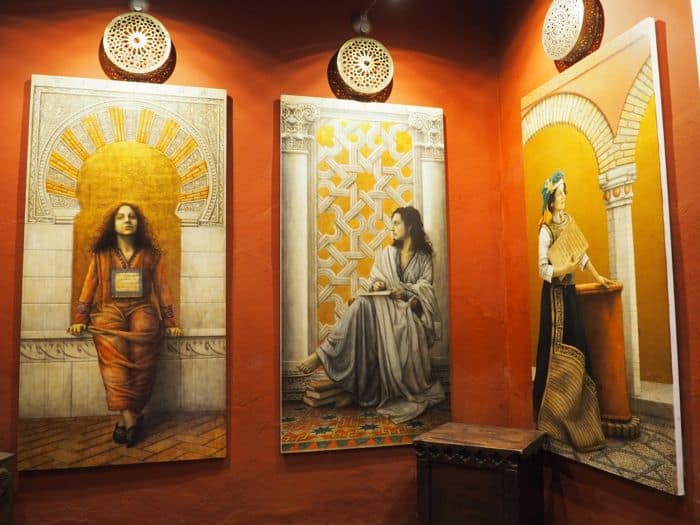
Noteworthy is the themed area dedicated to Jewish, Muslim and Christian women in the Andalusian city: you can learn why, during the period of Al-Andalus, women of the various faiths gained greater prominence in social life. On the first floor, in addition to the library and other interesting themed rooms, there is an area devoted to the Inquisition, with documents from the period and records of denunciations.
The museum is open from Tuesday to Saturday, 11:00–18:00. In July and August, it is open from 10:00–15:00. It is usually closed on Mondays and public holidays.
General admission costs €5. Pensioners and visitors with disabilities pay €4.50, while students pay €4.
Casa Andalusí
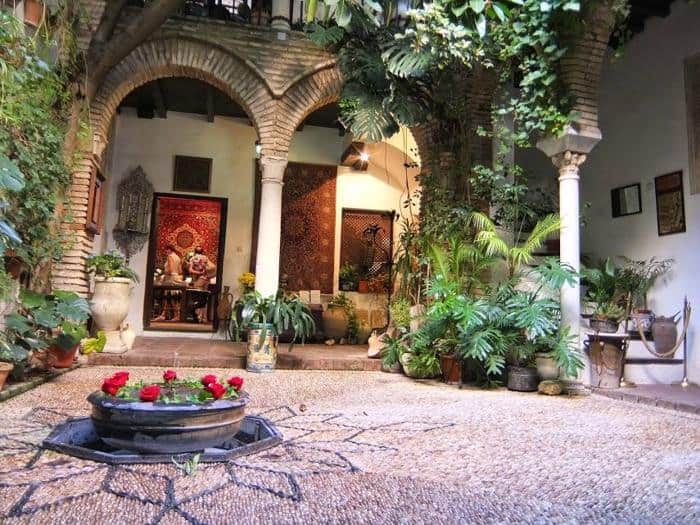
It is located at Calle de los Judíos, 12 and is a Mudéjar-style house built in the 12th century and recently restored. The patio is a marvel for the eyes, the sort that only Andalusian aesthetic taste can bestow!
In the basement you’ll be amazed by the beautiful mosaic dating back to the Roman era, while the rare collection of ancient coins in gold, silver and bronze dating from the Al-Andalus period is among the most important in Spain.
Casa Andalusí is open from Monday to Sunday from 10:00 to 20:00.
The entrance ticket costs €4.00 for adults and €2.50 for children under 12.
Judería of Córdoba: where to stay?
If you’ve been captivated by these places, know that there are some excellent accommodation options hidden among the narrow alleyways and immaculate little squares of the neighbourhood. At the link below you’ll find our recommendations for choosing accommodation in central Cordoba and, in particular, in the Judería.
