Although it is the largest city in all of Andalusia, even Seville is a human-scale city—or, more precisely, one geared towards tourists. This already gives us a first answer to the question in the title: if you plan to visit the city centre and the popular neighbourhoods around it, you can easily do so on foot. In our article on what to see in Seville and in the 3-day itinerary we have already provided a mapping of the main attractions, and you’ll have seen that they are all fairly concentrated and easily reachable without necessarily using public transport.
In this article, however, I’d like to provide a broader overview of all the ways to get around Seville, offering some additional advice and information on public transport (buses, metro and tram) and on other alternative ways to explore the city.
Contents
- Transfer from Seville Airport
- Seville by car: is it worth it?
- Getting around Seville on foot
- Getting around Seville by bus
- How to get around Seville by Metro
- How to get around Seville by Tram – MetroCentro
- How to get around Seville by tourist bus
- How to get around Seville by bicycle, river cruise and carriage
- Seville Public Transport Map
Transfer from Seville Airport
The first transfer you’ll need to make is, of course, from Seville airport to your hotel, or otherwise to the city centre. In our article on how to get from Seville Airport to the City Centre, we have already covered the topic, noting the pros and cons of using public transport. On this occasion I’ll just point out the possibility of quickly and securely booking, via Civitatis, a transfer from the airport (or from the Santa Justa train station) to the city centre (and vice versa), so you can make a comfortable transfer without having to worry about a thing.
Seville by car: is it worth it?
No, it’s not worth driving around Seville by car. If you’re planning a road trip around Andalusia and were thinking of hiring a car in these parts, I recommend doing so only after you’ve visited the city to avoid wasting money and time. At the link below you’ll find all the advice on hiring a car in Seville.
Where to park in Seville?
However, if you’re driving and don’t have a parking space included in your hotel’s rate, or you still need to use the car to get around, here’s a list of car parks in Seville. In our experience, these are the car parks most commonly used for the convenience of visiting on foot:
Getting around Seville on foot
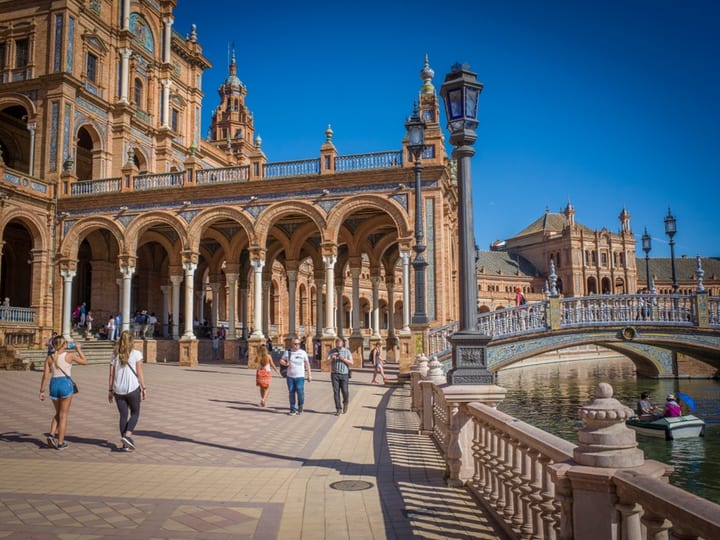
As mentioned, if you want to do a fairly “traditional” visit to Seville and don’t mind walking, you won’t have any problems. The main neighbourhoods of the Casco Antiguo are Barrio Santa Cruz, Centro and El Arenal: their proximity, the urban layout, the safety and, above all, the beauty of these central areas certainly encourage you to explore on foot.
The popular neighbourhoods (Triana and Macarena) are a little further from the centre, but nothing unmanageable. Using the very central Plaza Nueva as a reference point, it takes about 20 minutes on foot to reach the heart of the Barrio Triana, while to reach the gates of the neighbourhood Macarena allow around 25 minutes. Another area of Seville fairly popular with tourists is the Alameda de Hercules, about 15 minutes from Plaza Nueva. Finally, especially if it’s hot, don’t underestimate the distance to Plaza de España, which is quite a way south of the Cathedral (20 minutes).
If you arrive in Seville by train from another city, bear in mind that the walking time between the Santa Justa station and the Casco Antiguo is about 25–30 minutes. If you’re carrying luggage, I’d say it’s better to use public transport (we’ll look at which options later), or a private transfer.
Book a transfer from the station to your hotel
Walking distances to the main monuments
Below, using Plaza Nueva as a reference point, I list the walking distances to the main monuments so you can get an idea. As the centre of Seville is characterised by a charming but dense network of streets, you might get lost and take a little longer (it happens to me often, especially in the maze of Santa Cruz), so consider using maps and GPS navigation if you’re in a hurry.
- Alcazar and Cathedral: 7 minutes
- Plaza de España and Parco di Maria Luisa: 20 minutes
- Plaza de Toros: 7 minutes
- Torre del Oro: 15 minutes
- Casa de Pilatos: 12 minutes
- Metropol Parasol: 12 minutes
Getting around Seville by bus

The only line that goes into the centre of Seville is the C5, which, however, has few stops and is often out of service for technical reasons. The buses in Seville, though, as mentioned, are not strictly necessary for getting around the neighbourhoods of the Casco Antiguo, but they can certainly be useful for those wanting to reach more peripheral areas. In this respect the various C lines are very useful, as they circle the centre and reach some rather awkward areas, such as La Cartuja and the Santa Justa train station.
The strategic stops
The most important and convenient stops for those in Seville city centre are Prado de San Sebastián (near Plaza de España), Plaza del Duque and Plaza Magdalena (in the Centro district) and Plaza de Armas (on the riverfront).
Here are a few examples of smart ways to use the bus:
- Airport: EA line (from Plaza de Armas, with stops along Paseo de Cristóbal Colón and Marqués de Paradas)
- Santa Justa Station: line 21 (from Plaza de Armas), line 32 (from Plaza del Duque), line C1 (from Prado de San Sebastián)
- Triana neighbourhood: line C3 (from Prado de San Sebastián)
- Macarena neighbourhood and Alameda de Hércules: lines 13 and 14 (from Plaza del Duque)
- Cartuja Monastery: lines C1, C2 and 5 (from Prado de San Sebastián)
- Isla Mágica Theme Park: lines C1, C2 e C3 (from Prado de San Sebastián)
- Torre Sevilla: line 43 (from Plaza Magdalena)
- Stadio del Sevilla “Ramón Sánchez Pizjuán”: line EA (from Plaza de Armas, with stops along Paseo de Cristóbal Colón and Marqués de Paradas)
- Italica: line M177 (da Plaza de Armas)
Ticket prices
The single-ride ticket costs €1.40. The airport ticket (Line EA) costs €4 for a one-way trip and €6 return (on the same day). ATTENTION! Prices may vary over time.
There are also some reloadable cards that may suit those planning to use public transport frequently. In this respect I recommend the Tarjeta turística valid for 3 days (an ideal period for visiting the city), which allows unlimited use of all transport in Seville during its validity: not only the buses, but also the tram and the metro.
How to get around Seville by Metro
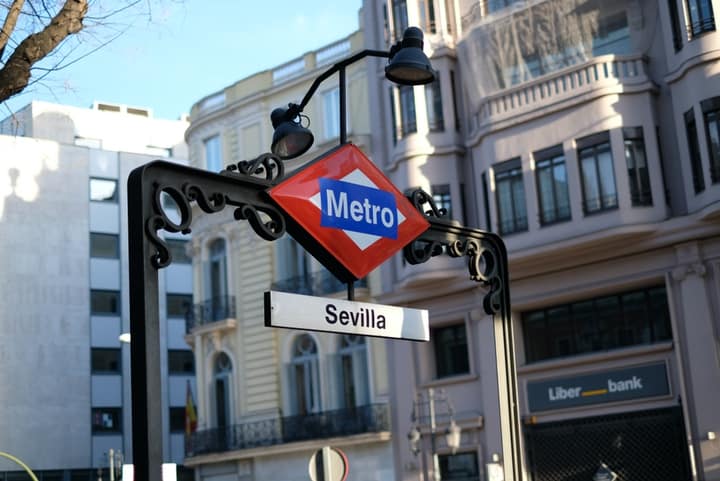
From a strictly tourist point of view, Line 1 – the only line (at least at present) of the Metro – is not very useful. In our article entirely dedicated to the Seville Metro we explained in detail how it works, the fare bands and the situations in which it may be worth using.
In short, if you have found accommodation outside Seville city centre near Metro stations, you can reach the southern part of the historic centre by getting off at Prado San Sebastian and Puerta de Jerez.
If you want to go to Triana, get off at Plaza de Cuba; if you’re going to Sevilla’s stadium, get off at Nervión. Unfortunately the Metro does not reach the airport.
How to get around Seville by Tram – MetroCentro
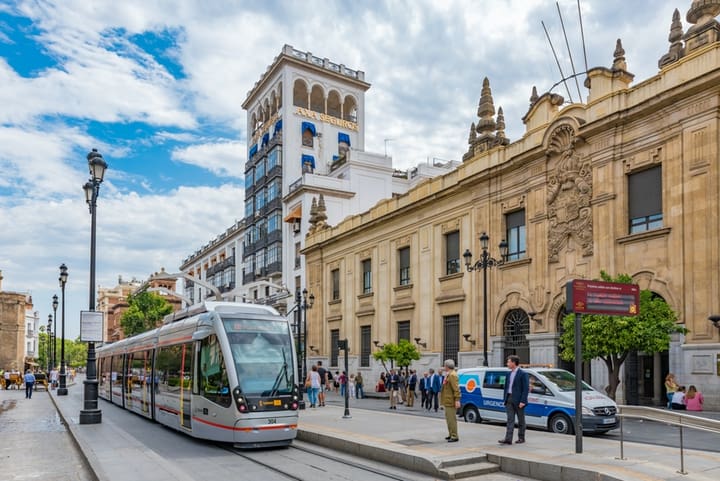
There is also a useful tram service in Seville called MetroCentro (T1), a single, very short line that links the central Plaza Nueva with San Bernardo Station, with a total of five stops. It can be very handy for anyone wishing to travel quickly between the Ayuntamiento area (Plaza Nueva stop), the Cathedral and the Alcazar (Archivo de Indias stop) and Plaza de España (Prado de San Sebastián stop), or for those wanting to connect with trains at Santa Justa (linked to San Bernardo station) and the various buses at Prado de San Sebastián.
How to get around Seville by tourist bus
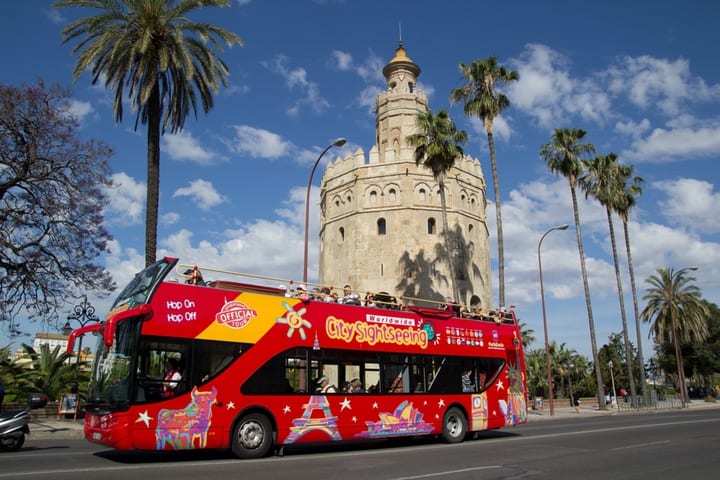
As an open-top, hop-on hop-off tour bus, City Sightseeing is an alternative way to get around Seville that is decidedly more panoramic and comes with a convenient audio guide. Following a sightseeing itinerary with designated stops, the tour bus can be convenient for those who need to make the most of their time and don’t have the opportunity to familiarise themselves with Seville’s transport network. In addition, the ticket includes various discounts for city tours and free entry to monuments.
At the link below you’ll find further details, including a link to purchase.
City Sightseeing Tourist Bus: info and tips
How to get around Seville by bicycle, river cruise and carriage
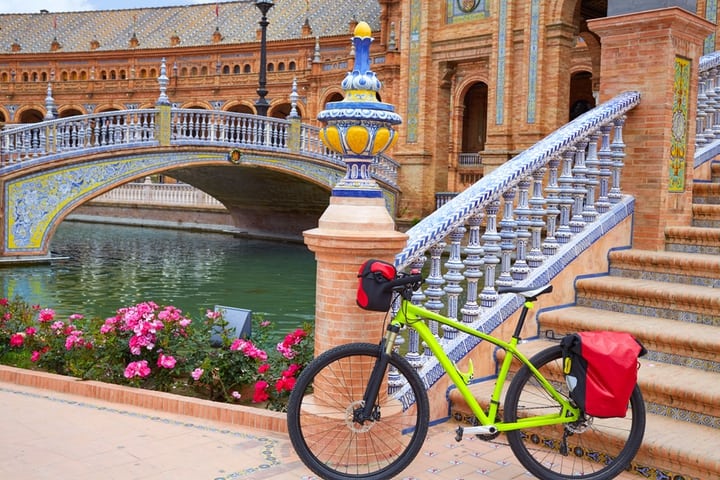
Thanks to the extensive network of cycle lanes, many neighbourhoods and areas of Seville can be explored by bicycle. At the link below you can get an idea of the prices for hiring standard and electric bicycles.
There are also less conventional but more enchanting ways to get around Seville: you can, in fact, settle into the aristocratic armchairs of a historic horse-drawn carriage: tell me if this isn’t one of the most romantic things to do in Seville!
Alternatively, you could join a Guadalquivir cruise to see from the river the magnificent palaces of El Arenal, the Palacio de San Telmo, the distinctive houses of Triana, the Isla de la Cartuja and much more.
