The oldest bullring in Spain, a theatre that pays homage to the 153 operas set in Seville, an ancient defensive tower, the remains of the Royal naval arsenal, a lovely riverside promenade, numerous churches and chapels and a huge choice of places to eat: the El Arenal neighbourhood (Barrio El Arenal) is without doubt one of Seville’s neighbourhoods with the most to see and do.
Contents
Where it is and how to get there
The El Arenal neighbourhood is located on the left bank of the Guadalquivir between the Puente de Triana and the Puente de San Telmo. To the east and south it borders the Barrio Santa Cruz along Avenida de la Constitucion and los Jardines de Cristina, near Puerta Jerez. To the north, beyond Calle San Pablo, lie the Museo and Alfalfa neighbourhoods.
El Arenal is one of the neighbourhoods within the Casco Antiguo of Seville, that is, the Old Town. The whole area is well served by public transport. Here, in fact, you will find the metro stop Puerta Jerez if you want to begin your visit from the southern side, the T1 tram stops Archivo de Indias and Plaza Nueva on the eastern side, and numerous bus stops, especially along the Paseo Cristóbal Colón, if you prefer to start exploring the neighbourhood from the riverfront.
Whichever route you decide to take, you will have no difficulty getting between the main attractions in this neighbourhood on foot or by public transport. However, I suggest you read our article on how to get around Seville if you would like some additional information or suggestions.
History of the neighbourhood
The name El Arenal is undoubtedly evocative: arena, meaning sand, is what once covered the ground of this part of the city in antiquity. From the old walls down to the river there was, in fact, a stretch of sand that eased the movement of the numerous ships and the city’s port activities. From the 13th century onwards the Atarazanas Reales, the empire’s shipyard, stood here, and it was from here that ships set off on overseas voyages.
As you wander the neighbourhood’s streets, you’ll discover other architectural features that testify to the city’s glorious past: the Torre del Oro and the other defensive towers from the early 13th century, and one of the three surviving city gates, the Postigo del Aceite on Calle Almirantazgo (the other two gates are the Arco de la Macarena and the Puerta de Cordoba). The city walls date back to Roman times, but it was during the Almohad period that the defensive walls took on the form and scale whose traces can still be seen today.
What to see
With a map in hand, take note of all the neighbourhood’s best attractions, which can be visited in half a day.
Maestranza Bullring
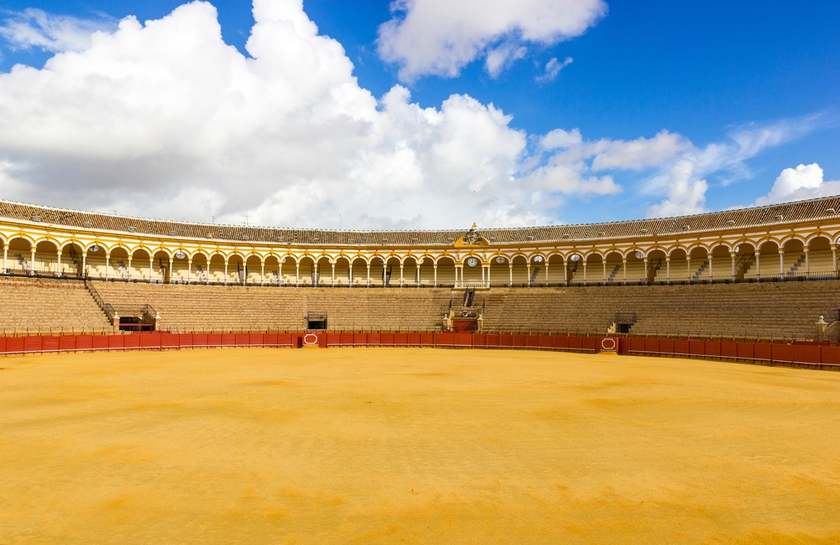
One of Seville’s most characteristic monuments is the Plaza de Toros de la Real Maestranza de Caballería. It is located in the El Arenal district at number 12 Paseo Cristóbal Colón. With its distinctive circular shape it still hosts bullfights and traditional spectacles.
Together with that in Ronda and a few others, the ring is among the oldest in Spain and is uniquely beautiful, with its white and ochre colours. Inside you can also visit a museum dedicated to the most famous bullfighters and bulls, the infirmary and the chapel where the bullfighters pray before the bullfight.
Maestranza Theatre
Inaugurated in May 1991, the Teatro de la Maestranza is Seville’s opera house and is also home to the Real Orquesta Sinfónica de Sevilla. The architects responsible for the project were Aurelio del Pozo and Luis Marín, and it was constructed in just four years. Artists such as Pavarotti, Domingo, Montserrat Caballé and Alfredo Kraus have sung here. The main auditorium, with its distinctive 47-metre diameter dome, can accommodate up to 1,800 spectators. The building also contains smaller performance spaces, as well as rehearsal rooms. Throughout the year the theatre stages performances of classical and symphonic music, ballet, flamenco and zarzuela.
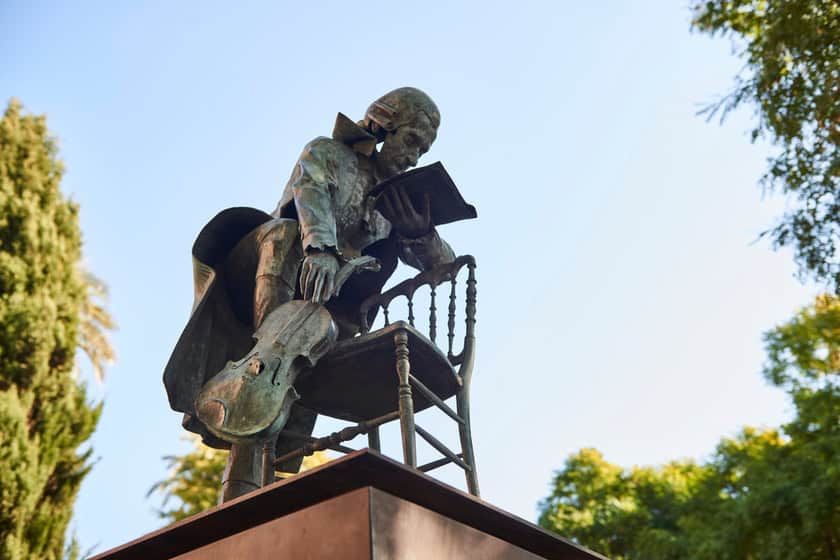
The city of Seville is closely linked to music. Besides the well-known flamenco, more than 150 operas are set in Seville, including the wonderful Carmen by Bizet and The Barber of Seville by Rossini. Not everyone knows that right in the El Arenal neighbourhood there is the house where the barber Figaro is believed to have lived (opposite the Casa de la Moneda on Avenida de la Constitución) and the Maestranza bullring where part of Carmen was set. The bronze statue paying tribute to Carmen la Cigarrera stands on the paseo Colón near the theatre, as does the statue of Mozart with a violin, a scroll and his left hand resting on a chair.
Tower of Gold
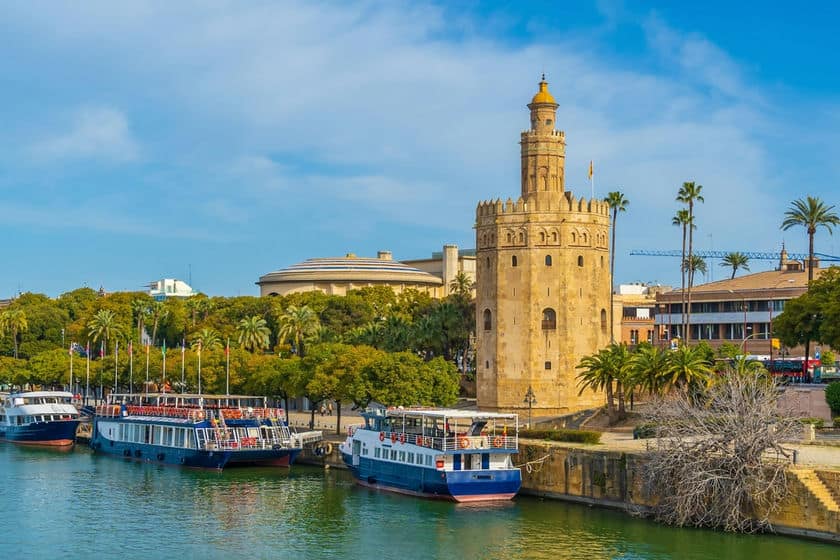
Standing 36 metres tall, this ancient tower on the banks of the Guadalquivir is part of the city’s historic heritage. Its construction is attributed to the Almohads who, from the 1200s onwards, strengthened the city’s defensive walls and built several watchtowers. Among these, alongside the Torre del Oro, were the Torre de la Plata, the Torre de Bronce and the Torre Abd el Aziz.
The Torre de la Plata, with its octagonal shape, can still be seen on Calle Santander, as can the Torre de Abd al-Aziz, hexagonal in shape, at the junction of Avenida de la Constitución and Calle Santo Tomas. Of the Torre de Bronce, only the base remains; it was discovered by chance in 2012. The Torre de Oro is now open to visitors and houses the Naval Museum of Seville. The famous scenic cruises on the Guadalquivir also depart from this area.
Guadalquivir River Promenade
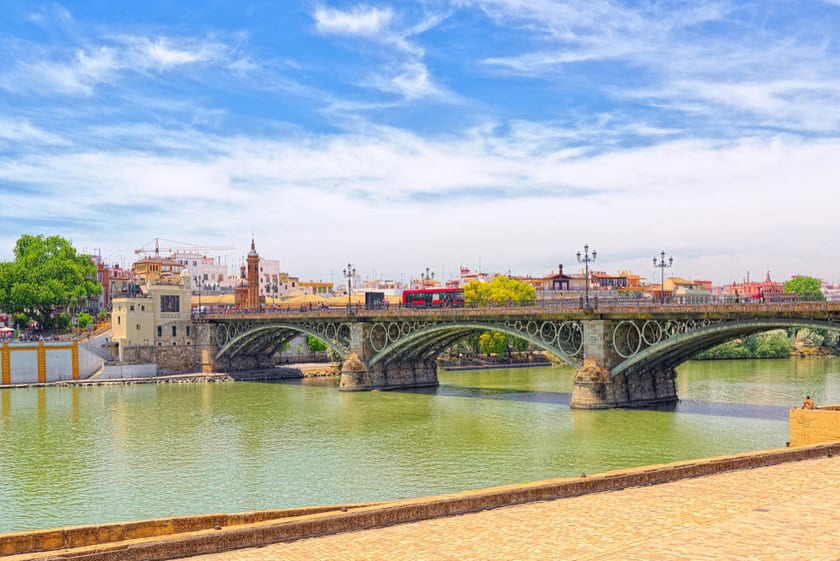
The Guadalquivir flows through the centre of the city and in the past was Seville’s lifeblood, enabling it to be Andalusia’s main port. Today the river remains a key feature of the cityscape: in addition to the panoramic cruise, one of the best ways to enjoy the city is to stroll along its bank along the Paseo de Cristóbal Colón. This broad road, less than a kilometre long, is home to some of Seville’s most important attractions such as the Torre del Oro, the Teatro de la Maestranza and the Plaza de Toros. As you walk you’ll also pass the statues of Carmen, the heroine of the eponymous opera, of flamenco singer Antonio Mairena in the Rafael Montesinos garden, and the equestrian monument to Maria de las Mercedes Bourbon-Orleans.
The Triana Bridge, or rather the Puente de Isabel II, marks the northern boundary of the El Arenal neighbourhood’s riverside promenade, while to the south it is bordered by the Puente de San Telmo. From this side of the Guadalquivir you can admire both bridges, beautiful both by day and by night when they are lit up. From this bank of the river, moreover, you can also admire the houses of the Barrio Triana, on the opposite bank.
Hospital of Charity
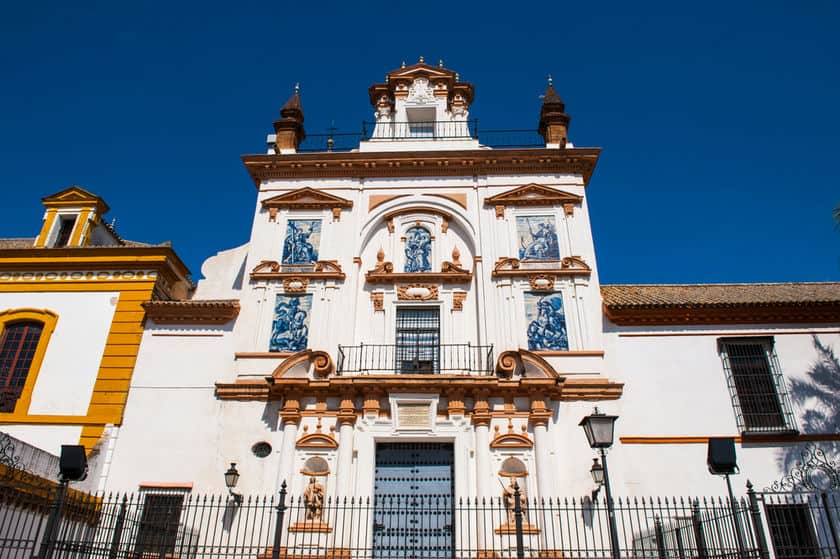
The Church and Hospital of Charity are one of the many places of interest in the El Arenal neighbourhood. The complex dates back to the seventeenth century and stands out for its Baroque style and for the presence, especially inside the church, of extraordinary works of art by artists of the calibre of Murillo, Valdés Leal, Pedro Roldán and Bernardo Simón de Pineda.
If today we can admire so much art and beauty, we owe it to the intervention of Miguel Mañara Vincentelo de Leca, who, from 1661–1662, went on to become a key figure in the development of the Confraternity of Charity and the construction of the hospital and the adjoining church to serve the sick and the less well‑off of 18th‑century Seville. Beside the Teatro de la Maestranza you can see some gardens: they are the Jardines de la Caridad, today part of the complex of the Hospital de la Caridad.
Plaza del Cabildo
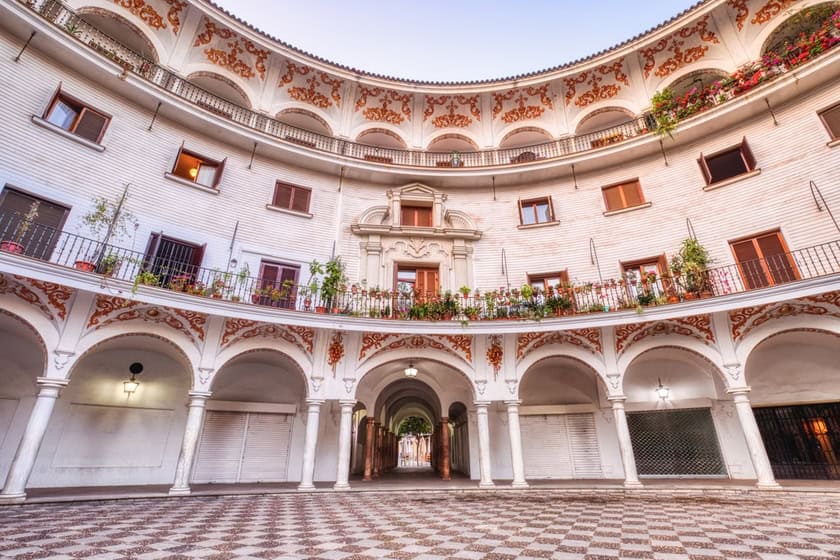
Leaving the broad Paseo de Cristóbal Colón behind you, you’ll find yourself in a maze of narrow streets, where splendid churches, historic buildings and small squares that seem to hide away abound. Among these is the small Plaza del Cabildo, with its semicircular building delicately decorated with frescoes and embellished with arches, the fountain and the ancient Almohad walls. Close by is also one of the arches that once served as an entrance to the city, the Arco del Postigo del Aceite, on Calle Almirantazgo.
Shipyards (reales Atarazanas)
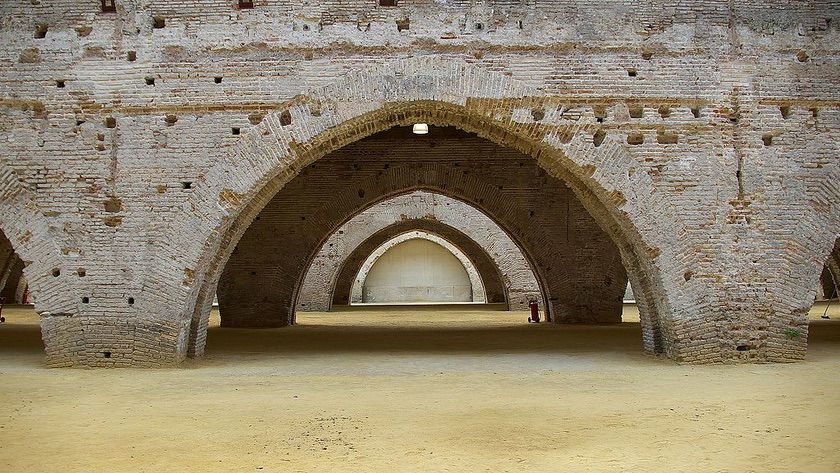
Near the Arco del Postigo del Aceite, visible only partially from Calle Dos de Mayo, are the Reales Atarazanas, the shipyard of Seville from the 13th to the 15th century. Its spectacular spaces, with stone naves in the Gothic–Mudéjar style, housed the Crown’s ships, stored munitions and artillery and, in more recent times, served as the perfect set for several scenes of Game of Thrones. Unfortunately only 7 of the original 17 naves remain, as over time they were absorbed by the Hospital de la Caridad and the Artillery Maestranza, but their historic value and beauty will remain unchanged.
El Arenal Market
In the northern part of the neighbourhood, a short distance from the Triana Bridge, you’ll find the El Arenal Market and its local produce. Opened in 1947, this covered market is located on Calle Pastor y Landero, where in the 19th century there was a prison, the Cárcel del Pópulo. Today it is one of the most popular spots in El Arenal, especially with lovers of good food, quality ingredients and excellent tapas.
Where to stay?
If you’re looking for accommodation in Seville, the El Arenal neighbourhood can certainly be an excellent choice given the many attractions, convenient public transport stops and its proximity to other neighbourhoods such as the Barrio Santa Cruz, Triana and the city centre. El Arenal is also renowned for its excellent culinary scene and is home to one of Seville’s most famous flamenco venues, called El Arenal (you can find information and tickets here).
