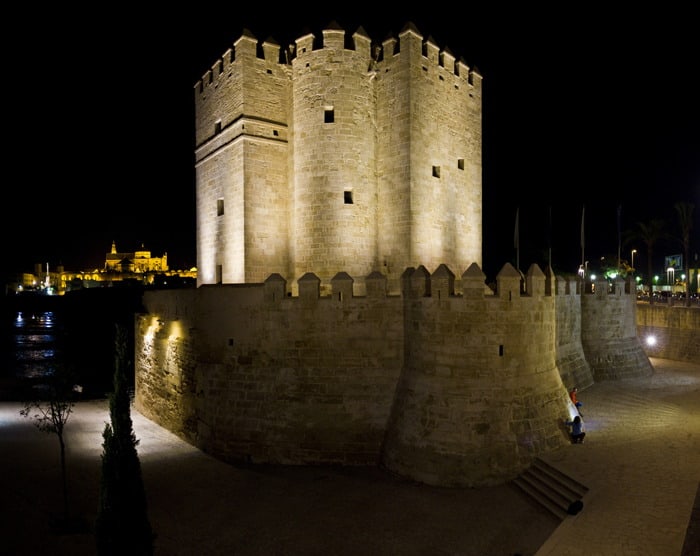
Even if you perhaps didn’t know it, one of the places of interest in Cordoba that is most important and visited is the Torre de la Calahorra itself, a majestic tower-fortress on the banks of the Guadalquivir. The structure dates back to Arab rule and served as a defensive work protecting the city. Major structural alterations and continual restorations now make it imposing and gleaming in the eyes of visitors who reach it via the Puente Romano.
I recommend visiting the interior of the tower that houses the Museo de las Tres Culturas, also known as the Museo Vivente de Al-Andalus. In this innovative museum you will discover the history, perhaps at times a little romanticised, of Cordoba during Arab rule when Jews, Christians and Muslims coexisted peacefully and the city, as the capital of Al-Andalus, was the cultural centre. The museum terrace offers a beautiful panoramic view over the Puente Romano and the city.
Contents
Historical notes on the Torre de la Calahorra
Built during Arab rule, it probably originally consisted only of the two square towers and an arch that linked it to the Puente Romano. Thanks to this small fortress, access to the bridge could be controlled and, if necessary, blocked.
The greatest transformation took place in the 14th century thanks to Henry II of Trastámara who decided to enlarge the small fortress by adding a third tower, a moat and a drawbridge to protect himself from attacks by his brother Peter.
Over the centuries the tower has had various functions: among other things, it was a prison for foreign soldiers, a place of quarantine where the sick were housed during an epidemic that struck the city at the end of the eighteenth century, and a school for girls in the nineteenth century. Since 1931 it has been a Historic-Artistic Monument, and today it belongs to the Paradigma Cordoba Foundation, which has set up a museum inside.
Visiting the tower: useful information, opening hours and prices
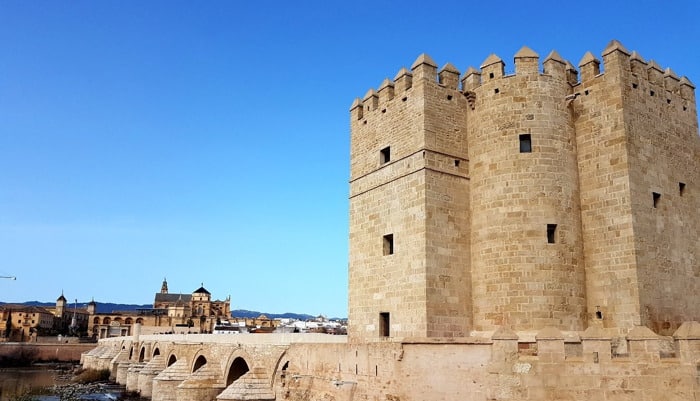
The Torre de la Calahorra is located on the southern bank of the River Guadalquivir: coming from the city centre you will need to cross the majestic Puente Romano (pedestrian) to reach it… you can’t miss it. If you travel by bus, bear in mind there is a stop right on the other side of the river for lines 3 and 12.
Admiring it from the outside is a delight for the eyes thanks to the light‑coloured stone with which it was built. The moat and crenellated towers are easily visible. As well as from the bridge, a splendid view of the tower can also be enjoyed from the south riverside along Avenida Fray Albino.
The Museo de la Torre de la Calahorra is open every day with the following opening hours:
- March to May: from 10:00 to 19:00
- From June to September: from 10:00 to 14:00 and from 16:30 to 20:30
- in October: from 10:00 to 19:00
- from November to February: from 10:00 to 18:00
The admission ticket costs 4.50 euro for adults and 3 euro for students and pensioners. Children under 8 years of age do not pay. The admission price includes an audio guide in Italian.
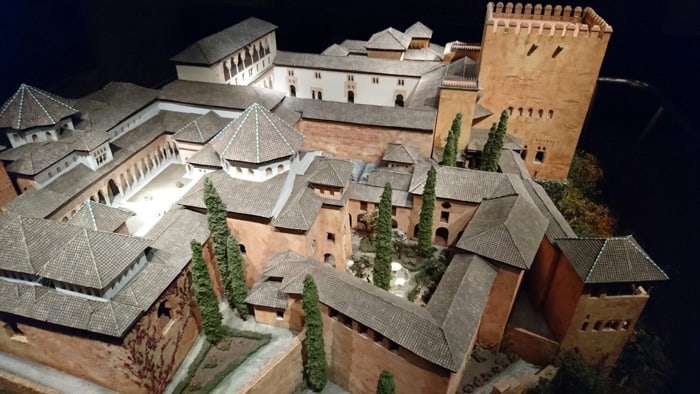
Inside the museum there are 8 exhibition rooms, various daily video screenings, splendid scale models of Arab buildings including the Mezquita and the Alhambra of Granada, and the lovely panoramic terrace of the tower.
Museo Vivente de Al-Andalus
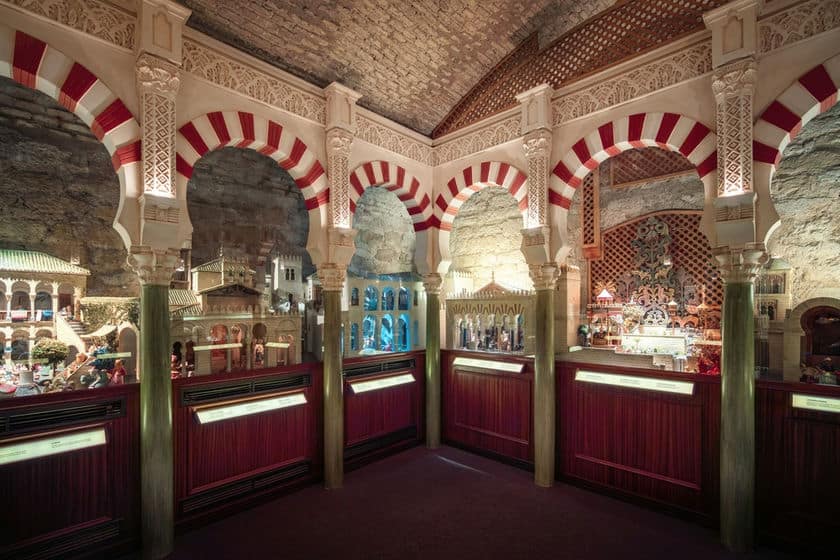
The museum inside the Torre de la Calahorra is very distinctive but extremely important for understanding Arab culture during the rule of Al-Andalus, when many of the leading thinkers, philosophers and artists gathered in Cordoba, the capital and a cultural centre of fundamental importance. The city’s golden age was, in fact, between the 9th and 12th centuries. There are 8 exhibition rooms and the visit typically lasts around one hour. Additionally, during the day a documentary of around 55 minutes on the evolution of humanity is screened several times. At the entrance you will be given the screening times.
In the first room, visitors learn about the history of the museum and its historical, geographical and artistic context. The second room introduces visitors to the exchange of knowledge between Jews and Muslims, with the Jewish thinkers Averroes and Maimonides — honoured with a statue in the Judería quarter — on one side, and the Muslim Ibn Arabi on the other.
The Christian king Alfonso X of Castile, known as the Wise, founded the Toledo School of Translators. Thanks to him, important works on mathematics, geography, philosophy and astronomy were translated into Latin. Among the works commissioned by Alfonso X were the famous Alfonsine Tables, which charted the position of the stars in the sky and predicted eclipses.
In the third room you will find geographical maps and texts on medicine and architecture produced during Cordoba’s golden age. Life at the palace in the Alcazar of Cordoba is recounted in the fourth room, while in the fifth room you will see a magnificent scale model of the Alhambra.
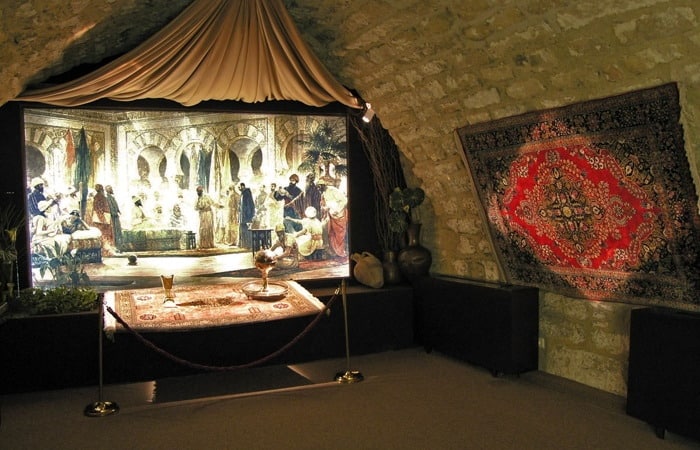
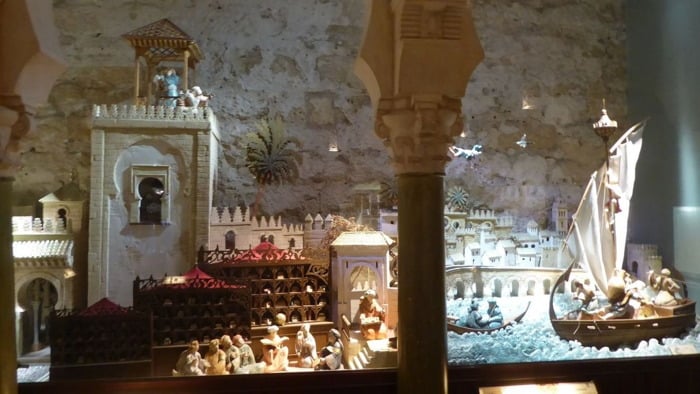
The sixth room is dedicated to the musical culture of Al-Andalus. The seventh and eighth rooms recreate important moments of life in the 10th century inside the Mezquita, the Alcazar, the market, the Synagogue, a church, the Arab baths and the most important sites of Cordoba. If you wish to explore further, there is a documentary of about 55 minutes that tells how, according to the authors, millennia of knowledge from East and West met during the period of Al-Andalus and laid the foundations for all subsequent cultures.
Where to stay?
For all advice on accommodation in Cordoba, please see our dedicated article. We recommend paying particular attention to the neighbourhoods Centro and Judería, which are practically on the opposite side of the river.
