It’s often said: Seville is the hottest city in Europe. This fact, which appears on our continent’s weather bulletins almost every summer, would put off all lovers of the cold who, by giving up, would risk missing out on one of Spain’s most beautiful cities. The figures don’t lie, and yes, in summer Seville reaches very high temperatures, but that doesn’t mean it can’t be visited with the right precautions. Above all, not all seasons are the same and, after all, the year offers plenty of alternatives: the important thing is to know what kind of climate to expect and to set off properly prepared.
Contents
The climate of Seville
Although Seville’s climate is considered Mediterranean, the city in inland Andalusia shows significant differences between summer and winter, mainly concerning the humidity of the air, which brings a substantial difference in how temperatures are perceived. If winter is very humid, and therefore the cold is felt more sharply, summer is characterised by extremely dry air: even though average temperatures are higher than in other Spanish cities, the dry air makes the heat less oppressive. In Seville it rains little (the average is 50 rainy days a year) and in summer almost not a single drop falls.
It is no coincidence that Seville, as with the whole western part of Andalusia, is compared in terms of climate to North African countries. This also helps to make the Moorish architecture, which draws so many tourists to the city, appear as if placed in its natural setting, so similar is the landscape to the pre‑desert of neighbouring Morocco. So the heat isn’t all bad. Moreover, as I mentioned earlier, the seasons are not all the same and, if you exclude July and August, you don’t sweat that much here either.
Seville in spring
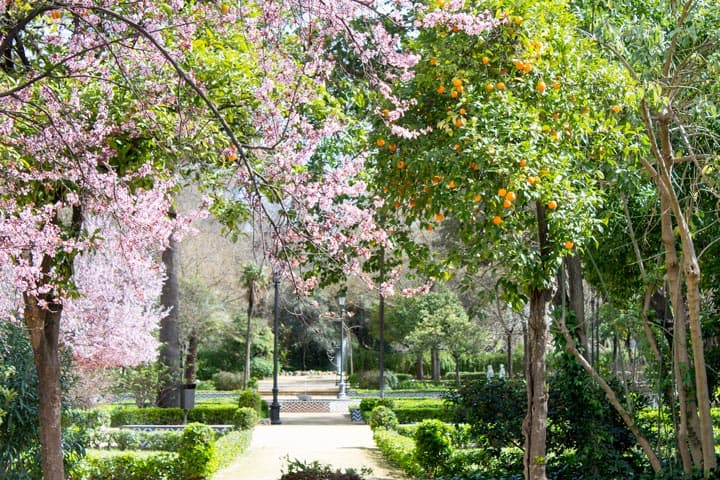
Spring is the most changeable season, but also the best time to visit Seville. In these weeks the skies cloud over more suddenly and deliver the bulk of the rainfall, although the showers are considerably fewer than in other Spanish cities. March is the wettest month of the year, but it rarely exceeds 10 days of rain — about a third of the month. At this time windy days are common, which can be annoying when accompanied by a whipping drizzle. Apart from these rare cases, however, March is an excellent month to visit Seville, as temperatures are already more than mild, with night-time lows just under 10° and daytime highs that can already exceed 20°. Ideal, then, for getting around the city on foot.
In April the chance of rain falls to 7 days out of 30 and it’s increasingly light showers, while temperatures begin to rise. On sunny days, which average 24-25°, peaks close to 30° can sometimes be reached, while at night the temperature increasingly rarely falls below 10°.
May already opens the doors to summer. In some years, it’s hard to regard it as a spring month. Especially in the final weeks, scorching days are not far off and it’s not uncommon to exceed 30° under the midday sun. On average, the daily temperature in May hovers around 27°. At night, it tends more towards 15° than 10°, so it’s already pleasant to be outdoors after dinner. Compared with the two previous months, and in line with the rising temperatures, the chance of encountering rainy days falls: less than a week in the whole month.
The spring months are the best time to visit Seville, both because of the climate and because the city’s main unmissable events take place at this time. Coming across a procession during the Semana Santa or taking part in the Feria de Abril are experiences that make a visit to Seville doubly unforgettable.
Seville in summer
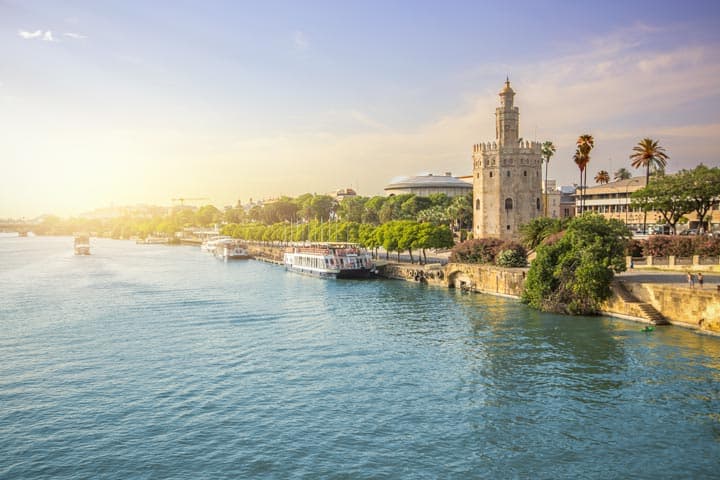
As already mentioned, the summer is scorching but dry. Daily temperatures regularly exceed 30 degrees from June to September and in those two months it almost never rains: at most 1 or 2 days of rain. But the months to avoid if you really suffer from the heat are July and August, in which 35° is regularly exceeded and days where the mercury rises above 40° are frequent. These two months often go by without a single cloud lingering over the city to bring relief with a few drops of rain. At night, temperatures hover around 20° in July and August, a few degrees lower in June and September.
Don’t worry, though, it’s not impossible to visit Seville in summer. There are two factors that mean it’s not as extreme as people tend to think.
- The first factor is the characteristically dry climate: temperatures reaching 45°C here do not feel nearly as much hotter than 35°C as they would in more humid cities. This does not mean you can spend hours under the August sun without sweating, but with the right precautions — a hat, suitable clothing and water in your backpack — it is still possible to enjoy the beauty of the Andalusian capital even in summer.
- The second aspect to consider is the sea breeze. Only 70 km (43 miles) separate Seville from the Costa de la Luz, and in particular from the beaches of Huelva, from which the Atlantic breeze reaches the city unhindered across the Guadalquivir plain. In the evening, this cool breeze brings relief and makes summer nights particularly pleasant. If you are a fan of Seville’s nightlife, you will love the way the city streets come alive after sunset, starting with a tapas crawl and continuing to the sound of flamenco in the lively bars and venues of the city centre.
Seville in autumn
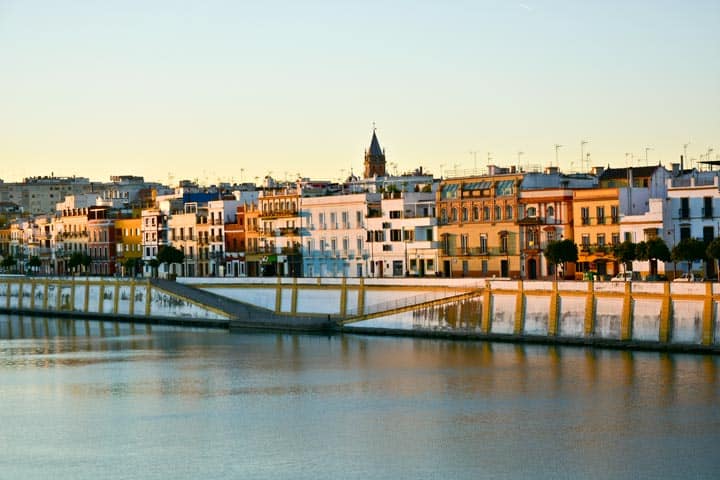
One could say that autumn begins in October, since September is still very much a summer month. In fact, even in October itself there can be very hot days, with temperatures close to 30°. In general, however, with temperatures very similar to those in May, it is an excellent month for strolling through the streets of the historic centre. Average highs just above 25°, lows just under 15°, a low chance of rain and an evening breeze that cools the streets make October one of the ideal months for a visit to the city.
November shouldn’t be dismissed either. Average temperatures drop gradually, by about 5° compared with the previous month. As with March and April, November is the perfect month for those who enjoy getting around the city in mild-to-cool temperatures. As in spring, the chance of rain also becomes more frequent at this time, though it rarely exceeds seven days in the whole month. Autumn is a good season to visit Seville from a weather point of view, and is also ideal for those not seeking festivals and tourist attractions, but a city that is calm and immersed in its everyday life.
Seville in winter
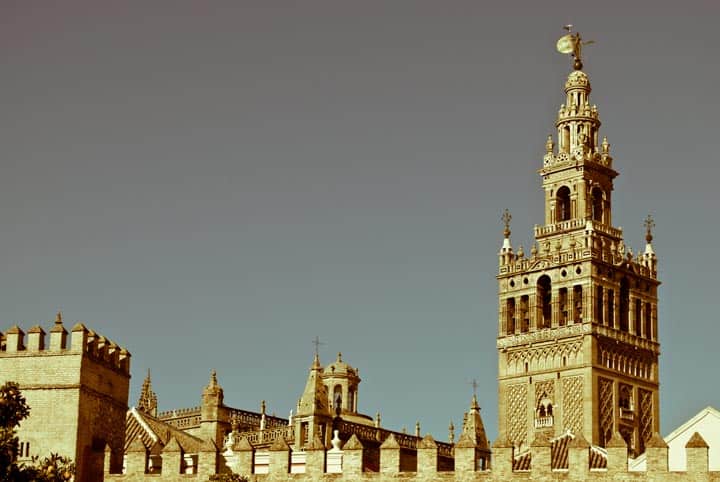
From December to February we have winter in Seville, which proves very mild, but humid. After March, in fact, December and January are the rainiest months of the year, the only ones in which more than a week of precipitation occurs. Sunny days are still the most frequent and temperatures are never too severe. In January the average nighttime minimum is 5° and the daily maximum 15°. In the other two months temperatures are a couple of degrees higher. In all three months, it’s very rare to reach 0° and in daytime sunshine it’s hard to fall below 10°. Compared with other Spanish cities, then, calling it winter may seem a stretch.
Visiting Seville in winter is by no means a bad idea. It’s true that you may get a few days of rain, but anyone who can’t tolerate extreme heat will find a city with a perfect winter climate, where they can explore freely without the annoying throngs of tourists.
Best time to visit Seville
One thing is certain, and I’ve already emphasised it: if you are extremely sensitive to heat, try to avoid Seville in summer. That said, every season offers excellent reasons to visit the capital of Andalusia. The hot months are the worst from a climatic point of view, but they are also the most popular because work holidays force many tourists to travel between July and August. Moreover, if you’re doing a road trip, including a few days by the seaside, it makes perfect sense to choose this time of year. The important thing in this case is to set off with the knowledge that scorching heat and large numbers of tourists will be your daily companions on Seville’s streets.
As I also wrote in the general article on the best time to visit Andalusia, the shoulder seasons are the best choice from a climatic point of view. If you can choose, travel in spring or autumn: you will have ideal temperatures to visit Seville and the other Andalusian cities. Remember that in spring you will have the opportunity to attend some of the most interesting traditional events in all of Spain, but if what you are looking for is tranquillity and an absence of crowds in the streets, autumn is the season for you.
Don’t dismiss winter: you might find very good flight deals, and if you take a look at our page on where to stay in Seville, you’ll realise that accommodation prices are much more favourable than in summer. Cloudy days are still in the minority in Seville, the air is cool but you don’t need extremely heavy clothing to cope with the winter weather.
