Andalusia enchants its travellers with monumental palaces rich in history and art, and with lush gardens and courtyards where fountains and water features offer peace and harmony: just think of the Alhambra in Granada or the Real Alcázar in Seville.
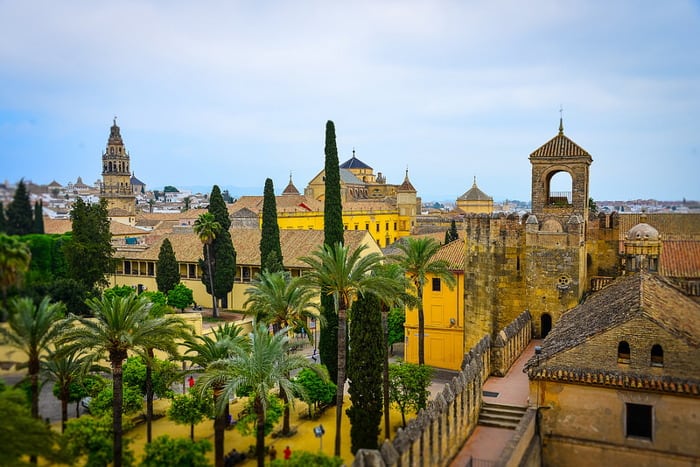
Although less well known and much smaller in size, the Alcázar de los Reyes Cristianos in Cordoba will surprise you with its magnificent crenellated walls, its skilfully tended gardens rich in emblematic statues, its large fountains and the presence of ancient mosaic floors housed within the palace.
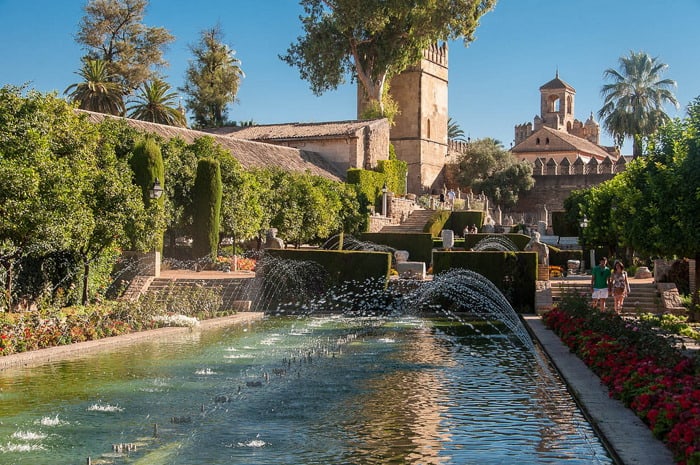
The magnificent structure of the Alcázar of Cordoba also served as the seat of the Inquisition for three hundred years, a military garrison for Napoleon Bonaparte’s troops and a civil prison. Since 1950 the Alcázar de los Reyes Cristianos has become a national monument and today is undoubtedly one of the most important attractions of Cordoba.
Contents
The history of the Alcázar of Cordoba
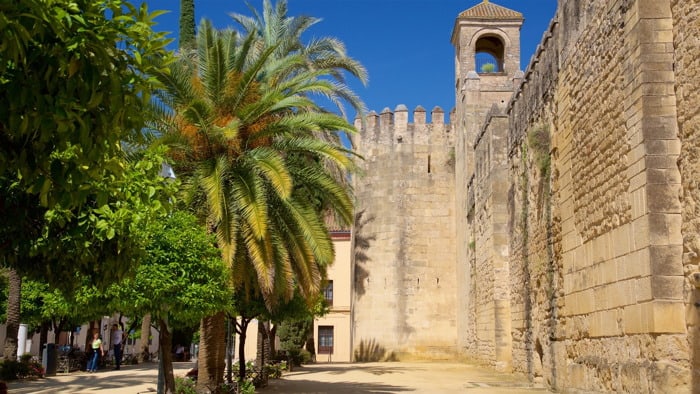
Of Roman origin, the building became an Arab royal palace thanks to the Umayyad dynasty, which founded the independent Caliphate of Cordoba. The palace, with the appearance of a fortress, was enlarged with gardens, the largest library in the West and an area devoted to the Arab baths. To irrigate the extensive gardens, the caliphs had a system of mills and aqueducts built to bring water from the Guadalquivir to the palace: the best known is called the Molino de la Albolafia and can be seen near the Roman Bridge, on the riverbank (north side).
After the Christian conquest, in 1328 Alfonso XI ordered the start of construction of a palace for the Christian kings on the site of the old Arab fortress. His design was intended to make the Christian victory over the Arabs evident, but the mudéjar style was retained, and even today, as you visit the palace, you’ll realise that the echo of the ancient Moorish buildings is strong.
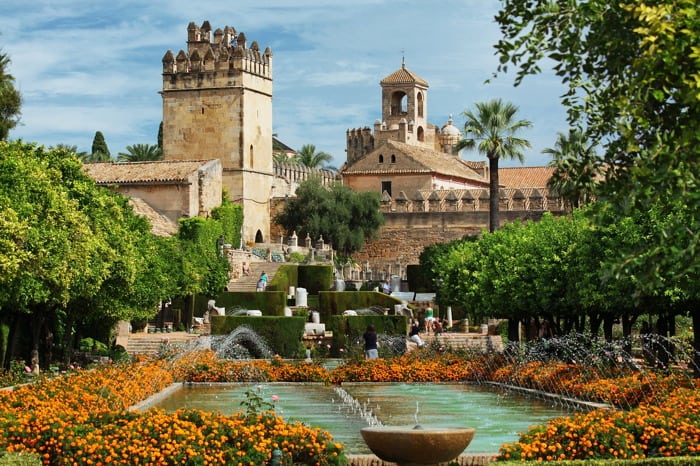
The enlargement of the gardens and the construction of the massive tower, today known as Torre de la Inquisición, date back to the fifteenth century. As mentioned, between 1490 and 1821 the Alcázar housed the Holy Inquisition, and the tower is now the symbol of that period. Various rooms were converted into prisons or torture chambers.
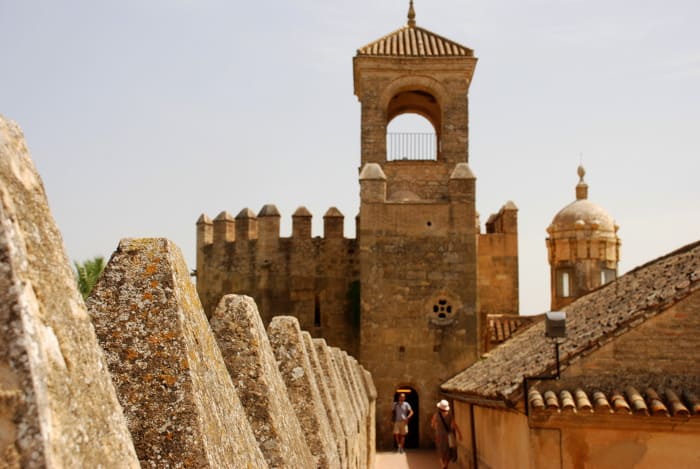
The Alcázar de los Reyes Cristianos now belongs to the Municipality of Cordoba and is open to the public as a national monument, within whose walls centuries of history can be felt — from the clash between East and West to the momentous decision to fund an expedition to discover a new world, from the human madness of the Holy Inquisition to the foresight of opening the palace to visitors to bear witness to, preserve and publicise the historical choices that, right or wrong, have changed our view of the world for ever.
What to see inside the Alcázar
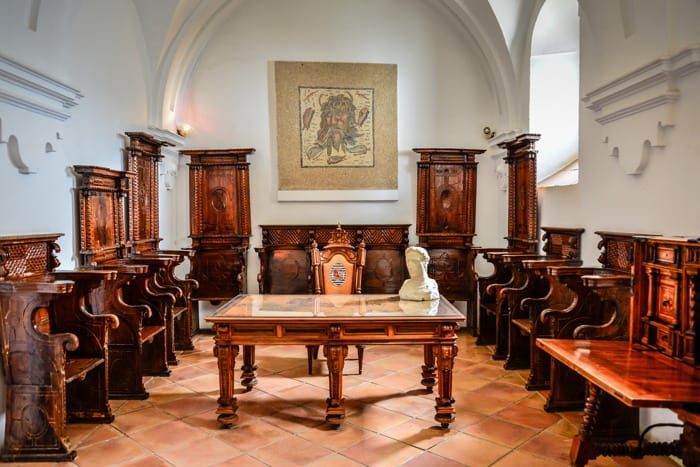
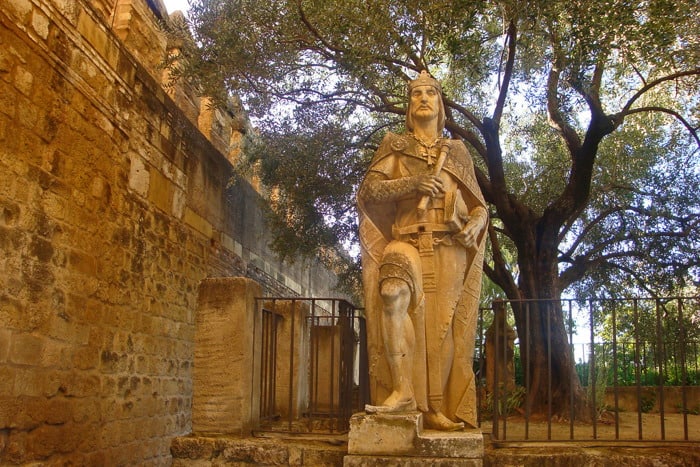
The palace is not very large and can be visited in a short time. The statue of King Alfonso welcomes visitors who, as they proceed, enter the palace rooms that house archaeological finds of inestimable value: alongside statues and busts from the Roman period, pause to admire the sarcophagus dating from the 3rd century and the numerous Roman mosaics dating to the Augustan period. Among the most famous are the one depicting the embrace of Eros and Psyche and that of the cyclops Polyphemus with the nymph Galatea.
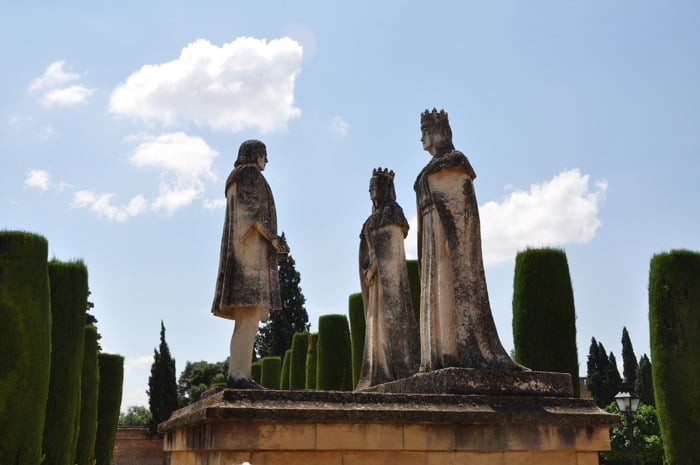
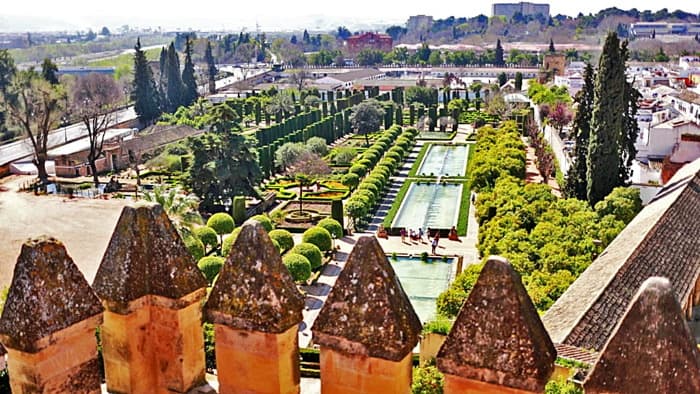
The courtyard is spacious and lush. Hedges, flowers and citrus trees make these terraced gardens among the most beautiful in Andalusia. The long pools of water are home to fish that will delight children, while fountains and sprays, playing together, create a relaxing, pleasant atmosphere. Of particular note are the three large statues: Isabella and Ferdinand on one side with Christopher Columbus facing them, which recall the meeting of the Italian navigator with the Spanish monarchs in 1486 to request funding for the historic maritime venture.
Baños del Alcázar Califal
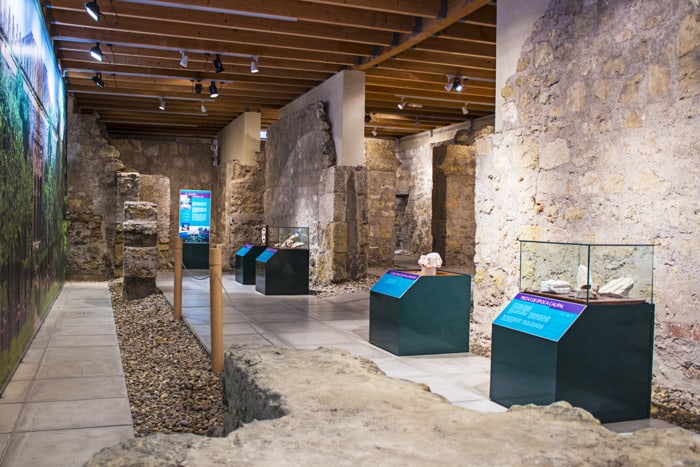
Facing the Alcázar are the Baños del Alcázar Califal. They were built in the 10th century by the Arabs and were the most important Turkish baths in the city. The Christians buried them in the fourteenth century and they remained hidden underground for 600 years. Almost by chance, they were discovered in 1903 and, from that moment on, restored and returned to prominence. The multitude of finely decorated rooms welcomes the visitor who, during the visit, will be able to see the area devoted to cold baths for purificatory ablutions of body and mind, the area reserved for warm baths, with a relaxation area and a massage area, and finally the largest area dedicated to hot baths. To think that this building dates back ten centuries is striking, but to be fair it must be said that there are better-preserved Arab baths in Andalusia, such as the Bañuelo in Granada.
Useful information for your visit
The entrance to the Alcázar of Córdoba is on Calle Caballerizas Reales, while the Baños del Alcázar Califal are opposite the Alcázar, on Capo Santo de los Mártires. It’s not difficult to reach this area: we’re just a short walk from the incredible Mezquita of Córdoba and the Caballerizas Reales, and there’s no better way to explore the historic centre than on foot! In any case, the nearest bus stop to the entrance is Mártires, on Avenida Fleming: the lines are 3 and 12.
Tickets for the Alcázar of Córdoba and guided tour
The Alcázar ticket can be purchased on its own or combined with the Baños Califales. There is also a package that lets you save on the total cost of tickets for several museums in Cordoba. Here are the different options.
- Alcázar ticket:
- General admission: €6.71
- Students under 26 and over-65s: €3.56
- Children under 18: free
- Baños ticket:
- General admission: €3.11
- Students under 26 and over-65s: €1.76
- Children under 18: free
- Combined Alcázar + Baños ticket:
- General admission: €7.16
- Students under 26 and over-65s: €3.79
- Children under 18: free
- Combined ticket Alcázar + Baños + Bullfighting Museum + Julio Romero Museum + Fosforito Flamenco Centre:
- General admission: €13.91
- Students under 26 and over-65s: €7.16
- Children under 18: free
Tickets can be purchased directly from the official website. However, if you have a good understanding of Spanish or English, I would suggest considering this guided tour: it lasts one hour and costs €19 (€9.50 for children), a price that already includes the admission ticket. The guided tour will certainly help you get more out of the visit, revealing many interesting details about the palace.
Opening Hours
The opening hours of the Alcázar and the Baños del Alcázar Califal are usually the same:
- Summer opening hours, from 15 June to 15 September: Tuesday to Sunday, 08:15–14:45.
- Winter opening hours, from 16 September to 14 June: Tuesday to Friday, 08:15–20:00; Saturday, 09:30–18:00; Sunday and public holidays, 08:15–14:45.
- Closed on Mondays.
Some final tips
- Unlike the royal palaces of Seville and Granada, it isn’t necessary to book entry in advance, although sometimes, especially in summer, the queues can be long: avoid the hottest hours because Cordoba doesn’t mess about!
- Remember that thirty minutes before closing, tickets are no longer sold, so, in practice, access to the monuments ends thirty minutes before closing time.
Where to stay?
Most of the Cordoba attractions are located in this area, between the charming Jewish quarter and the Barrio Centro. If you’d like to stay in this area, follow our tailored recommendations at the link below:
