Entering this square you will feel at the centre of the world, surrounded by marvellous examples of art and architectural beauty, in a perfect balance between nature and human endeavour: you will see vast open spaces and sumptuous buildings, you will see yourself mirrored in the water of the canal that runs through the square and enjoy the harmony of its bridges and the elegance of its arches, you will be captivated by the colours of the azulejos and the warm red of the bricks. Here the history of a great nation and its fragmented geography can be perceived by the most attentive visitor: you are in Plaza de España in Seville, the semicircular plaza conceived as an embrace and, as such, one that will stay with you.
Contents
The history of Plaza de España in Seville
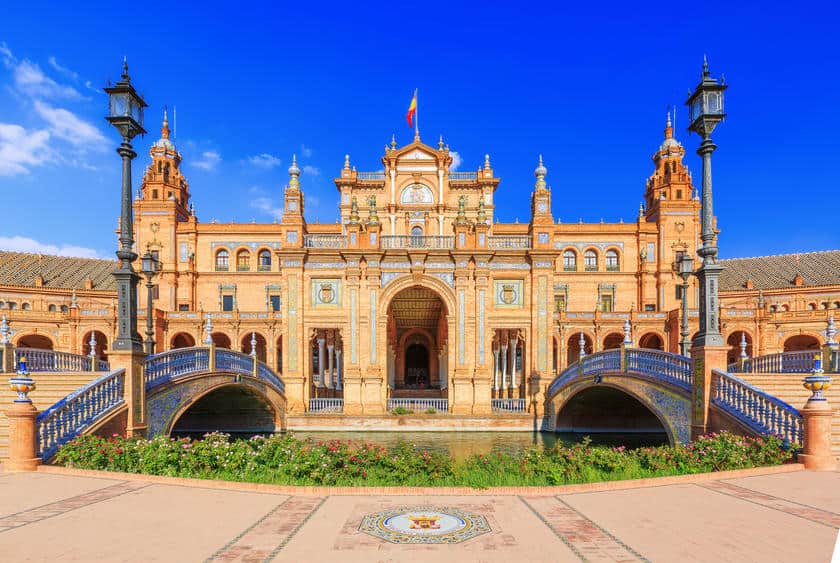
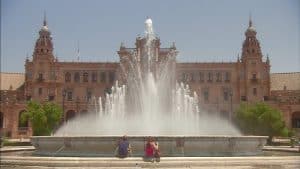
Unlike famous attractions such as the Seville Cathedral, the Alcázar and the Torre del Oro, Plaza de España does not have centuries of history behind it. The square was built between 1914 and 1928 for the Ibero-American Exposition of Seville in 1929. The architect responsible for this immense work was Anibal González, although work from 1926 onwards was completed by the architect Vicente Traver. It is to the latter that the fountain located in the centre of the square is attributed, which at the time provoked debate because, critics argued, it detracted from the sense of vast open space the square originally conveyed.
After the exhibition, Plaza de España was due to become part of the University of Seville. Instead, the military government decided to use the property as the headquarters of the Captaincy General of Seville and the Military Museum. Even today several government offices are still housed in the buildings that overlook the square and part of the wonderful Parque de María Luisa.
In 2010 Plaza de España underwent restoration and an expansion of its pedestrian area. The square you can visit today is therefore even more evocative and carefully detailed.
Things to do in Plaza de España
Plaza de España covers 50,000 square metres, of which only 19,000 are built on. The square has a semicircular shape with a diameter reaching 170 metres. As mentioned above, the creation of the square was linked to the Ibero‑American Exposition due to be held in 1929, and it was precisely for this reason that the architect conceived it in this form to represent an embrace from the mother country, Spain, towards its former colonies. The open linear side faces the River Guadalquivir and, ideally, towards the Americas.
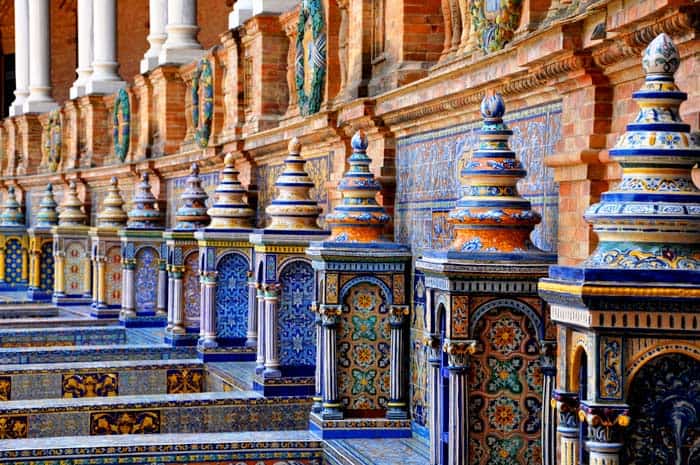
A splendid horseshoe-shaped portico follows the curved section, enclosing the large square. At its ends stand two towers, the Torre Norte and the Torre Sur. The materials used to construct the buildings around the square are primarily marble, exposed brick and ceramics in the typical colours of the azulejos. The Art Déco style blends beautifully with Neo-Moorish and Neo-Mudéjar, with Renaissance and Baroque elements enriching the buildings. It is precisely the fusion of these styles that makes the square unique in its splendour.
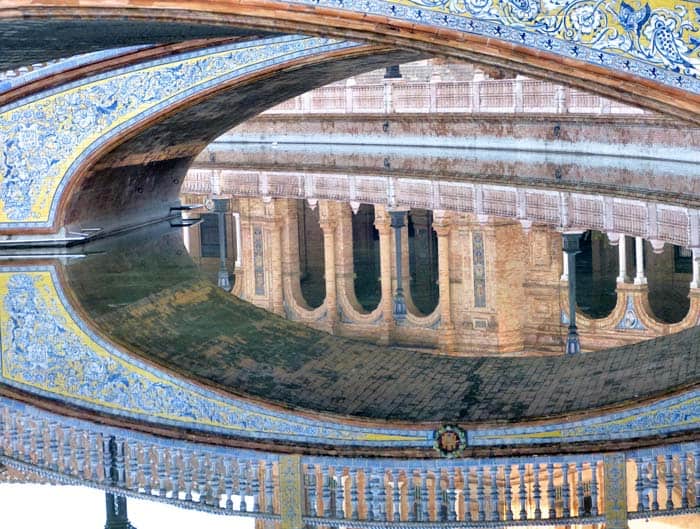
The square is crossed by a navigable canal about 500 metres long. This feature has made the square even more enchanting and many have likened it to ‘a little Venice’. The canal can be navigated both by rowboats and by motorboats. You can even hire boats and enjoy the square by ‘navigating it’. A second distinctive feature is the presence of the 4 bridges over the canal, which represent the 4 ancient kingdoms of Spain.
An open-air lesson in Spanish history…
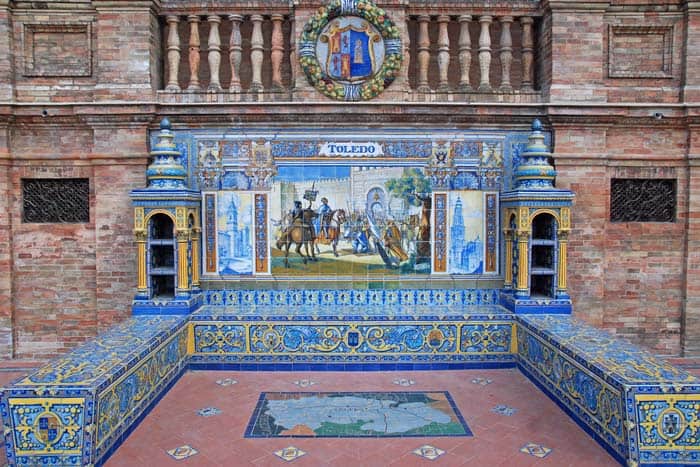
There are many symbols related to Spain’s history (and geography) in the square: the 48 provinces of Spain, for example, are represented by 48 medallions with busts of prominent Spanish figures, placed on each of the arches around the square, and by as many benches finely decorated with ceramics in splendid colours, which run along the entire perimeter of the semicircle.
These precious maiolica seats are a destination for many Spanish tourists who – while in Seville on holiday – upon arriving at Plaza de España go in search of the coat of arms of their own province to take a souvenir photo: the search is fairly straightforward because the provinces are arranged in alphabetical order along the circular arc of the square.
Movies Filmed at Plaza de España: Star Wars and More…
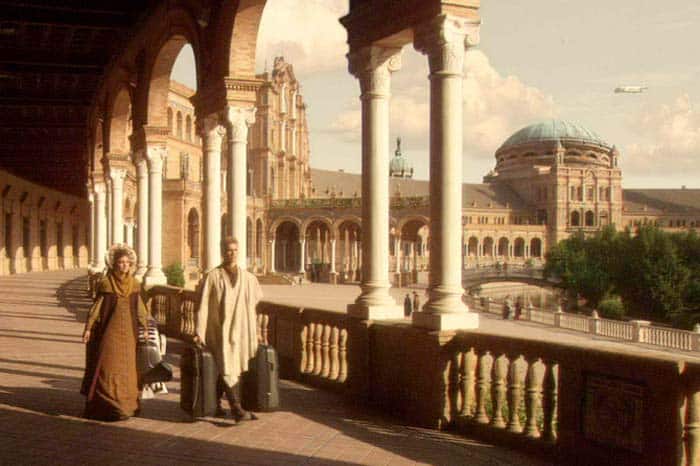
- Star Wars fans will instantly recognise the square. George Lucas chose it as a filming location for Star Wars: Episode II – Attack of the Clones in 2002.
- Filmed several years earlier, the famous Lawrence of Arabia also features the square. Some scenes were filmed inside the beautiful Casa de Pilatos as well.
- More recently, the 2012 satirical comedy The Dictator also used Plaza de España for several outdoor scenes, chosen by director Larry Charles.
Useful information: where is, how to get there, opening hours
Plaza de España is located in the Parque de Maria Luisa, between Avenida de Isabel la Católica, Avenida Gran Capitan, Avenida Portugal and Avenida de la Borbolla. To reach the square I suggest using the Cid Campeador roundabout as a landmark, close to the former Real Fábrica de Tabacos, which now houses the University of Seville.
The nearest bus stop to the roundabout, and therefore to the park entrance, is the Avenida Maria Luiz (La Raza) stop for lines 34, A6 and C2. The nearest metro station to Plaza de Espana is Prado San Sebastián on line L1. It is about 700 metres on foot from the centre of the square, so less than a 10-minute walk.
The square is generally always open and admission is free. Recently, Plaza de España has been the target of vandalism, so a night-time closure is in place. In winter it is open until 22:00, while in summer it stays open until midnight. It reopens at around 8am.
Hiring a rowing boat to navigate the canal costs €6, while hiring a motorboat costs €12. Boat hire is available from 10:00 to 22:00 in summer and from 10:00 to 20:00 in winter.
Where to stay near Plaza de España?
The square is a stone’s throw from the historic centre, which is the best neighbourhood to stay in to fully immerse yourself in the magical atmosphere of Seville.
