In Seville, we find vast squares that take your breath away, as well as tiny little squares tucked away among the streets of the historic centre. Some are overlooked by the city’s most important buildings, while others have curious stories that are sure to fascinate. Here we take a look at which ones you absolutely can’t miss on a visit to Seville.
Contents
Plaza de España
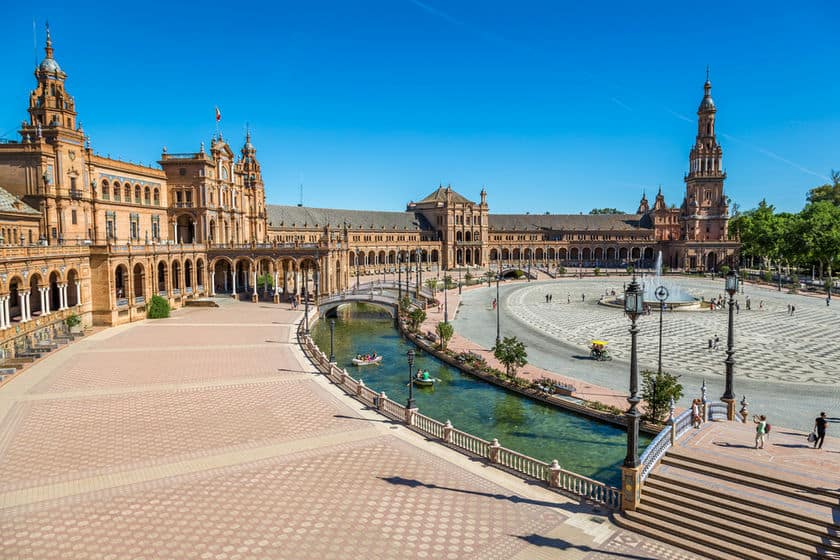
Who, while scrolling through the photos of their trip to Seville, doesn’t have at least one taken in Plaza de España? This is the city’s most famous square and I have no hesitation in calling it one of the most beautiful squares in the world. The colours of the azulejos are reflected in the canal crossed by bridges, while water jets from the fountain at the centre of the huge semicircle that makes up this vast esplanade surrounded by arches. It is hard to remain indifferent to the majesty of this meeting place, so crucial to the history and everyday life of Seville, from which there is direct access to Parque Maria Luisa.
Plaza de América
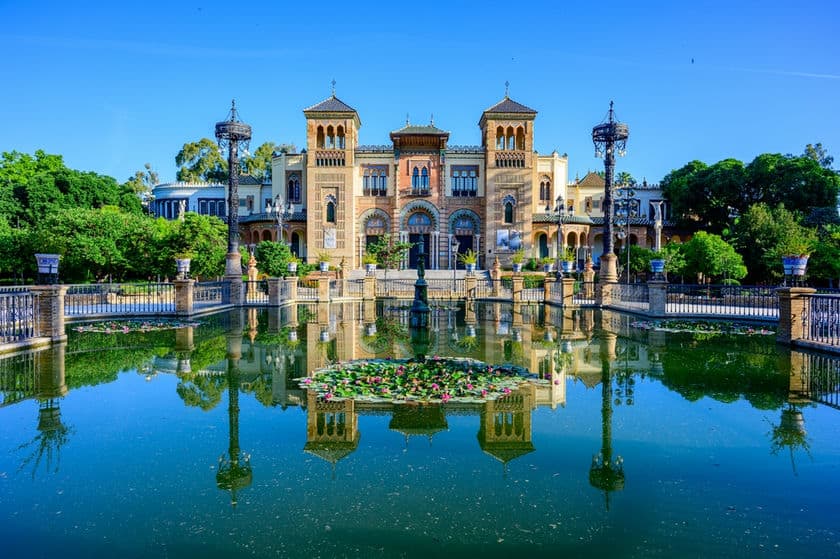
In Parque de Maria Luisa we find another square where water and colour are the stars. It is surrounded by some of the most beautiful buildings in the large park, in particular the one that today houses the Museum of Arts and Popular Traditions and the one that houses the Archaeological Museum, the former in Mudejar style and the latter Renaissance, built between 1913 and 1916 in view of the Ibero-American Exposition of 1929. The enormous basin of the fountain in the centre of the square, where water lilies grow, reflects the sumptuous palaces and the greenery of the surrounding plants, making the atmosphere even more magical.
Plaza del Triunfo
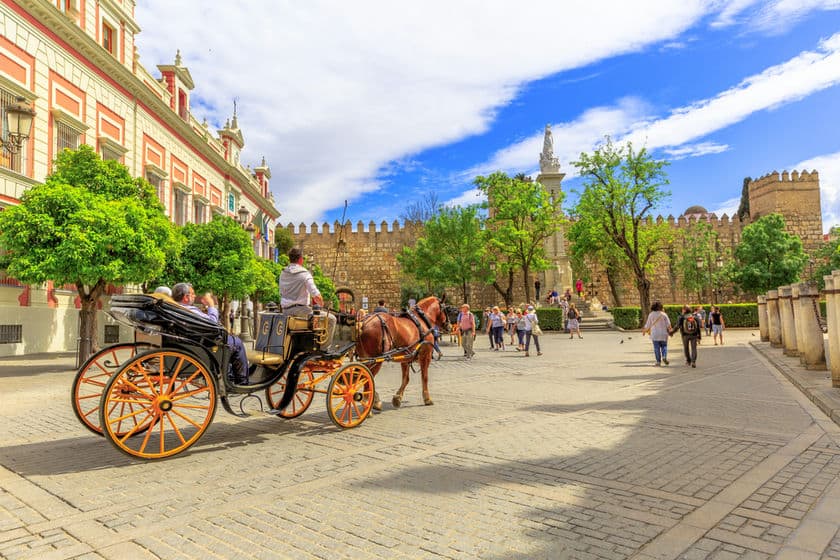
Plaza del Triunfo is among the squares you will certainly see, even unintentionally, when visiting Seville. It is in fact located in the area of the historic centre declared a UNESCO World Heritage Site, which includes the nearby buildings of the Real Alcázar, the Cathedral and the Archivo General de las Indias. Measuring 135×100 metres, it is among the largest squares in the city, as well as one of the most beautiful to see.
This large square changed its name several times. Initially it was called Plazuela de la Lonja (little Market Square), but it was known as Plaza de los Cantos (Square of the Stones) during the period when the cathedral was under construction and the stones used to build the church were piled up here, and later as Plaza del Hospital del Rey (King’s Hospital Square) when the current building that houses the Casa de la Provincia was the seat of the Hospital de Nuestra Señora del Pilar. Its current name is due to the monument erected after the Lisbon earthquake of 1 November 1755, which also had significant consequences here: the parishioners who were attending the All Saints’ Day Mass were saved, continuing the celebration in the square.
Plaza del Cabildo
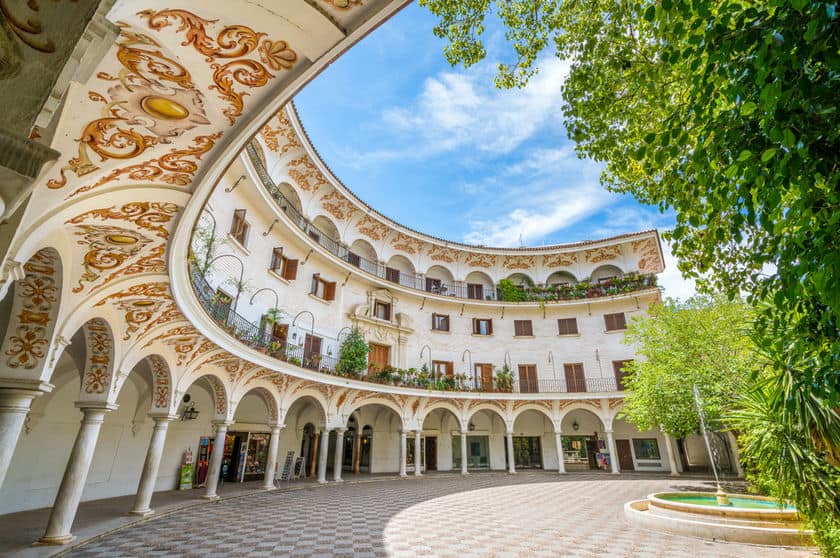
Not all squares are located at the intersection of two streets and can be reached by walking through the streets of a city. In some cases, there are squares hidden among the walls of buildings: this is the case of Plaza del Cabildo, which we could almost define as a mix between a square and a patio. It can only be accessed on foot, through three possible entrances, and you find yourself surrounded by a beautiful semicircular arcade rich in decoration. The straight side of this semicircle is made up of part of the ancient city walls of 1184, in front of which stands the fountain typical of Andalusian patios. If, in itself, it is one of the most interesting squares in Seville, if you go there on Sunday morning you will find it at its liveliest, thanks to the weekly market held there.
Patio of Banners
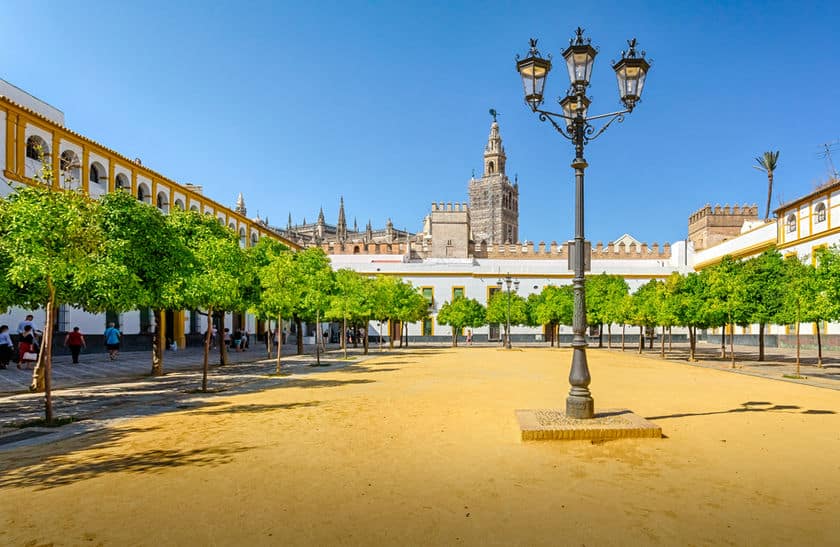
If Plaza de Cabildo is called a square but is more accurately described as a patio, the Patio de Banderas is in fact more of a square than a patio. It is part of the large complex of the Real Alcázar, by whose walls it is completely enclosed, and its size (almost 1,500 sq m), together with its rectangular shape, offers the chance to enjoy an excellent view of the Giralda. It is now the exit gate of the Alcázar, so anyone visiting the palace must pass through it. Originally an access route to the royal palaces, it was later used as an armoury and as a riding arena.
Today it is one of the places in Seville where it is really difficult not to be met with a crowd of tourists. But why does it bear this name? Well, the flags that signalled the presence of the king or queen used to be raised here: they therefore let all the people of Seville know that the sovereigns were in the city. Also, if you go there, don’t just wander around the square: look for the underground crypt, it will fascinate you!
Plaza Nueva (and Plaza San Francisco)
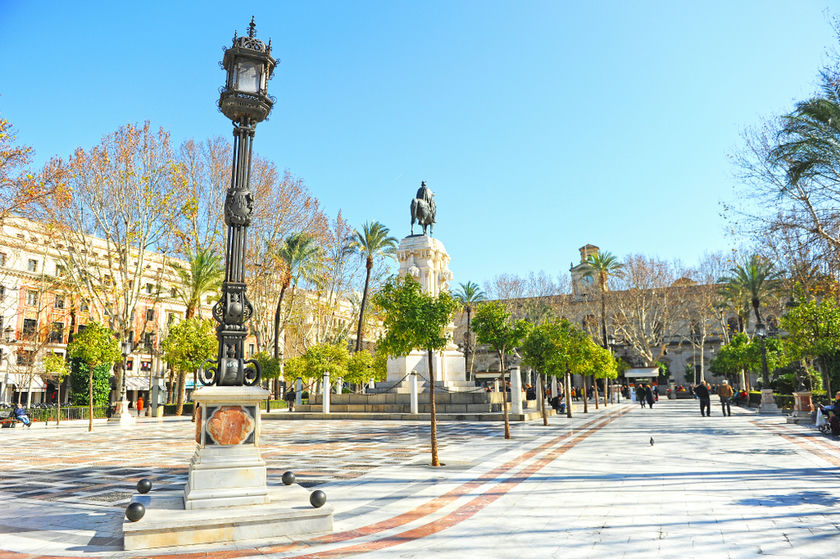
Among the historic squares of Seville, one of the newest is the one that (naturally!) is called Plaza Nueva. It is in the Casco Antiguo, on the border between the El Arenal and Alfalfa districts, and stands on the site of a huge convent, which was even larger than the square itself and was almost completely destroyed by a fire in 1810 and finally demolished in 1848. A square with a modern style, looking out onto the Ayuntamiento de Sevilla. On the opposite side of the beautiful town hall building is the smaller Plaza de San Francisco, which in a certain sense can be considered an extension of the same square, if the Ayuntamiento is seen as lying within the large open space.
Plaza de la Encarnación
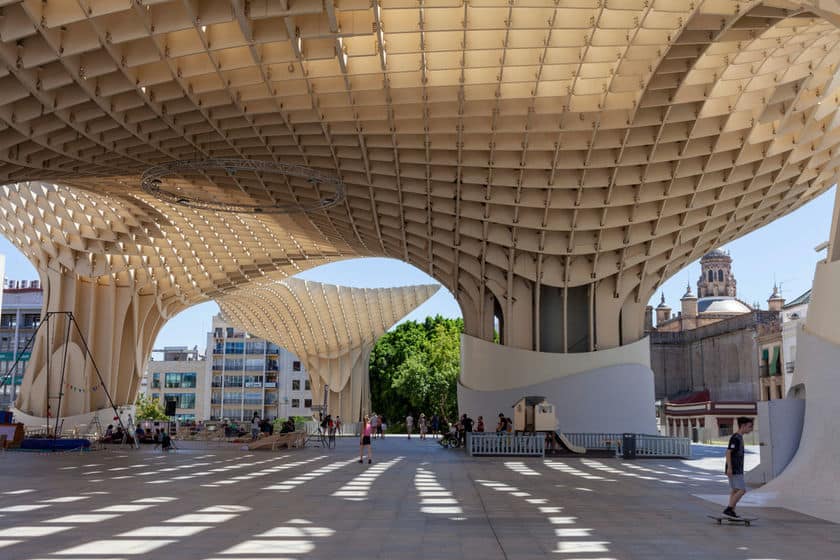
If you arrive by bus from the airport, you will most likely get off at Plaza de la Encarnación, looking up to work out what that unusual structure shading the square actually is. It is the Metropol Parasol, a contemporary architectural project that provides some welcome shade (essential during Seville’s scorching summers), but that is not all. At the top, there are also panoramic walkways offering views over the city, while on the underground level beneath the square there is a covered market, and even further below you can see archaeological remains dating back to Roman times. Although it is not a historic square, today this is one of the most unusual places to see in Seville.
Alameda de Hércules
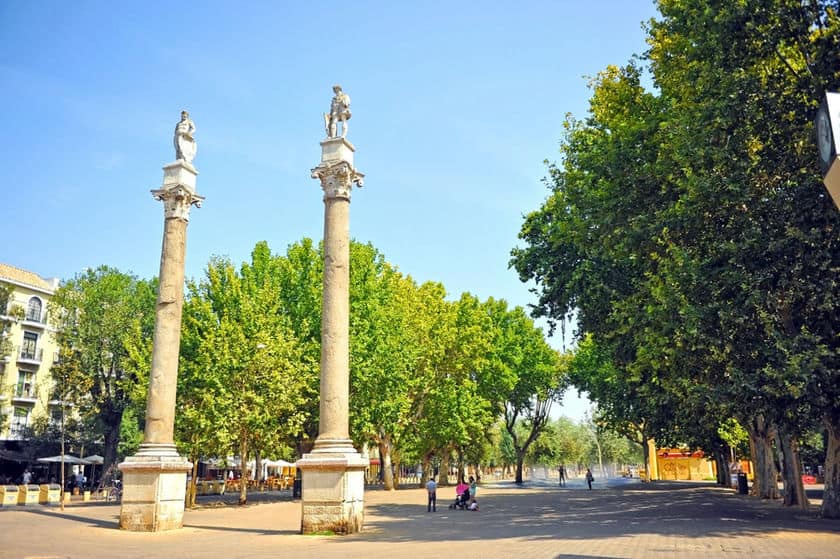
More than a square, the Alameda de Hércules is an exceptionally wide and long avenue, created in 1574 to reclaim the marshy, and therefore highly unhealthy, land in the area. Since 1578, this elongated square has been entered between two columns taken from an ancient Roman temple dedicated to Hercules (hence the name of the square), topped with statues representing Julius Caesar and Hercules respectively. Almost a century later, two more columns were added at the opposite end of the square, this time bearing statues of lions holding shields representing Seville and Spain.
For many years, from 1975 to 2004, the Mercadillo was held here: a weekly Sunday market that attracted thousands of people. The market has since been moved, but in return the area has been revitalised as one of the centres of Seville’s nightlife. With the growth of restaurants, bars and nightspots, it is now one of the best places to go out in the evening, whereas a few decades ago it had a reputation for being a rough and decidedly undesirable area.
Small squares of the Barrio Santa Cruz
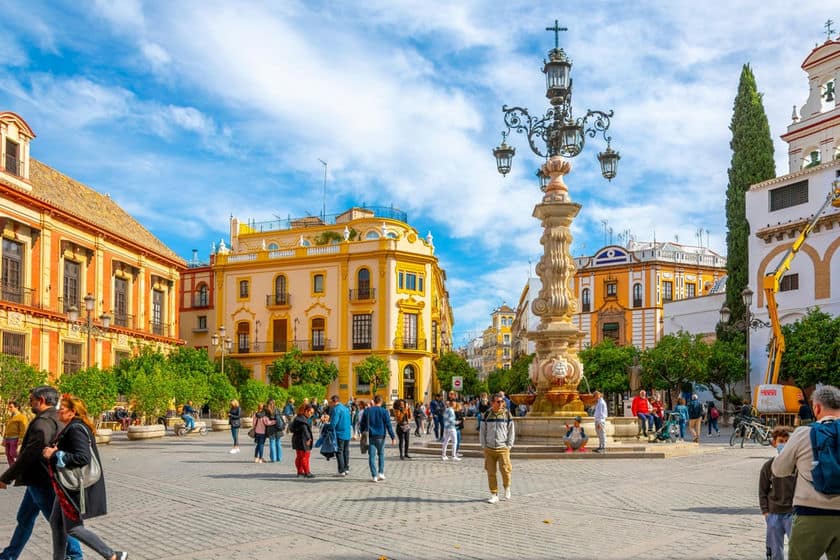
If you have read our article on the Barrio Santa Cruz, you will already know that when visiting this neighbourhood you should expect a maze of narrow streets and small squares. One of the nicest things about this part of the Casco Antiguo is simply getting lost and letting yourself be surprised by what appears around every corner. Among the many squares, however, make sure you do not miss Plaza Virgen de los Reyes, located just a short walk from Plaza del Triunfo and offering an excellent view of the Giralda. Then there is Plaza de Santa Marta, a tiny square hidden among the houses, and Plaza Doña Elvira, which feels like a garden enclosed by the buildings of the historic centre. Plaza de los Refinadores and Plaza de Santa Cruz are two more squares worth seeing, while Plaza de la Escuela de Cristo is a tiny hidden gem behind the Colegio Diocesano San Isidoro.
