Vejer de la Frontera is one of the most renowned and best-loved pueblos blancos in the province of Cádiz. Perched on a little hill about 200 metres high stands a village with characteristic white houses, narrow streets and an imposing 11th-century castle. Around the pure white village, the green of the fields alternates with bare earth, watched over by ancient windmills along the Barbate and Salado rivers.
In the distance, the blue of the sea greets the visitor in a truly stunning panorama. About 10 kilometres (6,2 miles) from the town centre there are in fact a full 7 kilometres (4,3 miles) of coastline: El Palmar beach is part of the Costa de la Luz and looks out over the Atlantic between Roche and Trafalgar.
With its rich historical, artistic and natural heritage, this whitewashed town overlooking the Atlantic is among the most distinctive in Cádiz and, in my opinion, in all of Andalusia: if you’re in the area, you absolutely must not miss it! Here is what to see in Vejer de la Frontera:
Contents
The main attractions of Vejer de la Frontera
The historic centre of Vejer de la Frontera is characterised by its typical Andalusian charm, with narrow alleyways, enchanting flower-filled patios and pretty little squares where the locals spend their time in total relaxation, between one tapa and the next. Here’s what to see on a stroll.
The city walls, gates and towers
The origins of Vejer de la Frontera are very ancient: suffice it to say that remains from the 7th century BC have been found, and that there is evidence of fortifications dating back to the Bronze Age. Today, the ancient city wall from the Arab period is clearly visible, with four gates:
- Arco de la Segur
- Arco of Sancho IV
- Arco de la Villa
- Arco de Puerta Cerrada
There are also two ancient towers in the town: Torre del Mayorazgo, accessible from Casa de Mayorzago (see below) and Torre de la Corredera.


Castle of Vejer de la Frontera
The castle dates back to the 10th and 11th centuries and is located at Calle Castillo 9, in the highest and oldest part of the town. Still in excellent condition, it was the residence of the Dukes of Medina Sidonia in the 14th century. The castle has two patios: the main one has a cistern that collected rainwater, while from the second you can go up onto the defensive walls, from which there is a splendid view.
- The castle is normally open from Monday to Saturday from 10:00 to 14:00 and from 17:00 to 20:00, and on Sundays from 10:00 to 14:00. The closing day is Sunday.
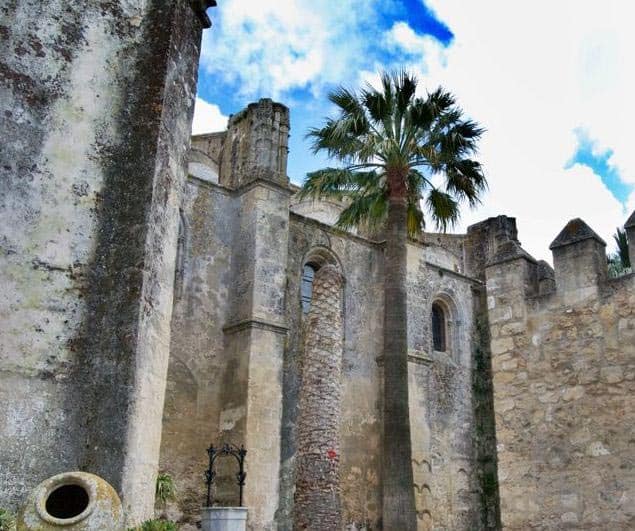
House of the Mayorazgo
This Baroque palace dates from the eighteenth century, has two magically charming flower-filled patios, and access to the ancient Torre del Mayorazgo and the medieval walls. As it is an inhabited building, there is no admission ticket, but it can still be visited on request. It is located in Callejón de la Villa.

Plaza de España
This beautiful square, which appears almost by magic when you emerge from the maze of little streets and ups and downs, dates back to the sixteenth century and, in the two centuries following its construction, was the setting for bullfights at the initiative of the town’s nobility. The colourful frog fountain was built in 1957 and is in a typical Seville style with majolica tiles and azulejos. In the square you can also admire the Town Hall and two houses, numbers 12 and 13, now home to the offices of the Justice of the Peace.

Church of the Divine Saviour
Built on an ancient mosque, it has the form of a basilica with a rectangular apse and three naves. The church was built in two different periods and, therefore, in two different styles: Gothic-Mudéjar at the beginning of the sixteenth century and late Gothic in the seventeenth century. The magnificent altarpiece from the seventeenth century is the work of Master Francisco de Villegas. To reach the church, you will need to get to Plaza Padre Ángel, in an area full of bars and restaurants.

Museum of Customs and Traditions of Vejer
The museum is located in Calle Ramón y Cajal 4, inside the Convent of the Conceptionist Nuns. The convent was originally founded in 1552 by Juan de Amaya. The façade is Renaissance in style, and worth admiring are the spherical dome of the main chapel and the vaulted crypt.
Next to the church, in the heart of the Jewish quarter, is the famous street called Arco de las Monjas, where a photo is a must.


The Roman aqueduct of Santa Lucia and its mills
In the locality of Santa Lucia, about 5 kilometres (3,1 miles) from the town centre, there is a Roman aqueduct which was refurbished in the Arab period and is one of the town’s symbols. In the fifteenth century, a system of 7 water mills was created, used by the inhabitants to turn grain into flour. Around the town, a few mills are still visible today, while in the town museum you will have the opportunity to see some working tools and understand the history and way of life of the place in the past.
The beaches of Vejer de la Frontera: El Palmar
Vejer de la Frontera offers not only an enchanting historic centre, countryside where the human hand is in perfect symbiosis with nature, and a centuries-long history: the beach of Vejer de la Frontera – among the most famous for sports enthusiasts in search of adventure on the beaches of Cádiz and province – is the ideal place to relax, enjoy water sports and have fun.
El Palmar is the main beach of Vejer de la Frontera and is located about 10 kilometres (6,2 miles) from the town centre. The beach has fine sand and the water is clear and clean. Ideal for sailing, surfing, windsurfing, water skiing and fishing. In summer there is a lifeguard service, showers, toilets, an information point and many restaurants and bars. El Palmar is therefore one of the best-equipped beaches in the area.
Part of the beach, the northern section, is shared with the nearby town of Conil de la Frontera. To the south, meanwhile, the Trafalgar Lighthouse stands tall on the peninsula that divides the Zahora area from that of Los Caños de Meca.

Where to stay in Vejer?
If your main interest is having a bit of a beach holiday on the Costa de la Luz, bear in mind that in the resort of El Palmar there are some interesting options, especially apartments and holiday homes. At the link below you will find a list of the available properties:
All available accommodation in El Palmar
If, on the other hand, you like the idea of staying one or more nights in the heart of the historic centre of Vejer de la Frontera, consider booking one of the characteristic Moorish-style apartments at El Cobijo de Vejer: incidentally, the breakfast is superb! If there is no availability, see the link below:
