Seville is the most important city in Andalusia and Cadiz is known as the oldest city in Europe. Both are well worth a visit and, if you are planning a trip to the southernmost region of Spain, I would suggest including both Seville’s artistic and architectural highlights and historic Cadiz with the nearby beaches of the Costa de la Luz in your itinerary.
But what are the possible ways to cover the distance between these cities? In this article I explain the various ways to travel by train and by bus, but also the stops you can make if you have a hire car and want to discover other places along the way.
Contents
How to get from Seville to Cádiz
Between Seville and Cádiz you can travel by train, bus or car. Which option is best? Well, it depends on your needs and the type of trip you are planning. Normally, the train is the quickest way to travel between large cities, but that is not the case here. Between these two cities, the bus is often the fastest way to get around and it is usually also the cheapest. The car allows you to make intermediate stops. Let’s look at the details of each option.
Distance from Seville to Cádiz
Seville and Cádiz are about 74.6 miles apart and by car it takes around one hour and 20 minutes to cover this distance without stops. Given that public transport connections are very good, using them is an excellent idea if you do not need a car and do not want to make any intermediate stops.
Seville to Cádiz Train

As we explained on the page dedicated to how to get around Andalusia by train, high-speed rail is currently not as developed in this region as in other parts of Spain. The only two AV lines useful for travelling between the main cities of Andalusia are Seville-Cordoba and Cordoba-Malaga. So you cannot rely on high-speed rail to travel from Seville to Cadiz and vice versa.
Fortunately, though, the distance is not excessive, so even with the local train – Renfe Media Distancia – journey times are not too long. We are talking about around 1 hour and 45 minutes. At certain times you will also find the Renfe Alvia train: this is a hybrid train, running both on conventional tracks and on high-speed lines. Obviously on this route (as there is no AV line) it runs on the local train tracks, so the timings are practically the same.
The train ticket price for the Seville-Cadiz route is around €20 (for the local Media Distancia train), while the Alvia train has variable prices depending on when you buy the ticket. Usually, though, it costs a bit more (around €30-40) and saves you at most a quarter of an hour of travel time. That is why it does not prove to be a very worthwhile option for this route.
To see train times from Seville to Cádiz, with all the specific prices, I recommend using Omio. In my experience, it is the best way to get a clear overview of all the public transport available – both the various trains and the buses – so you can easily choose the most convenient option or the one best suited to your needs.
Find a train from Seville to Cadiz
Seville to Cádiz Bus
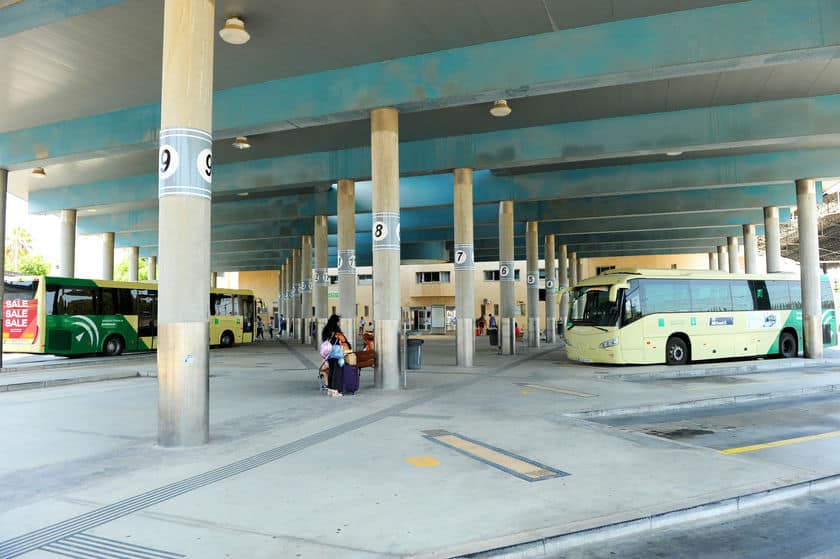
There is also a bus service between Seville and Cádiz, and it is very often cheaper than the train. The prices are not much different from those of the local train: on average it costs €18. The journey time is very similar: the buses also take around 1 hour and 45 minutes. This means that, in practice, the choice between train and bus mainly depends on the timetables. See whether the timetable of a train or a bus is more convenient for you, and how close your accommodation is to the train station or the bus station. You can also search for buses on Omio, so that you can compare the available options directly, including with trains.
Find a bus from Seville to Cadiz
How to get to Cádiz from Seville by car
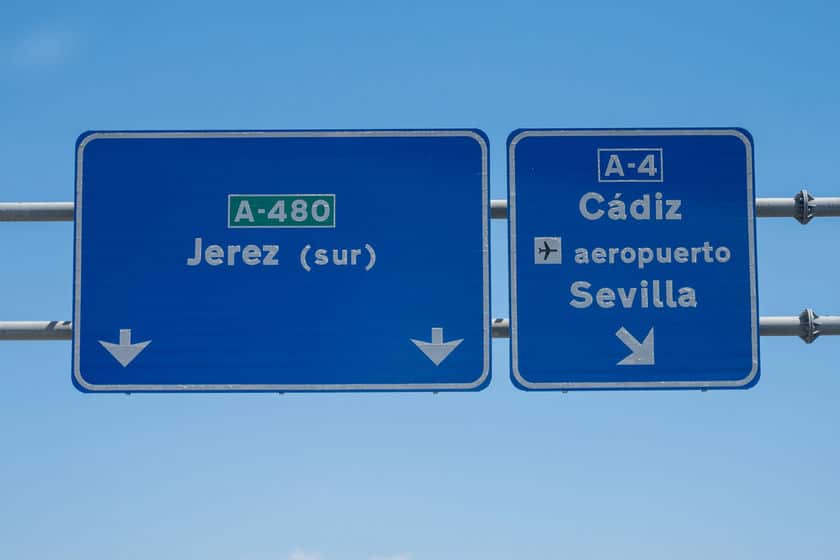
To drive between Cadiz and Seville and vice versa, the most direct and fastest route is the A4 motorway, also known as the Autovía del Sur. It is about 75 miles and takes at least an hour and twenty minutes (but longer at peak traffic times). If you decide to make a few intermediate stops (I suggest some further on), of course you will have to add a few miles and the journey time will also increase.
From Seville to Cadiz in a day
Can you visit Cádiz in a day from Seville? The technical answer is yes, you can. My advice, however, is not to do so, unless you really have no choice. But let’s look at the reasons behind the two answers. As I explained in the previous paragraphs, the journey time on public transport between Seville and Cádiz is less than two hours. This means that if you leave early in the morning and return to Seville in the evening, you’ll have a fairly full day to devote to visiting Cádiz.
So: if you’re based in Seville and only want to see the most famous sights, then yes, you can visit the city as a day trip from Seville. Of course, you can’t discover every corner of Cádiz in the space of a day, but you can head home having had a taste of this beautiful city. Alternatively, you can also do a guided day tour to discover the best of Cádiz and Jerez de la Frontera starting from Seville. Everything is organised and you won’t have to think about a thing!
From Seville to Cádiz: what is there to see?
If you are planning a road trip in Andalusia, there are a few stops you can easily add to the Seville-Cadiz route. As it is a fairly short journey, breaking it up is not really necessary, but it can be a good way to discover smaller towns and unexpected places. Let’s see which the main stops are that you can make.
Dos Hermanas
Right on the southern outskirts of Seville lies a town usually overlooked by tourists, Dos Hermanas. It is true that this town, made up mainly of residential neighbourhoods, is undoubtedly less interesting than many other Andalusian towns, at least from an artistic and architectural point of view. However, this is one of those places that are worth visiting especially at particular times, the more folkloric ones.
I am referring in particular to the Romería de la Virgen de Valme, a procession held on the third Sunday in October during which the statue of the Madonna is carried from the Church of Santa María Magdalena to the hermitage of Cortijo del Cuarto. Put like that, it sounds like an event of little importance, but it is in fact one of the most popular and best-attended pilgrimages in all Andalusia. Every year, 200,000 people take part! If you find yourself in Andalusia at exactly that time of year, considering a stop in Dos Hermanas is the way to discover a tradition
Jerez de la Frontera and El Puerto de Santa María

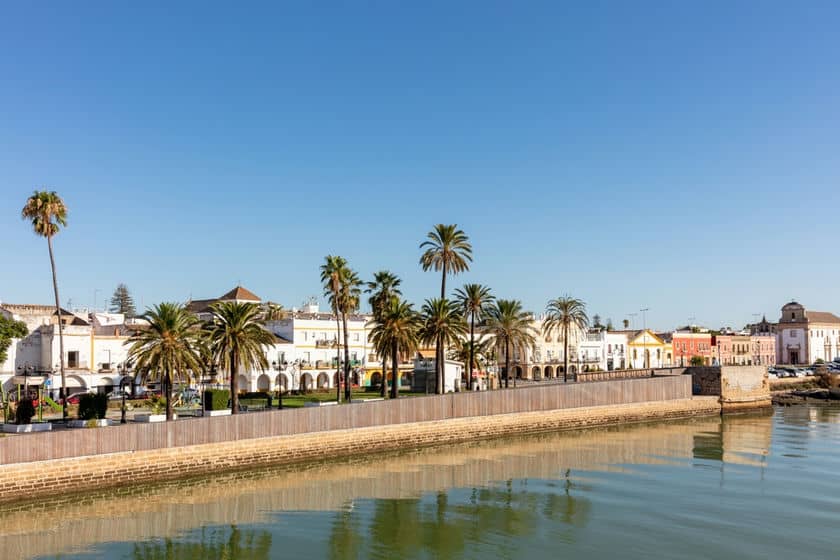
Let us now turn to the main stops I recommend making at any time of year. Along the road between Seville and Cádiz, I suggest first of all that you stop in Jerez de la Frontera. This very ancient city is known internationally for the MotoGP held at its circuit, but there are very different reasons to visit it. Its historic centre, where you can lose yourself among the alleyways, its imposing Alcázar, its majestic cathedral and many other attractions: it has nothing to envy some of the Andalusian provincial capitals, and if you pass through here I strongly recommend devoting at least a few hours to it.
Jerez de la Frontera Travel Guide
Just a stone’s throw from Cadiz you will find El Puerto de Santa María, a coastal town where you can relax on beautiful beaches and stroll along the seafront, as well as visit historic places. Among others, the Castillo de San Marco and the Iglesia Mayor Prioral are not to be missed, but let’s not forget its grand Plaza de Toros (the third largest in Spain!), the lovely Monasterio de la Victoria and many other attractions.
El Puerto de Santa María Travel Guide
Arcos de la Frontera

In addition to the aforementioned stops, which are located right along the road that leads from Seville to Cádiz, there are also others that can be reached with not too demanding detours. The first and most famous is without a doubt Arcos de la Frontera. We are talking about one of the most famous of the pueblos blancos of the province of Cádiz and, more generally, one of the loveliest villages in inland Andalusia. Perched on a rocky outcrop on the banks of the Guadalete river, it is a stretch of white houses around the castle that watches over the whole town from above, from which stand out historic buildings of great value, such as the Basilica Menor de Santa Maria de la Asuncion and the convent of Saint Augustine.
Arcos de la Frontera Travel Guide
Lebrija, Sanlúcar de Barrameda and Chipiona

If you have more time available, one idea could be to make one or more stops on the western side of the main road. In particular, this route allows you to stop in at least three very distinctive little towns. The first you come to when arriving from Seville is Lebrija, one of the most authentic Andalusian places in this area. Little visited by tourists, intense, deeply rooted in flamenco and tradition. It is famous for Gypsy culture and for having given birth to great flamenco artists. The most iconic monument is the Iglesia de Santa María de la Oliva, whose bell tower is called the Giraldilla because it looks like a smaller version of Seville’s Giralda.
We then come to Sanlúcar de Barrameda, a town with a special charm, combining sea, wine and an elegant yet informal Andalusian atmosphere. It is the home of manzanilla, the freshest sherry in the region, and here fish tapas and ice-cold glasses are part of everyday culture. The seafront at sunset is magnificent, with views across the river to Doñana National Park. The historic centre, especially the Barrio Alto, retains noble palaces, hidden courtyards and a very attractive, decadent beauty. Magellan set off from here to sail around the world, and its historic buildings are all waiting to be discovered.
Sanlúcar de Barrameda Travel Guide
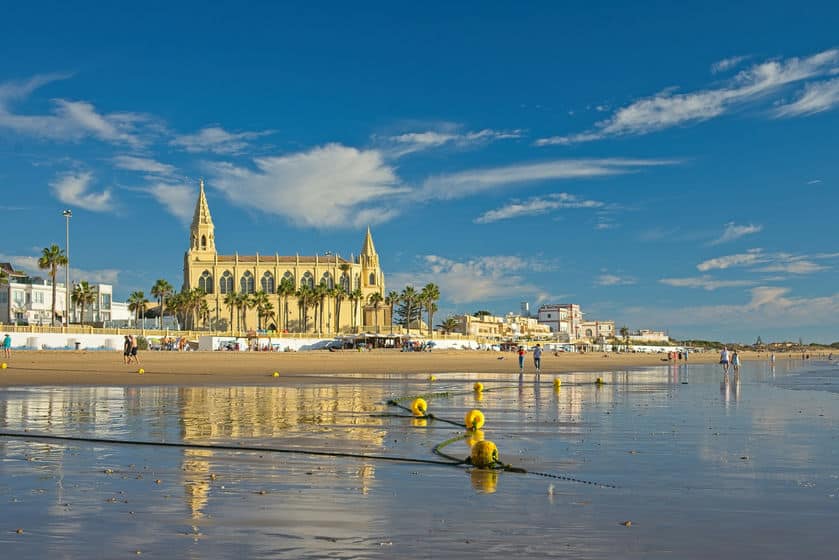
Finally, if you add a few more kilometres, you can reach Chipiona, a coastal town surrounded by the beaches of the Costa de la Luz. It is usually not part of the classic tourist itineraries and perhaps it is not among the most captivating towns in Andalusia, but if you have time to make it to the coast, I can assure you that the Santuario De Regla is very scenic when seen from the very long golden-sand beach.
Where to stay
If you follow this itinerary, you will certainly stay overnight in Seville and perhaps also in Cádiz (unless you visit it as a day trip). But it may also be a good idea to spend the night in one of the smaller towns, where you can often find lovely, characterful places to stay. Here is where you can stay on the main stops:
