Located just 25 kilometres (15,5 miles) from Málaga, Mijas is a picturesque town perched on a hill just over 400 metres high, with whitewashed houses, narrow streets and donkeys carrying people and luggage like genuine taxis. Without doubt, this is one of the most popular destinations on the Costa del Sol.
Today, the municipality is divided into three main areas: Mijas Pueblo, with its charming historic buildings and donkey taxis; Las Lagunas, which merges into the municipality of Fuengirola, with modern buildings, golf courses and shops; and La Cala de Mijas, with around 12 kilometres (7,4 miles) of beautiful sandy beaches. Mijas in Andalusia has now become a highly sought-after tourist destination for visitors to the Costa del Sol, and it is easy to see why: it offers everything you could wish for, including mountains, sea, services and activities of every kind.
Contents
What to see in Mijas Pueblo
The pueblo is the most beautiful and famous part of Mijas. Located at an altitude of 428 metres, Mijas Pueblo has whitewashed houses with colourful windows overlooking the coast, courtyards and viewpoints filled with flowers, and narrow streets where it is not unusual to come across the famous burro-taxis, donkeys wearing brightly coloured blankets which, somewhere between tradition and folklore, serve as a means of transport around the town.
Here are the main places of interest to visit in this small Andalusian village:
Iglesia de la Inmaculada Concepción
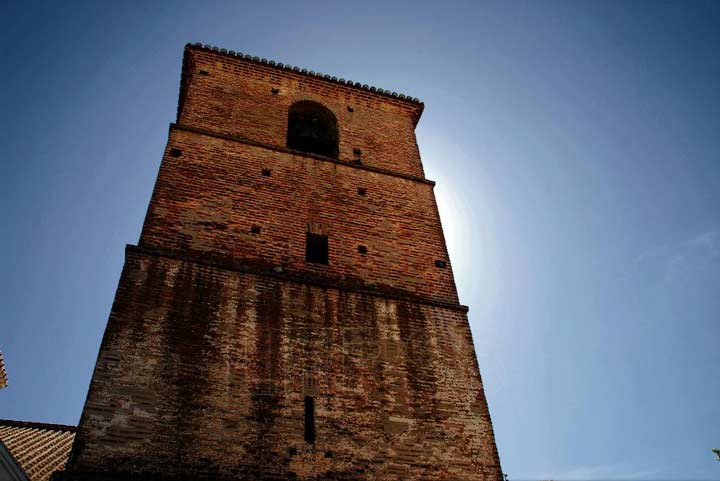
Located in the upper part of Mijas on Paseo de la Muralla, this church was built between the 16th and 17th centuries over the remains of an ancient mosque and castle. Consecrated on 1 September 1631, it has three naves and two crypts. The Torre de la Vela was originally a square Mudéjar tower forming part of Mijas Castle. Today, it is attached to the church and serves as its bell tower. The church is open every day of the year.
Ermita de la Virgen de la Peña & Ermita del Calvario
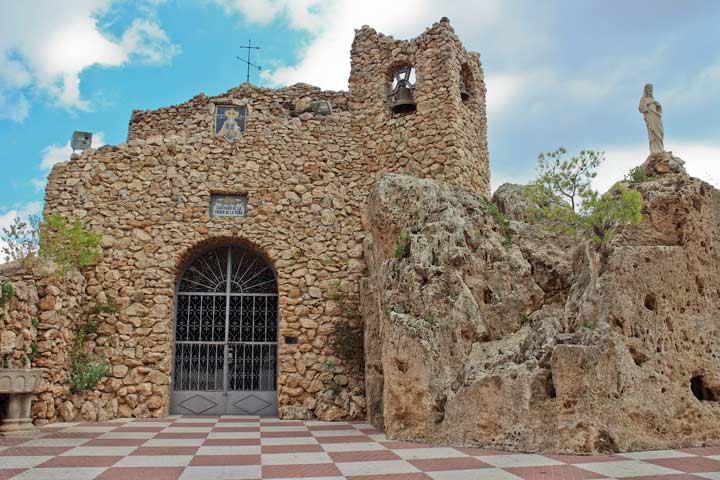
Carved into the rock, the Hermitage of the Virgen de la Peña was built in 1548. According to legend, the Virgin appeared to shepherds in the cave located on this very spot. Whether you are a believer or not, the hermitage is extremely atmospheric and the view towards the sea is breathtaking. It is located at Av. del Compás, 7.
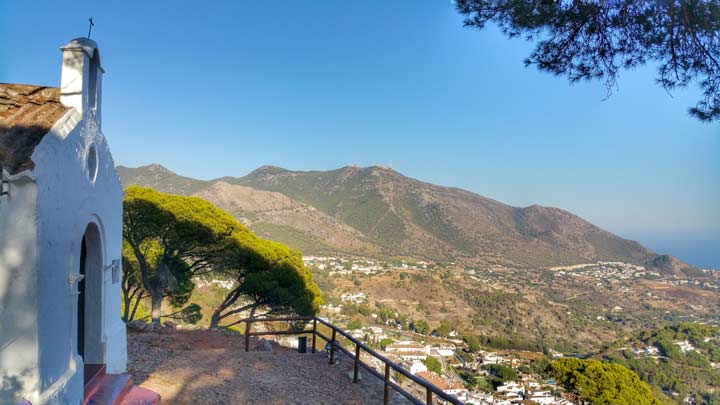
The Hermitage of Calvario occupies an even more striking position, perched on the hill overlooking the village. The hermitage is open only on Good Friday and the first Friday in March, but it is worth reaching it along the woodland path to enjoy an exceptional view over the entire coast. The main trailhead is located directly on the A-387, above the village, just beyond a car park beside a viewpoint (see map): from here, many other paths branch off, making this an ideal area for hikers.
Plaza de Toros de Mijas
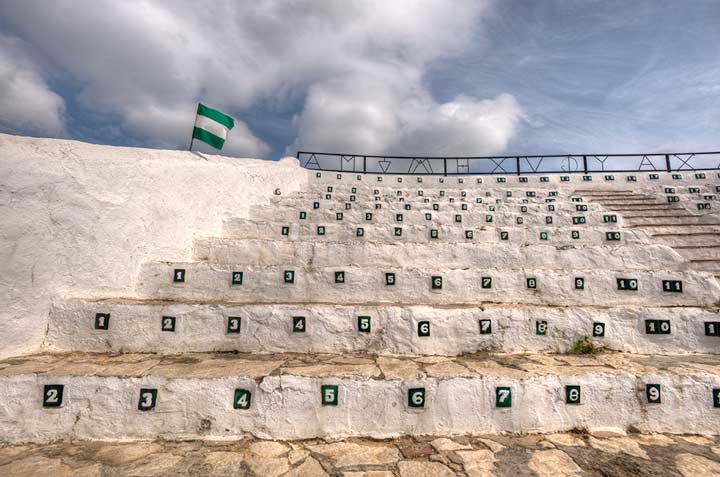
The Plaza de Toros de Mijas is truly unusual: from the outside, it looks simply like another of the town’s whitewashed houses built into the rocks, while inside it is a genuine bullring with an elongated oval shape, a rarity among arenas used for bullfighting. It was officially opened in 1900. It is located in the Jardines de la Muralla, near the Iglesia de la Inmaculada Concepción.
Museo Etnográfico de Mijas
Located in Plaza de la Libertad in Mijas Pueblo, this ethnographic museum offers an insight into what life was like in Mijas decades ago. Across approximately ten rooms, you can see farming and fishing equipment, a bakery with an old oven, two olive presses and a traditional house.
The admission price is very low: €1.
The museum is generally open every day from 10 am to 7 pm.
Centro de Arte Contemporaneo (CAC) de Mijas
At Calle Málaga, 28 in Mijas Pueblo, you will find the second-largest permanent collection of Picasso ceramics in the world, after that of the Picasso Museum in Paris. The museum is not devoted solely to Picasso, however: it houses around 600 works by artists including Dalí, Miró, Foujita and Georges Braque.
The admission fee is €3 per person. Admission is free for children aged 5 and under.
The opening hours are from 10.30 am to 2 pm, Monday to Saturday.
The beaches of Mijas
One of the defining features of the Mijas seafront is the Senda Litoral, a long wooden boardwalk that runs alongside the various beaches for their entire length. The Senda Litoral is part of a project intended to connect all the beaches of Málaga province along more than 180 kilometres (111,8 miles) of coastline. In Mijas, this section has already been completed: the boardwalk stretches along the coast, is between 4 and 6 metres wide, and is ideal both for walking and for those who want to exercise.
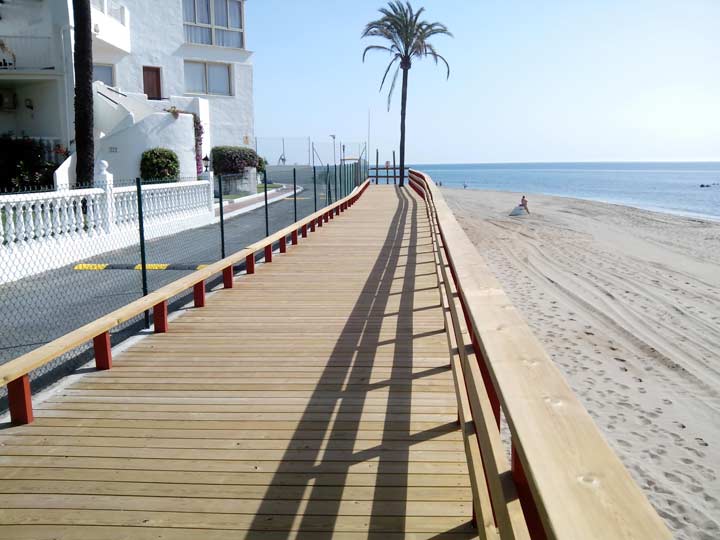
Mijas has 12 kilometres (7,4 miles) of beaches, offering a perfect combination of sand, nature and sunshine. All the beaches in Mijas have easy access and are equipped with showers and drinking-water fountains. During the summer, lifeguard services are also available every day from 11 am to 7 pm. The area’s rich biodiversity also makes it important to protect its natural habitats, preserving both the beauty of the landscape and the presence of rare birds, cetaceans and corals.
Among the most popular beaches in Mijas are Playa La Luna-Royal Beach, Playa de Calahonda, Playa El Bombo, Playa de la Cala de Mijas – Butibamba and Playa Las Doradas – El Chaparral.
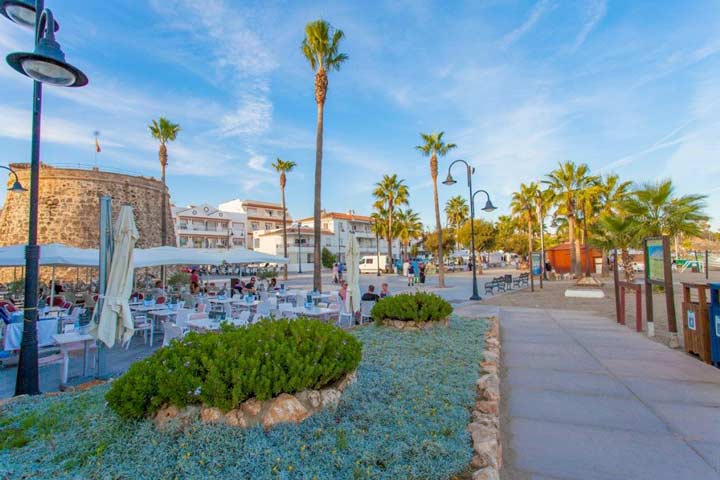
- Playa La Luna – Royal Beach: located in the Calahonda area, this beach is not particularly easy to reach, despite being well signposted. Perhaps for this reason, it is generally less crowded than other beaches in the area. It lies on the border between Mijas and the Marbella beach known as Cabopino. From the A-7, take exit 195, at kilometre 196, and follow the signs to the beach. After passing through a small tunnel, you will reach the beach. The sand is fine, and there are plenty of green areas, as well as a refreshment kiosk.
- Playa de Calahonda: one of the most famous beaches in the area, it stretches for 4.4 kilometres (2,7 miles) and lies at the westernmost point of the municipality of Mijas. Golden sand alternates with rocky sections, and the sea is generally calm. It is ideal for families because it offers all the services needed to enjoy a pleasant day by the sea in comfort and complete safety.
- Playa El Bombo: with dark sand and crystal-clear water, this beach is located in the Cala de Mijas area. It offers public toilets, sunbed hire, opportunities to practise water sports and several chiringuitos where you can sample the local cuisine. The beach is easy to access, and there is also a nearby bus stop connecting it with the town centre.
- Playa de la Butibamba – Playa de la Cala de Mijas: around 1.3 kilometres (0,8 miles) long and 20 metres wide, this beach is also located in Cala de Mijas. It lies close to the town and is therefore generally crowded in summer. Easily accessible via the Senda Litoral de Mijas, it offers numerous facilities, including a car park near the beach, showers, public toilets, access for people with reduced mobility and sports equipment hire.
- Playa Las Doradas – El Chaparral: this beach is 4.4 kilometres (2,7 miles) long and is one of the most beautiful on the Costa del Sol. It is not as wide as some of the other beaches in the area, but it still measures around 12 metres across. The sand is dark and mixed with stones. It is ideal for surfing, sailing and diving. There are refreshment outlets, sunbed and boat hire, as well as a convenient car park. By car, follow the Mijas-Fuengirola road and the A-7, then take the Cala de Mijas exit towards Boulevard de la Cala. It is only a 20-minute drive from the town.
Where to stay
Below you will find several links listing all the hotels and apartments available in Mijas Pueblo and La Cala de Mijas. There is generally more availability by the sea, but if you book well in advance, you can also find charming accommodation up in the hills!
