Just 7 kilometres from Cordoba lies Medina Azahara, the largest archaeological site in all of Spain and one of the most captivating. Since its discovery in the early twentieth century, unfortunately the work to bring to light the parts of the city still buried has been very slow: today, in fact, only 10-15% is open to visitors. Fortunately the importance of the archaeological complex has been recognised in recent years and the European Union has allocated funds to develop it and step up excavations and restoration work, so that Medina Azahara remains today one of the most interesting destinations in Cordoba and throughout this part of Andalusia.
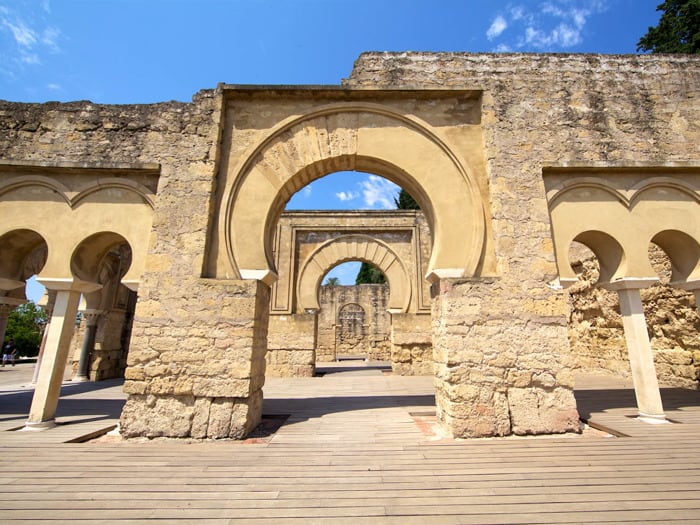
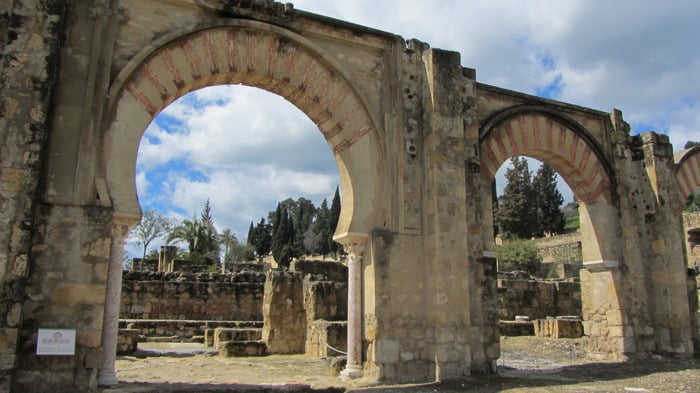
I recommend visiting it during your Andalusia road trip to experience firsthand the effect of standing before ruins that, after more than 1,000 years, still defy time: the Moorish-style arches, the ancient walls, the reconstructions of how sumptuous the noble palaces once were… you’ll have the chance to discover what the ideal city for a powerful caliph in AD 936 was like. The charm of this place is incredible and you’ll realise its importance at first sight.
Contents
Medina Azahara, between history and legend
The remains of the city called Medina Azahara, or in Arabic Madīnat al-Zahrā, cover an area of as much as 112 hectares: the city, in fact, had a rectangular plan and measured about 1,500 metres by 750 metres. The size and splendour that characterised this city made it one of the most beautiful and richest in the entire Mediterranean.
Legend has it that the caliph created this sumptuous city in honour of one of his concubines, Zahara, and that its name derives from her. According to the same romantic legend, he also surrounded the city with almond trees so that, in spring, their white blossoms covering the streets and the city would remind her of the snow of her homeland, Syria. Zahara means ‘flower’, making the name more than appropriate.
According to another version, however, Zahara means ‘brilliant’, so the name would literally mean ‘brilliant city’. In the caliph’s mind, building such a vast and sumptuous city — one that would shine with its own light in the Mediterranean — was intended to represent the importance and power of the new caliphate and to assert his own role in the eyes of other Islamic communities, especially in relation to the imam-caliphs of Cairo and Baghdad.
Founded between 936 and 941 by the Caliph Abd al-Rahman III, the entire caliphal court moved there in 945. The city was built on three levels.
- At the highest level was the palace of the caliph and the most illustrious figures of the caliphate, together with the guards’ residences.
- On the second level there were large gardens and kitchen gardens.
- On the third level, lower than the other two, lay the settlement itself, and here the large mosque stood out; it was actually situated outside the walls to allow access to those who lived beyond the city.
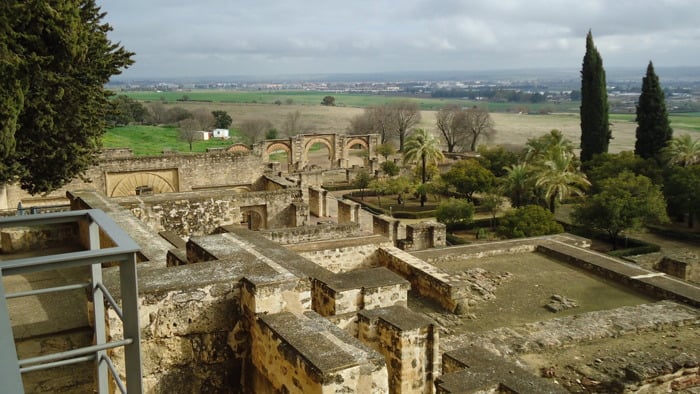
Despite its splendour and the efforts to build it, the city had only a short life. Already in 1010, just 70 years after its construction, it was destroyed and left to decay, remaining buried for several centuries until the first excavations in 1911.
What to see?
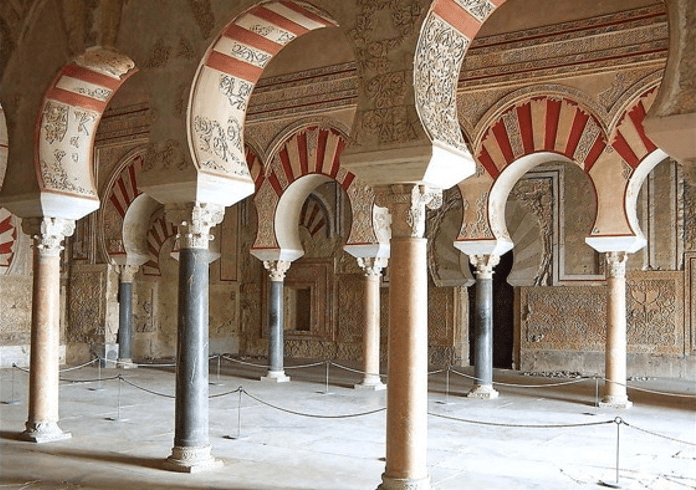
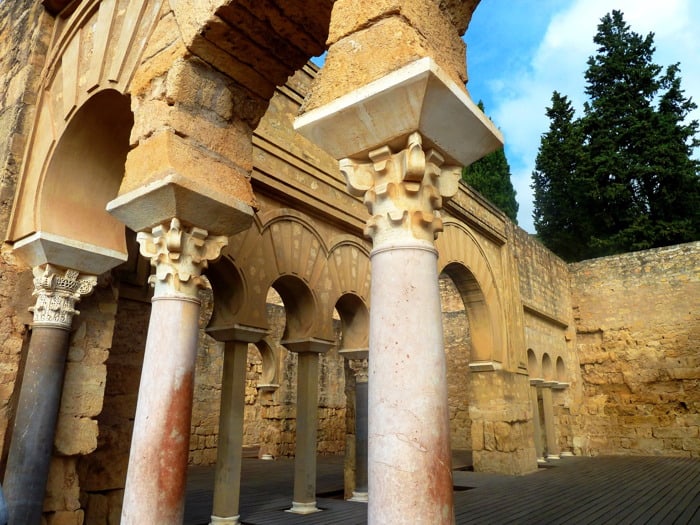
In the upper part you will therefore find the Salón Alto, divided into five aisles marked by arches: this area of the Medina is today the best known and gives a very tangible sense of the architecture of the wealthiest buildings in the citadel. A little further down is the marvellous Salón Rico, divided instead into three aisles with red and blue marble arches: the two side aisles are blind, while the central one is open.
You will see the splendid Jardín Alto, divided into four areas and adorned by four pools. Also noteworthy is the large eastern portico, which looks out directly onto the parade ground.
Wandering among the ruins, you can also see the remains of the ancient mosque, the Casa Real, the House of the Vizier, the Patio de los Pilares, the Vivienda de la Alberca and the various servants’ quarters.
The museum
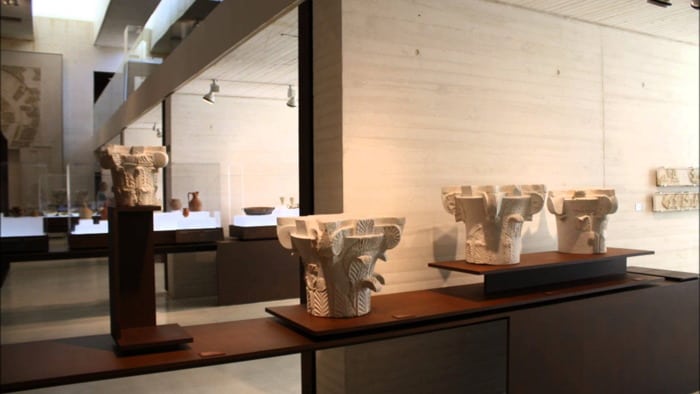
If you have a little more time, you can combine a visit to the archaeological site with one to the museum, a modern award-winning (but somewhat clinical) building with thematic exhibition spaces that can help to frame the historical and cultural period in which the construction of Medina Azahara took place.
Useful information for your visit
Opening hours
The opening hours are:
- From 21 March to 20 June:
- Monday: closed, except when it falls on the eve of a public holiday
- Tuesday to Thursday: 09:00–18:00
- Friday and Saturday: 09:00–21:00
- Sunday, public holidays and Mondays falling on the eve of a public holiday: 09:00–15:00
- From 21 June to 20 September:
- Monday: closed, except when it falls on the eve of a public holiday
- Tuesday to Saturday: 09:00–15:00 and 20:00–22:00
- Sunday, public holidays and Mondays falling on the eve of a public holiday: 09:00–15:00
- From 21 September to 20 March:
- Monday: closed, except when it falls on the eve of a public holiday
- Tuesday to Saturday: 09:00–18:00
- Sunday, public holidays and Mondays falling on the eve of a public holiday: 09:00–15:00
Aside from Mondays, except when they fall on the eve of a public holiday, the archaeological complex is also closed on 1 and 6 January, 1 May, and 24, 25 and 31 December.
Opening times may vary on public holidays, so check the official calendar before visiting.
Ticket prices
The entrance to Medina Azahara costs €1.50 for UK citizens, as the free-entry rule applies to EU citizens. The price is still very low.
Bear in mind, however, that the shuttle bus connecting the museum car park with the archaeological site is payable, whether you arrive by car or by bus from Córdoba. The shuttle bus costs:
- €3 per person
- €1.50 for children aged 5–12 and seniors over 65.
How to get to Medina Azahara from Cordoba?
The address of Medina Azahara is Carretera de Palma del Río, Km. 5.5. It is about 8 km from Cordoba. The GPS coordinates are 37° 52′ 50.8″ N 4° 51′ 15″ W.
Reaching the archaeological site from Cordoba is not complicated. You can get there by car or by bus, or book day tours.
- By car, take the Carrettera de Palma del Río (A-431) until you see signs for Madinat al-Zahra. Take the CO-3414. You can leave the car in the museum car park, but from there you will have to take a shuttle bus that links the museum to the archaeological site. The service runs every 20 minutes.
- If you do not have a hire car, there is a daily bus service to Medina Azahara from Córdoba. The bus now leaves from Paseo de la Victoria, near the Red Cross Hospital roundabout and Mercado Victoria. Tickets can be booked in advance and include the shuttle bus between the reception centre and the archaeological site. The return ticket costs €10 for adults and €5 for children aged 5 to 12. Bear in mind that Medina Azahara is usually closed on Mondays, except when Monday falls on the eve of a public holiday.
Guided tours of the archaeological site
To truly appreciate the archaeological site and discover the history and hidden secrets in the remains you see, I recommend booking a guided tour. This option is also ideal for those without a car.
Here are some options:
- guided tour departing from Cordoba: in English and Spanish, approx. 3 hours. The price includes the coach transfer to and from Cordoba, admission, the shuttle bus and the guide;
- guided tour departing from Medina Azahara: in English and Spanish, approximately 2 hours. The price includes the entrance fee, the shuttle bus and the guide;
- private guided tour departing from Medina Azahara: in English, Spanish, Italian, French, German and Japanese, approximately 4 hours. The tour is private and the number of friends and family in the group is up to you, but in any case must not exceed 30 people.
Availability and tour information
Here are some useful links to help you organise your visit to Cordoba and Medina Azahara:
