Guadix is one of those small towns in inland Andalusia that is generally overlooked by mass tourism, yet able to arouse the curiosity of the more attentive traveller. What is striking about Guadix is not so much the presence of a single, unmissable attraction, but rather its ability to bring together, with a certain personality, a range of different and equally interesting aspects: historical, urban, landscape and folkloric.
Its best-known symbol is undoubtedly the cuevas, the cave houses that characterise the hilly area developed on the southern side of the city, stretching from east to west; but you only need to linger a little longer to realise that these cave dwellings are just the beginning of a much broader story, made up of monuments, urban views and surprising landscapes. So here is what to see in Guadix.
Contents
How to get to Guadix
Guadix is located in eastern Andalusia, in the province of Granada, north of the Sierra Nevada and at the heart of the Hoya de Guadix, a basin in the inland area of Granada within the territory known as the Geopark de Granada. As we shall see, this natural area is not just a forgettable backdrop, but is certainly well worth a scenic visit as a short excursion in the surroundings of the town.
Because of its geographical location, Guadix is a little off the classic tourist routes in Andalusia, but it is an ideal stop-over if, before or after Granada, you have decided to add Almería and/or Cabo de Gata-Nijar Natural Park to your itinerary. Guadix is in fact located along the A-92, the motorway that links the two provincial capitals of eastern Andalusia.
How to get there from Granada
If you want to visit Guadix from Granada in a day, allow for a 40–45 minute drive each way and 2–3 hours for the visit, which can become 4 or more if you decide to reach one of the viewpoints in the Geopark.
If, on the other hand, you want to use public transport, there is a train that gets you to Guadix station in 1 hour and 10 minutes: it is the MD 13942 (Media Distancia). In this case, however, you will have to forgo visiting the Geopark. Here you can buy tickets.
Alternatively, you can join a guided tour from Granada, which includes both a visit to Guadix and to Granada Geopark.
What to see in Guadix
Below, I’ll point out the places you shouldn’t miss during a visit to Guadix. The main points of interest are gathered in the town centre, but for reasons of importance I’ll start by talking about the Barrio de las Cuevas, which is in a slightly more outlying area.
Barrio de las Cuevas
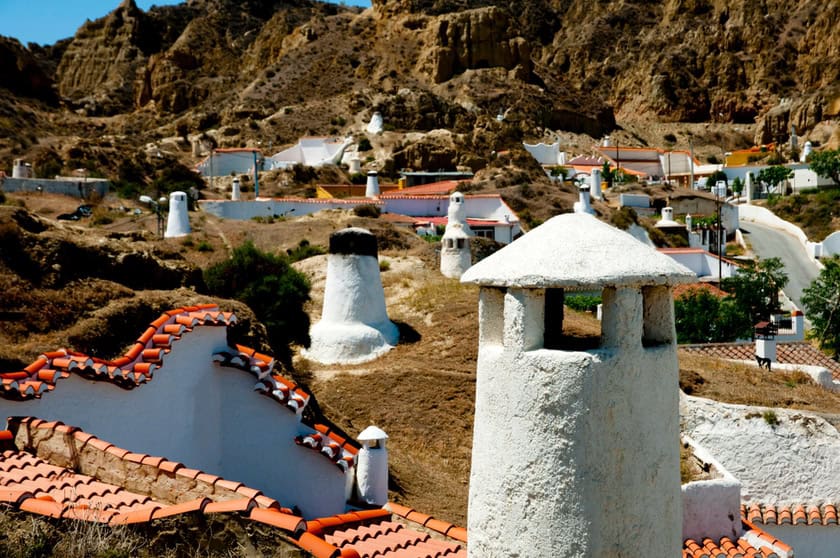
Carved into the clay hills (cerros) that surround Guadix, the cuevas belong to an ancient tradition with roots in the Roman and Arab periods, but which came into its own and found its main social purpose especially after the Reconquista, when these dwellings became a refuge for minorities excluded from the life of the monumental city.
Over time, that peripheral core evolved into the Barrio de las Cuevas, a vast troglodyte district that is still inhabited today, offering visitors a uniquely distinctive urban landscape made up of façades carved into the earth and a dense spread of white chimneys dotting the hillsides around the city.
If you want to get to the heart of the Barrio de las Cuevas, I recommend heading to Plaza Padre Poveda, where you will find the Cueva Museo Centro de Interpretación Cuevas de Guadix (entry: 2.60 euros), the cave church Ermita Nueva, also known as Cueva Santa de la Virgen de Gracia, and one of the neighbourhood’s main viewpoints.
This small square, a quarter of an hour’s walk from the centre but also reachable on the Guadix tourist train, is the best place to begin because it brings together, in a small area, almost all the essential sights of the neighbourhood: the cuevas museum, housed in original cave houses, the church carved into the rock and the Mirador Padre Poveda, which is reached in just a few minutes. From here you can continue on to the Mirador Cerro de la Bala, another lovely viewpoint, ideal for admiring the neighbourhood and the town from a privileged position.
Cattedrale of the Incarnation of Guadix
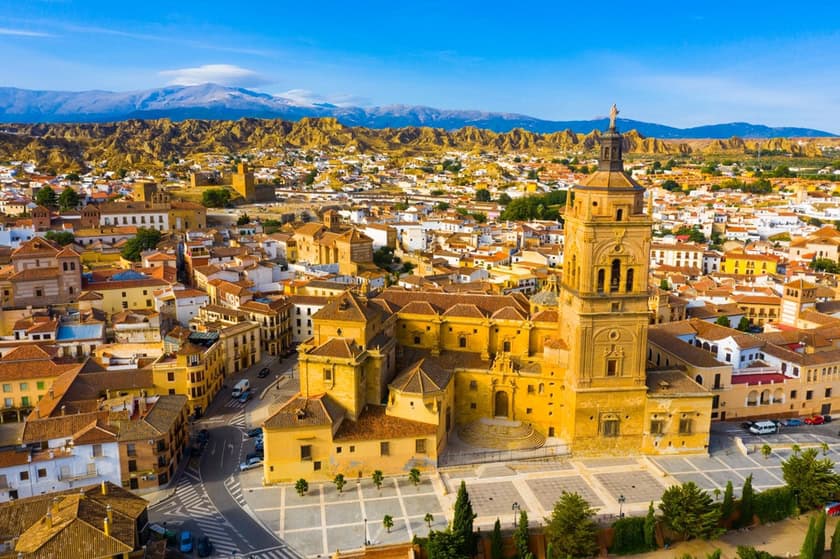
The Cathedral of the Incarnation of Guadix is the monument that best sums up the history of the city and the transition from one culture to another. This monumental cathedral, poised between the Renaissance and Baroque, stands on the so-called Sacred Hill: here, according to official sources, there would first have been a Visigothic cathedral and then the great Arab mosque, before the current building, constructed between the 16th and 18th centuries. The visit thus makes it possible to grasp the outcome of a long historical and artistic layering, still clearly legible in the layout of the complex.
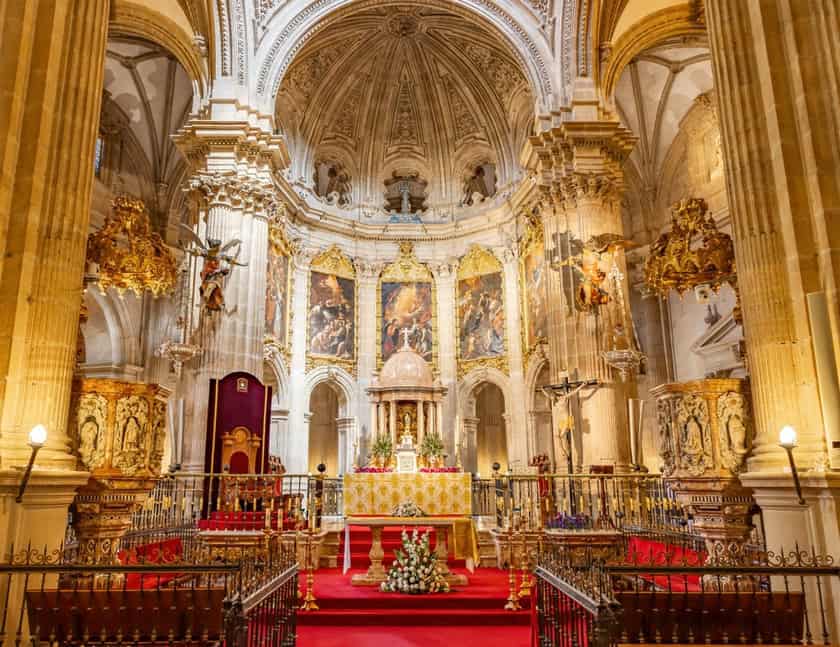
The cathedral still dominates Guadix’s urban skyline today with its façade, tower and various monumental doorways, visible from many points in the centre. It is also possible to climb the tower to admire the views over the city and the surrounding area, while inside there is a copy of Michelangelo’s Pietà.
The visiting hours are as follows:
- Monday to Thursday: 11:00-14:30 and 16:00-18:00
- Friday–Saturday: 11:00–19:00
- Sunday: 15:00-18:00
From Monday to Saturday, from 9 to 9.45, admission is free. Here are the prices during regular visiting hours:
- Cathedral entrance: €7 full price, €6 reduced price,
- Cathedral + tower admission: €9 full price, €8 reduced price
- Solo tower: €5
- Guided tour of the cathedral + tower: €12
Alcazaba of Guadix
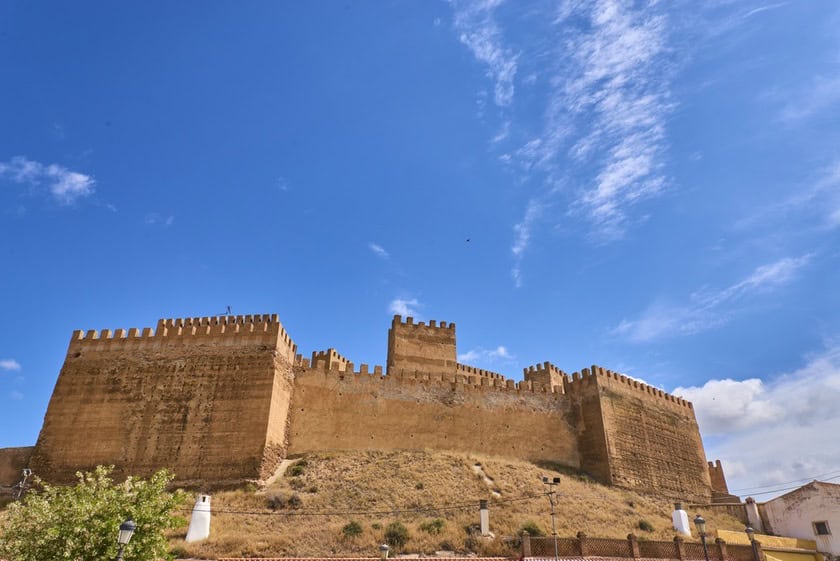
L’Alcazaba of Guadix is there to recall the town’s glorious Islamic past. Its compact mass, of brick and reddish earth, still dominates the upper part of the historic centre today, strongly shaping the urban profile of Guadix. It was a medieval frontier fortress, designed mainly for military control and defence during the Caliphal period, around the 10th century, although the oldest structures identified with certainty — a gate and a tower in the lower area — would date to the following century.
From an architectural point of view, the Alcazaba masterfully preserves the robust, austere character of the great fortifications of al-Andalus, with imposing crenellated walls, towers and a simple yet striking silhouette. At the time this article was written (April 2026), the fortress of Guadix was closed for restoration, and therefore could only be visited from the outside.
Roman Theatre
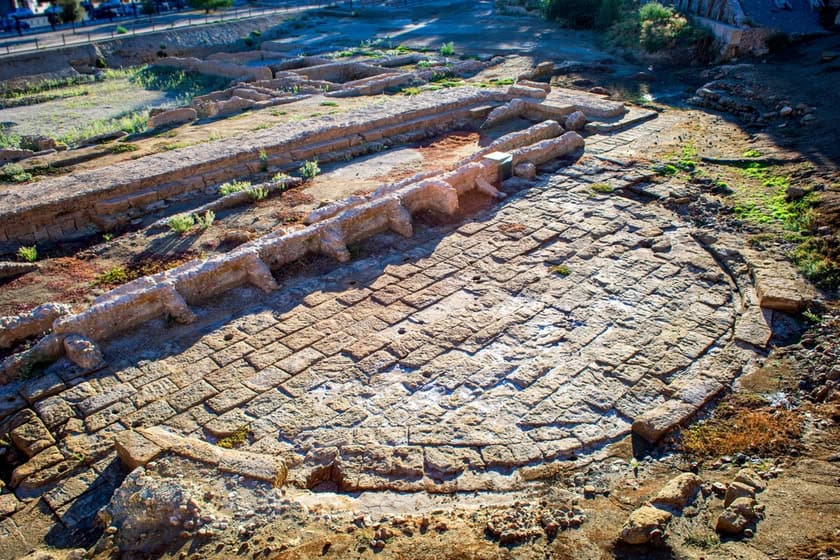
At the gates of the centre, in the lower part of the city, are the remains of the Roman Theatre of Acci, the site that allows us to trace Guadix back to its Roman phase, when the city was the ancient Colonia Iulia Gemella Acci, founded to receive the veterans of the legions after the Battle of Munda (45 BC). The theatre, built at the beginning of the second quarter of the 1st century AD, was part of a monumental complex of almost 6,000 square metres and clearly bears witness to the status achieved by Acci in the imperial period.
The visit is possible only on a guided tour on Sunday at 10:00, with mandatory booking and tickets available from the Tourist Office. The price is 2.60 euros for adults, 1.55 euros for pensioners, 2.05 euros for groups and free for under-14s.
Plaza de la Constitution
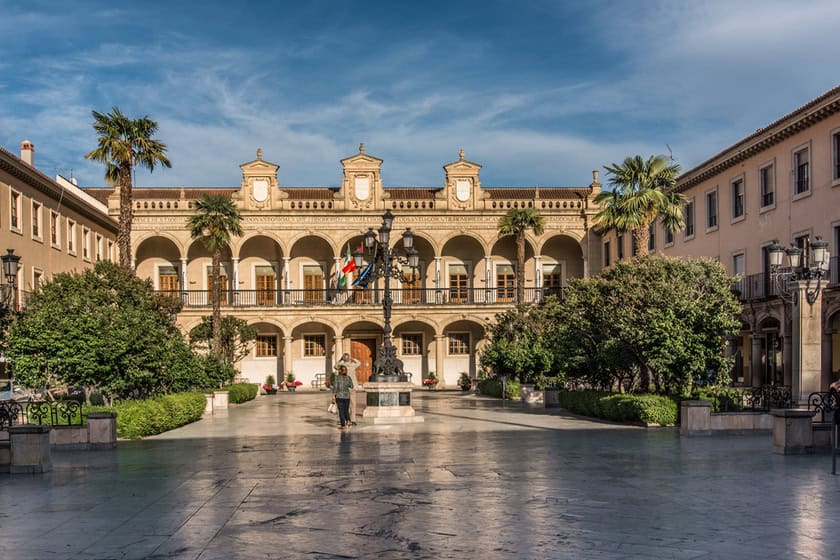
To get a taste of everyday Guadix, it is worth making your way to Plaza de la Constitución, the main square in Guadix. It was created between the late 16th and early 17th centuries as the city’s new civic space, in keeping with the urban reorganisation of the Renaissance period, as shown by the ancient 17th-century arcades, now incorporated into the Oficina de Turismo building. There are also a few restaurants here, one of which I recommended in the section on where to eat in Guadix.
Hospital Real de la Charity
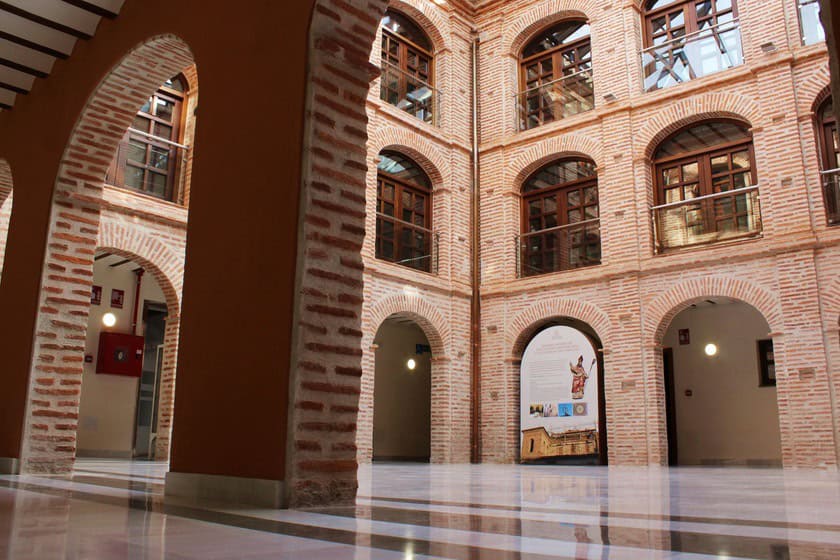
The Hospital Real de la Caridad is an interesting visit for anyone who wants to discover a less well-known side of Guadix’s history. The complex preserves objects, accounts and stories spanning almost five centuries of history linked to care and charity, and inside you can see the rooms of the old hospital, a historic pharmacy (botica) and the church of San Torcuato.
Hospital Real de la Caridad is open from Tuesday to Saturday, from 16:00 to 18:00. The full ticket costs 5 euros, while the reduced group ticket is 3 euros.
Church of Santiago
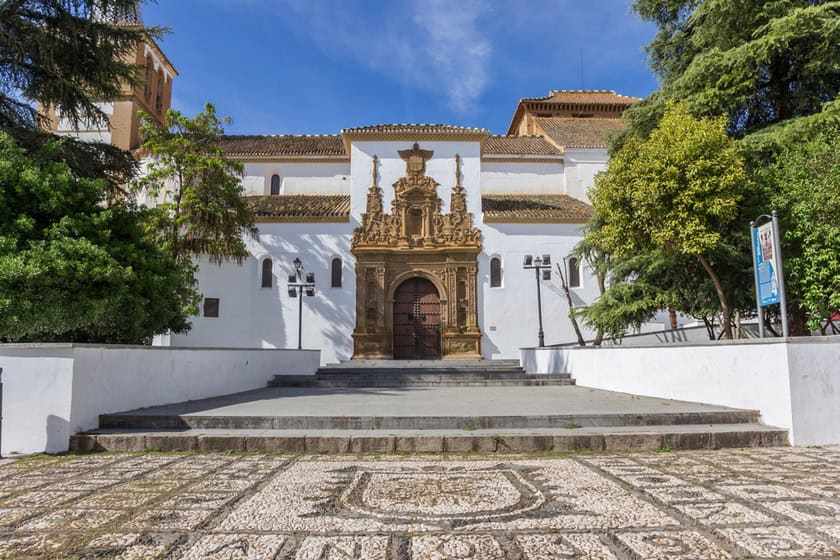
The Church of Santiago is one of the most interesting religious buildings in the historic centre of Guadix. Designed by Diego de Siloe, it retains a traditional Mudejar layout and is above all known for its splendid Plateresque façade, one of the most notable elements of the city’s architecture. Even without going inside, simply admiring its exterior is enough to understand why it is considered one of the most interesting churches in Guadix. According to the official opening hours, it is normally open half an hour before Mass: in winter at 6:30 pm, in summer at 8:00 pm.
Parish of Santo Domingo
Among the various churches in Guadix, I would also mention the Parish of Santo Domingo, now known as the Church of San Miguel, which originally belonged to the former convent of Santo Domingo, founded in 1500 by the Catholic Monarchs. The church was built between 1530 and 1550: its very simple façade still displays the original Renaissance portal with the Dominican emblem.
Inside, the floral and grotesque motifs, along with the figures depicted on the wooden ceiling of the nave, stand out in particular, as do the Mendoza coats of arms in the main chapel and some paintings with Dominican subjects. The church can be visited, but as it is a place of worship, it is advisable to enter discreetly and check for any closures or changes to opening times before planning your visit.
Mirador de la Magdalena
Located in a different position from the other two miradors already mentioned, the Mirador de la Magdalena clearly shows, in the foreground, the eponymous Iglesia de la Magdalena, the Cathedral, the Alcazaba and, in the distance, the Barrio de las Cuevas, set against a backdrop of eroded hills and small mountains.
Where to eat in Guadix
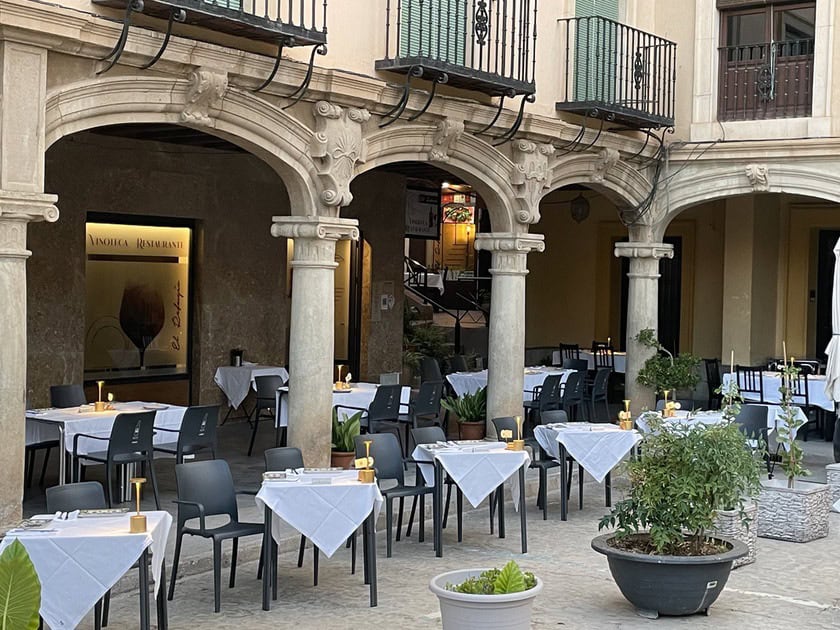
Do you need a recommendation for lunch or dinner in Guadix? Here are a couple of places to try in the town:
- Restaurante El Refugio: this quiet, quality restaurant is right on Plaza de la Constitución, in the heart of Guadix (see photo above). A good idea is to have dinner here, at one of the outdoor tables overlooking the square, perhaps trying their patatas a lo pobre, a typical Granadan dish made with potatoes, onions and peppers. Their fillet steak and artichoke heart are also very popular.
- Taberna El Paciego: this tapas bar is a simpler and cheaper option, ideal for a quick lunch with a sandwich (bocadillo) or proper tapas in generous portions. It is a little outside the centre, in the direction of Mirador de la Magdalena.
Where to stay in Guadix
Very probably, you will be thinking of visiting Guadix as an intermediate stop before or after your stay in Granada, so it is unlikely that you will need to stay overnight there. If, however, my account has captivated you and you would like to devote a little more time to this little town, or it is useful to you for itinerary reasons, here is where I recommend you stay:
- Casa Cueva Picoesquina: would you like to sleep in a cave house in the cave quarter? This is one of the best in Barrio de las Cuevas: understated but well furnished and equipped, cool without the need for air conditioning, and with a terrace with barbecue. Perfect for an experience from times and places long past.
- Hotel Palacio de Oñate: is the cave-house experience not for you? Then perhaps this elegant hotel, right in the historic centre, just a stone’s throw from the cathedral and the main streets of Guadix, is a better option. It offers spacious rooms, stylish common areas and all the amenities of a traditional hotel, including a restaurant and spa.
The surroundings of Guadix
If you’ve decided to spend more time in this area, the good news is that there’s no shortage of things to see around Guadix: “end of the world” views, imposing castles, dolmens and little villages hidden among the badlands. Here are the best ones, based on my experience.
Granada Geopark
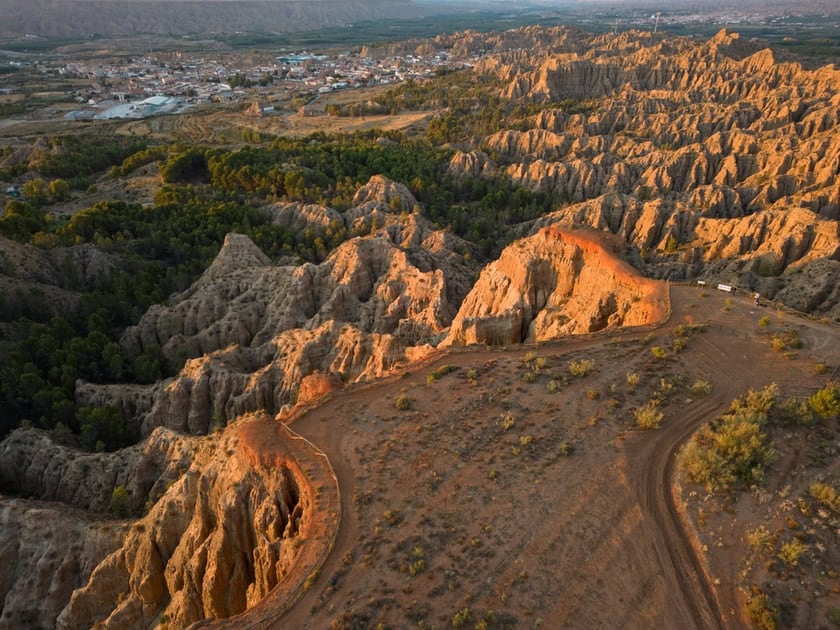
The Granada UNESCO Global Geopark, or more simply the Geopark de Granada, is the name given to the vast region that forms the natural backdrop to Guadix and the surrounding area. Here the landscape is made up of clays and other soft sediments which, carved and shaped over centuries by erosion, have given rise to a system of badlands, canyons, plateaux and badlands of a reddish hue that may bring to mind certain landscapes of the western United States. It is precisely this type of terrain, workable and sufficiently stable, that has favoured the emergence of the cuevas, which we have seen are one of the area’s characteristic features.
Below are some tips for visiting the most accessible parts of the park independently. If, on the other hand, you are looking for a guided tour, have a look at the one linked below, departing from Guadix:
Granada Geopark Off-Roading Tour
Gorafe
If you want to see the Geopark’s most spectacular side, you’ll need to head towards the Gorafe area, where some of the most scenic badlands in the whole region open up. About 40 minutes from Guadix lies the Mirador del Puntal de Don Diego, one of the most remarkable viewpoints: from here, the eye ranges over an almost lunar landscape of ravines, ridges, gullies and eroded reliefs stretching as far as the eye can see.
In the same area there is also the Parque Megalítico de Gorafe, famed for the presence of over 240 dolmens spread across several prehistoric necropolises; some can be found along the road to the viewpoint, although reaching them means factoring in short stretches on unpaved tracks, which could become difficult to navigate if it has rained.
The Purullena, Marchal and Beas de Guadix area
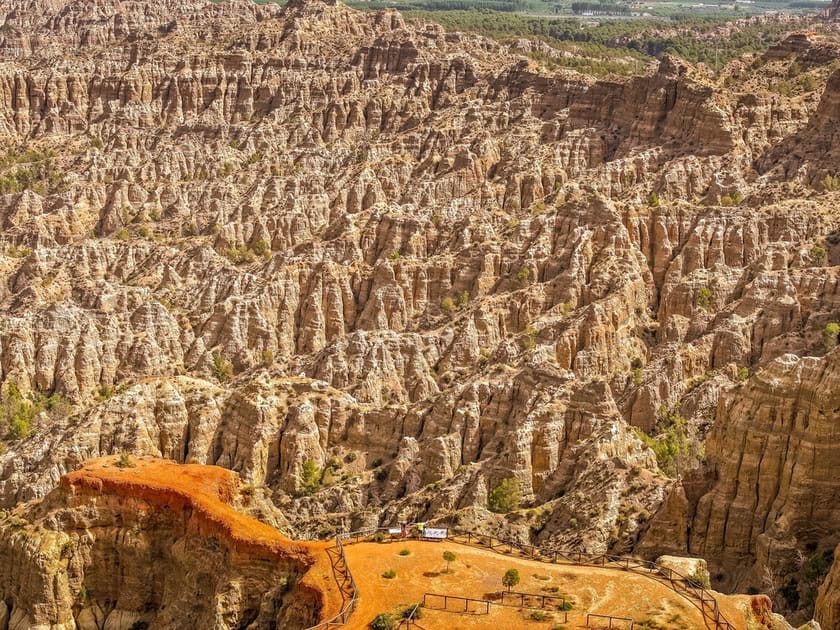
Certainly, the Gorafe area is not exactly round the corner, especially if you do not want to spend too much time visiting the surroundings of Guadix. If you want to stay closer, the most immediate area to explore is around the “cave villages” of Purullena, Marchal and Beas de Guadix, which are crossed by the Granada Geopark Badlands Route. Here the presence of badlands is already quite evident and clearly shows the relationship between the area’s geology and its habitability.
There is a fantastic viewpoint for admiring this landscape: the Mirador del Fin del Mundo, in the municipality of Beas de Guadix. Official access is on foot from the village (here), following an uphill track of about 1 km (0,6 miles).
If you have little time and are travelling by car, you can follow the example of many travellers, who reach the area via Paulenca and take here onto a dirt track: in this case it is worth checking the condition of the road surface, especially after rain, and only tackling it with a suitable car.
You can also reach two other very scenic viewpoints, very close to one another, by taking this road on the route from Guadix to Purullena, and driving for about 4 km (2,4 miles):
- Mirador Cárcavas de Marchal: overlooks the small village of Marchal, but also offers a fine landscape of eroded hills.
- Mirador Badlands de Purullena: more remote and atmospheric, it offers a closer view of the badlands at a point where the gorge is narrower.
In fact, continuing along the same ridge, you can also reach the area of the Fin del Mundo, but the route becomes less straightforward and follows other unpaved side roads.
Castillo de La Calahorra
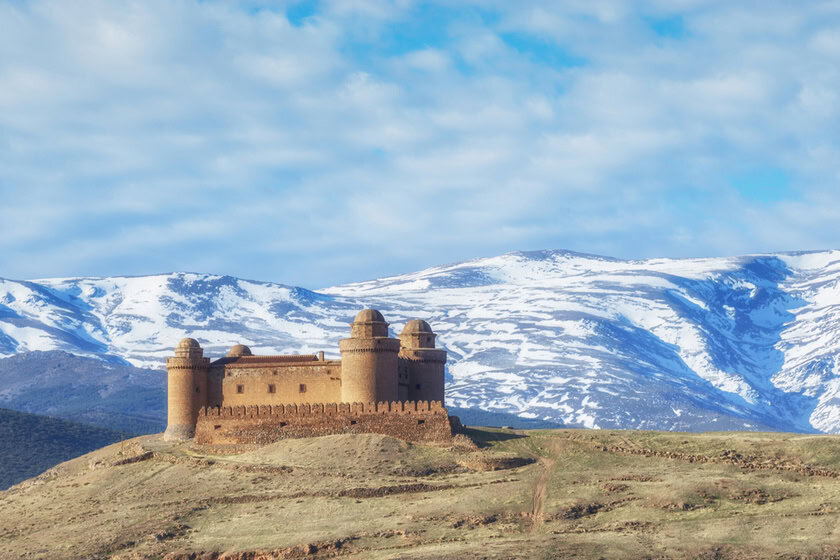
Among the most interesting excursions in the area around Guadix, I’d also recommend a short detour to La Calahorra, a small village in the Marquesado de Zenete, in whose vicinity stands one of the most astonishing castles I have seen in eastern Andalusia: the Castillo de La Calahorra. Set apart on a hill at the foot of the Sierra Nevada, the castle is unmistakable even from afar: even without going inside, it is already worth the detour for the striking view it offers over the landscape of the Marquesado, with the Sierra Nevada as a backdrop.
Built at the beginning of the sixteenth century at the behest of the Marquess of Zenete, it is regarded as one of the first major works of the Italian Renaissance in Spain and stands out for the contrast between its massive, austere exterior – with four cylindrical corner towers topped by domes – and the elegant Tuscan-style inner courtyard. Visits are possible only on guided tours on Fridays, Saturdays and Sundays, strictly by online booking.
