The Catedral de la Encarnación di Granada (Cathedral of the Incarnation) is the building that best represents the Catholic reconquest of Granada. When the Catholic Monarchs freed the city from the Moors in 1492, there were two defining gestures they wished to make: the use of the Alhambra as their palace and the replacement of the great mosque with this church.
With this article we want to provide practical help in organising a visit to the Cathedral of Granada and the Royal Chapel (Capilla Real), two monuments whose history and features are well worth knowing.
Contents
Why and how to visit Granada Cathedral
Granada, you’ve probably already realised, is one of the cities in the world where different cultures have alternated and intertwined, in some cases peacefully, in many others with bloody wars. One of the main characteristics denoting the differences between the peoples who have contested the city is religion.
The Cathedral of Granada is not merely a church; it is a symbol of one people’s dominance over another, a sign of the supremacy granted by God over this territory. This idea likewise informed its architectural design and led to the building being enriched with numerous treasures.
How to get there
The church’s main façade is on Plaza de las Pasiegas, and it is from here that you enter. Granada has, over the centuries, lost much of its population and can now be explored comfortably on foot, so you won’t have any trouble locating this monument, as with most of the city’s points of interest. On Gran Vìa de Colòn, near the square, the buses C1, 111, LAC stop, which may be useful if you’re staying outside the historic centre and want to get here quickly.
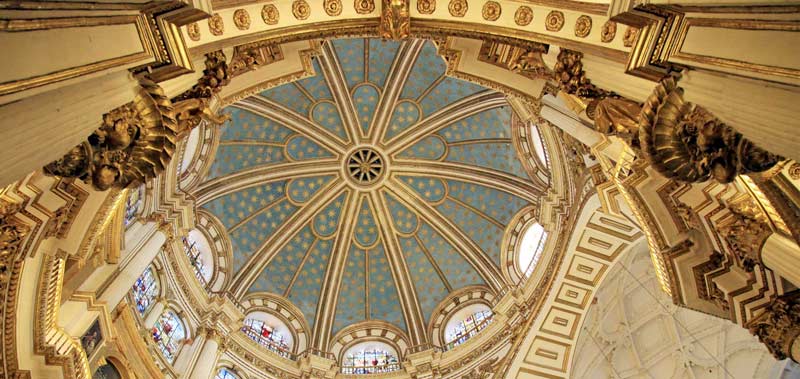
Granada Cathedral Tickets
Admission ticket prices are as follows:
- Full price: €7 (audio guide included)
- Reduced for students up to 25 years old and people with disabilities: €5 (audio guide included)
- Children up to 12 years and people with disabilities: Free
- Groups: €5 (audio guide included)
Every Wednesday, from 15:15 to 17:00, the entrance is free for everyone. However, you must book your entry on this page of the Archdiocese of Granada website.
Opening hours of the Cathedral
The cathedral is open to visitors at the following times:
- Monday to Saturday: from 10:00 to 18:30
- Sundays and public holidays: from 15:00 to 18:15
Historical background
It is the imperial‑city project of Emperor Charles I that gives meaning to Granada’s cathedral. 21 May 1492 thus marks the beginning of the church’s history, with the foundation of the cathedral chapter. Initially the seat was the royal mosque of the Alhambra, but in January 1493 Hernando de Talavera was appointed the first archbishop of Granada and in October 1494 the cathedral began a series of relocations: to the church of Santa Maria in the Realejo first, then to San Francisco, until the final move that only took place in 1502.
Despite Queen Isabella’s wishes, the old mosque was not considered suitable to serve as the cathedral and it was decided to build a new grand church here, in the city centre, beginning with the Royal Chapel of Granada.
The exterior of the cathedral
As I mentioned, this church has symbolic significance as well as purely religious and artistic‑architectural importance. Seeing it in its urban context is essential. The sheer size of the building, with a footprint of 377 ft × 213 ft (115 x 65 metres) strikes you in the way it sits in the middle of the city: it seems that, when moving around the centre, every street leads back here, and that it is not isolated but connected to the surrounding buildings. In a way that is true. It was conceived as a monumental complex that, in addition to the Royal Chapel, includes the Lonja, the parish of the Sagrario, the College of San Fernando and various houses and outbuildings.
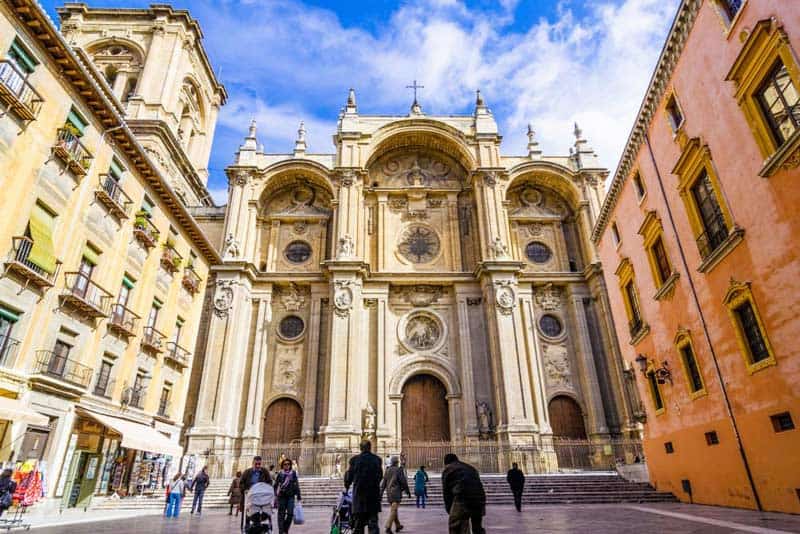
Beside it are the archbishop’s palace and the important building that housed Granada’s first Christian university, which from 1769 became the Church Curia and is today the Centro Cultural Nuevo Inicio. But what strikes most is the neighbourhood in which the church is situated: the surrounding streets were those of traditional trades and markets, where people worked and traded. It was therefore the liveliest part of the city, chosen, not by chance, as the definitive site for the principal church.
My advice is to start from Plaza de las Pasiegas to see the façade, then move to the left to admire the bell tower and continue along via Carcel Baja to see the doors of San Jerònimo and del Perdòn. On arriving at the Placeta de Diego Siloe, you can finally see the Torre del Reloj and the Puerta del Ecce Homo.
The façade and the towers
As I mentioned, we are in the craftsmen’s quarter. Plaza de las Pasiegas owes its name to the cloth merchants. The monumental baroque façade that dominates the square has two important characteristics: its architecture and decoration and, above all, its iconographic programme. Both aspects are closely linked to the interior decorations and the symbolism of light.
According to Siloe’s design, the Renaissance façade was flanked by two imposing towers of 266 ft (81 mt), conceived with three square stages topped by an octagonal chamber. For various reasons, the right-hand tower was never built and the left-hand one was completed to a height of 187 ft (57 mt). Although lower than originally intended, the church bell tower is nonetheless a fine example of the architectural innovations of the 16th century, with a prevailing verticality and a fusion of different styles. Architecturally, the first stage is of Doric order: it has pilasters with niches and large arches. The second, of Ionic order, features paired pilasters and arches with simple, graceful coverings. The third is of Corinthian order and its columns begin with a large arch which in turn houses groups of three arches for the placement of the bells.
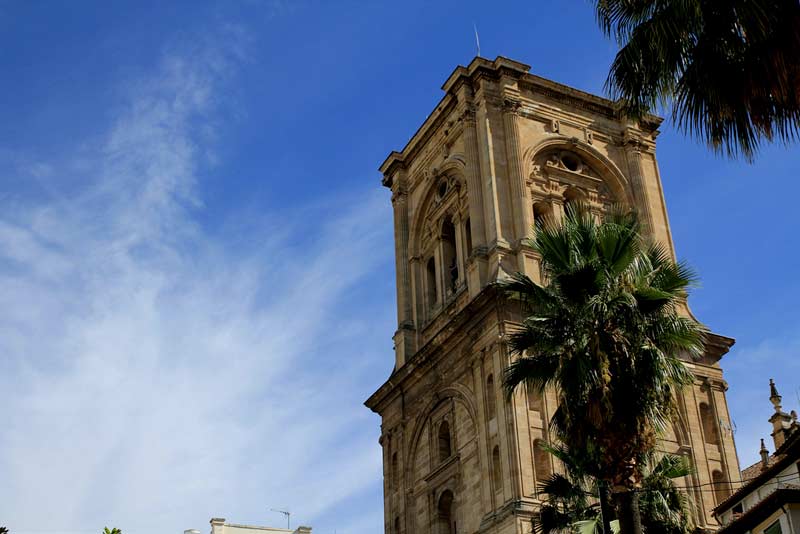
Much simpler and smaller than the main bell tower, the Torre del Reloj stands at the back of the church, beside the dome. It has two bells, one above and one below: the upper one for the hours, the lower one for the quarters.
The treasures it contains

The first thing to see on entering is the main chapel, which is also the centre of the church’s architecture: it was originally intended to be the sovereign’s burial place and it is here that the visitor is accompanied on entering the church. This space began to take shape in 1528 with the Alba-Siloe project and is unique among all Spanish cathedrals for its iconography.
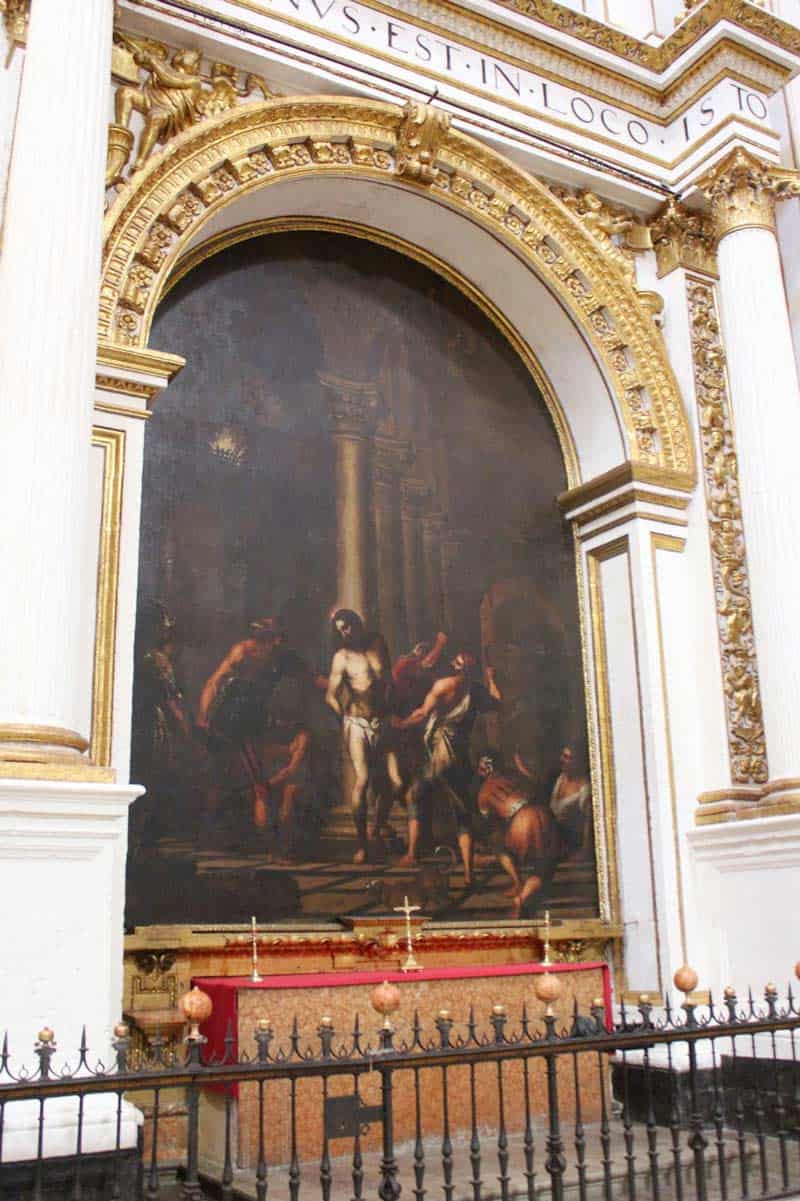
Before getting there, however, we come across two altars. The Altar del Santo Cristo is famous for its painted altarpiece, with works by Cano’s disciples Pedro Atanasio Bocanegra and Juan de Sevilla. Of the latter, the painting of the Flagellation of Jesus is regarded as one of the finest paintings in Andalusia. The same two artists decorated the Altar de San Bernardo. Here Bocanegra’s work, the Nursing Madonna, is perhaps the more significant: an explosion of colour, a display of all the artist’s abilities. With these two altars we find the first hints of the concept of ‘salvation’, which will later be developed in the works of the Main Chapel.
The Main Chapel, not to be confused with the Royal Chapel, is the focal point of the cathedral, inspiring harmony born of the use of different materials and the meeting of diverse styles and historical influences. Here Siloe attempts to emulate the Holy Sepulchre in Jerusalem, doing so with distinctive features of the European architectural tradition.
Paintings and sacred art
The Catedral de Granada has an exceptionally rich pictorial heritage, distributed in the Main Chapel and on the west front, in the side chapels and on the perimeter altars, as well as those housed in the cathedral museum. The oldest painting contained in the building is the Virgen del Pòpolo, a gift from Pope Innocent VIII to Queen Isabella. The church also houses examples of Flemish, Italian and Spanish painting.
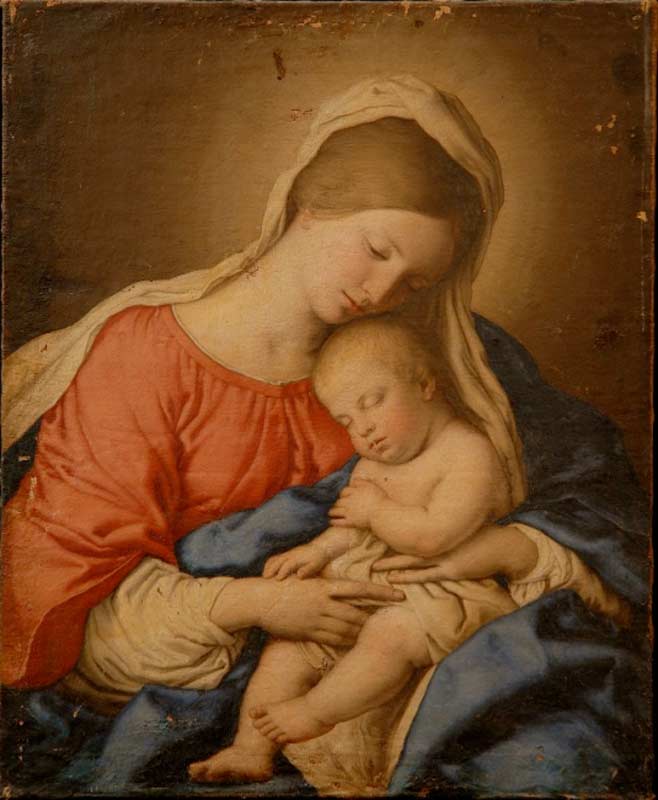
In the museum, by contrast, the oldest and most famous painting is the Virgen con el Niño, whose author is unknown and which some even attribute to Leonardo da Vinci. Unfortunately, the canvas is in a very poor condition and has had to undergo numerous restorations. Virgen con el Niño dormido is instead a painting by Giovanni Battista Salvi, known as Il Sassoferrato. Juan Sánchez Cotán’s Inmaculada Concepción de María and Francisco Pacheco’s Virgen de la leche (master of Velázquez and Cano) are other paintings of interest. The latter, also known as The Virgin of Bethlehem, corresponds to the frequent iconographic theme of Mary in the act of breastfeeding the infant Jesus. Surrounding Mary is a group of ten angels: five play musical instruments, while others sing with an open book in their hands. In the top right corner, a child angel dressed in white completes the maternal scene.
The Royal Chapel: the mausoleum of the Catholic Monarchs
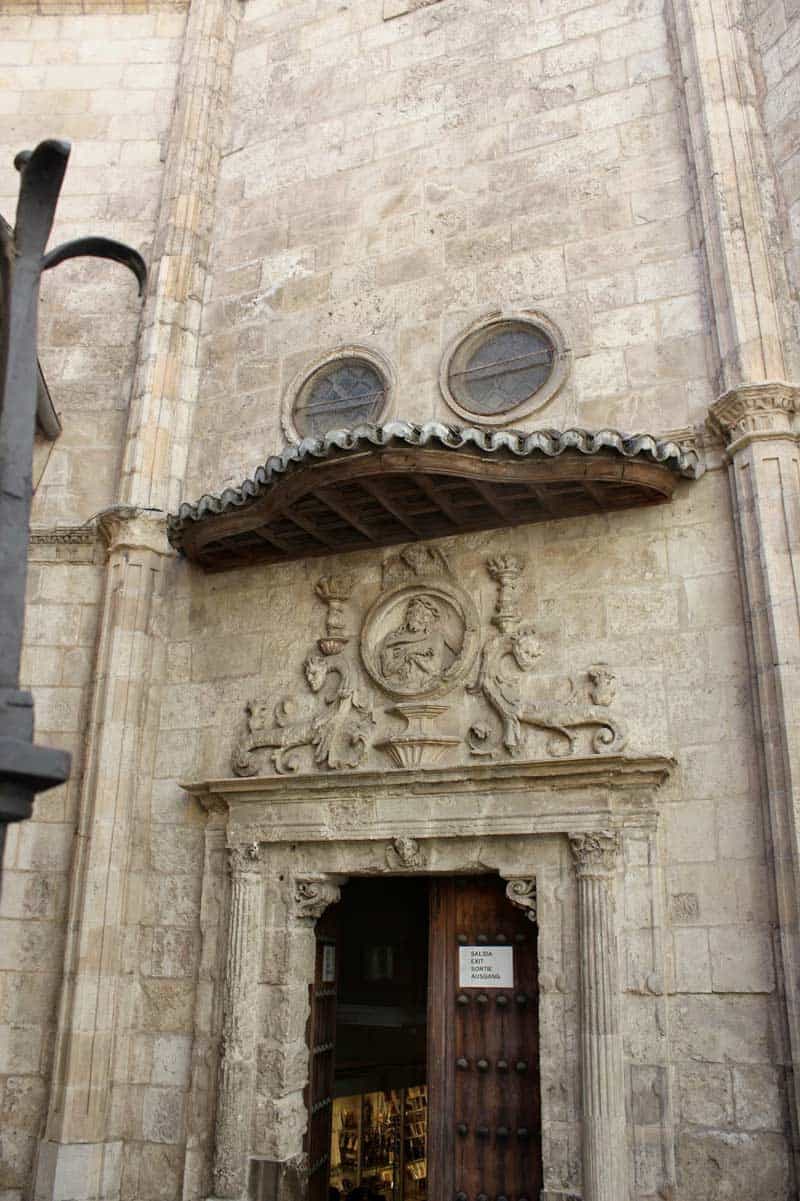
Beside the Cathedral stands the Royal Chapel. It is here that the remains of the Catholic Monarchs Ferdinand and Isabella are kept, as well as those of Philip the Handsome and Joanna the Mad. In 1506 the two sovereigns ordered the construction, together with the cathedral, of this mausoleum so they could rest there after their deaths.
The Royal Chapel is adjacent to the cathedral, it is not part of it, but at the same time embodies its grandeur through its architecture with the dome and the stained-glass windows, the sculptures and the paintings by Alonso Cano. Perhaps the portals are the ones of greatest interest. The three doors of the Ecce Homo, of Saint Jerome and of the Forgiveness.
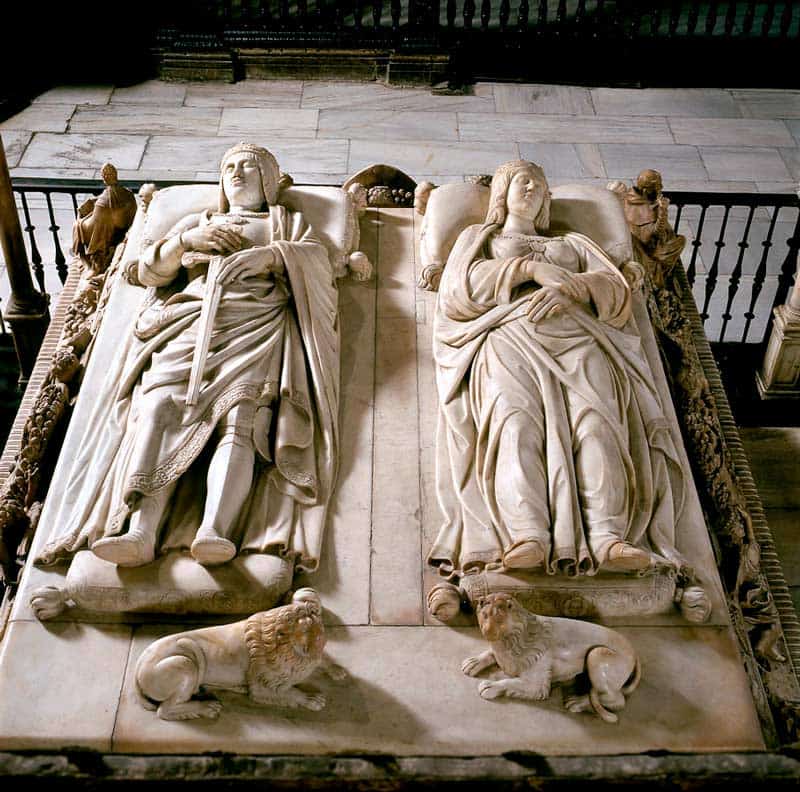
Inside, alongside the works of art that express pictorial talent, particularly that of Alonso Cano, the place of greatest interest is the mausoleum. The work of the Florentine sculptor Domenico Fancelli, the figures of the two sovereigns are depicted recumbent. The king is given a military character: full armour and cloak, his hands on his sword. The queen is represented with simplicity, her hands gently resting on her body, which conveys humility and honesty: the virtues that were associated with her in life. At the sovereigns’ feet are two lions, symbols of royalty and vigilance. On the sides of the tomb, meanwhile, four roundels depict the baptism of Christ, the resurrection, Saint George with the dragon and Saint James.
Opening hours and tickets for the Royal Chapel of Granada
The Royal Chapel is open to visitors from Monday to Saturday from 10:15 to 18:30; on Sundays and public holidays from 11:00 to 18:00. The admission fees are as follows:
- Full price: €7 (audio guide included)
- Reduced rate for students up to 25 and people with disabilities: €5 (audio guide included)
- Children up to 12 years and people with disabilities: Free
On Wednesdays a number of free admissions for everyone are available. It is, however, necessary to book in advance on this page of the Archdiocese of Granada.
Guided tour of the Cathedral and the Royal Chapel
For those who wish to visit the two buildings with the support of a tour guide, I recommend a tour lasting 2 hours which, of course, also includes the admission ticket in the price. At the link below you can read all the details of the tour.
Guided tour of the Cathedral and the Royal Chapel
Where to stay
If you’re looking for accommodation near the cathedral, it means you’ve chosen to stay in the centre of Granada, the ideal location for getting around the city on foot. Open the link below to see which hotels are available in this area, and what advantages or disadvantages staying in this neighbourhood may have compared with surrounding areas, also consult our article things to do in Granada.
