In the air, the evocative atmosphere of Semana Santa can still be felt, but the city of Seville is already preparing for a celebration that is perhaps even more folkloric and spectacular: the Feria de Abril de Sevilla.
If you haven’t had the chance to visit Seville during Holy Week, the people of this welcoming and open city offer you a second opportunity to discover and appreciate it. The Feria de Abril takes place about two weeks after Semana Santa and the people of Seville build a true city within a city.
That’s right: every year an area of 275,000 m² between Los Remedios and Barrio Tablada is set up to host a huge celebration of lights, colours, music, traditional dress, food stalls, carriages, horses and performances by the best flamenco and sevillana dancers. On top of that, there is also a large funfair with 400 different rides. For a whole week the entire city takes part in the Feria de Abril festivities!
Contents
Seville’s Feria de Abril: two centuries of history and tradition
Since ancient times, markets have shaped the social life of every city in the Mediterranean area. They were an opportunity for traders from different areas to meet, an occasion that was not limited to simple buying and selling, but became a fundamental moment of knowledge, comparison and sharing. Over the centuries the importance of markets has increased, especially for cities at the crossroads of trade routes or for border towns, just like Seville.
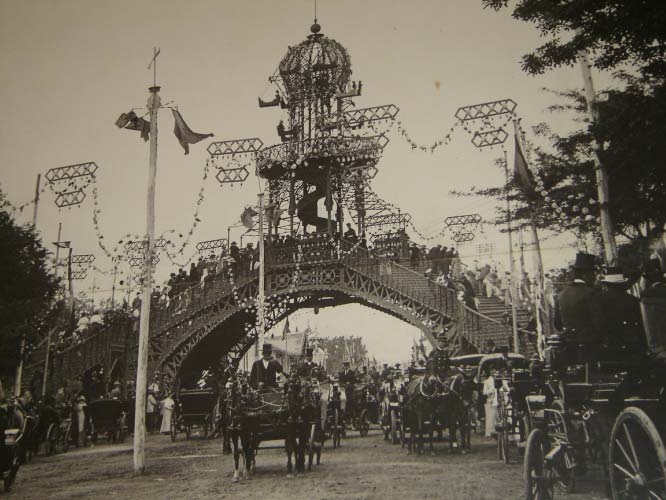
If we want to establish an official year for the beginning of Seville’s Feria de Abril, we can say without a shadow of a doubt that it was 1847. The livestock market took place in April in the Prado de San Sebastián and was approved by Queen Isabella II. The festive spirit of the Sevillians was quick to emerge and, in a few years, the simple agricultural market became a true city-wide celebration, especially in the three most important casetas (a sort of stand, to use an anglicism): those of the ducal family of Montpensier, the City Council and the Casino of Seville.
Today there are more than 1000 casetas inside which you will find tables, chairs, dance floors and above all a magical atmosphere. Just as at the end of the nineteenth century and unlike other famous and important festivals such as the Feria de Malaga, the casetas are mostly private and belong to the families or the city’s most important organisations. But it is well known that the people of Seville are very welcoming, and it is not uncommon to be invited in to celebrate with them.
When is Feria de Abril?
The Feria de Abril does not have a fixed date because it follows the Easter period. It generally takes place two weeks after Semana Santa, but there have been times when this became three if Easter was celebrated very early, or just one week if Easter fell in mid-April. The Feria de Abril should normally begin on a day in April (but this does not always happen).
For example, the Feria de Abril 2027 in Seville will take place from 13 to 18 April.
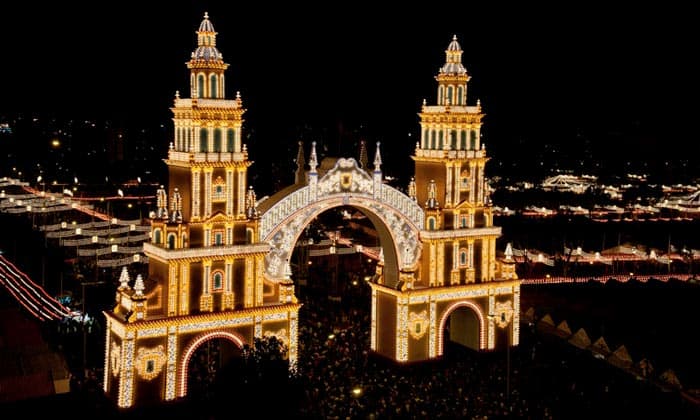
The start of the Feria is marked by the Alumbrao, the moment when all the lights of the illuminations are switched on one by one. It is the mayor who places their hand on the button that turns on the first lights: gradually the whole Portada (the main gate) lights up and the sparkle of the lights announces the start of the fiesta. The following Sunday the Feria officially ends with a grand fireworks display.
A curiosity? The word Alumbrao does not exist in Spanish; only the verb alumbrar does. Yet tradition has shaped the language to its own liking, and today there is not a single Sevillian who does not know this word.
Where does it take place?
The festivities are organised in a large area in Seville’s Los Remedios district, extending as far as Tablada. The Recinto Ferial is called the Real de la feria (or Recinto real), and it is the actual area where you will find the famous casetas, whose number now exceeds a thousand. You will also see the portada, the enormous gateway built and designed each year by a different engineer or artist: with its magnificent lights, it marks the entrance to the Feria City, at the start of Calle Antonio Bienvenida.
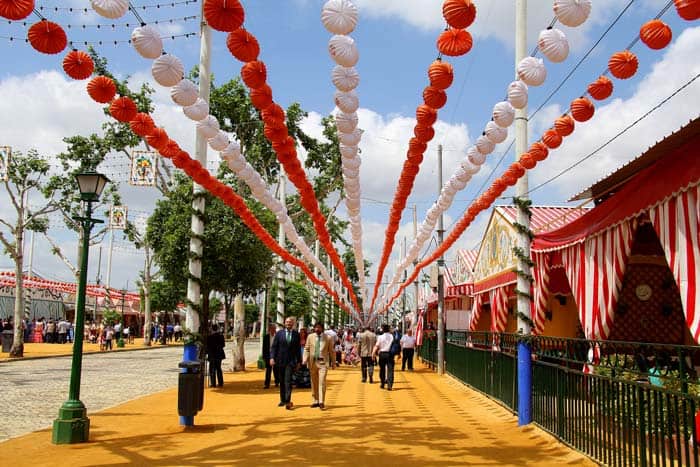
The streets are covered in earth mixed with sand, like that of a bullring, and each street is named after a famous bullfighter. Naturally, it is only possible to get around on foot, on horseback or by carriage. Not far away is Calle del Infierno, a large amusement park for adults and children. In Calle del Infierno there are no fewer than 400 different rides and, during the afternoon, it is the ideal place to take children.
The streets begin to come alive after 14:00 and the events continue until morning throughout the days of the week dedicated to the Feria de Abril.
How do you get there?
We usually advise those visiting Seville not to use the car in the city and to hire one only when you are about to set off on a tour around Andalusia, if you decide to do so. However, if you have already hired a car, bear in mind that it is possible to reach the Feria by car, and that there are more than 20,000 parking spaces in the immediate vicinity of the recinto ferial.
In this regard, around a thousand season tickets are usually sold each year for those who prefer to arrive by car throughout the week. The largest car park at the Feria is the Charco de la Pava, with over 10,000 parking spaces: here is a map.
For tourists, however, the best way to get to the Feria remains public transport.
- by metro: the three Line 1 stations closest to the Recinto Ferial are Plaza de Cuba, Parque de Los Príncipes and Blas Infante. The service is non-stop.
- by bus: from Prado de San Sebastián (Calle José María Osborne) a special line (Especial Feria) runs which takes you practically to the Feria gate. There are also other lines that get close to the Recinto, among which I would mention 5, 6, 41, C1 and c2.
- on horseback: starting from Calle Virgen de Luján, the horses cross Calle Asunción and arrive directly at the portada. The service is characteristic but a little pricey (around 95 euros),
Characteristic features and curiosities of the Feria
There is probably no other festival that manages, on its own, to unite and represent so well the thousand souls of Seville and Andalusian culture.
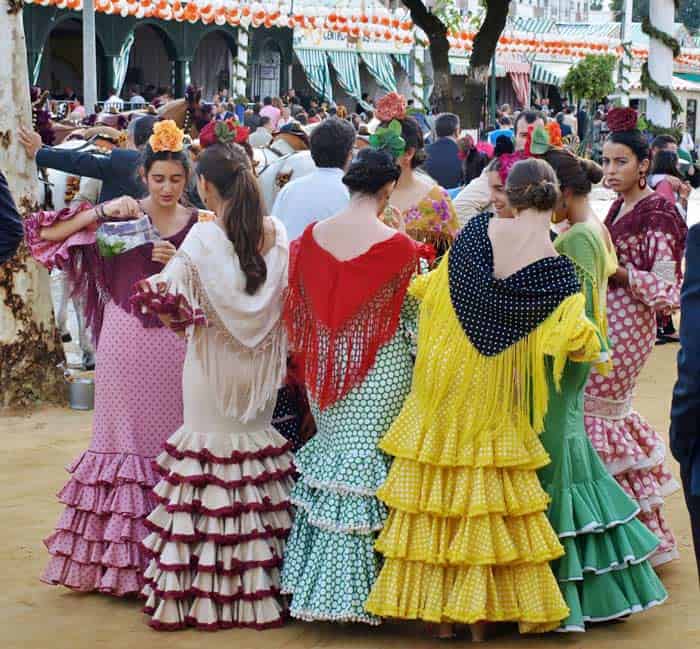
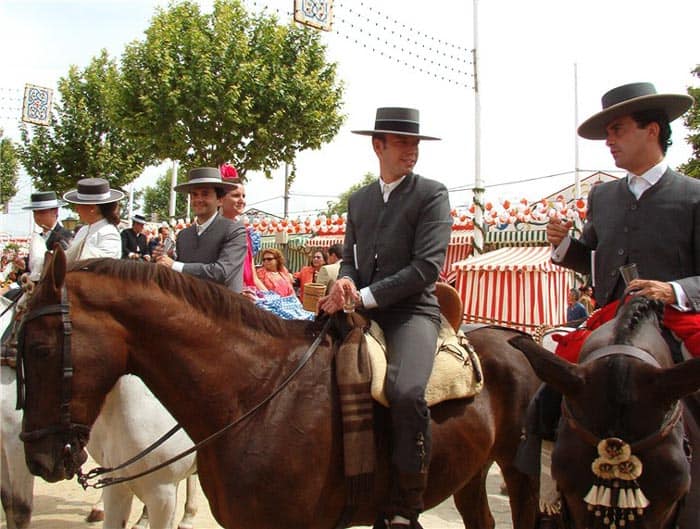
- During the Feria de Abril you will have the chance to see women wearing beautiful colourful dresses called trajes de flamenca or trajes de gitana. Don’t be surprised to see them on elderly ladies or little girls too: the tradition is passed down from generation to generation. The men are no less impressive, with their traje corto: waistcoat or short jacket, narrow trousers, hat and boots.
- The notes of the sevillana drift into the air and the dancing in the casetas begins. For anyone who does not know, the sevillana is a type of flamenco originating in Seville itself and danced masterfully by many of its inhabitants.
- The challenge between man and animal cannot be missing in the city that is the home of the bullfights, and so every day at the Plaza de Toros de la Maestranza you can, if you are interested, admire the skill of famous bullfighters during the corrida. The shows take place daily during Feria de Abril week.
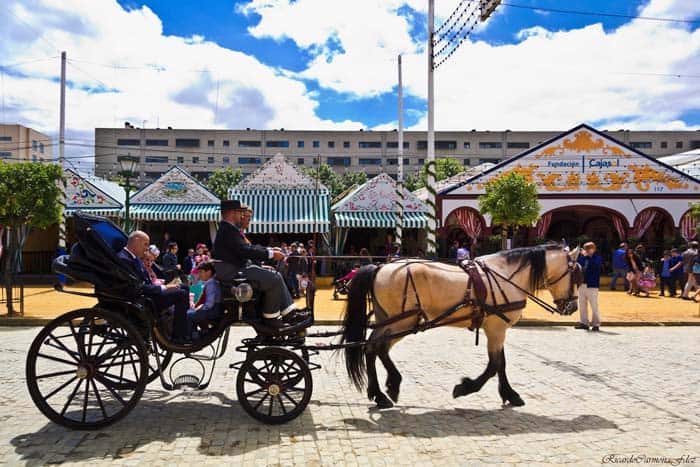
- Not just bulls. According to a typically Andalusian custom, an equally beautiful animal is honoured during the feria celebrations: the horse. Splendid equine specimens parade during El Paseo de Caballos y Enganches. The carriages are true works of art, some very old. The parade of no fewer than 1,400 carriages takes place on Sunday at 12 noon in Plaza de Toros de la Maestranza.
What to eat and drink in Seville during the Feria
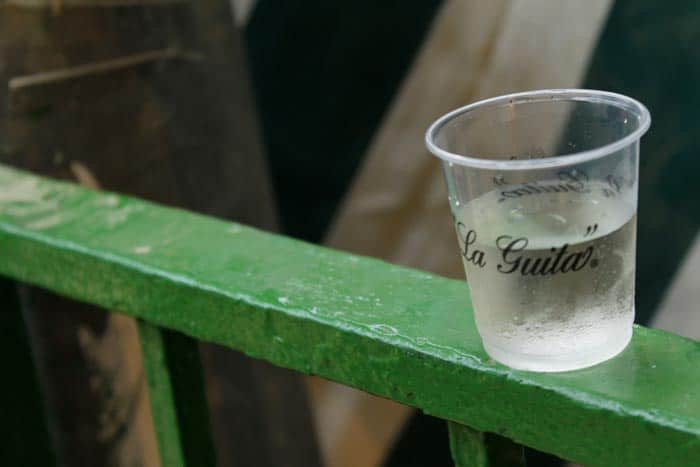
As with any respectable folk event, food is an important part and, as true foodies, we can’t miss a thing. The Feria opens with the Cena del Pescaito, a dinner of excellent fried fish. As for drinks, I recommend trying the rebujito, a drink served everywhere at the Feria made with wine and lemonade or lemon-flavoured fizzy drinks, fino wine or a glass of manzanilla. If you prefer something stronger, many serve sherry, an Andalusian institution that originates right in nearby Jerez.
The tapas are plentiful: jamon, cheese and much more are waiting for you. At the end of the evening, you can’t go to bed without first having eaten churros and drunk a good hot chocolate.
Where to stay?
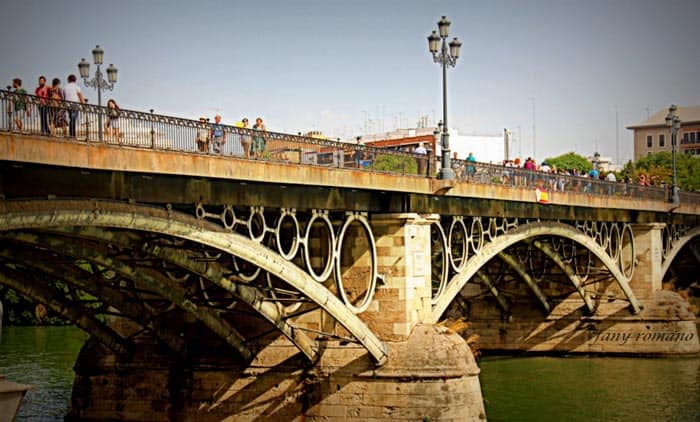
Don’t leave it until the last minute: this week of festivities is magical and people come from all over Spain to experience it, so if you plan ahead you’ll have far more choice! The best solution is probably to find accommodation in the nearby Barrio de Triana, but the central districts of Seville are also a good option because, as you’ve seen, the Feria area is well served by public transport.
Accommodation tips in the Triana district
Tips for all the other districts of Seville
Seville Fair will make you love and appreciate this splendid city even more. From the switching on of the many lights of the portada on Sunday night to the firework display the following Sunday, the Feria de Abril is a key moment for the city in which culture, tradition, history and fun come together to make everyone who takes part feel good.
