Among the towns not to be missed in north-eastern Andalusia are Úbeda and Baeza, two gems of the Spanish Renaissance that have been recognised by UNESCO as a World Heritage Site. A symbol of Spain’s rebirth after the Reconquista, when the Catholic Kings of Castile recovered the territories occupied by the Arabs, today they are among the must-see places in the province of Jaén.
Contents
Where it is and how to get there
Baeza is located less than 50 km (31 miles) north-east of Jaén. This is the location, and it takes just over half an hour to get there from the city. By contrast, you should allow around an hour and a half from Granada and around an hour and 45 minutes from Cordoba, which are the other two nearest major cities. There are also daily guided tours from both Jaén and Granada.
When travelling by public transport, the best option is to set off from Jaén, as there is a direct bus that takes less than an hour.
What to see in Baeza
Even just taking a walk through the town centre is worth the trip: every corner is a surprise, and you are filled with beauty among monuments and historic buildings. But let’s see which ones are absolutely worth seeing and which can be visited inside.
Baeza Cathedral
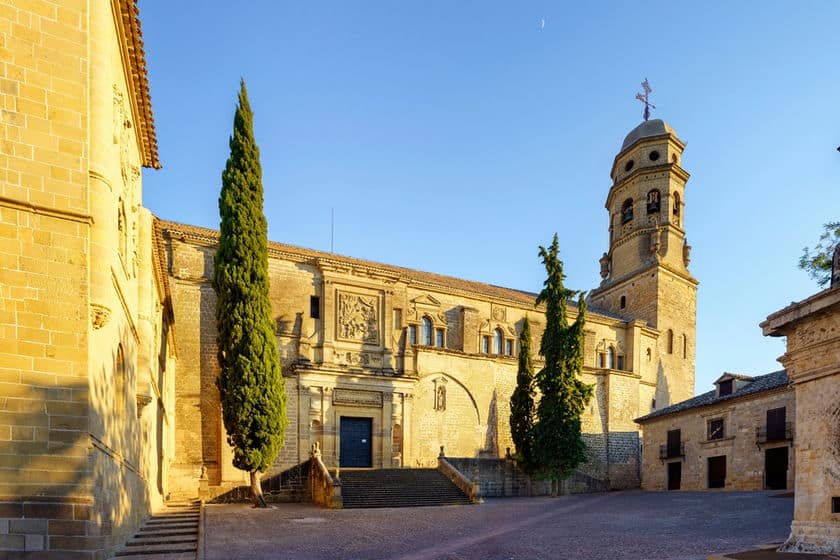
Plaza de Santa María is the city’s most important square, where several historic buildings overlook, including the Catedral de la Natividad de Nuestra Señora de Baeza. Let’s say that if you have little time and have to choose just a few, this is the town’s main church and also one of the most significant places from a historical point of view, as it was among the first to be consecrated during the Reconquista. The oldest part is the base of the bell tower, built on the foundations of the former minaret of the mosque on which the church was erected.
The current cathedral was completed in 1593, but the Gothic columns and vaults of the apse belong to the church built at the beginning of the century, much of which collapsed in 1567. Among the parts that survived the collapse, the Puerta de la Luna stands out: the portal, easily recognisable for its 13th-century poly-lobed arch topped by the 14th-century Gothic rose window. Inside, the most important feature is the so-called Golden Chapel, which stands out from the others for its imposing Mannerist portal and magnificent gilded altarpiece. The hexagonal pulpit in embossed, polychrome sheet metal is also very interesting. Not to be missed is the cloister surrounded by arcades, beneath which open five former chapels, all very distinctive.
Attached to the cathedral is also the Palacio de los Cabrera, also known as Casa Consistoriales Altas: in effect, the historic town hall, used as such under the reign of Philip the Handsome and Joanna the Mad. On the façade are in fact the coats of arms of these royals, together with that of Charles I, which was added later, during the renovation carried out in the 16th century.
The cathedral is open at the following times:
- From April to September:
- Monday to Friday: 10:00 am–2:30 pm and 4:00 pm–7:30 pm
- Saturday: 10:00 am–7:30 pm
- Sunday: 10:00 am–6:30 pm
- From October to March:
- Monday to Friday: 10:00 am–2:30 pm and 4:00 pm–7:00 pm
- Saturday: 10:00 am–7:00 pm
- Sunday: 10:00 am–5:30 pm
These are the prices for admission tickets for the self-guided visit, which includes an audio guide:
- Adults: €7
- Senior (65+ years): €6
- Young people and students (13-25 years old) and disabled visitors (33-60%): €5
- Children (0-12 years) and disabled people (over 60%): free
It is also possible to take a guided tour, which, in addition to the cathedral, includes the climb up the tower and a virtual reality experience that offers an innovative view of the church. The ticket costs €10 for everyone aged 13 and over (free for under-13s and for disabled visitors). If, instead, you want a city tour that also includes a detailed visit to the cathedral, I recommend this one.
Biglietto per la cattedrale di Baeza
Fuente de Santa María
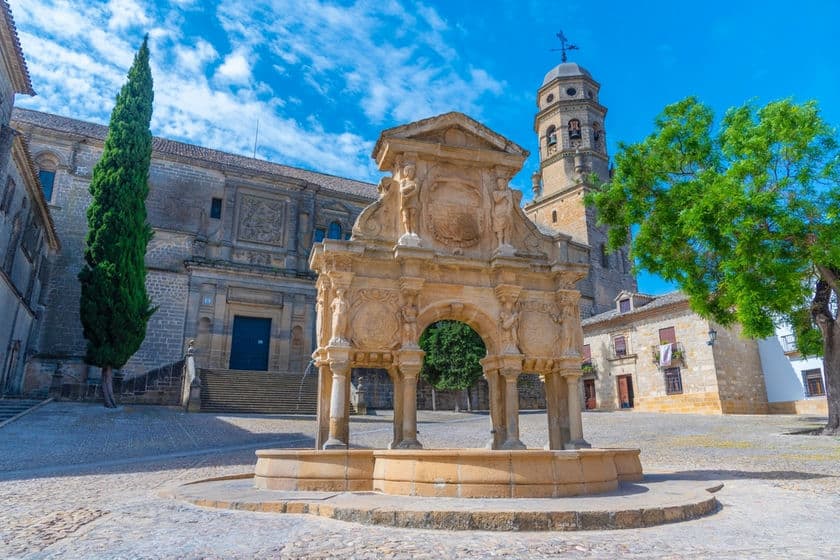
In the same square, opposite the cathedral, we find what is perhaps the town’s most iconic monument: the Fuente de Santa María. This large monumental fountain was built in 1564 to celebrate the arrival of the aqueduct in the city. A real achievement, so much so that the fountain was designed in the form of a Roman-style triumphal arch. The eight columns supporting the structure are topped by as many allegorical caryatids, whilst in the side bays there are four commemorative plaques explaining the construction of the aqueduct.
Jabalquinto Palace
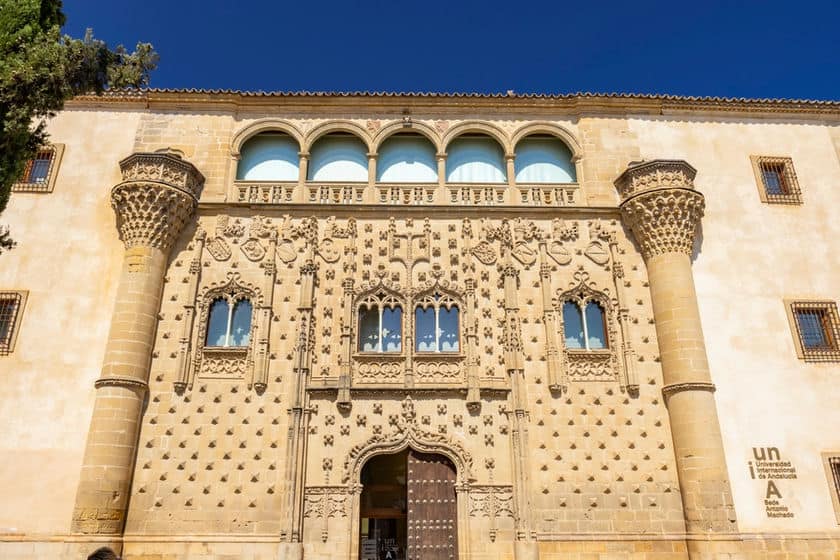
It is impossible not to stop in front of the façade of the Palacio de Jabalquinto: one of the finest examples of Isabeline Gothic, which stands out from all the other buildings for its diamond patterns and richly decorated mullioned windows. It was built in the 15th century and today is one of the premises of the Antonio Machado International University of Andalusia.
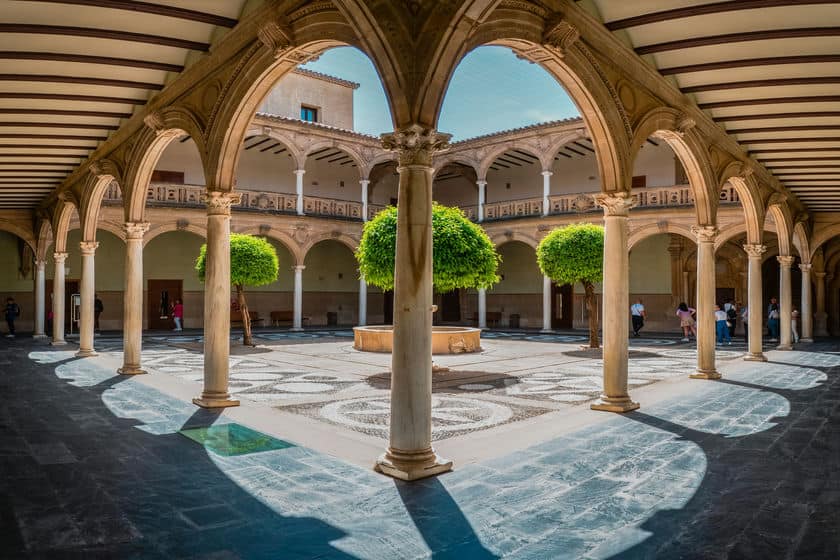
Crossing the threshold, you enter a Renaissance courtyard surrounded by a double colonnade with marble columns, and to reach the upper floor you climb a monumental Baroque staircase. It can be visited free of charge.
Church of Santa Cruz
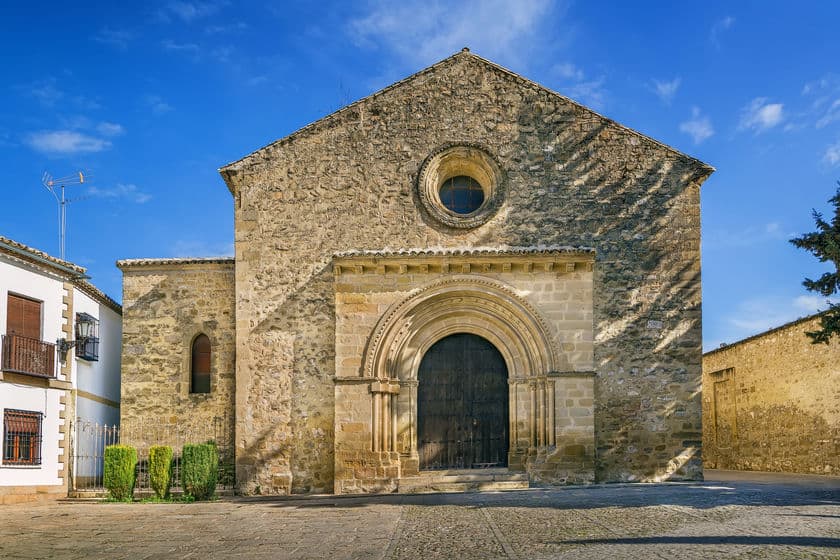
If the city cathedral is the most imposing and famous church, the Iglesia de Santa Cruz is a small hidden gem. It may go unnoticed by the most distracted tourists, but it deserves particular attention because it is unique in its kind. In fact, it is the only late Romanesque church in all of Andalusia, built in the 13th century after King Ferdinand III reconquered these lands.
The austere style of the exterior contrasts with the nearby Palacio de Jabalquinto, but the portal supported by columns with capitals decorated with acanthus leaves is very beautiful. Inside, the church houses an important fresco depicting the martyrdom of Saint Sebastian.
It can be visited free of charge, but opening times vary depending on the times of the celebrations.
Old University and Antonio Machado’s classroom
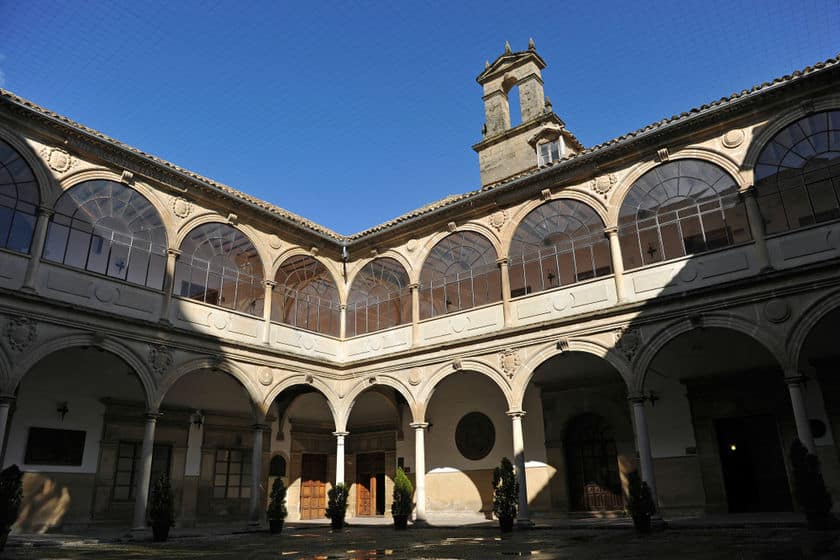
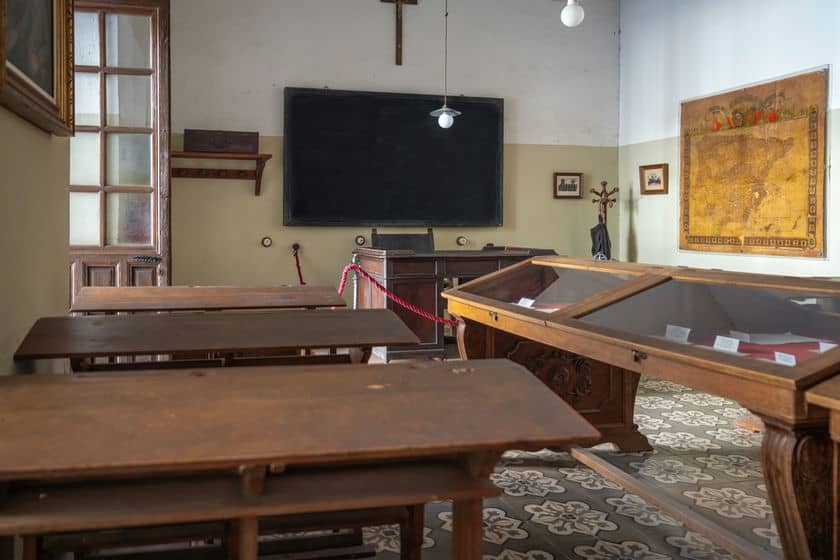
The Old University, that is to say the former university, is a Renaissance building famous for its beautiful inner courtyard, surrounded by arcades supported by Tuscan columns. The main hall, or Paraninfo, still has its historic wooden chairs and is still used for events. After the university moved to new premises, this building was turned into a secondary school and among its teachers there was none other than Antonio Machado. It was here that the poet published his “Complete Poems” and met Federico García Lorca, who was then a young student.
You can visit the classroom where Machado taught, still preserved as it was. Among the curiosities is the professor’s desk chair, full of small burn marks caused by the cigarettes the professor was constantly smoking. There are also some oddities, such as the desks being different depending on whether they were used by left-handed or right-handed boys.
The final part of the building is occupied by the Chapel of Saint John the Evangelist, which ends with the Barbudo Arch, one of the city gates.
A walk along the walls
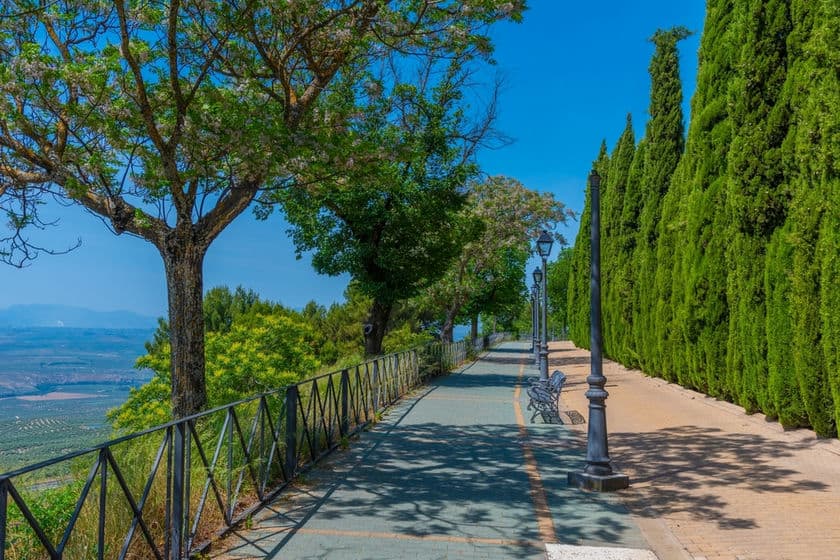
Among the most fascinating features of Baeza are its walls of Arab origin – later reinforced after the Reconquista – which bear witness to the fact that this was a stronghold located in a frontier zone. It was in fact close to the border between Christian and Muslim territories.
Although the full city wall no longer survives today, some sections remain and it is well worth walking along them to gain access to truly incredible viewpoints. From there, you look out over the olive groves that characterise the province of Jaén and seem to stretch as far as the eye can see.
I suggest starting from this car park and walking along the Paseo de las Murallas. Along the way you’ll also find the Monument to Antonio Machado,
Other things to see in Baeza
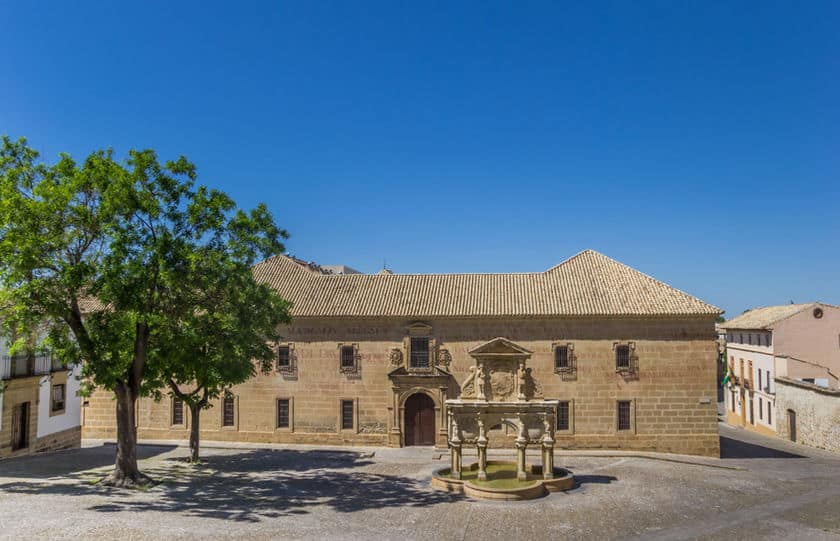
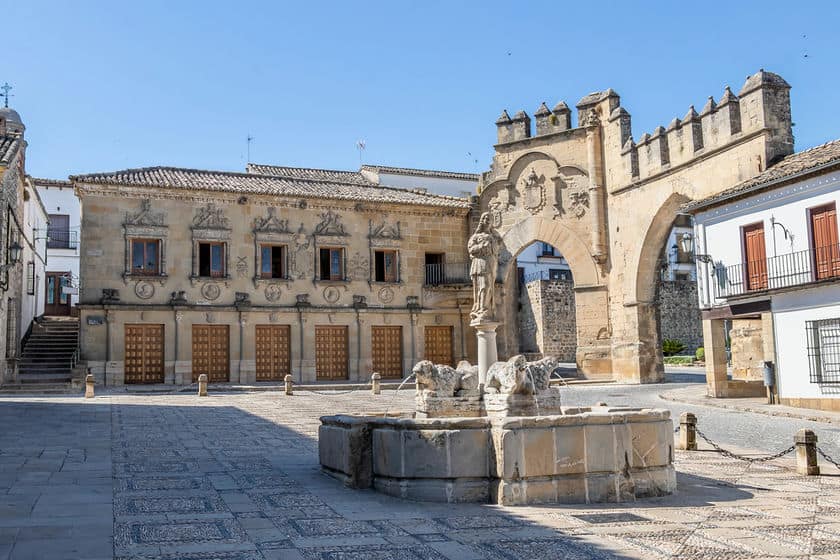
- Seminary of San Felipe Neri. On the opposite side of Plaza Santa María from the cathedral stands another building which, although less striking aesthetically, is highly important from a historical point of view. Today it houses the Antonio Machado International University of Andalusia, but it was built as a seminary in 1660 and remained in use as such until 1969. Particularly striking are the so-called “vítores”, that is, the numerous inscriptions of social criticism, created during the Middle Ages, which can in effect be understood as forerunners of today’s graffiti.
- Fuente de los Leones. In addition to the Fuente de Santa María, Baeza also has another very famous fountain, the Fuente de los Leones, dating back to the 16th century. It is located in Plaza del Pópulo, which because of this fountain is also called Plaza de los Leones. As the name suggests, its defining feature is the statues of four lions, above which rises a female figure, who appears to be Imilce, Hannibal’s wife.
- Torre de los Aliatares. In Plaza de España there is this imposing tower, one of the still-standing elements of the ancient perimeter walls from the Muslim period, dating from the 12th century. It is also called Torre del Reloj because the clock is installed on top of it.
- Museo Antonio Moreno. Known as the “Pintor de los Azules” (Painter of Blues), Antonio Moreno is a painter originally from Baeza whose works have featured in many collections, including three pieces in the collection of the Spanish royal family, and he has received many honours, being declared one of the best Spanish painters of the 20th century. In his hometown there is a museum dedicated to him.
Guided tours of Baeza
To get to know the city better, you can join a guided tour. Here are the main ones:
There are also tours that include nearby Úbeda and which can also be done starting from Jaén or Granada:
Where to stay in Baeza
Baeza is small, but it still has a range of places to stay overnight during a road trip exploring this part of Andalusia. In the map above you can see the various hotels available, but below I’ll give you some targeted recommendations:
- Hotel Puerta de la Luna: among the very best hotels, this very beautiful 4-star property is distributed across 3 buildings around a patio in perfect Andalusian style. It also has a swimming pool and two restaurants.
- Hotel Cetina Palacio de los Salcedo: right in the centre I also recommend this additional 4-star hotel, truly of excellent quality. It is housed in a restored historic palace and the interiors are enchanting.
- Hotel Baeza Monumental: as a 3-star hotel, I would instead suggest this one, which is right in the centre and offers different room types, some even with a terrace overlooking a street in the centre.
- Boutique Casa de los Pedraza: here, however, is accommodation created in a restored historic house. The room seems carved out of the rock and is truly very beautiful.
Where to eat in Baeza
If you find yourself in Baeza around lunchtime or dinnertime, you’ll need to eat something. I suggest a few restaurants where you can enjoy typical dishes, starting with Taberna Casa Andrés and Taberna El Arcediano, both very well known for their good food. Also very good, with a truly characterful atmosphere, is Taberna El Pajaro. For something simpler and more economical, but still good, I’d instead recommend Tasca Burladero, perfect for sharing boards, tapas and various dishes.
