Antequera is also known as corazón de Andalucía because of its position in the geographical heart of the Andalusian region. The municipality of Antequera covers a vast area of over 800 square kilometres (308 sq mi) and is therefore the largest municipality in the province of Malaga, and the fifth largest in Spain. Its territory hides towns rich in charm, nature reserves and monuments dating back as far as 4,500 years.
Contents
The natural, historical and artistic heritage of this city is very rich, so I won’t waste any more time and I’ll tell you what to see in Antequera. But first, a little information on how to get to the city.
How to get to Antequera
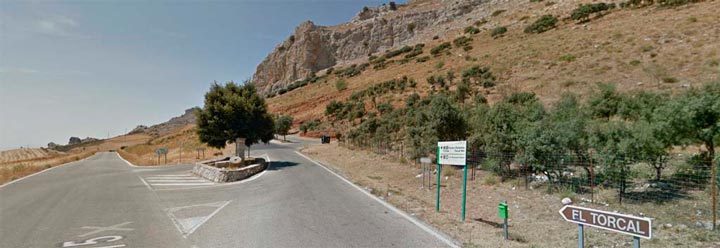
Antequera is easily reached from Malaga, Seville, Cordoba and Granada, so you can easily include it in almost any itinerary that includes these cities. We included it in our itineraries from Seville to Granada and from Malaga to Seville.
- Antequera is located 50 kilometres (31 miles) from Malaga and from the beaches of the Costa del Sol, and just over an hour from Granada, Cordoba and Seville, to which it is well connected via the A-92 Granada-Seville and A-45 Malaga-Cordoba-Madrid motorways.
- If you have not hired a car in Málaga or Seville, you can reach Antequera by public transport: the city has a lovely and important train station.
- Lastly, Antequera is 40 minutes from Malaga airport, 1 hour from Granada airport and around 90 minutes from Seville airport.
What to see in Antequera
Famous for the Neolithic remains discovered in its territory and for its exceptional natural landscapes, the centre of Antequera is no less impressive.
The locals pride themselves on holding 80% of the historical and artistic heritage of the province of Malaga, and admiring its monuments almost convinces us: strolling through the historic centre, you will also have the opportunity to see old mansions with splendid façades, patios embraced by elegant colonnades, Baroque churches worth a visit, such as the Iglesia de San Juan de Dios and the chapel of the Iglesia del Carmen, theatres, markets and local craft shops.
Below, the main attractions of Antequera:
MVCA – Antequera City Museum
The museum is an excellent starting point for discovering and appreciating the city’s history through its most important phases: prehistory, the Roman period, Arab rule and then Christian rule. It is housed in a beautiful Baroque palace, the Palacio Nájera, in Plaza Coso Viejo. It has 20 exhibition rooms, and those devoted to the Roman period are perhaps the most interesting. Here you can see the tomb of Acilia Plecusa and the famous bronze statue of the Ephebe.
- The admission ticket costs 3 euros for adults and 2 euros for children under 12, those over 65 and students. On Sundays, admission is free.
- The museum is closed on Mondays. Opening hours are as follows:
- da martedì a domenica: 10:00-18:00
- chiuso il 25 dicembre, 1 e 6 gennaio; orario ridotto 10:00-14:00 il 24 e 31 dicembre e il 5 gennaio.
Royal Collegiate Church of Santa María la Mayor
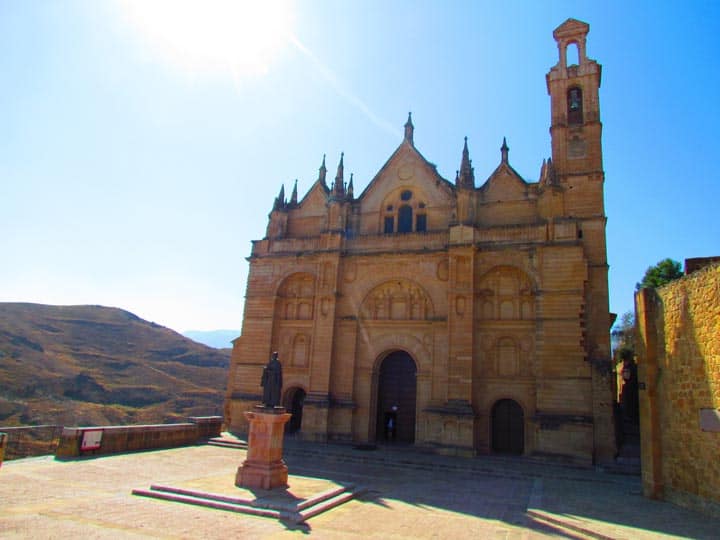
Considered the first Renaissance-style church built in Andalusia, it dates back to the 16th century. Its façade partly recalls Orvieto Cathedral, and the distinctive pinnacles are in Venetian Gothic style. The church has three naves separated by columns with wooden elements in the Mudéjar style. It is located in Plaza de Santa María.
- The admission ticket costs 3 euros for adults, 1.50 euros for pensioners and young people aged 7 to 16, and is free for those under 6. On Tuesdays from 14:00 to 18:00 admission is free.
- The church is open to visitors every day from 10 am to 6 pm.
Alcazaba
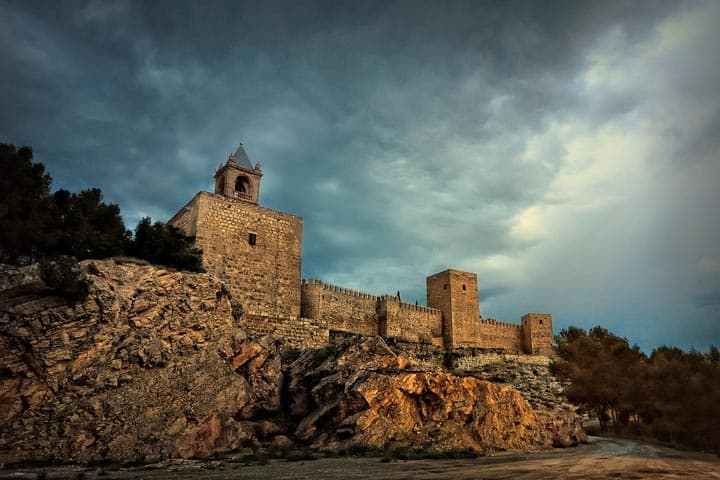
The Arab period was fundamental for the city. The Alcazaba bears witness to the strategic importance of this little town: a fortified enclosure with two imposing towers, the Torre del Homenaje and the Torre Blanca. In the past there were many gateways, and even today you can admire the Puerta de la Villa (now the Arco de los Gigantes), the Postigo de la Estrella and the Puerta de Malaga (now the Ermita de la Virgen de la Espera). Behind the Alcazaba rises the commanding silhouette of the Peña de los Enamorados, which I’ll talk about in a moment.
- The entry ticket (which includes a visit to the Alcazaba and the Real Colegiata de Santa María) costs 6 euros for adults, 3 euros for pensioners and children aged 7 to 16, and is free for under-6s. On Tuesdays from 14:00 to 18:00, admission is free.
- The Alcazaba can be visited every day from 10 am to 6 pm.
- Closed: 25 December, 1 and 6 January.
- Reduced opening hours: 24 and 31 December and 5 January (10:00 am–3:00 pm)
Where to stay?
If you don’t want to miss even one of Andalusia’s paradores, make a note: on Paseo Garcia de Olmo, a quiet green area not far from the Plaza de Toros, you’ll find the exclusive Parador de Antequera. If, on the other hand, you are happy with less prestigious accommodation, you can find what suits you at the link below.
All available accommodation in Antequera
What to see in the area around Antequera: dolmens and much more
Antequera is famous throughout Andalusia for its dolmens. Declared a UNESCO World Heritage Site in 2016, the Dolmen de Menga, de Viera and Tholos de El Romeral are an example of megalithic architecture perfectly integrated into the surrounding landscape and, together with the two natural areas of La Peña de los Enamorados and El Torcal, constitute an important tourist attraction.
Antequera Archaeological Complex Dolmens
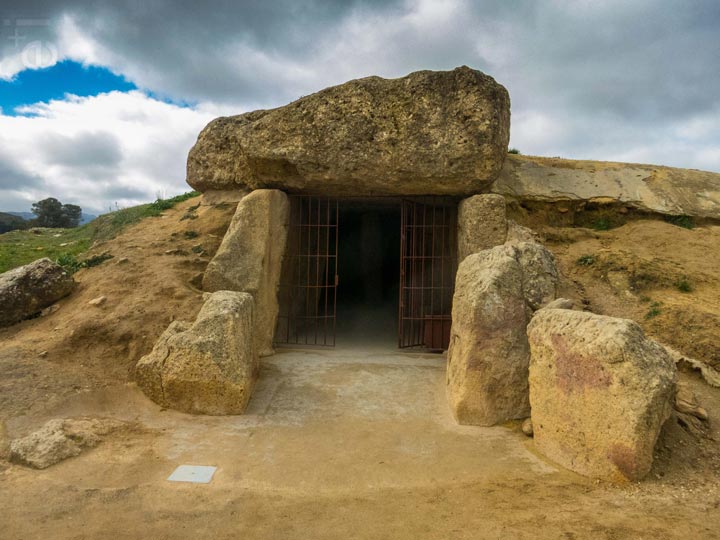
As they are located just outside the town centre (Carr. de Málaga, 5), it is useful to travel by car to reach the dolmen. If you do not have your own vehicle, you can take local bus line 1. Here is a guided tour of the dolmens that is worth considering to make the visit even more in-depth.
Dolmen de Menga
Mastodonic vertical and horizontal stones that create a sepulchre with covered galleries dating back a full 6,000 years. The funerary chamber at the back of the sepulchre is enormous: 6 metres by 3.5. The presence of a well in the funerary chamber makes this dolmen unique in Europe.
The visiting hours for the Dolmen de Menga are:
- 21 March – 20 June: Tue–Thu 9-18; Fri–Sat 9-21; Sun/public holidays 9-15
- 21 June – 20 September: Tue–Sat 9 am–3 pm + night visits 8 pm–10 pm; Sun/public holidays 9 am–3 pm
- 21 September – 20 March: Tue–Sat 9 am–6 pm; Sun/public holidays 9 am–3 pm
- Closed on Mondays (except on the eve of public holidays)
Dolmen of Viera
Near the Dolmen de Menga lies another similar giant: the Dolmen de Viera, probably built around 4,500 years ago. The corridor is 21 metres long and at the end there is a funerary chamber about 2 metres high and wide. The dolmen is oriented towards the rising sun during the equinoxes. Both outside the corridor and inside, you can admire schematic cave paintings.
The opening hours for visiting the Dolmen de Viera are:
- 21 March – 20 June: Tue–Thu 9–18; Fri–Sat 9–21; Sun/public holidays 9–15
- 21 June – 20 September: Tue–Sat 9–15 + night visits 20–22; Sun/public holidays 9–15
- 21 September – 20 March: Tue-Sat 9-6; Sun/public holidays 9-3
- Closed on Mondays (except on the eve of public holidays)
Tholos of El Romeral
This singular and magnificent tomb has the shape of a false dome and two orientations: towards El Torcal and towards the midday sun at the winter solstice. There are two funerary chambers: in the smaller one, intended for offerings, there is an altar. The Tholos de El Romeral is located in an industrial area about 3 km (1,8 miles) from the archaeological site where the other dolmens are found.
- You can visit the Tholos de El Romeral during the following opening hours:
- 21 March–20 June: Tue–Thu 9:00 am–6:00 pm; Fri–Sat 9:00 am–9:00 pm; Sun/public holidays 9:00 am–3:00 pm
- 21 June–20 September: Tue–Sat 9:00 am–3:00 pm, plus evening visits 8:00 pm–10:00 pm; Sun/public holidays 9:00 am–3:00 pm
- 21 September–20 March: Tue–Sat 9:00 am–6:00 pm; Sun/public holidays 9:00 am–3:00 pm
- Closed on Mondays, except when Monday falls on the eve of a public holiday
El Torcal
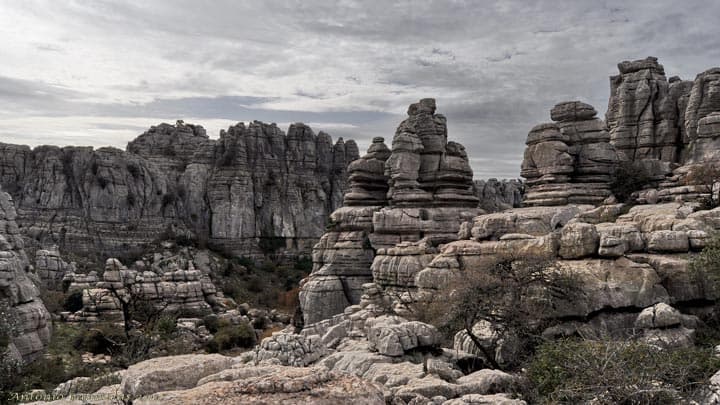
This timeless place is a veritable museum of natural sculptures. Water and wind shaped the marine rocks during the Jurassic era, around 150 million years ago. The paths between the rocks were created by fractures in the ground and by erosion, and today they allow visitors to stroll through this unique natural landscape. The four areas of El Torcal are:
- Sierra Pelada
- El Torcal Alto
- El Torcal Bajo
- Tajos and Vilaneras
In the El Torcal Alto area there is a Visitor Centre where an informative video is shown, there is an information point, a restaurant and toilets. In addition, from the adjoining Mirador de las Ventanillas there is a lovely view of Villanueva de la Concepción and Malaga. On clear days, you can see Africa.
You have the option of choosing between three free walking routes:
- the Green path (Ruta Verde) takes about 45 minutes (circular), approximately 1.5 km (1 mile). Difficulty level: easy
- the Yellow trail (Ruta Amarilla) takes around 2 hours (circular), approximately 3 km (1,8 miles). Difficulty level: moderate
- the Orange trail (Ruta Naranja) takes about 4 hours there and back (out-and-back), around 3.6 km (2,2 miles). Difficulty level: medium
There are also other guided routes which cost between 10 and 12 euros and which lead groups of hikers through areas of the park with breath-taking views.
- The El Torcal Alto Visitor Centre is free and is open every day of the week from 10:00 to 17:00 from November to March, and from 10:00 to 19:00 from April to October.
- From Antequera, you need to drive south on the A-7075 for 17 km (10,5 miles) (around half an hour) to reach the car park near the Visitor Centre. Normally, you can drive your own car up to the Visitor Centre, but if the upper car park fills up, you must leave your car in the lower car park and reach El Torcal Alto on foot (nearly 4 km – 2,4 miles) or by shuttle bus (1.50 euros).
La Peña de los Enamorados
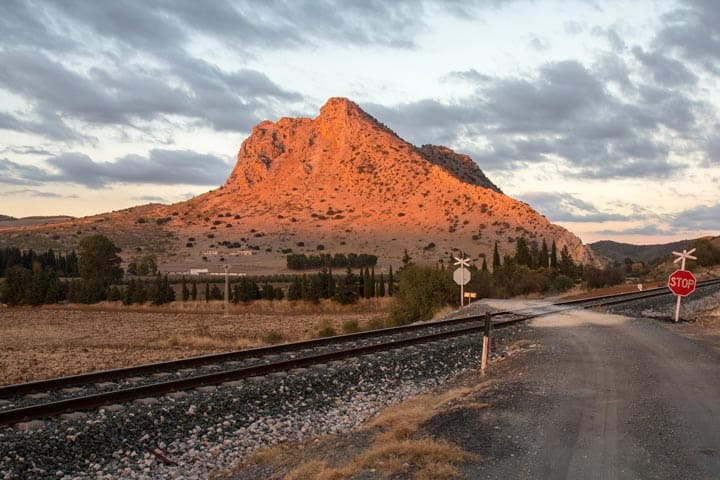
The shape of this promontory will doubtless remind you of the face of a man looking up towards the sky. Habited since the Bronze Age, it preserves rock paintings dating back to the Neolithic in the north-eastern area of the Peña.
If you want to admire this distinctive rock formation from afar, simply drive along the A-7282 heading east towards Granada, leaving the dolmen area behind: you can’t miss it!
El Caminito del Rey
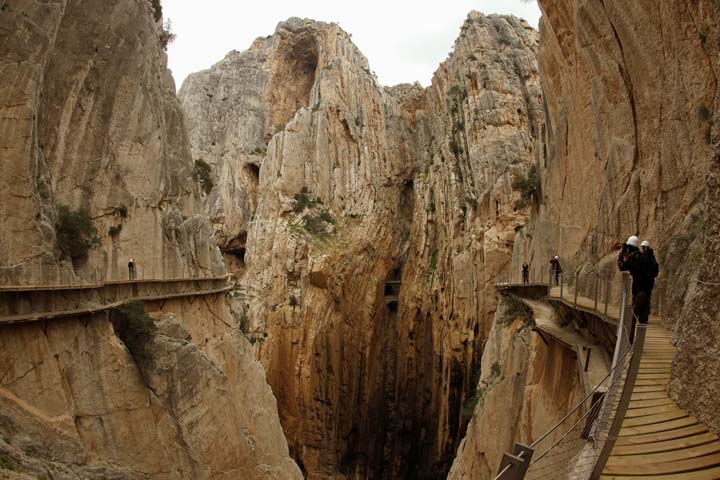
During your stay in Antequera, do not miss a visit to the nearby Caminito del Rey. Between Antequera and Ardales, the starting point for the Caminito del Rey, there are around 50 kilometres (31 miles). This splendid trail, known to enthusiasts as one of the most impressive paths in Europe, stretches for almost 8 kilometres (5 miles) through gorges and canyons, close to the rock faces of the Desfiladero de los Gaitanes, with walkways and bridges measuring just one metre in width and, in some places, suspended 100 metres above the ground. For more information, read our article dedicated to this excursion.
If the natural surroundings of Antequera intrigue you, I recommend spending at least two days in the area, using the city as a strategic base for your visit.
