Seville is the city that more than any other embodies the essence of “Most Catholic Spain”, that of the period of the Reconquista, when the Catholic kings reclaimed from the Arabs the territories they had occupied. From that period onwards, religion became deeply intertwined with tradition and local customs: it is no coincidence that, if you visit Seville during Holy Week, you can witness some of the most heartfelt processions and celebrations in preparation for Easter.
It is therefore quite obvious that in the Andalusian capital there is no shortage of churches: but which are the most beautiful and interesting ones to visit? Here is a list of the most noteworthy, to which other places linked to the ecclesiastical world can also be added, such as the Hospital de los Venerables or the Hospital de la Caridad.
Contents
Seville Cathedral (and the Giralda)
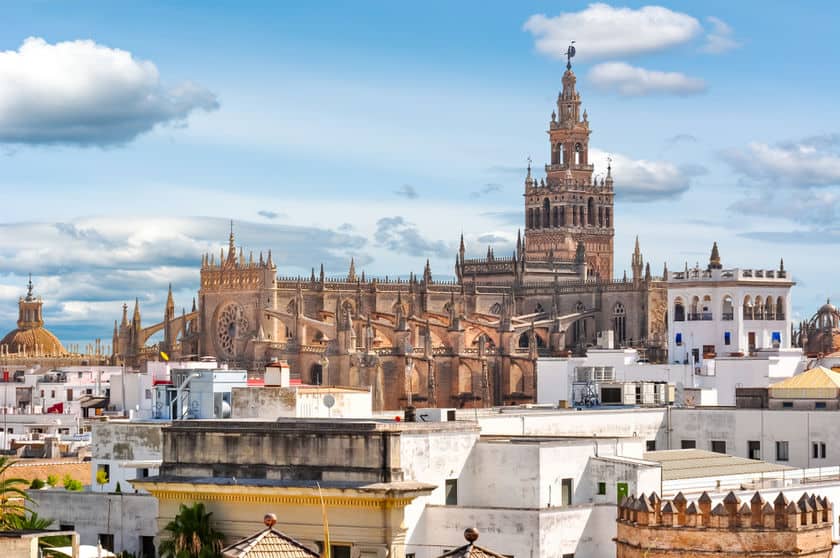
The Seville Cathedral is not an ordinary church. First and foremost, it is the largest church in Spain and, by virtue of its grandeur alone, it should already be included in any itinerary exploring the Andalusian capital. But that is certainly not the only reason, nor even the main one, to devote time to it. Built in Gothic and Renaissance styles, yet with several Arab elements, it replaced the former mosque, of which it still retains some features. This can be clearly seen in the Giralda, its famous bell tower, which was once the minaret and is one of the clearest examples of Spanish Moorish architecture.
The cathedral can be visited inside, where it houses, among other things, the tomb of Christopher Columbus, but you can also climb up onto its roof for a fascinating tour among the pinnacles. The bell tower can also be visited, and by climbing to the top you can at once appreciate its fine architecture and admire the splendid view over the rooftops of Seville.
Iglesia del Salvador
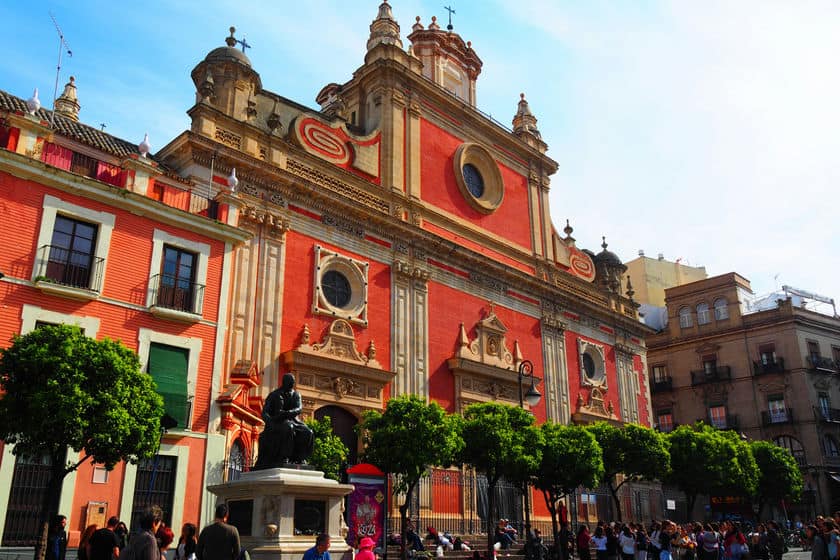
With its red façade, the Iglesia del Salvador is among the most easily recognisable buildings in Seville. Crossing its threshold, you find yourself immersed in one of the finest examples of Spanish Baroque. The history of this place has been tied to worship since time immemorial: a Roman basilica built on Visigothic foundations, it later became the city’s largest mosque (later surpassed only by the one on whose site the cathedral now stands). In 1248 it was transformed into a collegiate church and finally, in 1674, it became the present Baroque church, later restored in 1712 with the addition of the dome. One of the places of worship in Seville that absolutely must not be missed.
Iglesia del Salvador: our guide
Iglesia de Santa Ana
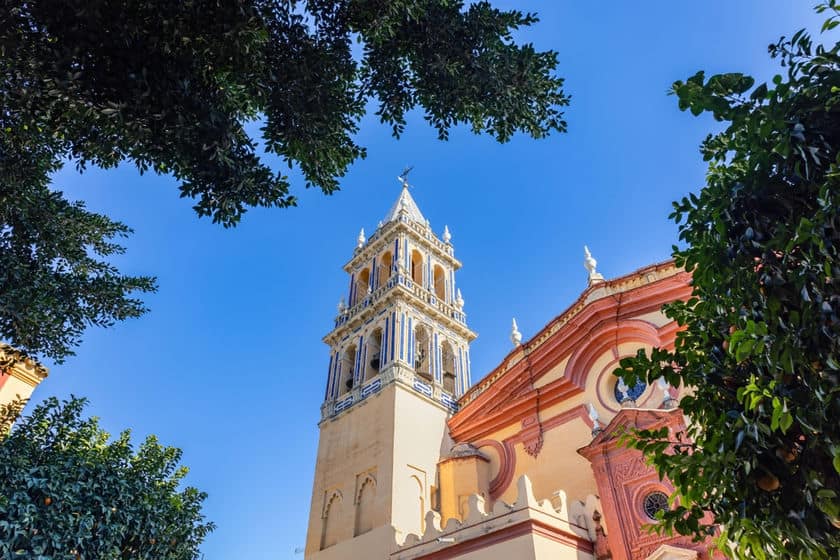
Walking through the Barrio de Triana, the blue-decorated bell tower of the Real Parroquia de Señora Santa Ana, or more simply Iglesia de Santa Ana, really stands out. Built in 1266, it is the first church constructed from scratch after the reconquest of Seville, unlike other churches that were built on former mosques. As it was also the only church located outside the city walls, it had to be fortified: even today, the battlements can still be seen on its terraces. Badly damaged by the earthquakes of 1355 and 1755, it underwent several restorations, so what we see today differs considerably from what it originally looked like. Among the most interesting features, besides the beautiful bell tower, is the Gothic portal that gives access to the left nave.
Basílica de la Macarena
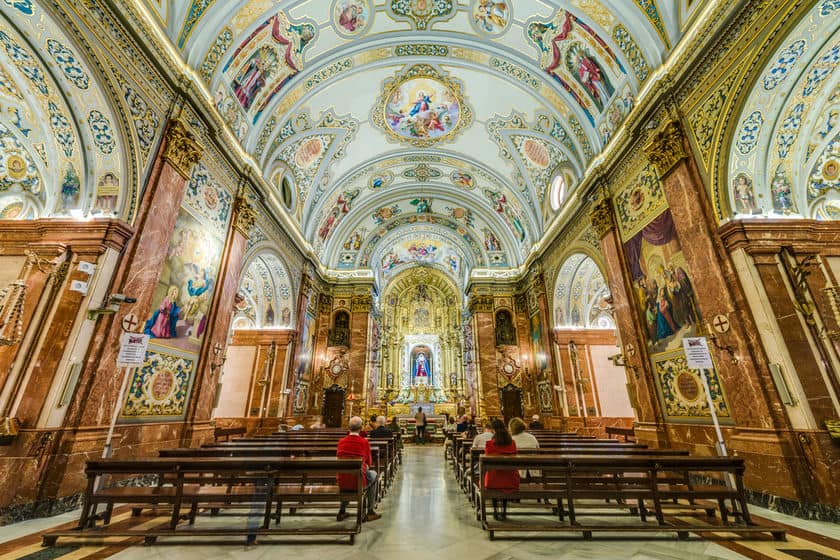
In the Barrio de San Gil, also known as the Barrio de la Macarena, stands the church of the same name, which houses one of Spain’s most venerated icons: the Virgen de la Esperanza Macarena. The Basílica de la Macarena, or more precisely the Basílica Menor de la Santísima María de la Esperanza Macarena, is not among the oldest churches, as it dates only from 1949; however, its fine neo-Baroque decoration and the famous statue of the Virgin preserved inside make it a place of great significance for the faithful, and not only for them.
Basilica Menor de Jesús del Gran Poder
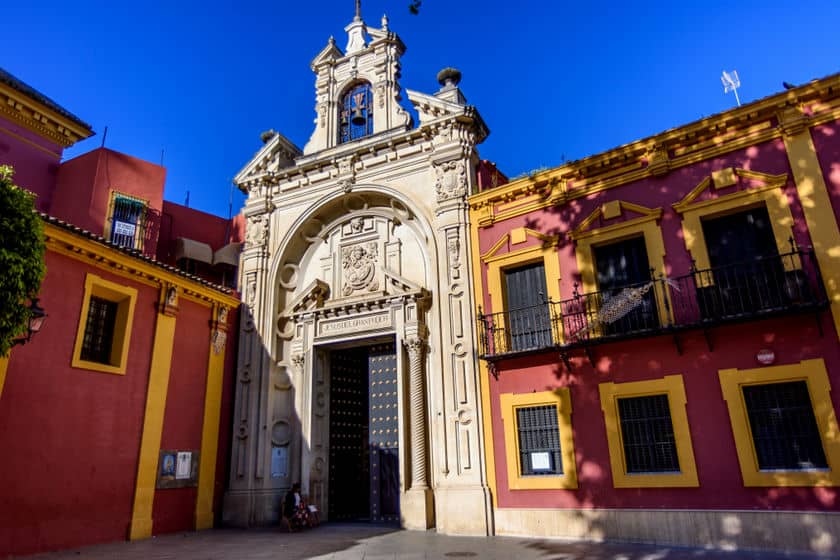
The Basilica Menor de Jesús del Gran Poder is also a relatively recent construction. It was built between 1960 and 1965 with a mix of styles, especially Renaissance and Baroque, but not exclusively. More than the building itself, it is worth a visit for the statue of Jesús del Gran Poder, known locally as the Señor de Sevilla. This 1620 work is a Christ carrying the cross, made of wood and standing 1.81 m tall. It is the city’s most venerated statue, and every year it is the centrepiece of the Good Friday procession, when it is carried through the streets by the Hermandad del Gran Poder, one of Seville’s main Catholic brotherhoods. If you are not in Seville over Easter, you can admire the work inside this church.
Parish of Santa María la Blanca
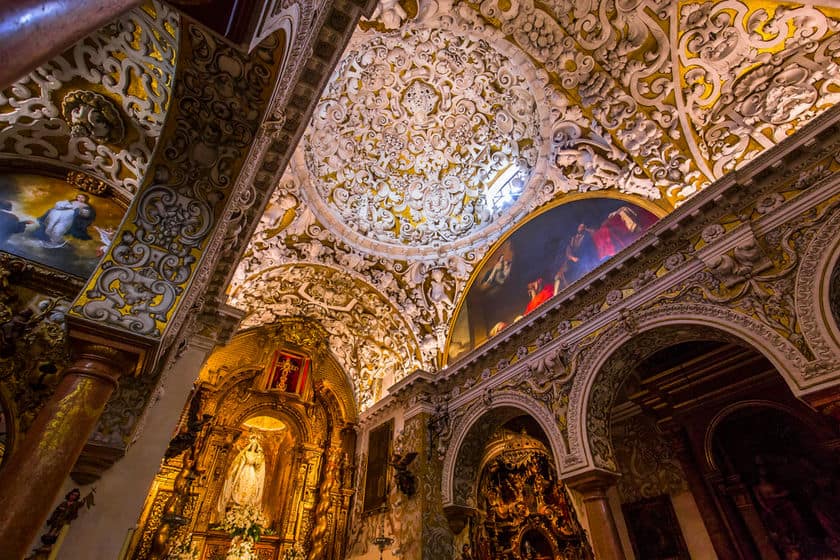
We know that Seville, as indeed the whole of Andalusia, saw both Arab rule and a strong Jewish presence. That is why churches that were formerly mosques or synagogues are often found. The parish of Santa María la Blanca is the only one within whose walls all three monotheistic religions were professed and which preserves the legacy of each.
Originally a mosque, it was then turned into a synagogue in 1252 and finally into a Catholic church in 1391. In 1661 much of the church was demolished and rebuilt: that is why the very sober façade is decidedly different from, and in contrast with, the richly ornate Baroque interior. On entering, one immediately sees the statue of Our Lady of the Snows, to which one of the city’s confraternities is linked: the Antigua y Fervorosa Hermandad del Rosario de María Santísima Nuestra Señora de las Nieves.
Iglesia de San Lorenzo
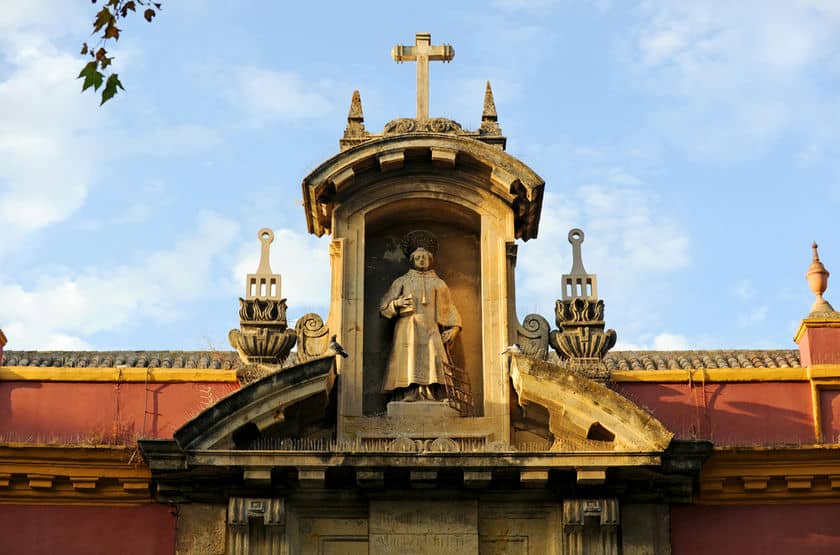
Built in 1300 in Mudéjar Gothic style and then altered in the following centuries, the Iglesia de San Lorenzo is located in the district of the same name, in the north-western area of the Old Town of Seville. Five naves and numerous chapels make it a church with a very irregular floor plan, but the exterior is also a great mix of architectural styles and elements dating from different periods. Inside, the finest piece is undoubtedly the 17th-century altarpiece, richly decorated and housing the statue of Saint Lawrence, to whom the church is dedicated. Another image of the saint can be found on a side altarpiece, as well as outside the church on the entrance portal.
Iglesia de San Luis de los Franceses
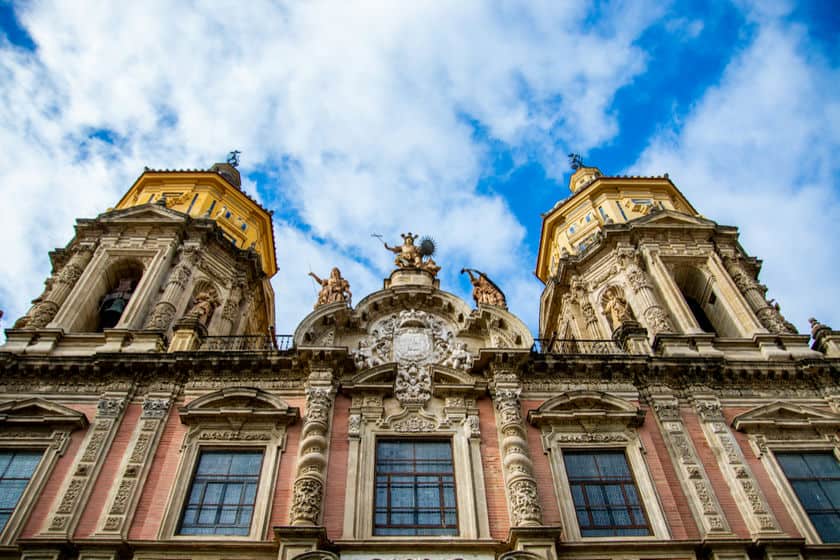
Among the finest examples of eighteenth-century Spanish Baroque is the Iglesia de San Luis de los Franceses, built by the Jesuits between 1699 and 1730. When the Society of Jesus was expelled from Spain in 1835, this place of worship was used in various ways until it was deconsecrated. Today it belongs to the Provincial Council of Seville. With a Greek-cross plan, it is topped at the centre by a large dome and decorated inside with 16 Solomonic columns and various chapels. Although it is no longer used for its original religious purpose, it is still one of the most beautiful churches in the city.
