When you hear mention of Cordoba, your thoughts immediately turn to the Mezquita, a spectacular monument that makes this city an absolutely unmissable destination on an Andalusia road trip. But visiting Cordoba is not just about that. Compared with a large city such as Seville, the atmosphere here feels even more Andalusian: as you wander from one alley to the next, you may find yourself in the heart of enchanting squares surrounded by white houses and orange trees, or standing before an imposing Gothic church, seemingly sprung from nowhere, behind a flower-filled patio.
A place to get lost in, then, following your instincts, as in other cities in Andalusia. But if you are wondering what are the things to do in Cordoba, instinct alone will not be enough: we want to tell you about the most beautiful attractions, the places to visit, the views not to be missed in a detailed guide to Cordoba.
Contents
Things to do in Córdoba: The top 6 attractions
But let’s really get to the heart of Cordoba: what should you see first? There are at least six places that we think are the main points of interest: we’ll tell you about them in order of importance.
Mezquita
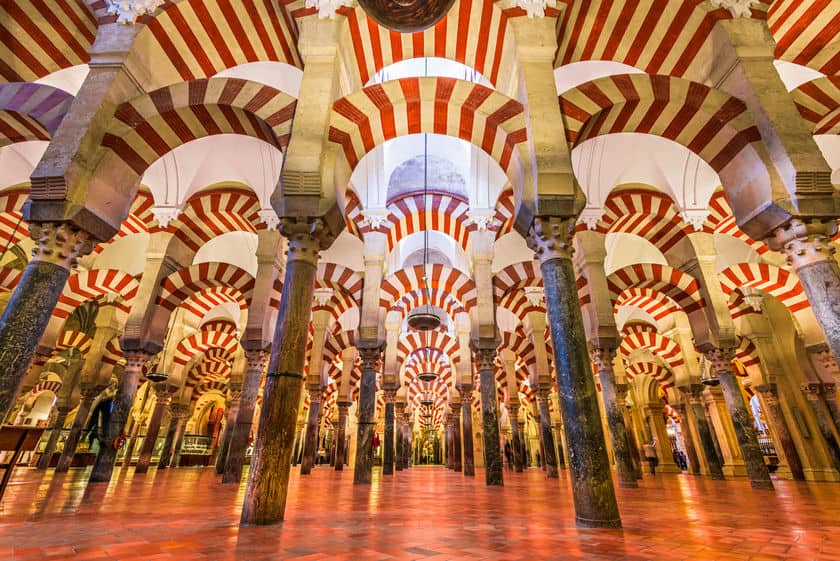
The city’s emblematic monument par excellence, the Mezquita of Cordoba is now identified with the Cathedral of the Immaculate Conception of Most Holy Mary, a name that gives emphasis on its current Christian identity. However, when visiting the Mezquita, you will realise that the Gothic cathedral (built in 1523) is set (illegally, one might say!) within the vast ancient mosque, creating a distinctive and fascinating blend of architectural styles and religious symbolism. You will lose yourself in the famous labyrinth of red-and-white arches and pillars, and be astonished by the miḥrāb, the former Muslim prayer area, and it will not seem at all strange to spot a crucifix beneath a Mudéjar-style arch.
Medina Azahara
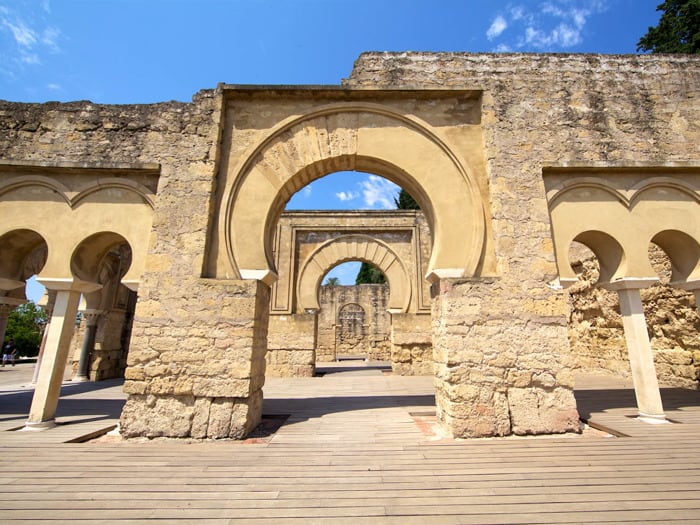
Less than 6.2 miles from Cordoba’s historic centre, you will find the imposing ruins of Medina Azahara, the caliphal residence of Abd al-Rahmān III, a central figure in Islamic rule in Andalusia at the end of the 10th century. The caliph had his grand palace built at the heart of a city of imposing dimensions. Archaeological work is bringing to light the ruins of a truly magnificent monument, and although the area of the city that can be visited is limited, it is well worth visiting this site to understand the remarkable importance of Islamic culture for Cordoba.
Alcazar de Los Reyes Cristianos
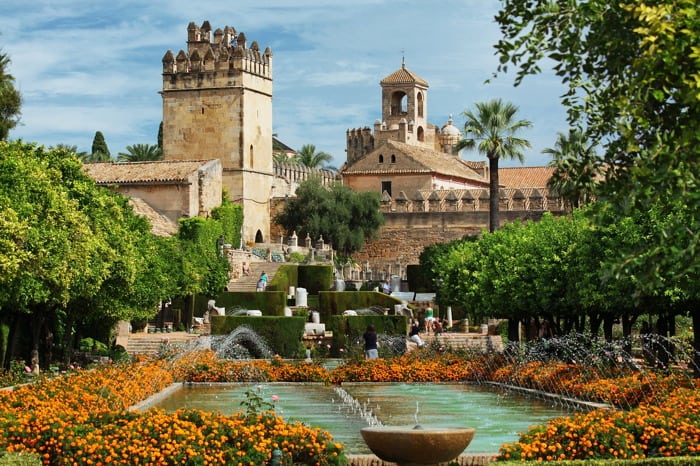
Among the royal residences of the great Andalusian cities, the Alcazar de Los Reyes Cristianos is certainly not the best known. However, few people would ever forgo a visit to this fortress: from the top of the highest tower, you can enjoy splendid views of the Puente Romano (which spans the Rio Guadalquivir) and the city. Not to be missed are the Moorish-style gardens and the collection of Roman mosaics displayed inside the fortress, some of which are truly moving. For a small additional charge, you can also visit the ancient Arab baths, the Baños Califales, also near Plaza Campo Santo de los Martires. If you do not want to miss this Moorish palace, read our in-depth guide to the Alcazar of Cordoba.
Caballerizas Reales
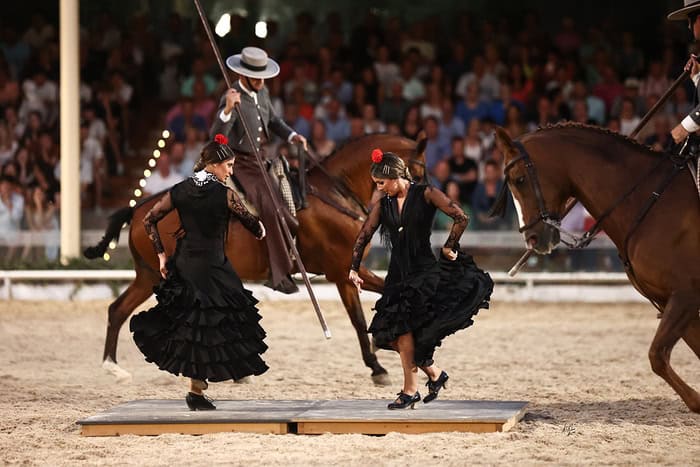
Caballerizas Reales (Royal Stables of Cordoba) are located at Calle Caballerizas Reales 1, right next to the Alcázar de los Reyes Cristianos (so they are ideal for a combined visit). Founded in 1568 at the behest of Philip II, these stables played a fundamental role in breeding the Andalusian horse and still preserve over five centuries of equestrian tradition today. A self-guided visit usually lasts between 30 minutes and 1 hour and allows you to see the Patio Central and the stables area (cost €5).
To make the experience truly unique, though, we recommend attending the official equestrian show “Pasión y duende del caballo andaluz”, which runs from Wednesday to Saturday at 21:00 and lasts around 70 minutes. It offers a combination of classical riding and Andalusian tradition, with performances that alternate between different techniques and choreographed moments accompanied by flamenco music and dance.
Puente Romano
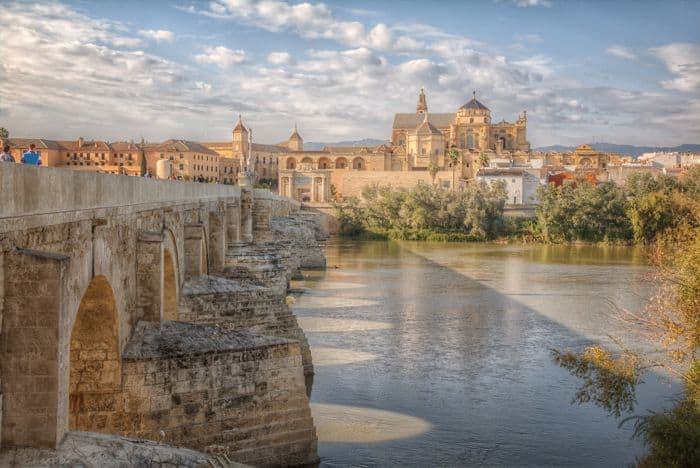
Difficult to forget the squat, archaic appearance of this ancient Puente Romano, characterised by its heavy buttresses and imposing arcaded structure. This massive pedestrian bridge is crowned on the southern side by the Torre de la Calahorra. Meanwhile, looking north-west from the middle of the bridge, you can see the Puerta del Puente and the majestic body of the Mezquita. As already mentioned, we recommend seeing the bridge from the viewpoint at the Alcazar: you will find this and other targeted tips in our article devoted entirely to the Roman Bridge of Cordoba.
Juderia (Jewish Quarter)
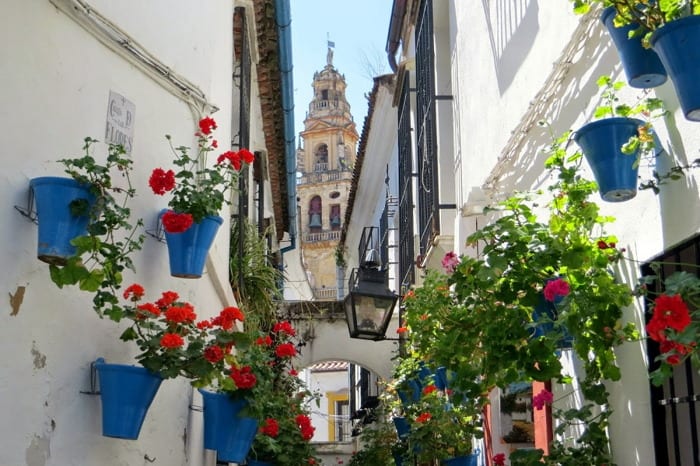
Some may be reminded of Seville’s Barrio de Santa Cruz: the Juderia is the old district where the Jewish community lived before the expulsion at the end of the 15th century by the Catholic Monarchs. Today, the quarter, located in an area not far from the Mezquita, appears as a network of narrow streets that recalls the most charming pueblos blancos of Malaga, whose character Cordoba broadly reflects: in addition to visiting the Synagogue of Cordoba, do not tire of seeking out patios and picture-postcard views, such as Callejon de las Flores, a tiny little lane lined with white houses and flower-filled balconies: once you reach the top of the steep incline, you are rewarded with a striking view of the Mezquita. In truth, it is a very touristy destination: wait for the crush of tourists to clear and take your postcard photo. Don’t miss our itinerary through the Jewish Quarter of Cordoba!
Cordoba Attractions: what is there to see if you have time left?
The classic Andalusia tours usually include a daily stop in Córdoba, which is a real shame! If that is your situation, don’t miss our article that will help you understand how to visit the city and what to see in Cordoba in 1 day.
If, however, the length of your stay in the city allows you to do a few more rounds, here are other places worth seeing in Cordoba: in some cases, it is precisely these routes that help you understand the city’s truest and deepest nature.
Palacio de Viana
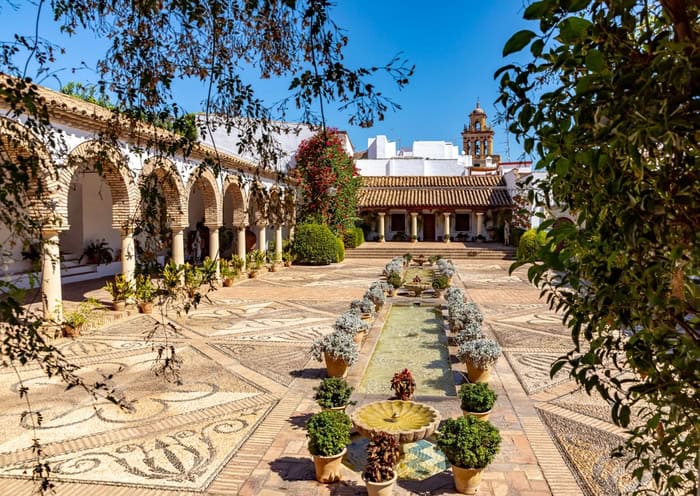
A visit to the Palacio de Viana, the former residence of the Marquises of Viana, could be just the thing if you have a passion for flower-filled patios. In this building you will find no fewer than 12 of them, as well as some finely decorated salons, galleries packed with rich furnishings and azulejos, libraries, art rooms and much more.
Plaza del Potro
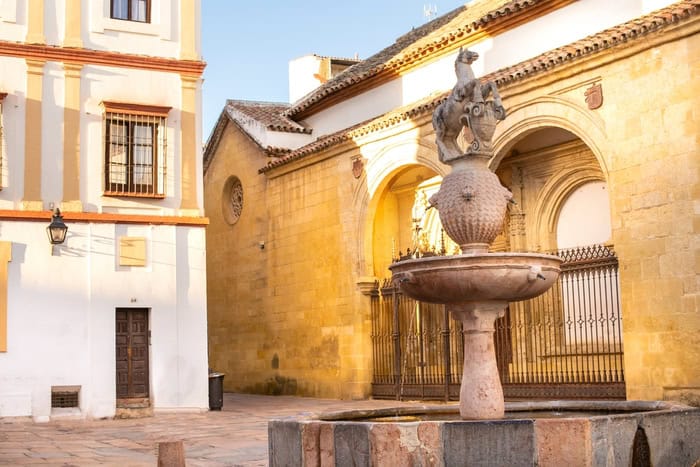
When visiting Cordoba, as you walk through the little streets to the east of the Mezquita, you will probably come across this small ancient square, certainly familiar to readers of Cervantes’ Don Quixote, which told of an inn called Posada del Potro, now a flamenco study centre. In the middle of the square there is a fountain depicting a foal and, on one side, the Museo de Bellas Artes. The square opens onto Calle Enrique Romero Torres, an adorable little street lined with restaurants, which slopes briefly down to the Guadalquivir.
Plaza de la Corredera
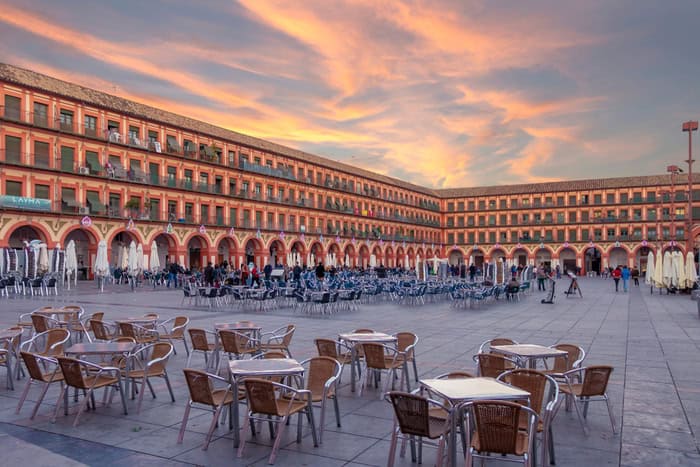
A space of quite different charm is Plaza de la Corredera, the only one in Andalusia that mirrors the shape and style of Madrid’s Plaza Mayor. It is a splendid rectangular square, surrounded by characteristic buildings and by a colonnade in warm colours that houses bars, restaurants and tourist souvenir shops. The atmosphere is lively and authentic.
Templo Romano
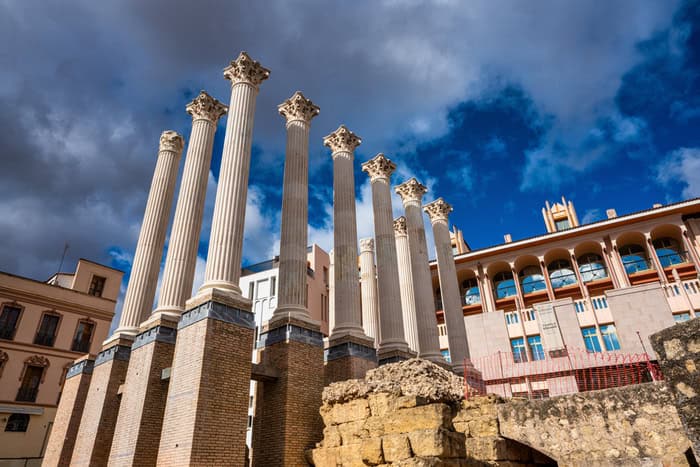
Walking through the streets not far from Plaza de la Corredera, you will notice the remains of an ancient Roman temple, further evidence of the Romans’ presence in Cordoba. The temple, dating from the 1st century AD, cannot be visited, but it is still clearly visible from the street, and at night the sight is certainly evocative.
Calleja del Pañuelo
What does “pañuelo” mean in Spanish? It means “handkerchief”: that is how wide this little street is at its narrowest point. It is the continuation of Calle Pedro Jimenez, which, winding and very narrow, leads to a small square with a fountain and a few little trees.
Cristo de los Faroles
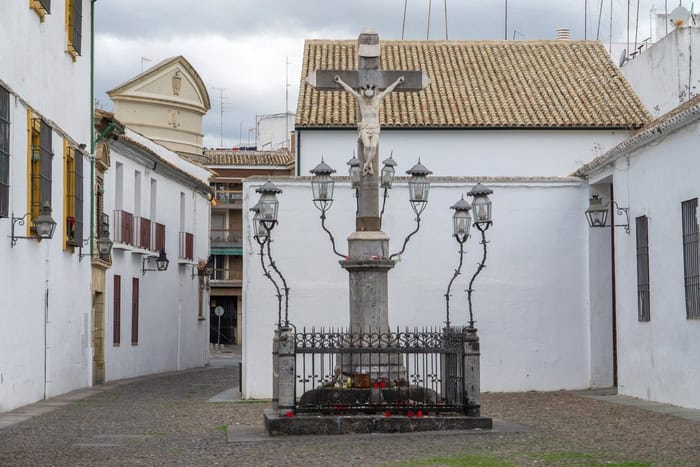
To the question “what to see in Cordoba?”, many will recommend the bare and very white Plaza de los Capuchinos. Go there: at the far end you will see a fine crucifix from 1794, the Cristo de los Faroles, surrounded by 8 lanterns and much venerated by the people of Cordoba. If possible, go to the square at night: this place has an uncanny, surreal and deeply religious atmosphere, in its most popular sense.
Iglesia de San Lorenzo
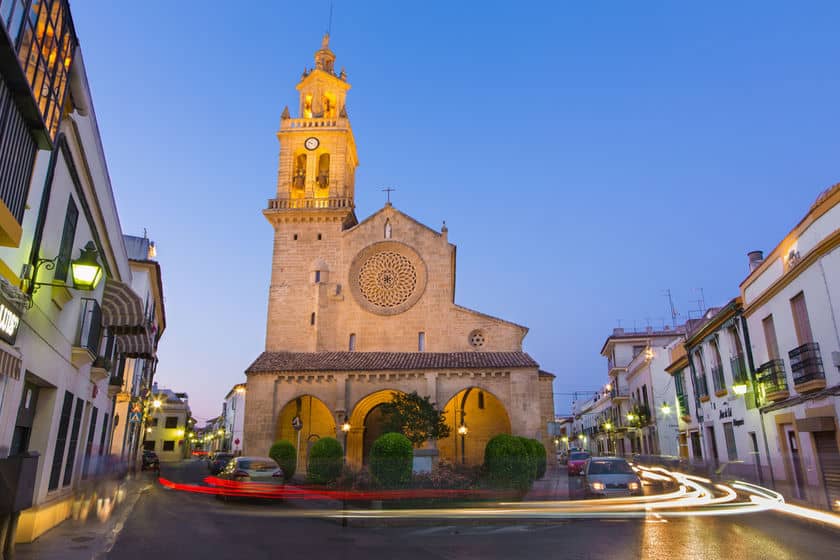
A little off the usual tourist routes, to the north-east of the Mezquita, in a lovely district that takes its name from it, stands the Iglesia de San Lorenzo, perhaps the most beautiful church in Cordoba, in Gothic style, with a bell tower built from the structure of a minaret and a Mudéjar rose window, one of the best preserved in all Andalusia.
Iglesia de Santa Marina
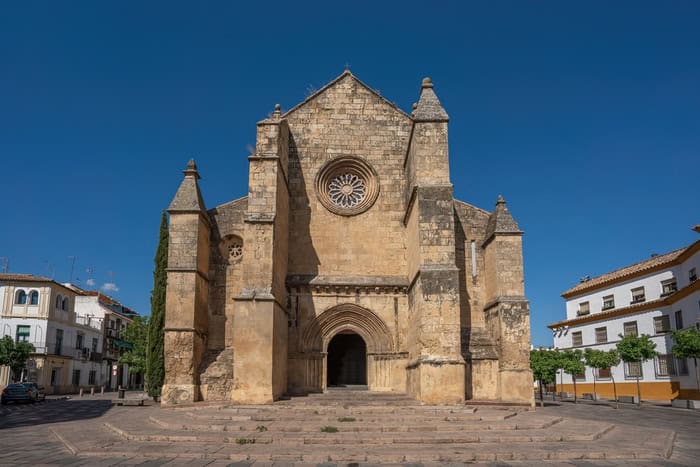
If you’re lucky, you’ll find it open, but it is still worth making your way to the Iglesia de Santa Marina, in the square of the same name, to enjoy the view in which it is set. In the same square you’ll find a monument to the famous bullfighter Manolete: in the colours of sunset, the beauty of this place is moving.
Plaza de las Tendillas
A lively hub where young and not-so-young people meet to have a beer and eat tapas, Plaza de las Tendillas is located to the north of Cordoba’s historic centre, at a significant meeting point with the modern city. Since the 14th century it has been an important point for the city’s commercial exchanges, and that role has remained, given that the classic shopping routes start from here. In addition to the equestrian statue in the centre of the square, you will certainly notice the clock, whose chimes are nothing more than flamenco-style guitar arpeggios!
Where to park in Córdoba?
To get around Cordoba, you don’t need a car (except for Medina Azahara): you can visit it on foot in no time, fully enjoying the atmosphere. If, however, you still have the chore of parking the car in Cordoba, here are some car parks that may come in handy:
… and now? What are the next steps?
Now that you’ve understood what to see in Cordoba, it’s time to make some other important decisions. Here’s a series of useful articles:
- tips on the best places to stay in Cordoba
- advice on where to eat in Cordoba
