Between the long River Guadalquivir and Seville Cathedral lies a Baroque architectural gem that is well worth visiting, not only for its artistic features but also for the story behind its creation: la Iglesia y Hospital de la Caridad.
This ancient building dating from the 17th century served as a hospital for the infirm and poor of the city; formerly, the bodies of those condemned to death were prepared here before burial, as were the lifeless corpses found in the streets of the city after incurable illnesses or natural disasters. What makes this complex even more interesting is its church, rich in works of art by artists such as Valdés Leal, Murillo, Bernardo Simon de Pineda and Pedro Roldán.
Contents
Location and how to get there
L’Hospital de la Caridad is located at Calle Temprado 3 in Seville’s Casco Antiguo.
The hospital is situated behind the Teatro de la Maestranza and a short distance from the Paseo Cristobal Colon, which runs along the Guadalquivir.
If you use public transport to get around Seville, you can easily reach the Hospital de la Caridad. You can, in fact, take:
- Bus lines 21, 40, 41, A2 and C4, getting off at the Paseo Cristóbal Colón (Dos de Mayo) stop, in front of the Teatro de la Maestranza and the Jardines de la Caridad.
- The metro, getting off at Puerta Jerez station, about a 5-minute walk away.
- Tram line 1, getting off at the Archivo de Indias stop, about a 4-minute walk away.
History of the Church and the Hospital
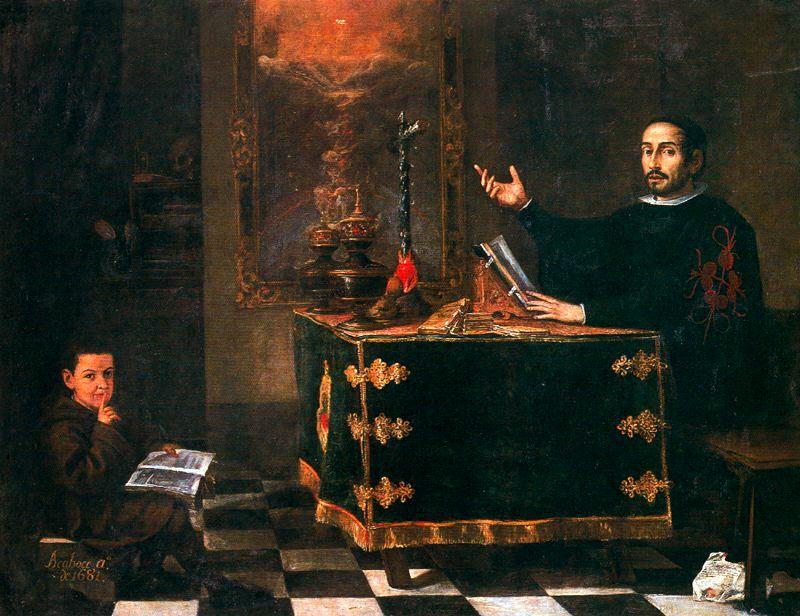
The key figure associated with the history of the Church and the Hospital de la Caridad in Seville was Miguel Mañara, born on 3 March 1627 in Seville, who became a brother of the Confraternity of Charity in 1661 following the death of his wife and a profound spiritual crisis.
From that year onwards Miguel Mañara committed himself both materially and spiritually so that the hospital would serve those most in need, increasing the services offered and its charitable works. Until then, the Confraternity of Charity had mainly concerned itself with honouring the dead, while through Miguel Mañara’s efforts the hospital became a point of reference in the city for the homeless, those in need of care and the poor in general.
Indeed, Seville in the seventeenth century was a city of great contrasts: on the one hand the city of merchants and gentlemen enriched by the fervent trade with the Americas (as told by the Archive of the Indies); on the other, the many poor and sick who could not escape destitution.
In addition to the hospital, on 16 July 1674 the confraternity inaugurated the new church as part of the complex. The project had been entrusted in 1644 to the architect Pedro Sanchez Falconete, but it was only after 1661 that, thanks to the efforts of Miguel Mañara, the façade by Leonardo de Figueroa, the main chapel and the sacristy were completed.
What to see
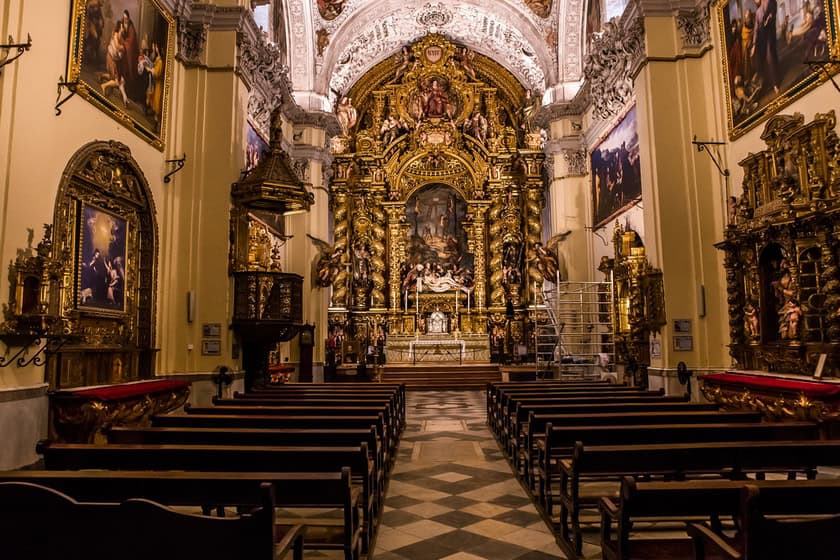
The church of the Hospital de la Caridad strikes the visitor from the moment they enter: the façade, in fact, features many elements in the Sevillian Baroque style and is divided into three sections where, alongside white and gold, panels of blue-toned azulejos stand out. At the top of the façade you can see the central pediment, two brick pinnacles at the sides and a protective railing.
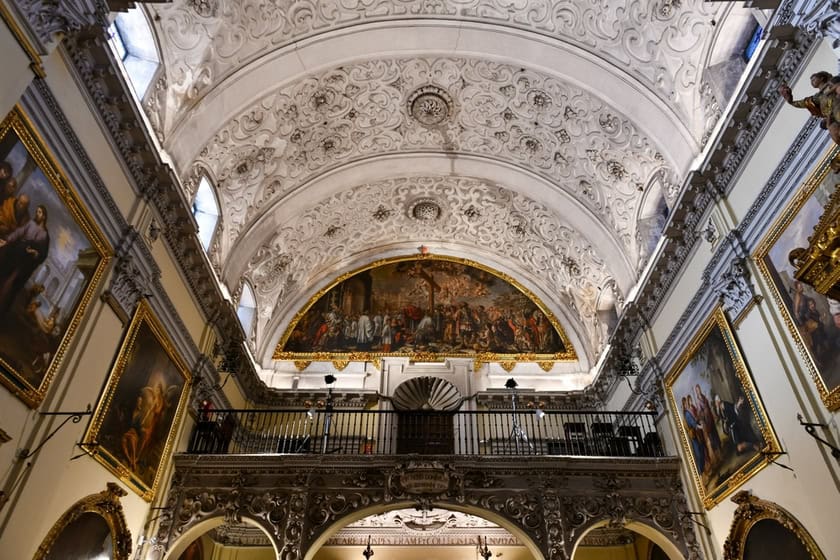
Inside the church there is a single nave and, if you look up, you can admire the finely decorated barrel vault and dome. During your visit, pause to observe:
- The two paintings by Valdés Leal, Finis gloriae mundi and In Ictu Oculi, which depict Death, as well as the artist’s other work in the church, The Triumph of the Holy Cross.
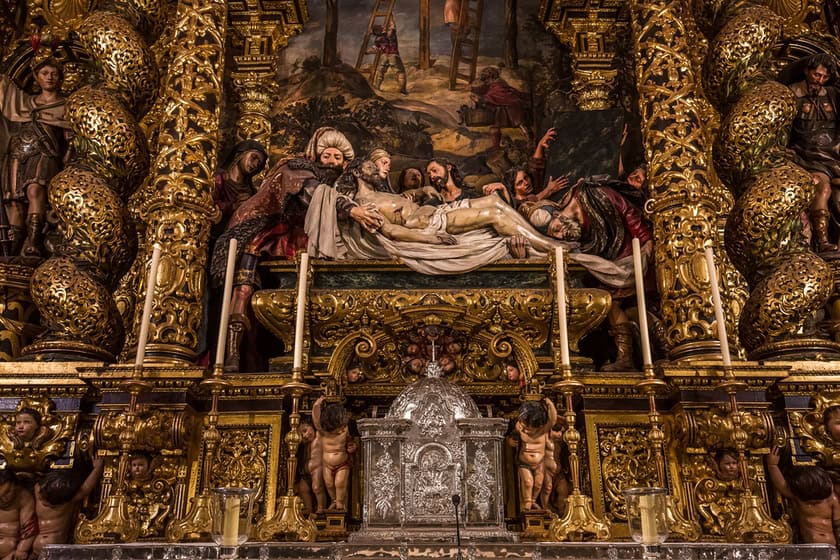
- The main altarpiece by Bernardo Simón de Pineda, in Baroque style. The sculpture you see in the centre, depicting the burial of Christ, was made by Pedro Roldán, while behind it you can admire the fresco by Valdés Leal. Together, the three artists created a masterpiece paying tribute to one of the brotherhood’s main services: the burial of the dead.
- Murillo’s six large paintings on the theme of Mercy, although only two are originals. The other four were stolen by a French marshal in 1810 and are now housed respectively in the National Gallery in London, the National Gallery of Art in Washington, the National Gallery of Canada in Ottawa and the Hermitage Museum in Saint Petersburg. Saint John of God Carrying a Sick Man on the left wall and Saint Elizabeth of Hungary Healing the Sick on the right wall are the two original paintings.
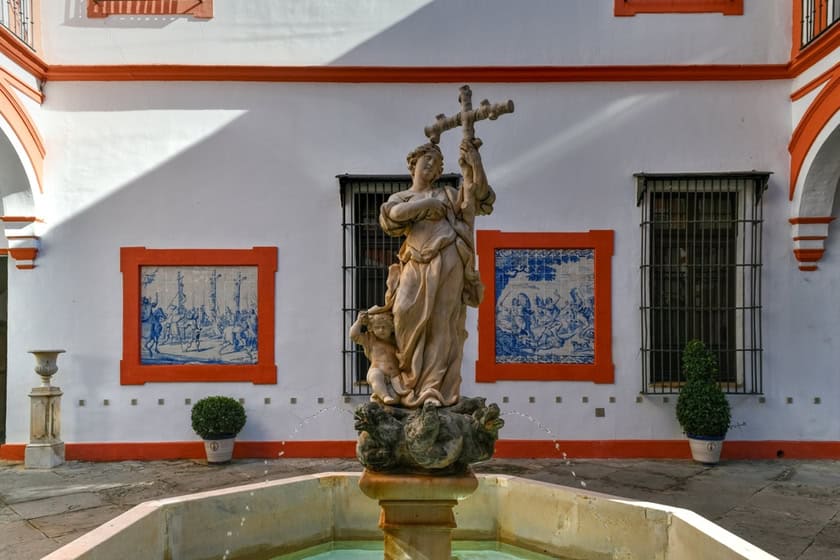
You enter the church through the courtyard with columns and arches. Each courtyard is embellished with a fountain: the Fuente de la Caridad and the Fuente de la Fe, both crafted in Genoa in 1682.
From the courtyard you can reach the Council Chamber, which now houses a permanent exhibition featuring Miguel Mañara’s funeral mask, some of his belongings and numerous letters from people grateful to Mañara for favours received through his intercession.
The hospital itself, however, is made up of four separate halls, to the construction and expansion of which Miguel Mañara contributed: he worked on the first three with the architect Francisco Ruiz de Escalona, and on the fourth with the architect Francisco Cansino.
Opening times and prices
ATTENTION! The Hospital de la Caridad is closed for restoration until 2027
The Hospital de la Caridad has the following opening hours:
- Monday to Friday from 10:30 am to 7:00 pm
- Saturday and Sunday from 2:00 pm to 7:00 pm.
You can enter until 18:30 at the latest.
To visit this ancient hospital you must purchase a ticket, the proceeds of which are donated to the confraternity’s hospice. The cost of the ticket is:
- €8.00 for adults, including an audio guide
- €5.00 for pensioners
- €2.50 for young people aged 7 to 18
Children under 7 enter free of charge. The audio guide costs €1.00. It may be useful to know that visits are free every Sunday between 16:30 and 18:30. Guided tours cost between €15 and €20 and must be booked in advance.
What’s nearby?
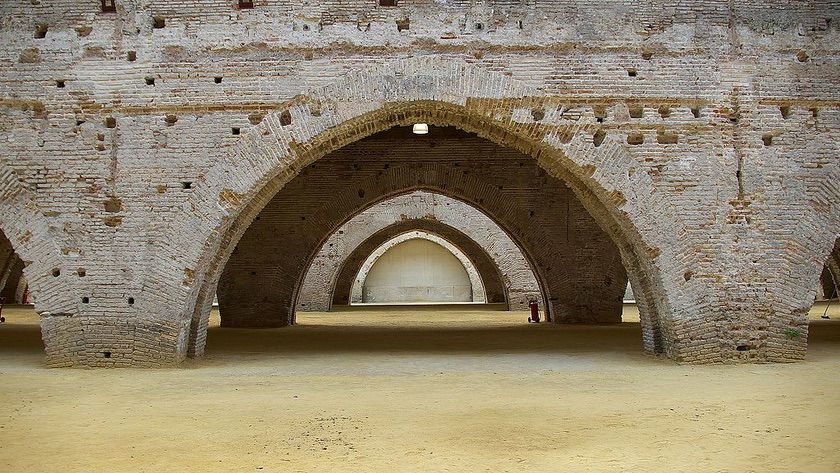
The complex of the Hospital de la Caridad has, over the centuries, incorporated several adjoining spaces. Among these are the Jardines de la Caridad between Calle Temprado and the Paseo Cristobal Colon, and the Atarazanas Reales, the shipyards of Seville used between the 13th and 15th centuries.
The Jardines de la Caridad are open to the public and can be visited at any time. Inside you’ll find a statue dedicated to Miguel Mañara: a man carrying a sick person in his arms. You’ll come across it when entering from the Calle Temprado side.
The Atarazanas Reales were the most important military naval base of the Crown of Castile. This shipyard, more than for building ships, served as a shelter for the Crown’s fleet and was in use for over two centuries. With Seville’s decline as a maritime power, the Atarazanas Reales began to be used for other purposes. The neighbouring Hospital de la Caridad, during its phase of expansion, was authorised to incorporate part of the naval base, as well as other buildings, and today only seven of the original seventeen bays remain.
Where to stay
If you’re looking for where to stay in Seville during your holiday, the Arenal neighbourhood is certainly worth considering. You’ll be in the Casco Antiguo of the city, so close to the main attractions — and in a city like Seville, where walking is essential, that’s only a good thing. You’ll be near the river, ideal for pleasant strolls, and close to the famous Plaza de Toros, the Torre del Oro and the Museo de Bellas Artes.
