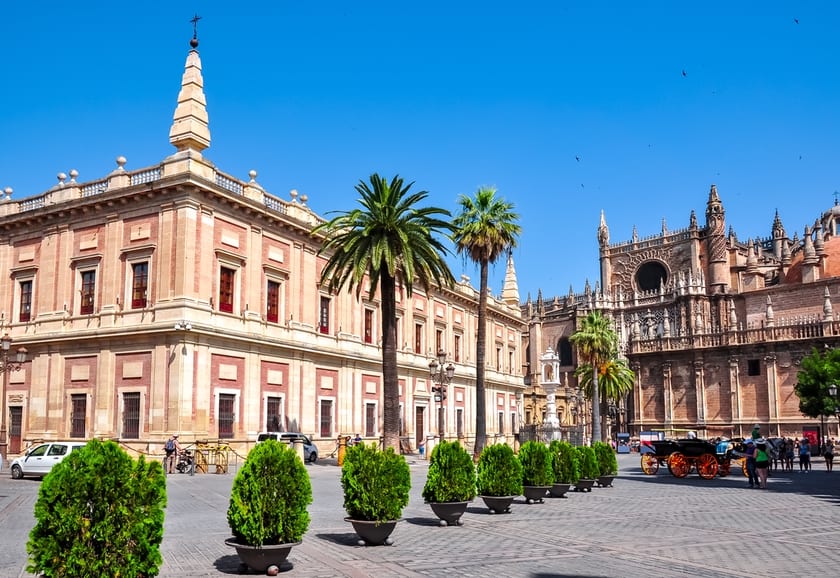
In front of the Alcazar and the Seville Cathedral stands a sumptuous and ostentatious Renaissance-style building: it is the Archivo General de Indias (General Archive of the Indies), which houses the most important documents relating to the Spanish Empire in the Americas and the Philippines during the colonial period. In this article we will provide some historical information about this place, and offer a few tips on how to visit it during your stay in Seville.
Contents
What is the Archivo General de Indias?
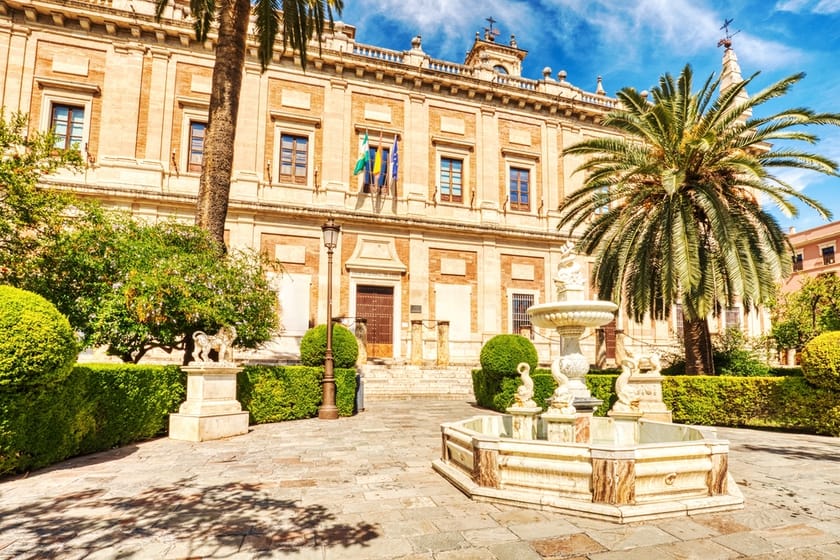
With its 43,000 volumes and 80 million pages of documents, covering a three-century span of history and encompassing the entire territory of the Americas, the Archivo General de Indias is also known as the ‘mecca of Americanism’. This is why the place is regarded as an important research institution, frequented by scholars from all over the globe. Within this state archive one can find texts relating to the discovery and exploration of the Americas, the independence from Spain, the history of local indigenous populations and commercial and maritime exchanges. There are also documents concerning the role of the Church in political decisions about the overseas colonies and the relationship between Spain and other European powers.
Since 1987 the Archivo de Indias in Seville has been designated a UNESCO World Heritage Site. In recent decades the archive has embarked on a major project to digitise its texts so they can be viewed safely and preserved for many years to come.
Where is it located?
The Archive of the Indies is located on Calle de la Constitución in Seville, a short walk from the splendid Gothic cathedral, famed for its bell tower, the Giralda, and the Real Alcazar, one of the most captivating buildings in the city and the wider region.
To reach the Archivo de Indias by public transport you can take Tram 1 and get off at the Archivo de Indias stop. You will find yourself practically in front of the building’s entrance. As you can read in our article on what to do in Seville, most of the attractions are in the same area of the city and it is possible to walk from one church, monument or square to another without any particular problems. Our article on how to get around Seville is useful for more details on the public transport available in the city.
Brief history of the Archive of the Indies in Seville
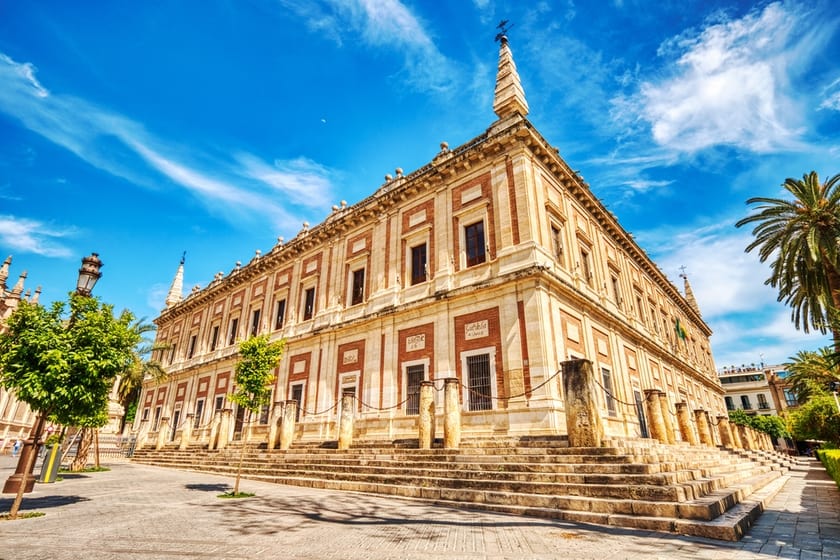
The building that today houses the Archive of the Indies, one of the five state archives in Spain, is known as Casa Lonja de Mercaderes, or the Merchants’ Exchange. The palace, in fact, was built from 1583 to accommodate merchants who traded with the countries of the New World and whom the Church no longer wished to have in the sacred spaces of the nearby cathedral where they had habitually met until that time. Thanks to the navigability of the Guadalquivir, Seville in the sixteenth century became the only port authorised to trade and market the products of the ‘New World’.
The king commissioned the architect Juan de Herrera, the same architect who designed the Monastery of El Escorial in Madrid. Many other renowned architects, such as Juan de Minjares, Alonso de Vandelvira and Miguel de Zumarraga, also collaborated on the construction and decoration of the palace, which was completed in 1646. The commercial and political decline of the Spanish Empire from the second half of the 17th century onwards also had repercussions for the palace: the Lonja de Mercaderes, in fact, began to be used for private residences, especially after the headquarters for overseas trade officially moved to Cádiz in 1680.
In 1785, by order of King Charles III, the Archivo General de Indias was created. The aim was to bring together in a single seat all the documents relating to the territories the Spanish Empire considered the “Indies” (that is, the Americas and the Philippines), which until then were scattered between Simancas (Valladolid), Cádiz, Madrid and Seville itself. The Lonja de Mercaderes was designated as the home for the new General Archive of the Indies thanks also to the Secretary of the Indies, Don José de Gálvez, the cosmographer Juan Bautista Muñoz and the architect Luca Cintora, famed for having worked on the Alcázar Real. Luca Cintora proposed a significant redevelopment project for the building, partly reviving ideas from Juan de Herrera’s original design.
The building
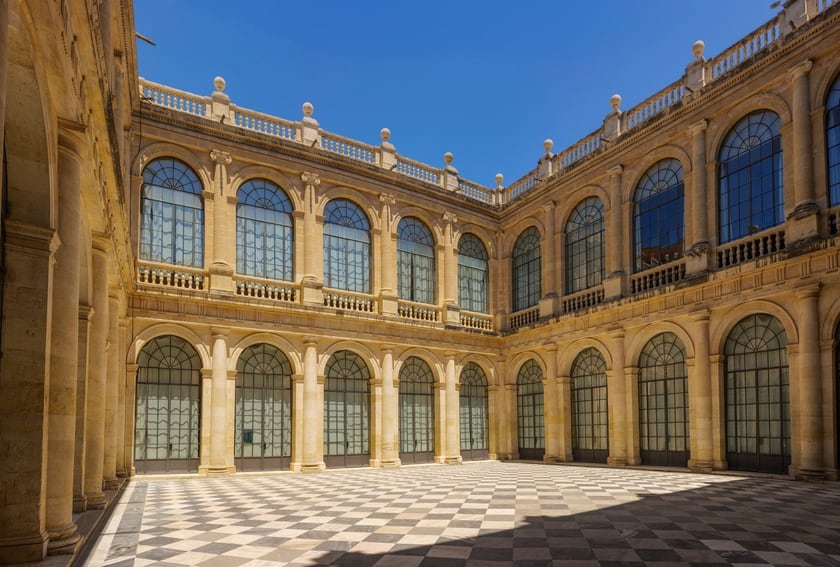
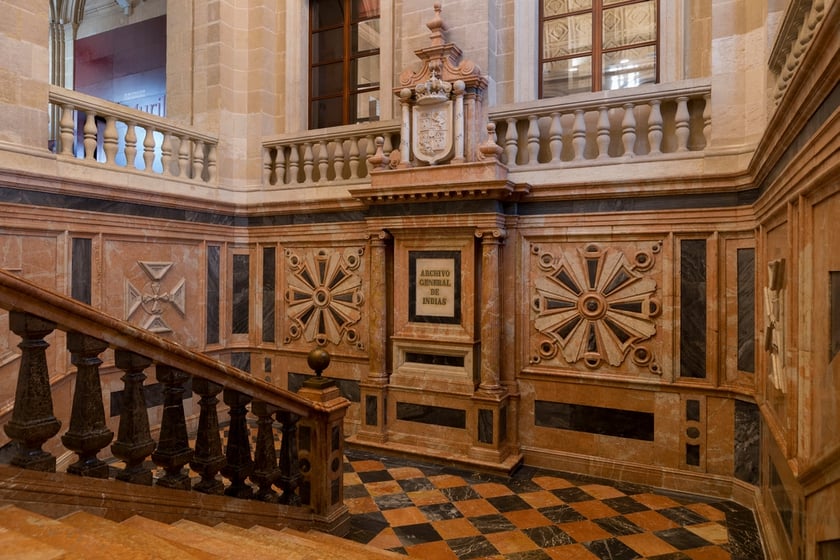
The Lonja de Mercaderes is made up of a central courtyard surrounded by two quadrangular galleries. The palace has a square plan and each side measures 56 metres in length. As you will notice when visiting, there are two storeys linked by a sumptuous marble-clad staircase. The four external corners are marked by four obelisks that soar into the Seville sky.
On the opposite side of Calle San Tomas you’ll find another important building, also home to the Archivo de Indias: Cilla del Cabildo. Built in 1770 to store grain to a design by the architect Pedro de Silva, in 1972 it became the seat of Seville’s Museum of Contemporary Art. Renovated between 2000 and 2004, it now houses part of the Archive of the Indies’ extensive collection of documents, to which it is connected by an underground passage. Inside there are administrative offices, reading rooms, a conference hall and a library. The Antigua Cilla del Cabildo is also a two-storey building and its façade is inspired by the style of the Lonja de Mercaderes. Admire the sculpture on the architrave depicting the Giralda amid lilies. You can also notice that part of the ancient city wall is incorporated into the building, including a tower. This is one of the five towers along Seville’s inner wall; another is the famous Torre del Oro.
Documents held
Inside the Archivo General de Indias lies an invaluable cultural and historical treasure, and it is the perfect place if you are seeking specific documents to understand the era of exploration, geographical discoveries, colonisation and the relations between the Spanish Empire and its colonies. Among the most important documents housed in these two splendid historic buildings are:
- the Capitulaciones de Santa Fe, the agreement signed in 1492 by Christopher Columbus and the Spanish royal family, establishing the terms of Columbus’s voyage to the Indies
- the letter written by Christopher Columbus in 1493 to King Ferdinand and Queen Isabella. This is perhaps the most famous document preserved in the archive, whose value is unquestionably priceless
- the will of the explorer Juan Sebastián Elcano
- the Treaty of Tordesillas between Spain and Portugal, signed in 1494, which divided the world between the two powers
- texts containing the firsthand accounts of the Conquistadors as they encountered indigenous populations
- reports of overseas voyages and of sailors’ and explorers’ arrival in the American territories
- ancient maps
- papal bulls
- among the archive’s most recent acquisitions, a book containing original consultations issued by the Spanish Treasury Council, bearing the signature of the king himself or of his secretary between 1621 and 1627.
How to visit the Archive of the Indies
Visiting the Archivo General de Indias is the best way to gain a thorough understanding of the political, commercial and social history of the Spanish Empire and its overseas colonies. One of the aims behind its creation was precisely to give voice to the many documents produced over three centuries concerning the administration of the Spanish colonies across an entire continent and part of another, eschewing rumours and accounts not based on documentary evidence.
The visit is free and you can walk along the four wide corridors of the main building on its two floors, letting yourself be surprised by the vaulted ceilings above you, finely decorated. The wooden wall decorations are crafted from wood sourced from Cuba.
Strolling through its broad galleries, surrounded by documents of inestimable value, you can get a flavour of the history of relations between Europe and the Americas, and of the memories of the various peoples who lived there, which still resonate with present and future generations.
Opening times and tickets
The Archive of the Indies in Seville is open:
- Tuesday to Saturday from 9:30 am to 5:00 pm, with last admission at 4:30 pm
- Sundays and public holidays from 10:00 am to 2:00 pm, with last admission at 1:30 pm
The day it is closed is Monday. The archive also remains closed on New Year’s Day, 6 January, Maundy Thursday and Good Friday, and on 24, 25 and 31 December. The visit to the Archivo de Indias building is free.
Guided tour
A good way to enjoy a visit to the Archive of the Indies in Seville is undoubtedly to take a guided tour: this way the guide can explain not only the architectural wonders of the palace that houses the archive, but also the history and the importance of the documents kept within. I recommend it, as it will be a journey through time across art, architecture, economics and science.
This tour, conducted in Spanish, lasts 1 hour and 30 minutes and is limited to a maximum of 30 people, allowing you to make the most of the visit without excessive crowds.
Where to stay in the area?
The Archivo General de Indias is right in the heart of the city — you won’t be able to avoid coming across it as you walk from one neighbourhood to another in the Casco Antiguo. Read our article dedicated to the best areas to stay in Seville.
