The Parque de María Luisa is one of the largest parks in Seville and is ideal for a long walk among the trees or for enjoying a little respite from the heat in the warmer months. You’ll find the park very clean and well maintained in its green areas; moreover, you’ll have the opportunity to stroll among majestic squares and sumptuous buildings from the 18th, 19th and early 20th centuries.
The park is home to some of Seville’s most important palaces and spaces: within the Parque María Luisa area, in fact, you can visit the famous Plaza de España, Plaza de America, the Museo de Artes y Costumbres Populares, the Museo Arqueológico Provincial and the Palacio de San Telmo with its gardens.
Contents
The history of the park

Palacio de San Telmo, built in 1682 and surrounded by an extensive garden. In 1849 the Duke of Montpensier decided to purchase the palace and the surrounding estates: at that time the gardens of great palaces were a point of pride for noble owners across Europe, and Montpensier commissioned the architect Lecolant to create an English-style garden whose geometries also recalled the French style. In 1893 Princess María Luisa of Orléans, the duke’s widow, donated the gardens to the city of Seville, which was so grateful that it named the park after her.
The layout of the park that you can admire today is the result of the extensive restoration and beautification carried out for the Ibero-American Exposition of 1929. Jean-Claude Forestier and Anibal Gonzáles were the principal architects of the work, conceiving and creating new, surprising areas in the park, including squares, pavilions (glorietas) and fountains.
Park opening times and how to get there
The best place to start an itinerary of the park and its surroundings is Puerta de Jerez, where you’ll find both the bus stop and the metro. If you prefer to arrive closer to the park and Plaza de España, the best stop is Prado de San Sebastian (the metro line is L1, currently the only one in the city). The park is open every day from 8:00 to 22:00 and there is no admission fee to enter.
Itinerary in María Luisa Park: what to see?
At this point I’d like to suggest an itinerary so you don’t miss the most beautiful parts of the park and its surroundings.

Arriving on foot, by metro or by bus at Puerta de Jerez you can begin the walk to reach the Parque de María Luisa by heading south. Take Avenida de Roma and shortly afterwards you will pass by the Hotel Alfonso XIII, with its entrance on Calle San Ferdinando 2.
This luxury hotel is considered the best in the city and one of the most important in Spain. Built in 1929, the elegant building preserves areas enriched with mudéjar-style tiles, frescoed ceilings, and a beautiful patio with arches and fountains. If this hotel is a bit too exclusive for you, take a look at our tips on where to stay in Seville!
Tips on where to stay in Seville

A short distance from the hotel is the historic Palacio de San Telmo, which houses a true artistic gem: the Capilla del Palacio de San Telmo. The palace was built in 1682 and served as a base for training senior officers of the Spanish army.
After becoming the official residence of the Montpensier ducal family, in 1901 it was converted into a seminary and today it is the seat of the regional government. The palace is open to visitors by appointment.

If you take Calle Palos de la Frontera you will pass an imposing eighteenth-century building, today home to the University. In the past this building was the Real Fábrica de Tabacos. Tobacco was the king’s monopoly: the guard towers and the moat you can still see today show the importance of this industry.
Indeed, production was highly lucrative: consider that three-quarters of European cigars were produced right here. The women who worked in this factory, built from 1728 onwards, soon became famous throughout Europe for their exuberance: it is on a cigarrera that the 1845 story by the Frenchman Prosper Mérimée is based, from which Bizet drew one of his most famous works, Carmen.

In Avenida María Luisa you’ll find another important monument: the Teatro Lope de Vega. Opened in 1929 for the Ibero‑American Exposition, it was conceived not only as a theatre but also as a casino. Lope de Vega was a great Spanish writer who lived between the 16th and 17th centuries. To this day, each year there are performances and major exhibitions within its walls, in the arcades and beneath the neo‑Baroque dome. The Café de Casino is open to the public.
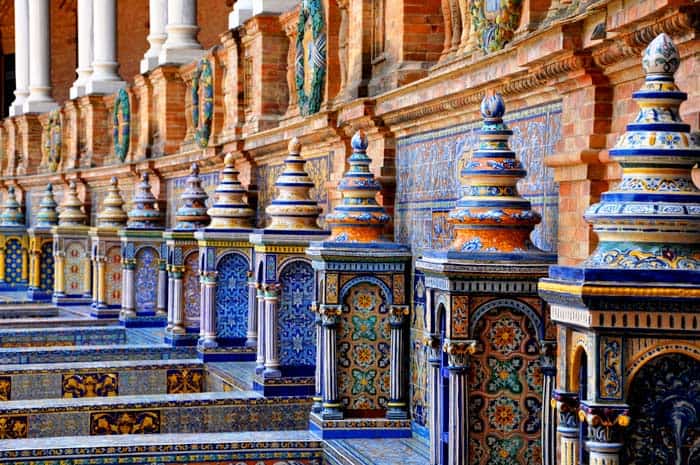
You’ve finally reached the heart of the Parque de María Luisa. Before entering Plaza de España you’ll find an area devoted to horse-drawn carriages and horse rides, popular with tourists and locals alike.
To your right are green areas with fountains, allegorical figures sculpted by Lorenzo Coullaut Valera at the beginning of the twentieth century and the bronze statue depicting Princess María Luisa. To your left, meanwhile, opens the wonderful Plaza de España. You are facing one of the most beautiful squares in Europe, with its navigable canal for boat trips, its arches and Seville’s azulejos.
It is precisely the ceramics that make the plaza and the park even more distinctive: strolling through the park adjacent to the plaza you’ll find vase-holders, benches, ducks and other animal figures decorated with precious, colourful ceramics. An example? The charming Fuente de las Ranas, the work of the ceramicist Manuel García-Montalván. The fountain is on the park’s main thoroughfare, just after the Isleta de los Patos, where you absolutely must make your way to the romantic Pabellón de Alfonso XII which overlooks the lake with its island.


Walking south, you’ll also come across a large octagonal fountain surrounded by myrtle hedges and decorated with ceramic lions: you are facing the Fuente de los Leones. This handsome fountain may call to mind the fountain in the Patio de los Leones of the Alhambra in Granada (by the way: if you’re planning to visit, don’t forget to read our article with all our tips for a tour of the Alhambra).
Before reaching Plaza de America, you’ll also come across the Monte Gurugú, a small rise pierced by a tunnel, on whose summit there is a glorieta. The name recalls a mountain located near Melilla, the Spanish enclave in Morocco.

In the southernmost part of the park, as mentioned earlier, Plaza de America, you will find the Museo Arqueológico Provincial. Established in 1929, it housed the Renaissance pavilion of the Ibero-American Exhibition. The museum is laid out over several floors: in the basement you will find artefacts from the Paleolithic through to the Roman Empire, while on the upper floor are the remains unearthed in the nearby Roman city of Itálica (Santiponce).
You will undoubtedly be left speechless by the 3rd-century BC mosaic floor. Particularly interesting too is the section on Moorish Spain, with objects discovered at Medina Azahara, Córdoba. The museum is open to the public with free admission for European citizens. Opening hours are: Tuesday to Sunday from 9:00 to 21:00 (on Sundays in the winter months the closing time is brought forward to 15:00).

Not far from the Provincial Archaeological Museum you’ll find the Museo de Artes y Costumbres Populares. Also established in 1929, it housed the Mudéjar Pavilion of the Ibero‑American Exhibition. Its façade is magnificent; inside you’ll find various displays relating to the arts and traditions of Seville and Andalusia: you can learn how leather or ceramics were worked and delve into the history of the azulejos.
There are also sections devoted to agricultural machinery and to the customs and traditions of local life such as Seville flamenco, the Semana Santa of Seville, the Feria de Abril and bullfighting. This museum is also free for European citizens and can be visited during the same opening hours as the Provincial Archaeological Museum.

To return towards Puerta Jerez, I recommend walking along Paseo de las Delicias. This wide avenue runs alongside the Guadalquivir River on one side, while on the other it borders the park.
You will see several buildings near the river that resemble fortresses: one example is the curious Costurero de la Reina, now home to the Tourist Office. Other pavilions with surprisingly beautiful façades include the Pabellón de Perú and the Pabellón de Chile. In the middle of the paseo, you will find a monument to Elcano, the navigator who completed the first circumnavigation of the globe after Magellan.
