Holy Week in Seville: the moving processions during the Easter period in Seville.
Anyone who has visited Seville has surely appreciated the beauty, art, traditions and joie de vivre of its people. But you cannot say you have truly got to know it unless you visit the city during the many processions and celebrations of Seville’s Semana Santa. When religion combines with a popular tradition that has centuries of history and customs, we discover a new soul of Seville and, if possible, fall in love with it even more.
During Holy Week, which runs from Palm Sunday to Easter Sunday, Seville is dressed in colours, traditional clothes and rituals that take us back in time. In 2027, Seville’s Semana Santa will take place from 21 to 28 March.
The number of active participants in the processions of Semana Santa is impressive: more than 60,000 brotherhood members take part in the processions through the streets of the city every year in the days leading up to Easter. The brotherhoods they belong to are almost 60, and each one has a tradition and a history that go back centuries. Let us look in detail at how Semana Santa in Seville unfolds.
The procession routes
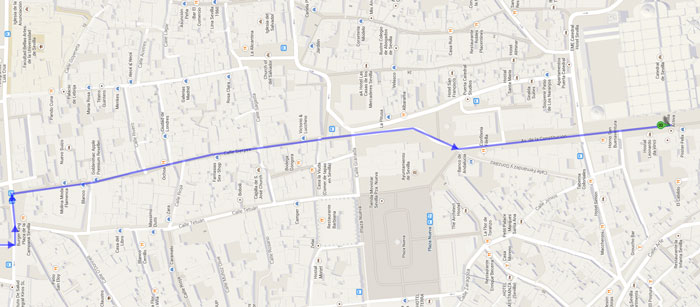
During Holy Week, each brotherhood has a specific route to follow. The procession sets off from each brotherhood’s church and continues through the city streets. All the brotherhoods follow a shared stretch known as Recorrido y carrera oficial. This ‘official route’ consists of passing through Puerta San Miguel, continuing on to Plaza de la Campana, Calle de las Sierpes, Plaza de San Francisco, Avenida de la Costitución, the Cathedral and Plaza Virgen de los Reyes.
The ritual requires that in Plaza de la Campana the Diputado Mayor and Diputado de Cruz of each brotherhood formally ask a representative of the Council of Brotherhoods for permission to continue the procession, which is officially granted.
The roles of the confraternity members
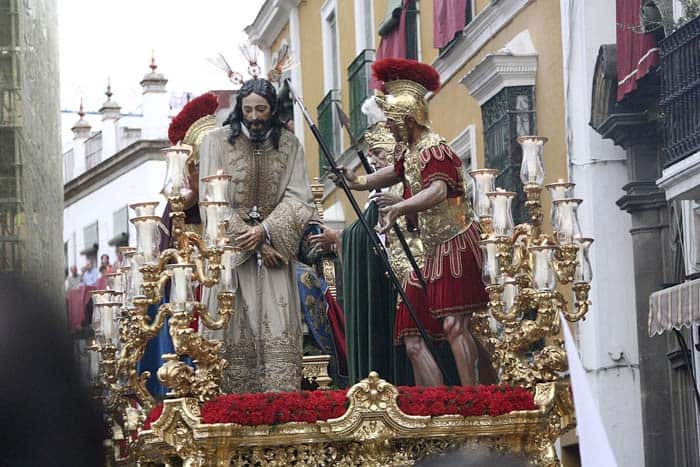
Each confraternity carries two or three statues or sacred images in procession: one represents Christ, one the Virgin Mary and – for the confraternities that carry three sacred symbols – there is an additional mystery of faith assigned to them by tradition and history.
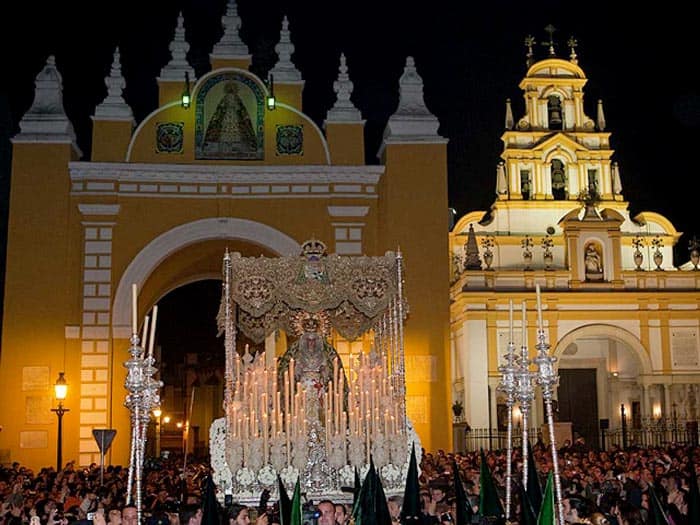
The statues or sacred images are often true Baroque works of art from the sixteenth and seventeenth centuries, sculpted by famous Spanish artists. The bond between man and the religious symbol is so strong that even the latter’s name is paso. The term means ‘step’ and evokes the skill and strength of the men, around 50 beneath each paso, who carry the icon on their shoulders step by step through the streets of the city. When the icon represents the Madonna, the paso is called a palio. The valiant men assigned the task of carrying the pasos or palios are called costaleros.
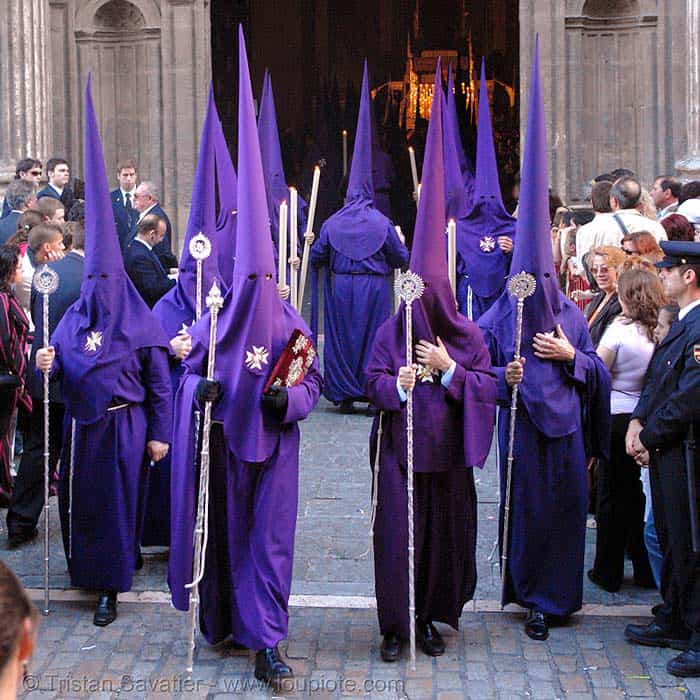
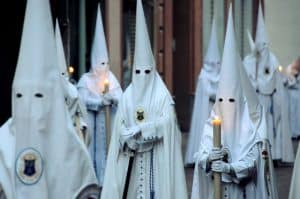
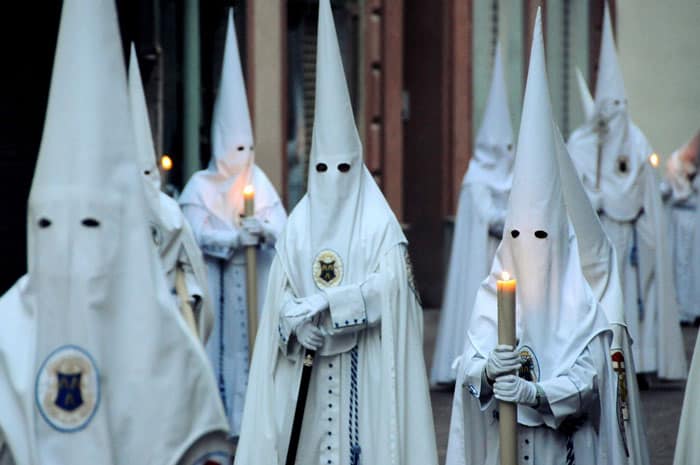
Particularly striking to see during the processions are the nazarenos, with their traditional robes in different colours and the typical pointed hood, the capirote. The acólitos wear a cassock and carry candles, crosses or incense thuribles. Among the penitents stand out the capataz, that is, the foremen, key figures who coordinate the costaleros and the pace of the pasos.
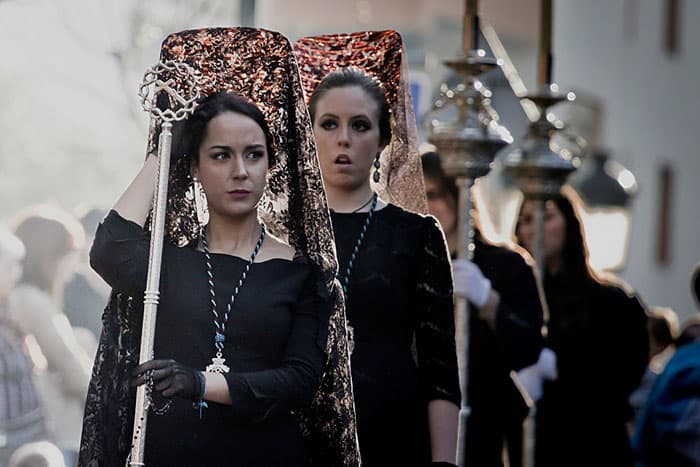
Unlike some Easter processions in Italy and other parts of the world, women in Seville also play an important role within the processions and the brotherhoods.
The black dress and tall lace headdress are adorned with finely carved tortoiseshell or bone combs, or, in more recent outfits, shells. The dress is called mantilla. Also parading through the streets of the city are the penitents: those who choose to do penance or make a vow and who, therefore, carry the cross or go barefoot.
The songs and prayers
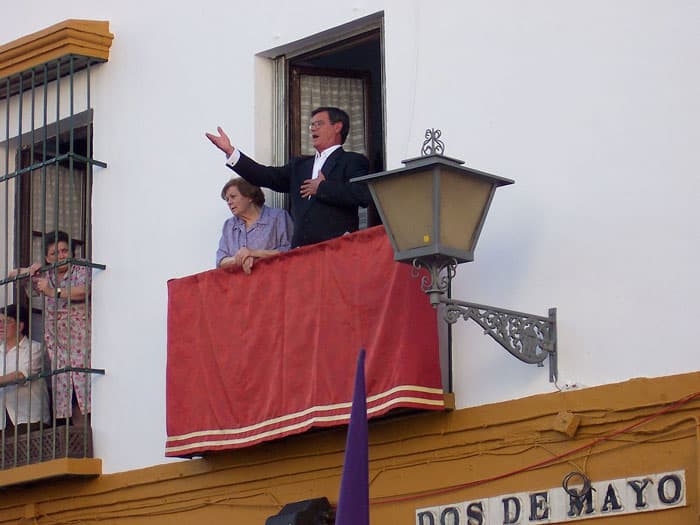
Siviglia is famous throughout the world for flamenco and the songs associated with it. During Semana Santa, this tradition that is so emblematic of popular culture echoes from the balconies and the squares: spontaneous songs are sung as the processions pass by. This sung prayer is called the Saeta and hearing it at the most moving moments of the procession gives you goosebumps.
The main brotherhoods
Certainly every brotherhood has its own importance, history and particular traditions. But there are four which, because of their historical significance, are considered the main brotherhoods: the Brotherhood of the Macarena, the Brotherhood of Jesus del Gran Poder, the Brotherhood of Esperanza de Triana and the Brotherhood of the Gypsies.
You can admire the processions of the most famous brotherhoods on the night of Maundy Thursday and the morning of Good Friday, the crucial hours of Holy Week, known as the Madrugá.
Best areas to watch the processions in Seville
Taking part in these events as a tourist is certainly a unique experience that I strongly recommend. Remember that the number of visitors to the city is huge during Semana Santa, so you will need to book a hotel in Seville well in advance: El Centro, Barrio Triana, Barrio Macarena, El Arenal are the districts most heavily besieged in the days of Easter in Seville.
Of course, I suggest you see as many processions as you can, and the best places to stop and wait for them to pass are, for example:
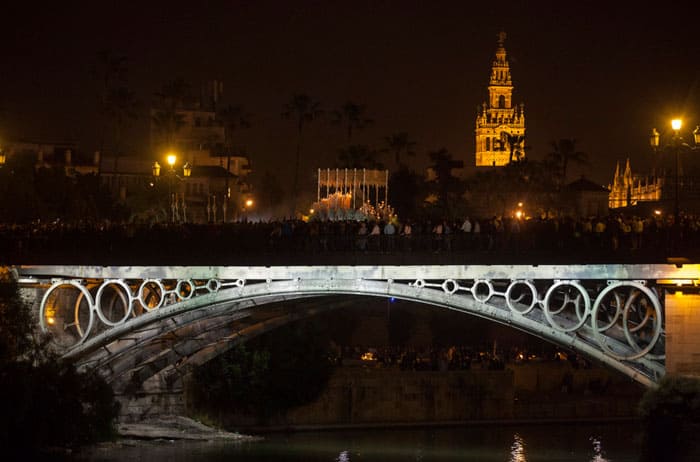
the Triana Bridge
Calle Feria
Calle Alvarez Quintero
the area near Plaza de la Alfalfa
Processions in Seville, Triana Bridge
Along the official route, the Recorrido y Carrera, there are paid seats (depending on the seats, the price can rise to several hundred euros). In general, too, getting tickets is not easy because they are already booked by the families of the confraternities’ members. If you want to try your luck, though, you can try contacting the High Council of Congregations and Confraternities by visiting their website.
Another tip is to pick up the free guides to the programme of the various processions’ routes and choose one of the churches from which the procession sets off. In this latter case, I recommend the Basilica of the Macarena or the Basilica of Jesus del Gran Poder.
A history spanning five centuries
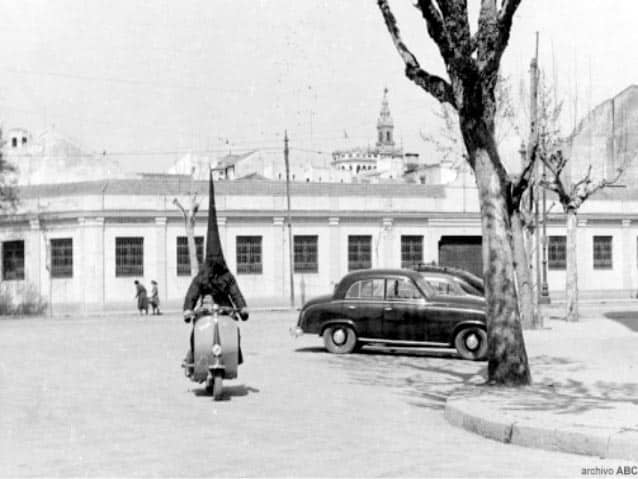
A Nazarene running late for the procession
Already in the Middle Ages, there were processions in Seville to commemorate the passion and death of Jesus Christ. With the Synod of 1604, Cardinal Fernando Niño de Guevara established the official route for the brotherhoods during the Easter processions: they had to stop compulsorily in front of the Cathedral and the Church of Santa Ana in the Triana district. Having a regulated route is still one of the main features of the Holy Week processions in Seville.
In the nineteenth century, thanks also to Luisa Ferdinanda of Bourbon, the number of confraternities grew, as did their importance in helping those in need and serving the city. Today the confraternities are active all year round and play a fundamental role in city politics.
The popularity of the processions of the Semana Santa in Seville has grown over the years and today attracts the faithful, the curious and devotees from all over Spain and the world. Caught up in the frenzy of everyday life, we are all struck by seeing a city that has for centuries come to a standstill to commemorate a religious moment and turn it into such a deeply felt and evocative event.
Interesting facts about Seville’s Semana Santa
According to tradition, the processions of some brotherhoods must be silent, while others can be much livelier.
La Brotherhood of Silence – which was so important in the establishment of the wonderful Hospital de Los Venerables – is the only brotherhood that does not ask aloud for permission to enter the Recorrido y Carrera Oficial. Being bound by the vow of silence, it is enough for them to show a written request to receive approval.
There is an annual membership fee to be paid in order to be part of the brotherhood. The costaleros, the capataz and the other participants in the processions, therefore, must necessarily be paying members.
The conical headdresses that conceal the face symbolise the effacement of human differences, and of man himself, before God.
The route that each brotherhood must follow and the times are established at a meeting called. The meeting takes place 14 days before Palm Sunday.
I pasos and the palios are true works of ancient art that must be honoured and protected. For this reason, if it rains the processions are cancelled.
After Semana Santa, Seville immediately changes its clothes and dives headlong into the fun: in April, the famous Feria of Seville takes place!
Flora Lufrano
Translator, writer and teacher with a passion for travel. I love meeting people from different cultures and discovering the many beautiful things the world has to offer.