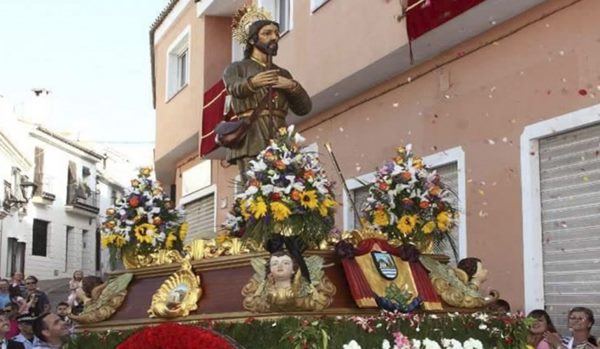
May is an excellent month to visit Andalusia: from a climate point of view, temperatures are ideal, especially when compared with the approaching summer months, a period in which you are very likely to have to face sweltering days, particularly inland, in the Seville Cordoba Granada triangle. From the point of view of events and festivals, the excitement surrounding the exceptional Feria de Abril in Seville has basically just died down, and the moving, dramatic civic processions – scattered all over Andalusia – of Semana Santa during Easter are still fresh in the mind: first and foremost, the Holy Week in Seville.
However, when it comes to events and festivals, the month of May is by no means any less lively: the city that is probably the star of this period is Cordoba, but there are other unmissable dates with Andalusian tradition: in Jerez de la Frontera, in El Rocío in the province of Huelva, in Seville itself and in many other small towns and villages across the region.
In this article, we want to give you an overview of the main festivals and events held in the month of May in Andalusia, so as to give you an idea of what to expect during these celebrations, which are so deeply felt and experienced by Spaniards.
Contents
The weather in Andalusia in May
May is one of the most pleasant times to visit Andalusia. The days are generally sunny and warm, but without the extreme temperatures that characterise the summer months. In Seville and Cordoba, average highs are around 27°C, while Granada is cooler, with average temperatures of around 24°C and evenings that are even cooler.
Along the coast, however, the climate is milder: in Málaga average highs are around 24°C, whilst in Cadiz they are around 22°C. Rainfall is generally infrequent, so May offers many hours of sunshine.
May celebrations in Cordoba
As we have mentioned, the queen of the festivities in Andalusia for the month of May is Cordoba. The city of the Mezquita begins to feel spring: the patios and terraces overlooking Cordoba’s Moorish little streets fill with flowers, in anticipation of the much-loved Concurso Popular de Cruces de Mayo de Córdoba.
Batalla de las Flores in Cordoba
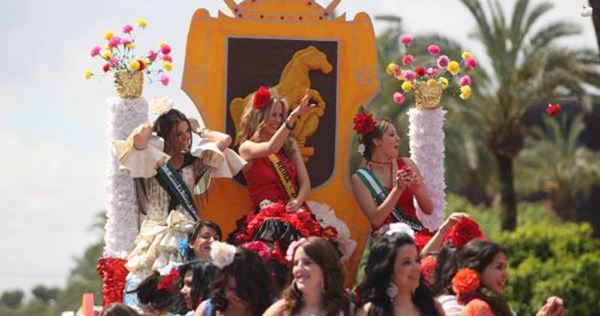
Along the whole stretch of the Paseo de la Victoria, not far from the Judería, a caravan of around 20 brightly coloured carts, richly decorated with flowers, makes its way along: it is the way in which the people of Córdoba welcome the arrival of spring.
The women, dressed in traditional costume, throw handfuls of carnations at the public, who are invited to respond blow for blow, giving rise, quite literally, to the Batalla de las Flores. The festival normally takes place in the first days of May.
The Cruces de Mayo and the Concurso Popular of Córdoba
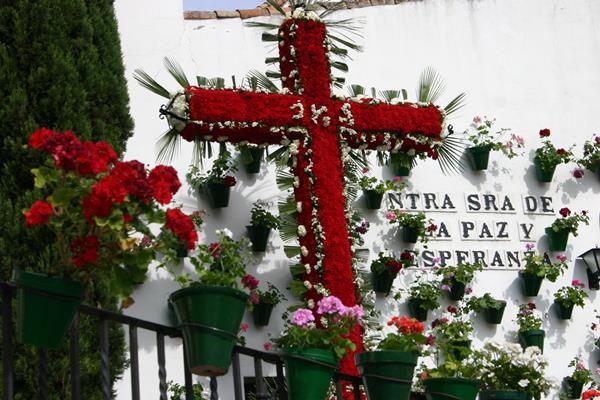
Always at the beginning of May – and usually by the 3rd – a celebration takes place that gives Córdoba a truly unforgettable appearance. The Cruces de Mayo festivity (which is also held in other cities in Andalusia) has its origins in pre-Christian times: it was a festival dedicated to the worship of Nature, held during the period when Spring was at its most abundant.
Tradition dictated that a wooden trunk be adorned with flowers; after the advent of Christianity, the wood was turned into a cross. The Concurso Popular – in addition to involving the city in dancing festivities, performances and shows – awards the Córdoba patio where the cross most beautifully decorated with flowers is displayed.
Walking through the streets of the city’s oldest districts (the centre, San Basilio, San Lorenzo, San Andrés, Santa Marina…) in search of the most richly decorated patios is an experience that, on its own, is worth the price of the trip to Cordoba!
Festival de los Patios of Córdoba
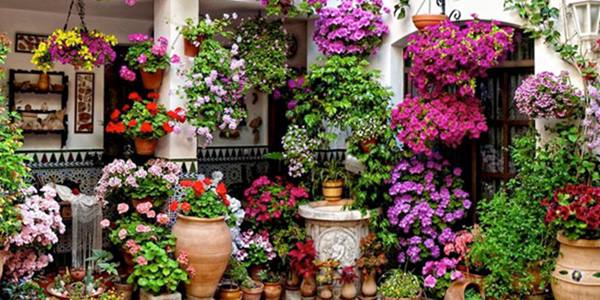
In the days following the Cruces de Mayo, the Festival de los Patios takes place, usually lasting until mid-May. Throughout this period, the Cordoban patios – already festive and colourful during the Cruces – shake the crosses from their backs and reveal themselves in all their explosive floral splendour. In all the neighbourhoods mentioned above, around fifty patios open free of charge to the public, which finds itself immersed in an Andalusian-Moorish setting of overwhelming aesthetic impact.
At this time of year, don’t miss the sumptuous Palacio de Viana, which we talked about in our in-depth guide to what to see in Cordoba: with its numerous patios and gardens, the palace is at its very best at this time of year.
Cordoba Fair
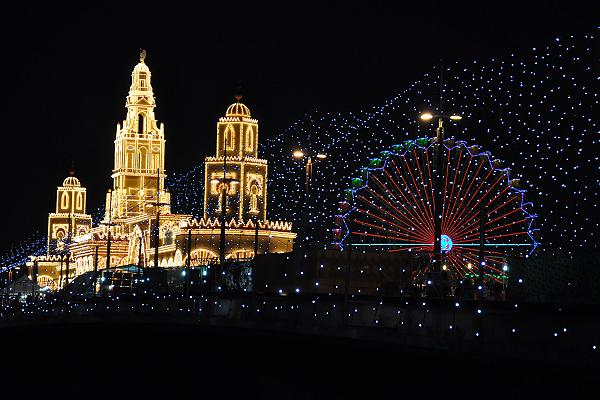
At the end of May, the people of Córdoba, not content with all the flower-themed festivities of the first half of the month, make their way to the El Arenal area, where the Feria of Córdoba is held, a celebration originally of a religious nature, as can be inferred from the other name by which it is known: Feria de Nuestra Señora de la Salud.
So, the final week of May is spent celebrating in Cordoba, with flamenco evenings and bullfighting-themed events, gastronomic events, folk singing evenings and traditional costume performances.
Tips on where to stay in Cordoba
The events in May in Seville
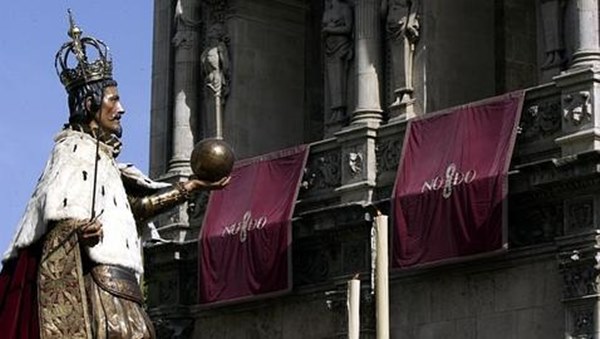
After the great excitement of the Feria de Abril, the city can breathe a little, but not all that much: the programme of bullfights continues in Seville, at the Real Maestranza de Toros, having begun in April; usually in the first few days of May, the annual Feria del Libro, takes place, whilst on 30 May the great feast of Seville’s patron saint, San Fernando, is held.
Tips on where to stay in Seville
The Feria del Caballo of Jerez de la Frontera
About a week after the Feria de Abril in Seville, many Andalusians usually head to Jerez de la Frontera, in the province of Cádiz, where the annual Feria del Caballo takes place, known as one of the most captivating equestrian events in all Spain. The origins of this festival are extremely ancient: the tradition of the Feria del Caballo in Jerez dates back to the late thirteenth century, when the horse market would suddenly spring to life, turning into a carousel of parades and celebrations with an equestrian theme, and not only.
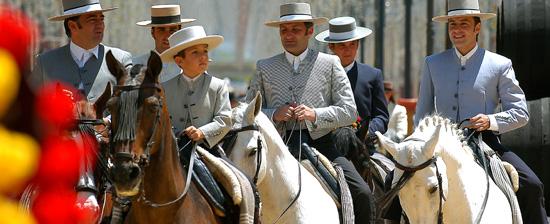
Between one glass of sherry and the next – in the heart of the city centre lit up and decked out with flowers – for an entire week you can admire a truly evocative spectacle of horses and riders in costume, lavish carriages, damsels in gypsy dress, fairground rides, but also bullfights, competitions and dance performances. Afterwards, you can spend some time visiting Jerez de la Frontera proper.
All available accommodation in Jerez de la Frontera
The Romería del Rocío
The numerous romerías in Andalusia (pilgrimages) take place seven weeks after Easter, on the day of Pentecost, in many towns and cities across the region. One of the best known – and undoubtedly the most attended – is the Romería del Rocío, which takes place in El Rocío, a small but picturesque village in the province of Huelva.
If you decide to make your way to this little village, know that you will not believe your eyes: you will see a multitude of hundreds of thousands of pilgrims (some say a million!) making their way, on foot or on horse-drawn carts, through the heart of the Parque Natural de Doñana to the dazzlingly white Ermita del Rocío, in veneration of the Virgin.
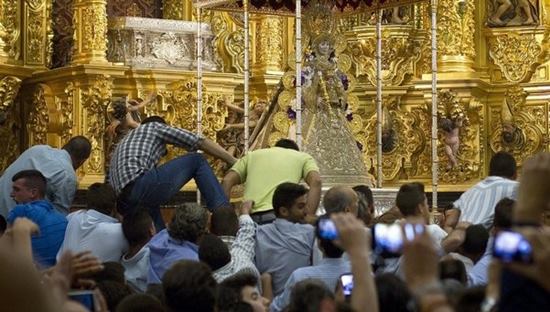
At the stroke of midnight, as the transition into Whit Monday takes place, while the immense column of faithful from the Romería del Rocío prays the rosary facing the canopy that houses the Madonna (here called Blanca Paloma), around the gate that separates her from the people there forms what we would define as more of a brawl than a procession: the faithful crowd together and perform the “salto de la reja” (the leap over the gate), violently fighting to be the first to bear the weight of the Madonna’s throne and thus carry it, while it sways dangerously, into the sanctuary. We covered this and much more in our article dedicated to El Rocío.
All available accommodation in El Rocío
The Corpus Domini in Granada (Feria de Granada)
Non that it happens all that often, but the calendar can sometimes place the feast of Corpus Domini (or Corpus Christi, the Sunday following the Most Holy Trinity, often in June) in the last days of May. Processions in honour of the Most Holy Body and Blood of Christ are held throughout Andalusia, but particularly striking is the one in Granada (where the celebrations spill over into the city’s annual Feria); here the festival is deeply felt, because it commemorates the conversion carried out by the Catholic Monarchs during the Reconquista of the city, which had until then remained in Moorish hands.
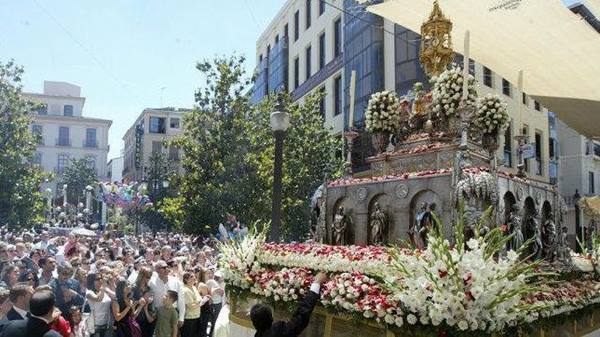
Roaming around the surroundings of the Alhambra in Granada these days means stepping into a whirlwind of colourful draperies, flowers, decorative plants, lush carpets, carriages, dances and historical performances that will take your breath away, in an atmosphere that has nothing to envy even of more celebrated processions. The processions of Corpus Domini are also very much cherished in Malaga, Seville, Cadiz, Ronda, Vejer, Zahara de la Sierra, Algatocín, Cómpeta, etc.
Tips on where to stay in Granada
The feast of San Isidro
In many Andalusian towns, and especially in the villages of the provinces of Málaga and Granada, San Isidro, patron saint of farmers, is celebrated on 15 May: the festivities held in Estepona, Montefrío and Alameda are particularly atmospheric, with romerías, agricultural-themed celebrations and traditional performances in the town square.