I will not easily forget the day I visited El Rocío: my wife and I set off from Seville in the morning, when it was already terribly hot. I had been driving for just over an hour, yet I already had the clear impression that I was moving through another world. Moorish palaces, large squares with orange trees and grand façades had given way to ever more open horizons, flat fields, pine woods and, as we drew nearer to the Doñana National Park, a wilder, marshier landscape. Human presence had diminished drastically: along the almost deserted road we passed only a few, very few urban centres, but nothing could have prepared me for what I was to see on arriving in El Rocío.
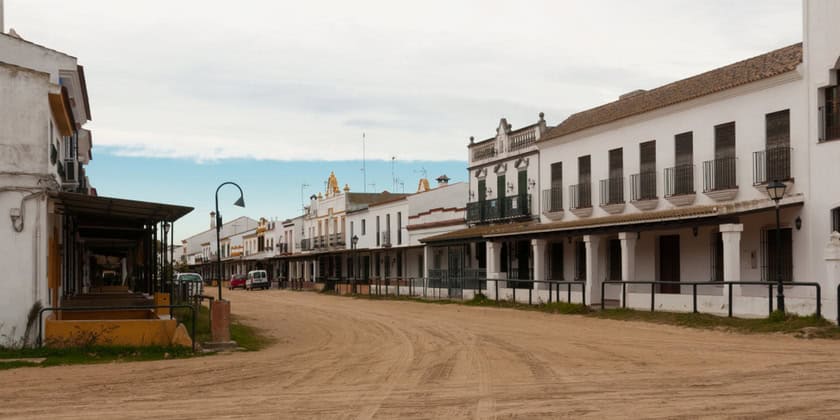
Of course, I had already had a peek at a few photographs of this place so out of time, but actually being there had a decidedly disorientating effect on me. The lagoon, the sandy streets lined with wooden porticoes, the low whitewashed houses, the horses tied to the fences and, in the background, the unmistakable silhouette of the Santuario de Nuestra Señora del Rocío. In short… was I still in Andalusia, or had I somehow ended up in a town in the Californian Wild West?
In this article I want to tell you about my experience in this very peculiar village in western Andalusia, giving you a few tips on what to see in El Rocío and its surroundings, with particular attention to history, customs and traditions.
Contents
Where is El Rocío located
El Rocío is a small village in the province of Huelva, geographically located within the municipality of Almonte, between the marshlands and the protected natural areas of Doñana National Park. It is no coincidence that the Centro de Visitantes La Rocina, one of the park’s main access points, is just 1 km (0,6 miles) away and can also be reached easily on foot from the village. But we will see that.
How to get to El Rocío
Generally, the two main reference cities for a visit to El Rocío are Huelva and Seville. At a reasonable distance as the crow flies there are also Cádiz and Jerez de la Frontera, but between them and El Rocío lie the mouth of the Guadalquivir and Doñana Park. As it is a protected area, there are no roads you can drive on, so it is necessary to considerably extend the journey by going via Seville.
From Seville
- From Seville, it takes 1 hour and 15 minutes by car via A-49 and A-483, passing through Almonte.
- There is a bus service operated by Damas that connects Seville to El Rocío with a journey of around 1 hour and 35 minutes. At this link you can buy tickets.
- There are various organised tours from Seville to Doñana National Park, and some of them also include a visit to El Rocío. You can find one here: by clicking the link, you can get more information.
From Huelva
- It takes just under an hour to drive from Huelva, again via A-49 and A-483 (though, of course, coming from the west).
- Getting around by public transport from Huelva is more complicated: you have to change buses at Almonte and the journey takes quite a bit longer. It’s not a solution I’d recommend.
Where to park
Working out where to park in El Rocío is fairly straightforward: when you enter the village, simply follow the signs for the “Ermita”; you will find the car park directly ahead. In any case, I have left the coordinates here so you can immediately see where to leave your car.
El Rocío between history and tradition
The vital heart of El Rocío, also from a visual point of view, is precisely the imposing and immaculate Santuario de Nuestra Señora del Rocío. Tradition has it that a hunter — or a shepherd, according to other versions — found an image of the Virgin hidden in the trunk of a tree among the woods of the Las Rocinas marsh. The man supposedly tried several times to take it away, but each time the statue would mysteriously return to the place where it had been found, indicating the spot where it wished to be venerated.
Da this miraculous episode would have originated the great popular devotion to the Virgin, even though the Hermandad Matriz itself — the mother brotherhood of Almonte that safeguards the Virgen del Rocío — specifies that the story of the “finding” was only put into writing at a rather late date, to explain a cult that was certainly older.
From a historical perspective, the origins of the sanctuary are linked to the Christian conquest of the territory of Niebla in the 13th century and the foundation of the first hermitage in the isolated landscape of Las Rocinas, on the edge of Doñana. Over the centuries, an increasingly important pilgrimage centre developed around this place of worship, transforming El Rocío into the heart of one of Andalusia’s largest popular devotions. The hermitage was later replaced by the present sanctuary, which was inaugurated in 1969.
Everything here points back to that origin: the appearance of the village, the rhythm of daily life and the organisation of its spaces remain deeply tied to pilgrimage, devotion and the landscape that surrounds it.
The Rocío Pilgrimage
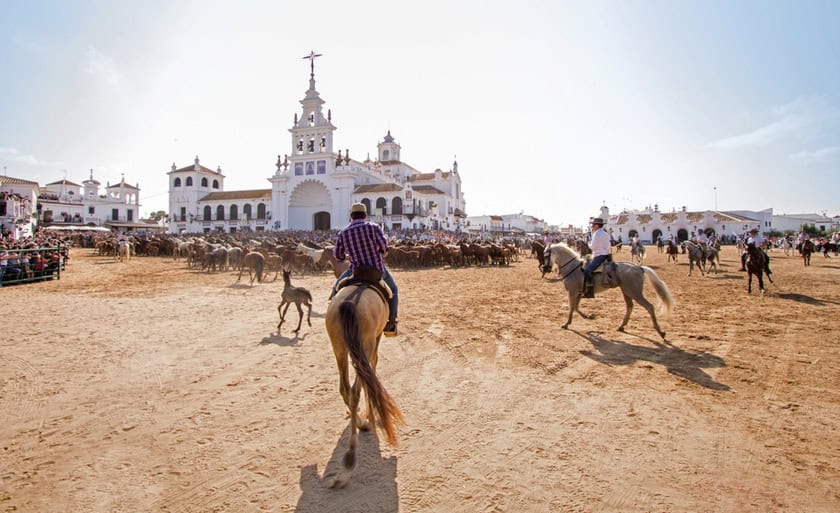
The most important event for El Rocío is without doubt the Romería del Rocío, one of the largest and most deeply felt pilgrimages in all Spain. Every year, at Pentecost, over a million people make their way to the village along historic routes that cross or skirt Doñana. During those days El Rocío fills with pilgrims belonging to hundreds of hermandades: they arrive with their carts and horses, singing and taking part in moments of collective devotion that completely transform the life of the village.
The most striking moment of the Romería comes in the night between Sunday and Pentecost Monday. While the rosary is prayed in front of the sanctuary, all the anticipation is focused on the balustrade separating the people from the Virgen, as everyone waits for the famous Salto a la Reja to take place: the faithful climb over the gate and rush towards the presbytery to take the statue of the Madonna and carry it in procession. In those moments, the atmosphere of recollection turns into a frantic scene: amid shouts and pushing, the Virgen is lifted up and taken out of the sanctuary to begin the procession through the crowd.
What to see in El Rocío
Once you’ve left the car in the car park mentioned in the paragraph above, your proper visit begins. In truth, you won’t have a great many attractions to visit or things to see: the best part of the experience lies in the free exploration of the streets branching out around the sanctuary, which you will immediately see standing out in the distance, with its solemn cross crowning a very white façade in a modern Andalusian style.
The Marismeño Walk
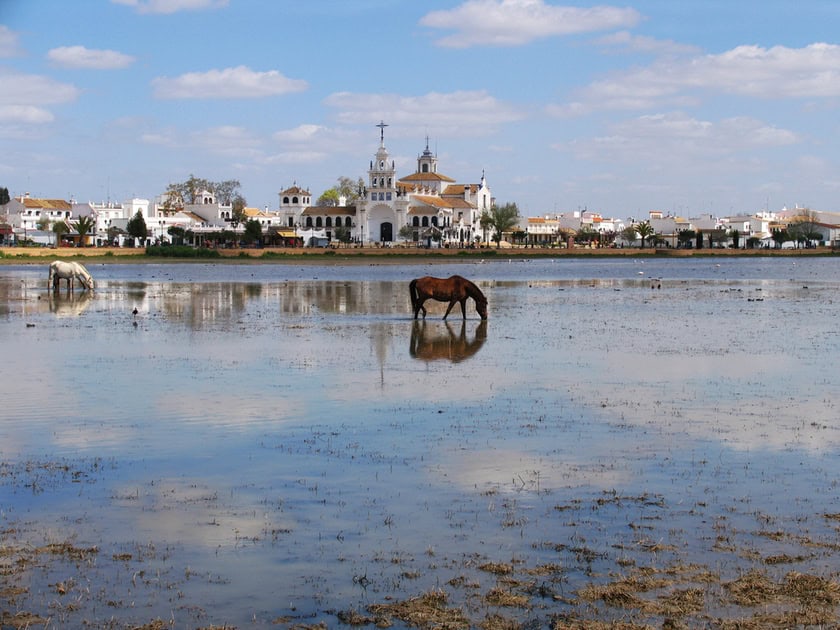
Beside the car park you’ll see the village’s other great star: the lagoon that opens out in front of the Doñana marshes. The advice is to enjoy the landscape, preferably at sunset, not only from the Mirador del Rocío, but also by walking along the Paseo Marismeño that branches off from there: a pleasant scenic stroll from which you can take in the marshland ecosystem, with shallow waters and wetlands where numerous bird species live, including flamingos, spoonbills, herons and moritos. Throughout the year you can also see horses and foals grazing in the grassy strips along the edge of the lagoon.
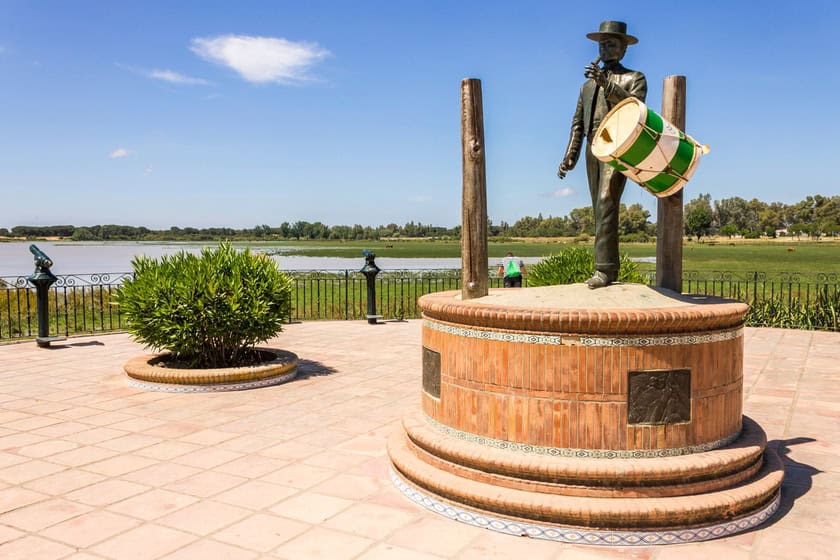
Along the promenade you will also find a bust of Pope John Paul II, in memory of his visit in June 1993. On the pedestal there is an inscription of a phrase the Pope uttered on that occasion: “Después de ver todo el mundo, que todo el mundo sea rociero” (“After seeing the whole world, may the whole world become rociero”).
The Sanctuary of Our Lady of El Rocío
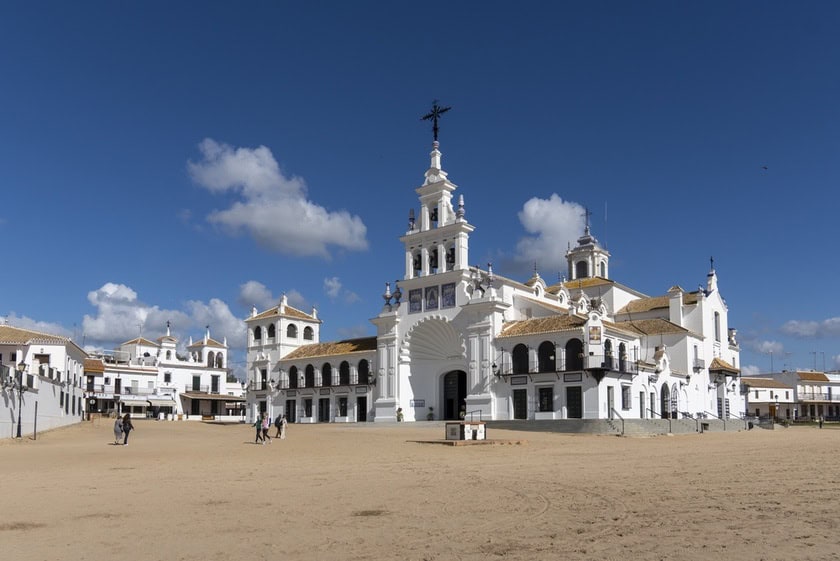
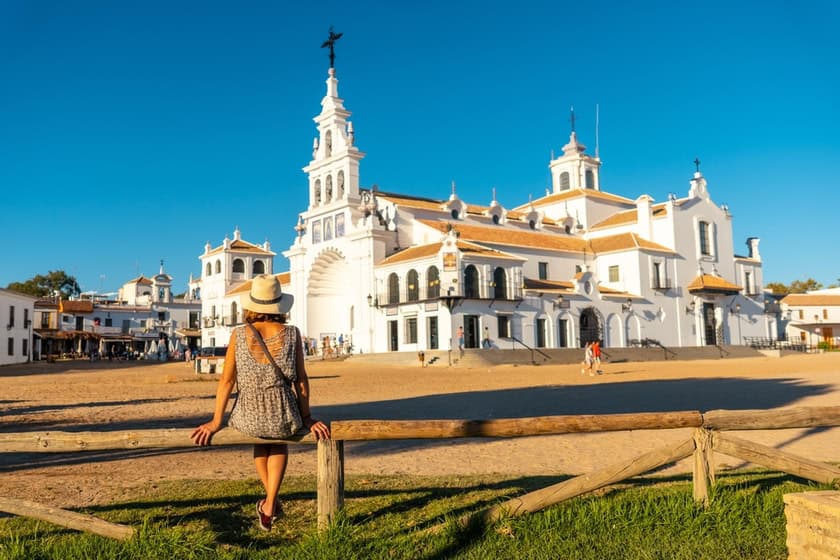
As you will have gathered, the central moment of a visit to El Rocío coincides with the very reason this village exists: the Santuario de Nuestra Señora del Rocío, which replaced the old ermita in 1969. With its imposing white façade, the sanctuary dominates the village and creates a striking contrast with the sand of the surrounding streets. Outside, the most noticeable features are the so-called Balcón del Papa, added for Pope John Paul II’s visit, and the arched portal, topped by a large shell-shaped decorative motif. The façade is crowned by a bell-gable and adorned with ceramic ornamental vases (pináculos cerámicos) that accentuate its outline.
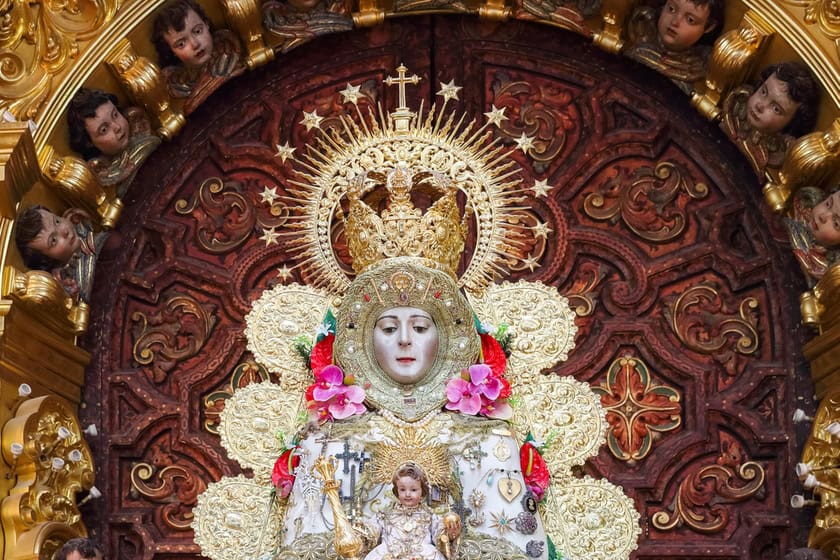
Entering the sanctuary, the eye is immediately drawn to the Retablo Mayor, a large gilded wooden backdrop in baroque style that frames the camarín of the Virgen del Rocío (the Virgin is also known as the Blanca Paloma), preceded by its antecamarín. Alongside this sacred core are other spaces that are important for understanding the life of the sanctuary, such as the sacristy, the chapel for the Virgin’s procession and the Capilla Sacramental y Penitencial. All these spaces clearly show how the church is organised around the needs of worship and the central moments of Rocío devotion, beginning with the Romería.
Next to the sanctuary is the Virgin of Rocío Museum-Treasury, where part of the Hermandad Matriz’s historical and artistic heritage is on display. Even a brief visit can help you better understand more than seven centuries of documented history of the Rocío devotion.
The Sanctuary of Our Lady of El Rocío is open every day from 08:30 to 19:00 and there is no admission charge.
A stroll to the ancient olive trees of Plaza del Acebuchal
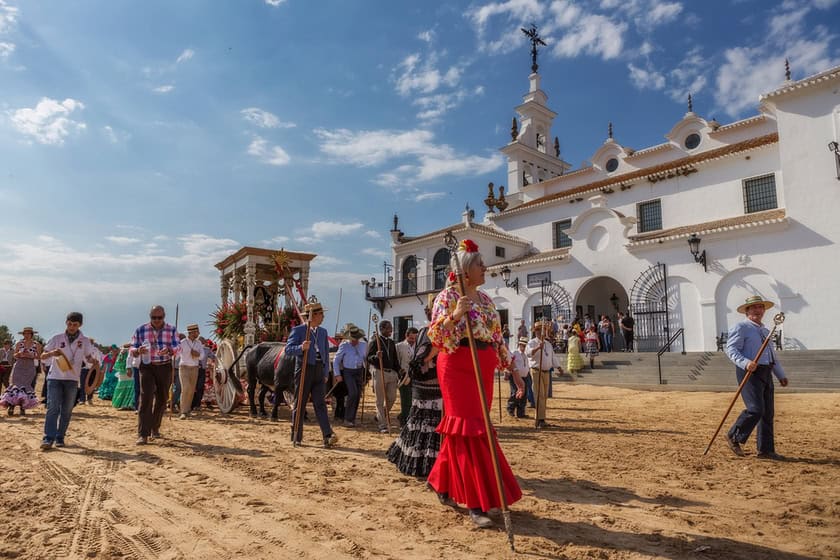
As mentioned, the great thing about El Rocío is wandering around the sanctuary and taking in, here and there, what feels like the dusty set of a western film (and in Andalusia there really is one, but on the other side of the region: Mini Hollywood). In this sense, it is well worth making your way to Plaza del Acebuchal, which takes its name from the acebuches, that is, the ancient wild olive trees found in this part of the village, representing a rare fragment of Doñana’s original Mediterranean woodland. Among them is El Abuelo (the grandfather), a tree that has seen over 600 springs in El Rocío.
The Hermandad Houses
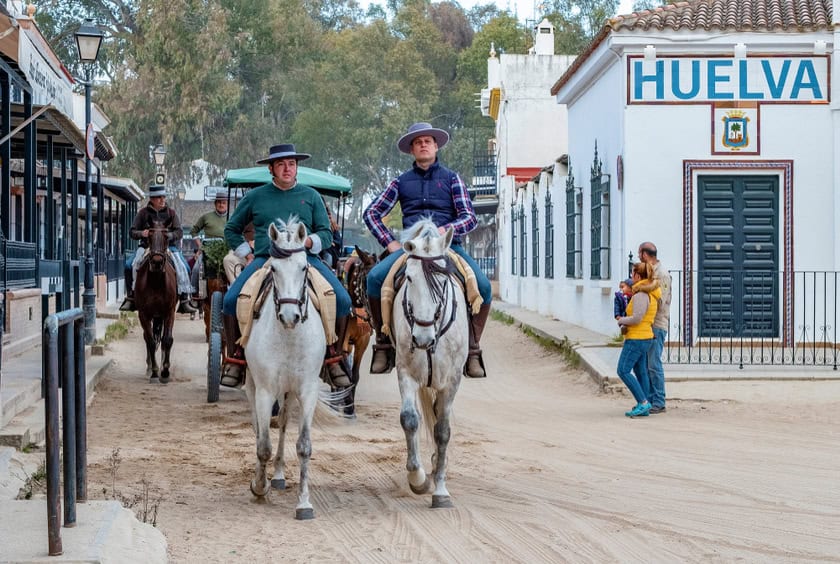
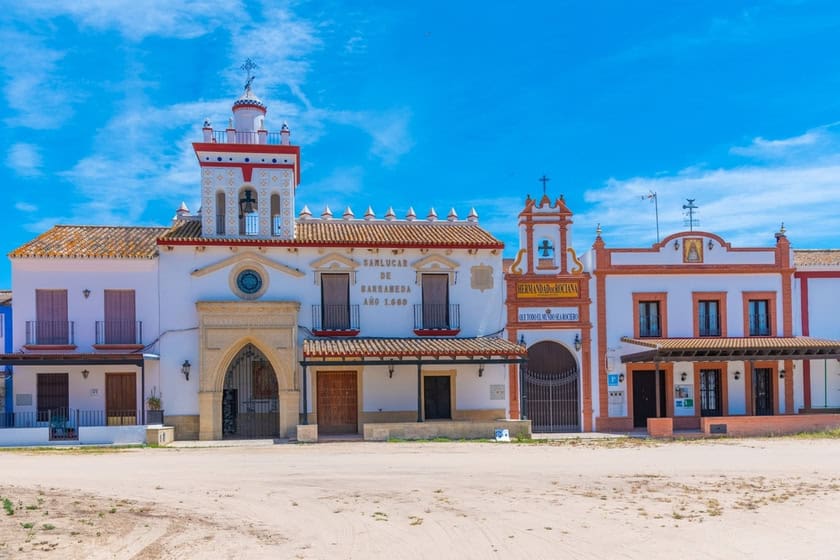
The Casas de Hermandad are the headquarters that the various Rocío brotherhoods keep in El Rocío as a base during the pilgrimages and, above all, during the Romería. They can be found in various parts of the village — from Plaza del Acebuchal to Plaza Mayor, from Plaza de Doñana to Calle El Real — and play a decisive role in shaping its appearance. The buildings that house them are large white houses, often enhanced by balconies, broad gateways and porticoes beneath which carts, horses and pilgrims can be accommodated. One of the most recognisable is the Casa Hermandad del Rocio de Huelva, in Calle El Real, while Plaza Mayor is an excellent area if you want to see several of them concentrated along the same stretch.
Tour from El Rocío to Doñana National Park
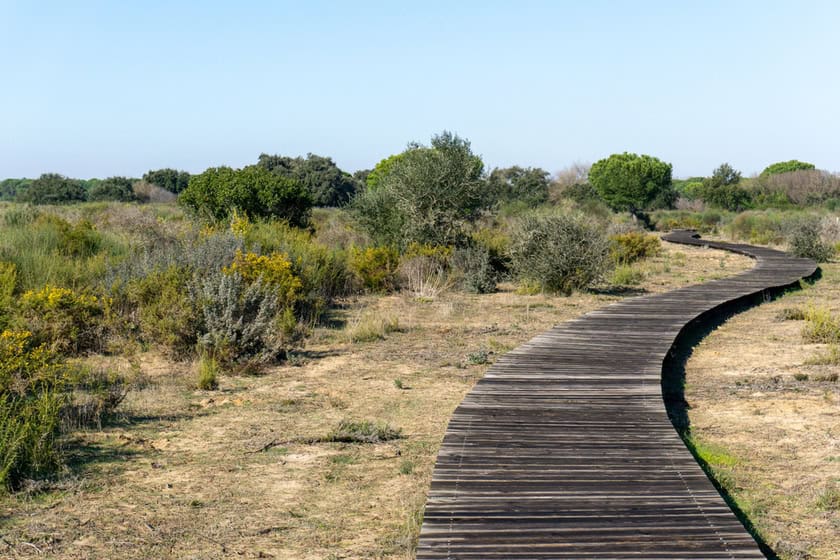
From El Rocío you can get a taste of the Doñana Park in several ways. The easiest and most immediate is still the walk along the Paseo Marismeño, but if you have a bit of time, it is well worth heading (15 minutes on foot from the car park) to the nearby Centro de Visitantes La Rocina. From here, an easy trail leads to various viewpoints over the Charco de la Boca, a more compact wetland than the village’s vast lagoon, where you can observe the local wildlife and the typical riparian vegetation.
The El Acebuche Visitor Centre (towards Matalascañas) is another option, but it requires a 20-minute drive and mainly makes sense if you want to devote more time to the nature side of the visit.
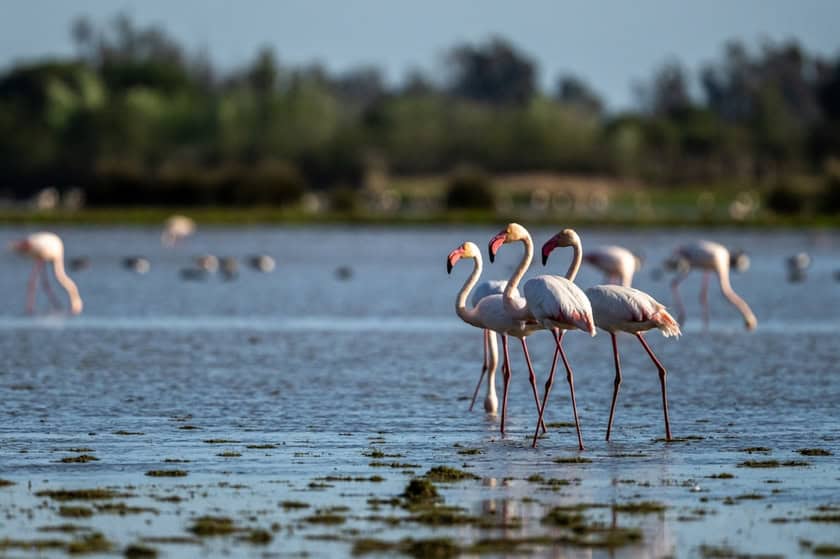
To visit the park more thoroughly, it is worth joining a guided tour in a 4×4 vehicle, the only way to enter the less accessible areas of Doñana… unless you want to do it by horse-drawn carriage!
- El Rocío and Doñana carriage ride: this 2-hour tour, departing from the village, lets you travel through the park’s landscapes in a carriage, the means of transport traditionally used by pilgrims to El Rocío. The route runs alongside the Doñana marshes and enters the park via the Puente del Ajolí, one of the area’s most symbolic access points, offering the chance to observe the local wildlife at a leisurely pace.
- 4×4 tour departing from El Acebuche: an excursion of around 3 and a half / 4 hours that takes you across dunes, beaches, woods and marshes, with panoramic stops and detailed explanations of the local flora and fauna. It is certainly a very different kind of experience from the glimpse you get while wandering around El Rocío.
Map of El Rocío
Where to eat in El Rocío
There are various bars and restaurants in El Rocío with, to be honest, not an especially stellar reputation: I stopped for a simple refresco at Taberna La Concha, but I don’t have particularly fond memories of it (and looking at the more recent reviews, it seems things have got worse). I’d recommend going for the safe option and choosing La Canaliega, a typical Andalusian restaurant just a stone’s throw from the sanctuary where you can eat fried fish and other seafood dishes, such as octopus or rape (monkfish).
Where to stay in El Rocío
The choice to stay overnight in El Rocío is not among the most common for visitors, who prefer to treat a visit to this village as an intermediate stop. However, sleeping here is definitely recommended if you want to have an off-the-beaten-track experience, fully experiencing a completely different corner of Andalusia.
- Hotel Toruño del Rocío: a comfortable hotel, perfect for those who want to stay near the lagoon and the sanctuary, with everything within walking distance. It is a modern property decorated in Andalusian style, with a restaurant, bar and free parking in Plaza del Acebuchal and the immediate surroundings. The rooms are air-conditioned, and some have a balcony with views over the marshes.
- Hospedarte Palacete Real: compared with the previous one, this hotel is more central. It is located in the heart of the village, so it is even better suited to those who want to immerse themselves completely in the suspended, timeless atmosphere of El Rocío. The property is simple yet elegant, perfectly in tune with its surroundings, and offers all the essential services for a peaceful, comfortable stay.
