One hour from Seville is one of the most interesting historic towns in the province of Seville, distinguished by its Baroque and Renaissance architecture, as well as its ancient history. Here you can lose yourself among some of the most beautiful streets in Europe, visit the ancient Roman necropolis or be left speechless before the Petra of Andalusia. I’m talking about Osuna, the stop you should add to your next Andalusian itinerary.
Contents
- Where it is and how to get there
- What to see in Osuna
- San Pedro Street and the Palacio de los Cepeda
- Calle Sevilla and its historic palaces
- Coto de las Canteras: the Petra of Andalusia
- Roman Necropolis of Urso
- Collegiate Church of Santa María of the Assumption
- Monastery of the Incarnation
- Torre of Mercy
- University of Osuna
- Plaza de Toros: the arena in “Game of Thrones”
- Other things to see in Osuna
- Holy Week in Osuna
- Where to stay in Osuna
- Where to eat in Osuna
Where it is and how to get there
Osuna is located in the province of Seville, specifically here, in the central area of Andalusia. That is why it is easy to include in several itineraries between the main cities. The distance from Seville is around an hour along the A-92 motorway, which links the regional capital to Granada, which is almost two hours from Osuna in the opposite direction. Córdoba and Malaga, on the other hand, are fairly equidistant from Osuna and are both an hour and twenty minutes away, one to the north and the other to the south.
Can Osuna be visited by public transport? Yes, and it can be a day trip from Seville: it takes one hour and twenty minutes by train. Moreover, this is one of the main possible stops on an itinerary from Seville to Cordoba.
What to see in Osuna
Osuna is a very small but charming town, and one that stands out as one of the places with the oldest and most interesting history in the province of Seville. Visiting it feels a bit like being in a history lesson: you move from archaeological evidence dating back to the 7th century BC, to those from the Muslim rule of the 1500s, and on to the rich Baroque heritage of the ducal period. In short: despite its small size, it is a treasure chest of history.
San Pedro Street and the Palacio de los Cepeda
Don’t know where to start when visiting Osuna? Well, obviously with Calle San Pedro, which is known as one of the most beautiful streets in Europe and is sure to leave an impression. It is not, in itself, one of those dramatic streets that takes your breath away as soon as you turn into it, but rather a street where you need to pay attention to every building you pass as you walk along. Yes, because it is a continuous sequence of Baroque and Renaissance palaces, each with a story to tell.
Between wrought-iron balconies and façades finely decorated with carved stone, it is lovely to stroll along this street, which, incidentally, is also much quieter than the hectic streets of the larger Andalusian cities, which are far more touristy.
The most iconic building is the Palacio de los Cepeda, which once belonged to the family of none other than Saint Teresa of Ávila. In fact, the image of the saint from Ávila is depicted above the entrance. The palace was built in the 18th century and its Baroque façade, with the portal framed by stone columns, is among the town’s most recognisable.
Particularly striking is the balcony topped by the family crest, in a sense protected by the statues of the two halberdiers standing alongside it. Inside the palace, the most interesting features are undoubtedly the beautiful patio and the staircase surmounted by a painted dome. Unfortunately, however, it can only be seen from the outside as it is used as a courthouse.
Calle Sevilla and its historic palaces
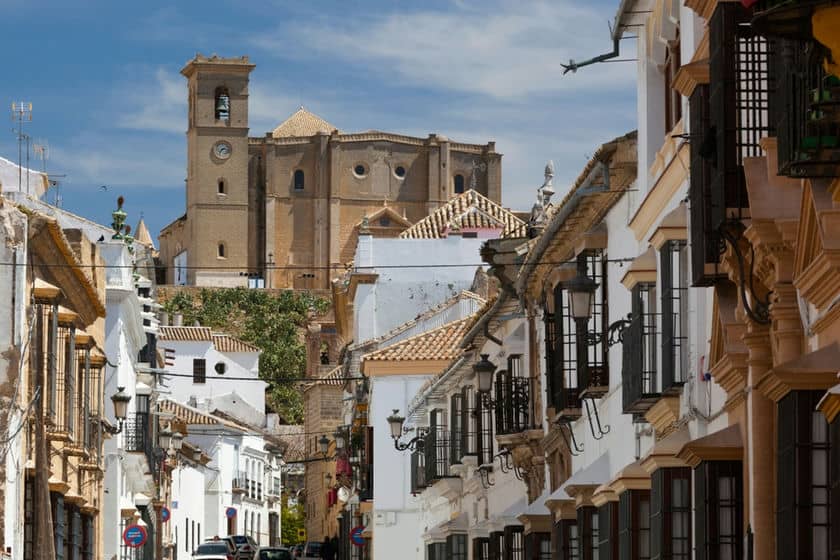
Another street where you absolutely must take a stroll is Calle Sevilla. There are two reasons for this: first, the view from here of the Collegiate Church is spectacular (I’ll talk about it in a moment), and second, there are countless historic mansions lining both sides of the street, with postcard-perfect façades.
If you don’t want to miss the prettiest ones, focus on these street numbers: 31, 33, 39, 44 and 50. Incidentally, they are all quite close to one another. In order, these are the historic mansions: Casa de los Torres, Casa del Marquesado de Campo Verde, Casa de los Rosso, Palacio de los Govantes y Herdara and Casa Solariega.
Coto de las Canteras: the Petra of Andalusia
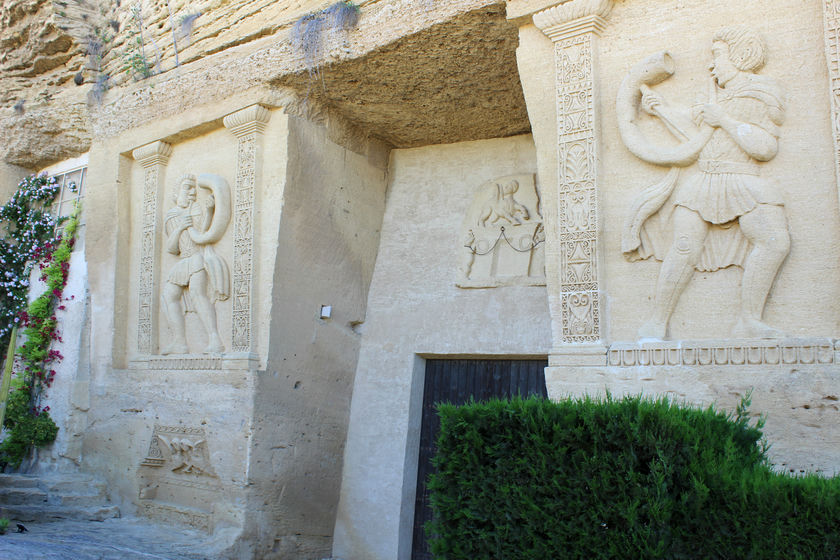
Osuna’s most surprising attraction is what many know as the Petra of Andalusia. I’m talking about the Coto de las Canteras, an incredible place that gives the impression of being in the Middle East rather than in Spain. It is a sandstone quarry, which for centuries was used to extract the stone needed to build the city’s buildings and which later became a place for culture and events, where the walls and blocks of stone have been sculpted, giving the site a surreal atmosphere.
The first uses of this quarry date back to more than 2,000 years ago, when the Turdetani people (one of the most advanced in the Iberian Peninsula) extracted large blocks of stone. Quarrying techniques were improved with the arrival of the Romans, who brought metal chisels and other tools. It was the Romans who built the city of Urso, now Osuna, using the stones from this quarry. But stone continued to be quarried here in the Middle Ages to build churches and defensive walls, as well as in the modern era – from 1700 to 1900 – for the city’s expansion.
After years of neglect, in the early 2000s a restoration and enhancement project gave new life to the ancient quarry. The sculptor Francisco Valdivia renewed the face of this place by creating sculptures directly into the stone and turning it into a spot that recalls Petra and the other ancient rock-cut cities of the Middle Eastern deserts. The most notable sculptures are: the Iberian lion (a colossal lion weighing over 40 tonnes), the vintage harvest (a wall of over 100 sq m depicting vines and bunches of grapes) and the Corrnus players (a series of reliefs around the entrance portal).
The site can be visited every day from 10 am to 2 pm, and on Saturdays also in the afternoon from 4 pm to 7 pm. The entry ticket costs €4 and is free for children up to their ninth birthday. There are also guided tours at specific times.
Guided tour of Coto Las Canteras and the Roman Necropolis
Roman Necropolis of Urso
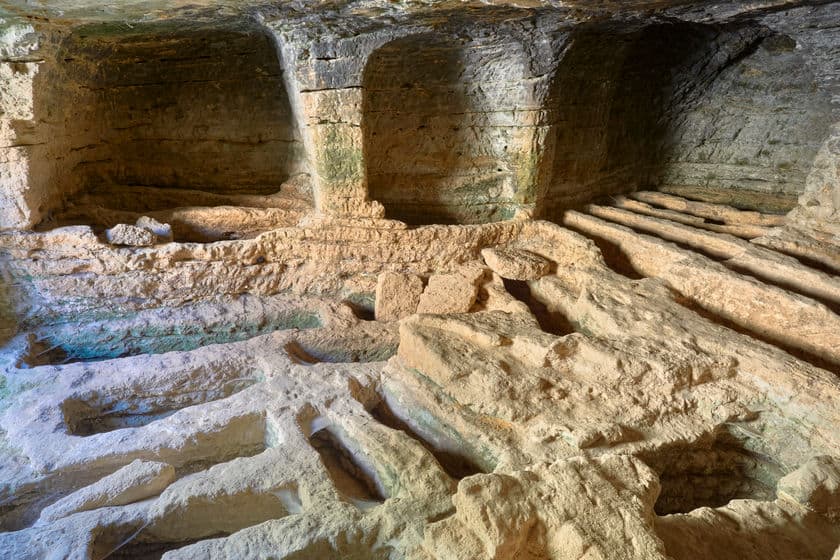
The archaeological area of Las Cuevas de Osuna, also known as the Necropolis of Urso, is among the most important Roman-era archaeological sites in Spain. Several tombs cut into the rock show how this must have been a vast and important burial place. The most significant archaeological excavations were carried out in the early 1900s, when the largest tombs and the fascinating underground chambers were uncovered, carved into the rock with vaulted ceilings and decorated on the walls with motifs ranging from birds to religious references.
Unfortunately, the part of the necropolis already known before these excavations was looted over the preceding centuries, but many finds have been preserved and are on display at the archaeological museum of Osuna and the National Archaeological Museum of Spain in Madrid.
Today the necropolis can be visited, but you should not expect a museum: the necropolis has free access, so there are neither opening hours nor an entry fee. On the one hand, that is an advantage because it costs nothing and can be visited at any time, but on the other you may find it difficult to visit it while fully understanding what you are seeing; that is why it may be worth joining a guided tour for detailed explanations about the site.
Guided tour of Coto Las Canteras and the Roman Necropolis
Collegiate Church of Santa María of the Assumption
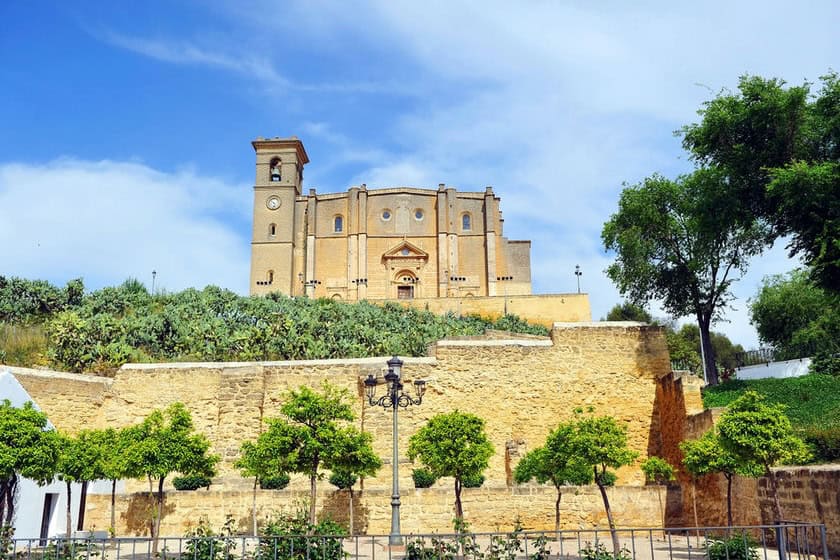
The most important church in Osuna is the Colegiata de Santa María de la Asunción, built between 1531 and 1535 and which for five centuries has dominated the town from the top of the hill on which it was built. This imposing Renaissance church has the outward appearance of a austere fortress, but inside it is bright, richly decorated and furnished with fine works by artists such as José de Ribera (Lo Spagnoletto), Juan de Mesa and others.
Among the unmissable highlights inside are the Chapel of the Merciful Christ, where the sculpture of Christ of Mercy made in 1622 by Juan de Mesa is located, and the Ducal Pantheon: an underground level with a chapel where almost all the dukes who succeeded one another in governing Osuna are buried.
The collegiate church cannot be visited independently, only on guided tours costing €6.60 (children under 12 pay just €0.60). If you wish, you can also buy a combined ticket that includes the collegiate church, the archaeological museum and the Monastery of the Incarnation. All tickets are on sale here.
Alternatively, you can also join a guided tour of Osuna that also includes the collegiate church.
Monastery of the Incarnation
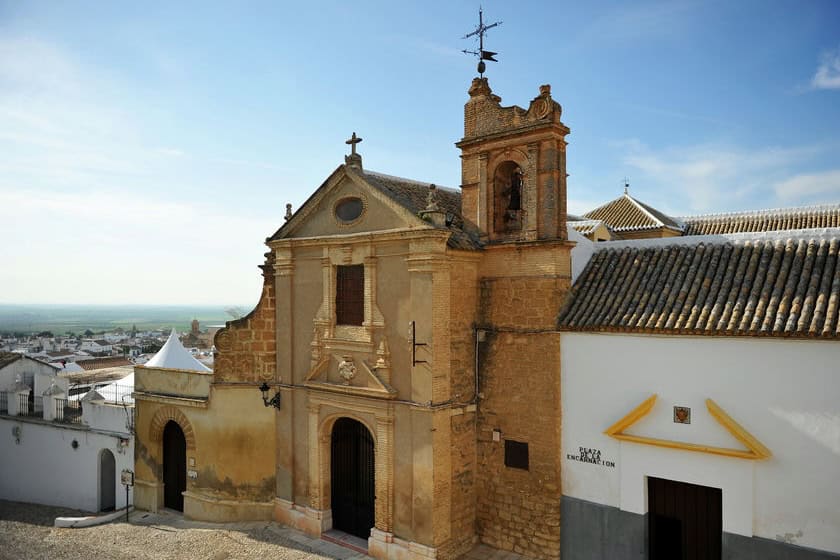
Among the things to see in Osuna, there is another one situated just a stone’s throw from the collegiate church, the Monasterio de la Encarnación. This convent, founded in 1626 by the order of the Barefoot Mercedarian nuns, actually uses a building erected in 1549 as the Hospital of the Incarnation of the Son of God.
It then served as a Jesuit school before taking in the nuns. Although the façade is not all that striking, it is the interior that is worth seeing. The convent church in fact houses a splendid Baroque and neoclassical altarpiece, with Solomonic columns framing the statue of the Madonna. There is also the cloister to pay attention to, surrounded by a double arcade with marble columns, whose bases are decorated with 18th-century Sevillian tiles. The tiles depict the seasons, the five senses, hunting scenes, bullfighting, nuns in prayer and a series of views of Seville’s Alameda de Hércules.
To visit the monastery, you can buy a combined ticket that includes the collegiate church, the archaeological museum and the Monastery of the Incarnation. All tickets are on sale here.
Torre of Mercy
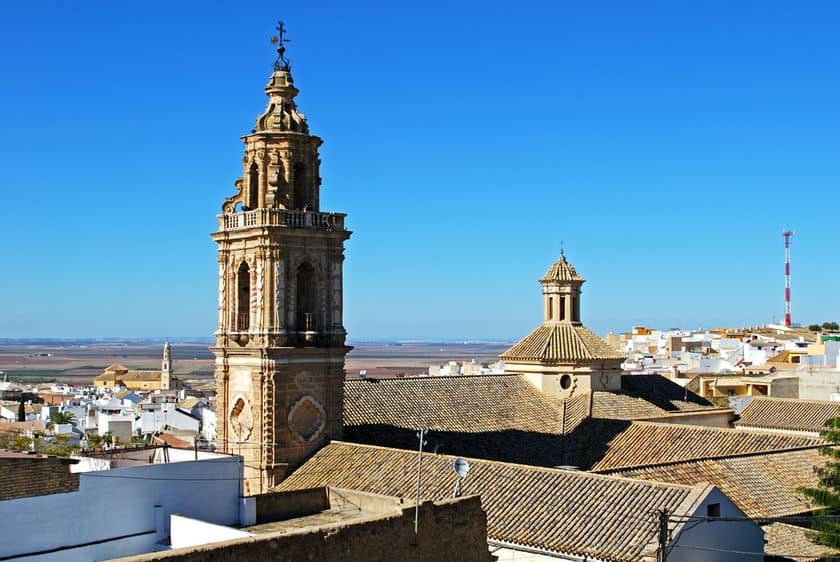
A short distance from the Monastery of the Incarnation stands the ancient Iglesia de la Merced. This church is part of a historic convent and dates back to the seventeenth century. Its most noteworthy feature is the bell tower, known as the Torre de la Merced, which boasts of being among the most beautiful bell towers in the province of Seville.
Considering that eye-catching bell towers abound in these parts, that is no small boast. The tower was erected between 1767 and 1775 and consists of four sections, topped by a richly decorated spire with carved plaques, balustrades with Corinthian columns and garland decorations.
University of Osuna
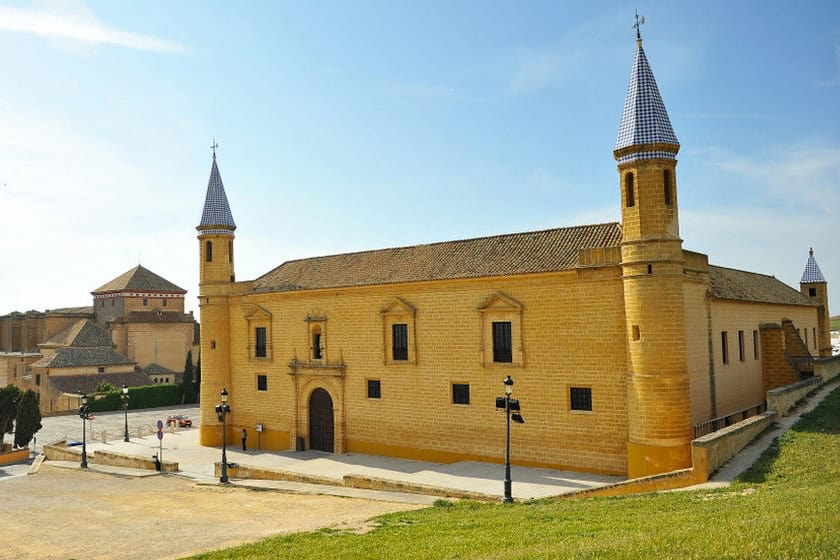
It was 1548 when Pope Paul III issued a bull authorising the construction in Osuna of a General Study dedicated to the Immaculate Conception of Mary. This was a request put forward by Count Juan Téllez de Girón, who wanted to create a university on the model of that of Alcalà de Henares. He therefore financed this building, which housed 15 main chairs and a college with 8 minor chairs. There were 4 faculties: Theology, Law (particularly Canon Law), Medicine and Arts. Needless to say, the most important and most attended was Theology, since the count’s idea was precisely to train better leaders for the Catholic Church.
With the 1807 reform, Osuna University was closed, like that of Baeza and another dozen or so universities, in order to be merged with Seville’s. In the 1990s, the historic building was adapted once more and, for one academic year (1996-97), it was used again for the courses of the “Francisco Maldonado” School of University Studies. Today it is affiliated with the University of Seville and can also be visited at certain times. As well as the exterior, the inner courtyard surrounded by a double arcade is particularly beautiful.
Plaza de Toros: the arena in “Game of Thrones”
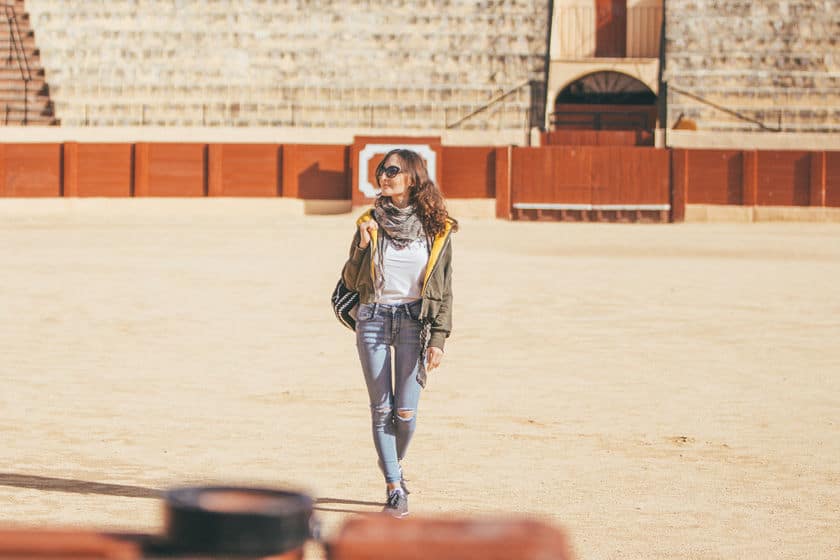
Are you a fan of “Game of Thrones“? If you’ve watched the TV series inspired by George R. R. Martin’s A Song of Ice and Fire, then when passing through Osuna you must not miss a visit to its Plaza de Toros. Yes, because this town’s bullring was used as a film location to represent the arena of Meereen, where Daenerys Targaryen survives the games by fleeing astride one of her dragons.
But you don’t need to have seen the TV series, nor to appreciate bullfighting, to be captivated by this magnificent arena inaugurated way back in 1904 and built using stones from the ancient Roman city of Urso. There is also the bullfighting museum, which tells the local history of bullfighting, and both the arena and the museum can be visited on guided tours. You can find information about the guided visits here.
Other things to see in Osuna
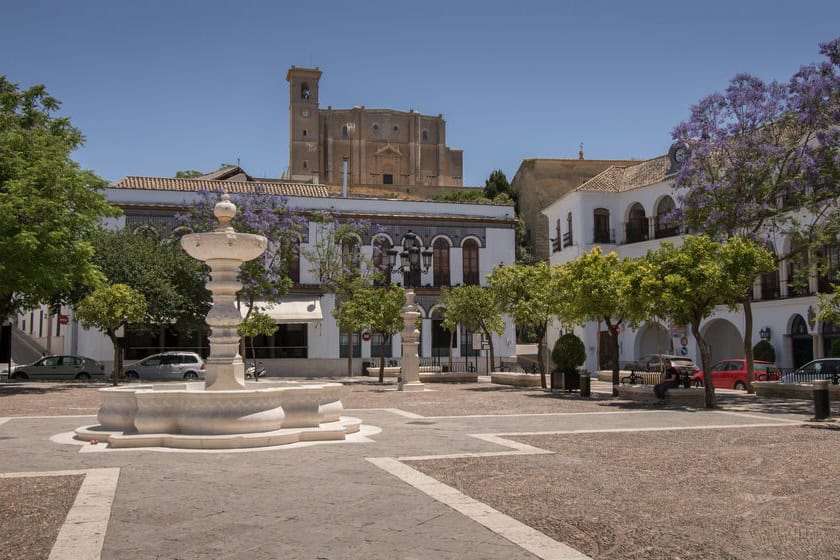
I have spoken about those attractions that above all deserve a stop during a visit to Osuna, but there is also plenty more to see. Here are some other things you might want to add to your list of what to see in Osuna.
- Plaza Mayor. Among the town’s squares, the Plaza Mayor is well worth a stop, where you’ll find the town hall and the Iglesia de la Concepción.
- Torre del Agua (Osuna Archaeological Museum). This small but interesting museum houses a fine display of prehistoric finds and a series of reproductions of the reliefs discovered during the excavations (the originals are in Madrid), as well as Iberian ceramics, coins, Visigothic tablets and much more. A visit to the museum costs €4.60 (children under 12 pay only €0.60). If you wish, it is also possible to buy a combined ticket that includes the collegiate church, the archaeological museum and the Monastery of the Incarnation. All tickets are on sale here.
- Osuna Museum. Not to be confused with the aforementioned archaeological museum, this is a museum located in the Palacio de los Hermanos Arjona y Cubas. You can visit the cellar, where there are terracotta jars for storing wine, oil and food, and the palace rooms that host exhibitions of various kinds. Among the most curious sections is the “Ice and Fire Room”, where props from the filming of the TV series “Game of Thrones”, shot here, are kept.
- Pósito Municipal de Osuna. This is a palace that is not only beautiful to look at, but also has a rich history behind it. It was built at the beginning of the eighteenth century as a municipal granary (“pósito” is precisely the granary). Over the years it was then turned into a court, a military recruitment centre, a hospital and, finally, a retirement home, a role it still serves today.
- Osuna Casino: the first casino in Osuna was inaugurated in 1848, later expanded and complemented by a theatre; it has a beautiful courtyard with cast-iron columns that give it a colonial feel. Today the whole historic casino has been turned into a social club, where people drink and relax in the old gaming rooms.
Holy Week in Osuna
If you travel to Andalusia during Holy Week, you will already know that Holy Week is among the most important times of the year for Andalusians. But while everyone knows about the processions of Semana Santa in Seville, there are others that are less in the media spotlight and turn out to be highly engaging. That is the case of those held in Osuna, without the crowds of the big cities and with a more intimate, immersive atmosphere.
If you want to choose a small town where you can see a procession, a Stations of the Cross or another religious event, I suggest Osuna. It is no coincidence that since 1999 it has been declared a Festival of Tourist Interest in Andalusia, for its historical and artistic value. The beauty of the statues and the care the brotherhoods put into preparing the processions definitely make all the difference.
Where to stay in Osuna
If Osuna is not a day trip from Seville for you, but a stop on a road trip itinerary, you might also choose to stay overnight there. On this map you can see all the available accommodation, but below I suggest some good hotels you can use as a reference.
- Palacio Marques de la Gomera: among the best 4-star hotels in the area, located right in the centre and set within a historic palace along the famous Calle San Pedro. If you’re looking for high-quality accommodation, choose this one.
- Hotel Las Casas del Duque: as a 3-star hotel, I recommend this hotel, furnished in a classic style, very simple and comfortable.
- Hospedería del Monasterio. Here is a 2-star place to stay, but don’t expect a low standard — quite the opposite, in fact. Andalusian, classic and elegant style, a lovely outdoor pool and traditional furnishings. It’s well worth an overnight stay.
Search for accommodation nearby
Where to eat in Osuna
Even if you visit Osuna as a day trip, you may need to have lunch in the town. Here are a few places where you can try typical dishes at good value for money.
- Taberna Jicales. Pleasant local tavern where you’ll find a huge selection of homemade tapas. There’s something for every taste.
- Taberna La Parroquia Osuna. Another very authentic tapas tavern where you can eat simple, good food.
- Restaurante Casa Curro. A small restaurant serving typical dishes, with a really long menu and good prices. Perfect for trying local specialities without spending too much.
