Partly overshadowed by the charm of nearby Ronda, Setenil de las Bodegas is to be considered one of the most beautiful and atmospheric villages in all of Andalusia. It is impossible that you will not have come across at least once on social media or in specialist magazines a video or photo of its incredible houses set into the rock, where the mountain literally takes possession of streets and dwellings, creating a landscape unique in the world.
In this article I want to give you some tips on how to reach and visit Setenil via an itinerary, while also telling you about my own adventure discovering this vertiginous little village hidden in the Sierra de Cádiz.
Contents
Origins of the town
The origins of Setenil de las Bodegas date back to the Islamic period, when the village developed as a fortified settlement along the río Trejo – a watercourse which further downstream flows into the Guadalporcún system – making use of the rocky gorge as a natural defence. In 1484 it was conquered by the Reyes Católicos after a long resistance, an episode to which the name septem nihil (“seven times nothing”) is linked, recalling the number of attempts that were needed to take the city.
The village’s distinctive feature is precisely its troglodyte architecture: the homes are carved directly into the rock, taking advantage of the large natural cavities typical of the area. This system was originally designed to provide defence and thermal insulation, but it also gave rise to a unique urban fabric, where the river carved out the space and people inhabited it without altering its nature. A similar scene can also be admired in Guadix, in the province of Granada, but Setenil is truly one of a kind!
How to get to Setenil de las Bodegas
As anticipated, Setenil de Las Bodegas is located in the province of Cadiz, among the hills of the Sierra de Cádiz, around 20 km (12,4 miles) from Ronda. It can be considered one of the most distinctive stops on the Ruta de los Pueblos Blancos of Cádiz, so if you are planning an itinerary of this kind, you will find Setenil almost on the way. It is usually visited before going on to Ronda, when coming from Malaga. The journey from Malaga to Setenil de Las Bodegas takes about an hour and a half, and it takes a further 25 minutes to reach Ronda.
Here are the coordinates to reach the town by car, which is absolutely the best way to get there. In fact, there are no convenient public transport options from the main nearby cities.
From Malaga (or Seville) to Setenil: organised tour
If you haven’t hired a car and still want to visit Setenil and Ronda, you can book an organised tour that will allow you to see the main sights of these two unmissable inland towns in Andalusia in a single day. There are departures from both Seville and Malaga:
Where to park?
I must admit that my first visit by car was quite an adventure. Before I worked out where to park, I found myself driving along the extremely narrow, steep little streets of the old town, with my heart in my mouth for fear of scratching the rental car. I remember perfectly that I ended up driving under the famous boulder in Calle Cuevas de la Sombra: certainly very picturesque, but not exactly ideal for anyone who gets easily rattled at the wheel…
So, make a note of the address of Parking Los Caños, which should be your starting point for a walking visit to the town. From there, just follow the signs for the town centre.
What to see in Setenil? Suggested itinerary
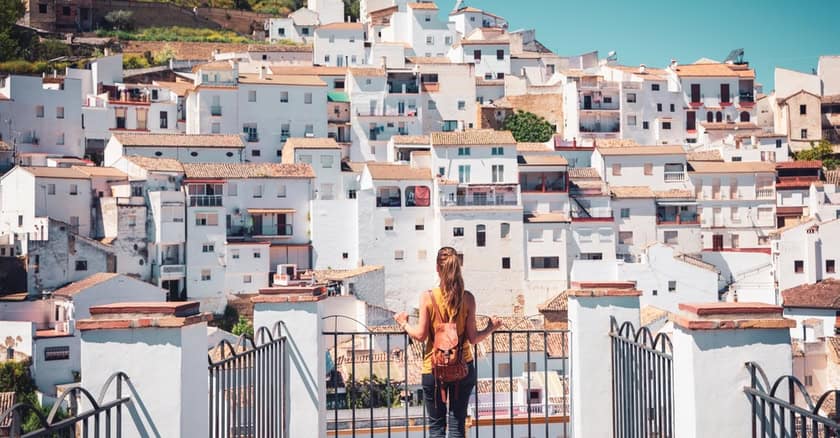
As is often the case in Andalusian pueblos blancos, the visit does not focus on monuments or public spaces, but above all on the pleasure of wandering through narrow, steep and uneven alleys, letting yourself be drawn in by the panoramic views. All the more so in Setenil de las Bodegas, where every corner knows how to surprise: just turn a corner and you find yourself beneath a huge rocky outcrop that looms over the houses, turning the street into a kind of shady cave.
Below are the streets, monuments and other things to see in Setenil de las Bodegas, laid out along an itinerary I have tried and tested, which starts right from the upper part of the town, near the car park. Just follow it step by step to see everything the village has to offer.
Setenil de las Bodegas Castle
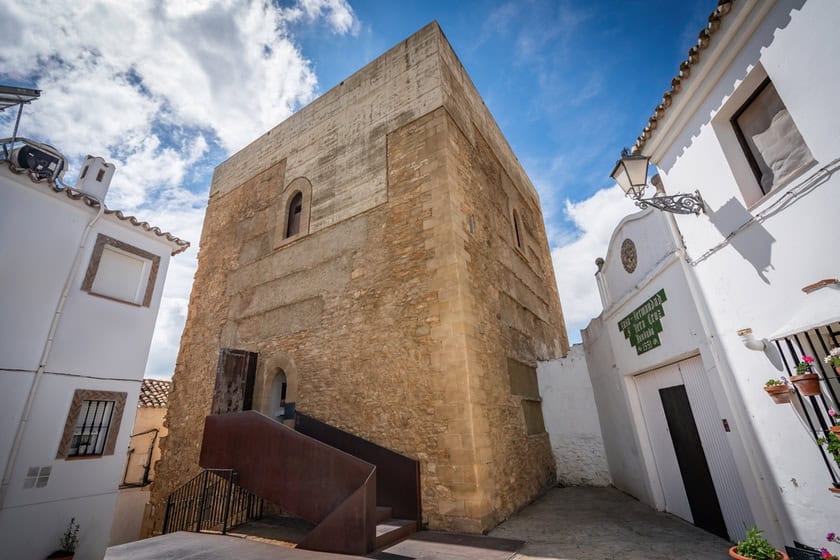
The first thing you’ll come across as you walk up from the car park is the Castillo de Setenil de las Bodegas itself. Situated at the highest point in the village, the Castillo is a fortification of Islamic origin (13th century) of which very few traces remain. Its position clearly underlines the strategic value of the site, long regarded as almost impregnable, as the history of the Reconquista shows. The castle visit is very short and includes the best preserved internal structures, accessible through a single entrance (ticket price: 3 euros):
- Torreón del Homage: the most important surviving element of the castle, as well as its main defensive core. Today the tower (Torreón) is the focal point of the visit to the complex: it houses small exhibition displays and allows you to climb to the upper levels, from which there is a lovely panoramic view of the village.
- L’aljibe is an underground cistern from the Islamic period, located beneath the Torreón and designed for the collection and storage of water during sieges. You can go inside to admire the ancient structure carved into the rock and covered by vaults.
House of the Little Lady of Setenil
Adjacent to the castle is also the Casa de la Damita de Setenil, a very small museum whose purpose is to tell the story of Setenil’s ancient roots. It houses the so-called “Damita”, a female anthropomorphic figurine dating from the Bronze Age (roughly the 3rd–2nd millennium BC). The artefact bears witness to human presence in this area long before the Islamic settlement. After leaving the museum, head to the Mirador del Lizón to admire the expanse of white houses below you.
Church of Our Lady of the Incarnation
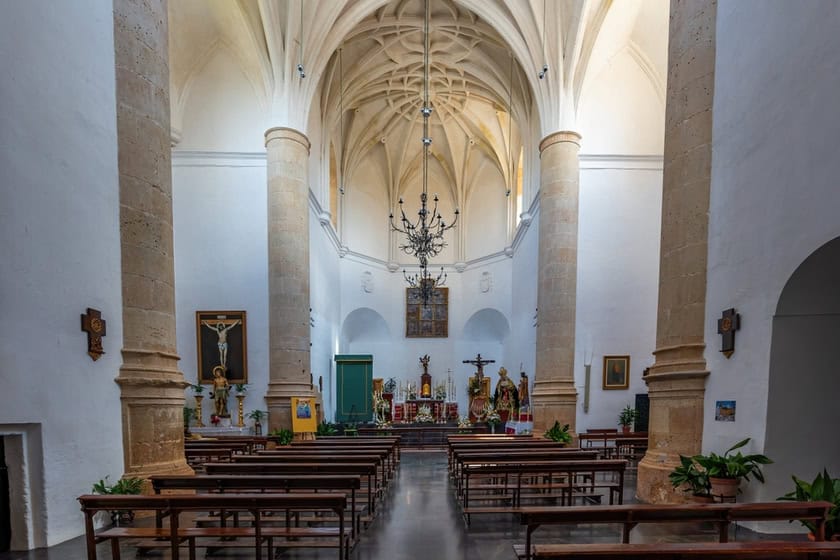
Near the castle you will also find the village’s main religious building, the Iglesia de Nuestra Señora de la Encarnación, which bears witness to the transition from Islamic to Christian rule. The church was built after the conquest of 1484, probably on the site of the old mosque, as often happened in Andalusia.
The architecture reflects this transitional phase: the original structure is Gothic in style, but it features Renaissance elements added in later centuries. The interior is simple, with a wide and bright nave. In front of the church, you will also find the Mirador de la Villa, ideal for seeing the town from above, and above all the cave houses beneath the cliff on Calle Jabonería.
One of the best views of the church, however, can be enjoyed from the Mirador del Carmen, which looks out over the walls, the Torreón of the castle and the church apse at the top of the cliff, towering over the whole village. We’ll see it later.
Andalusia Square
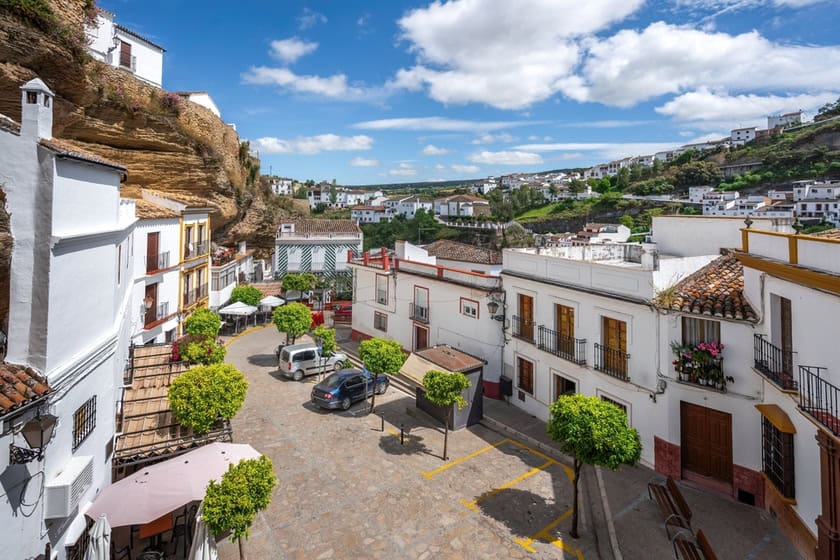
Plaza de Andalucía is a must-pass point between the upper part and the streets descending towards the lower part of the gorge carved by the Trejo. Of course, you shouldn’t expect a monumental square, but rather a peaceful space beneath the cliff, with bars and venues frequented by locals, who relax at the tables in the shade of the orange trees.
Near the square you will also find the Tourist Office, where you can ask for information about visiting the village, but above all admire the beautiful 16th-century mudéjar-style ceiling, once part of the old town hall (Antigua Casa Consistorial).
Herrería Street
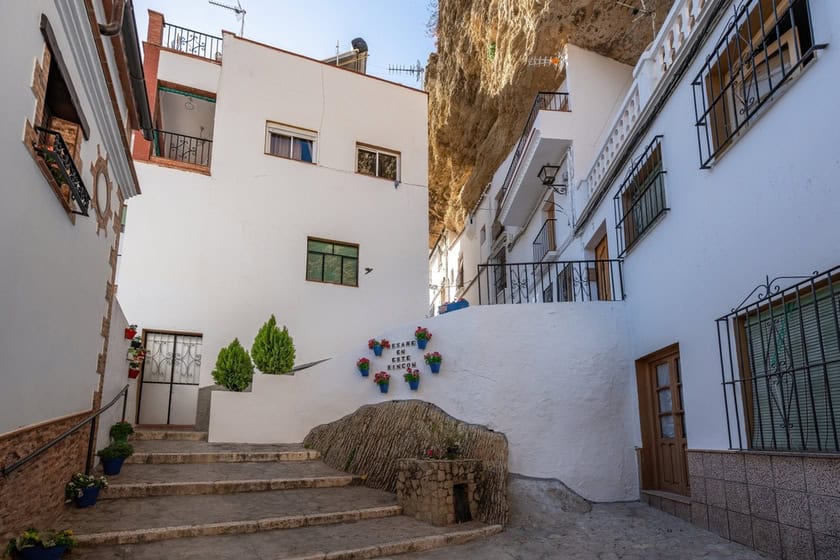
From the square, instead of going down Calle Constitucion, take here the more modest Calle Herrería, a very narrow little street with stairways winding downhill between white houses wedged among the rocks, towards the river and the famous Cuevas del Sol and de la Sombra. Along the way, you’ll also come to a stop on the Ruta del Amor de Setenil: the Rincón del Beso, a small spot marked by a sign that gathers together the lovers visiting the town. Once you reach the bottom, via Calle Vega, you reconnect with Calle Constitucion and continue downhill towards the famous streets in the rock.
Calle Cuevas de la Sombra
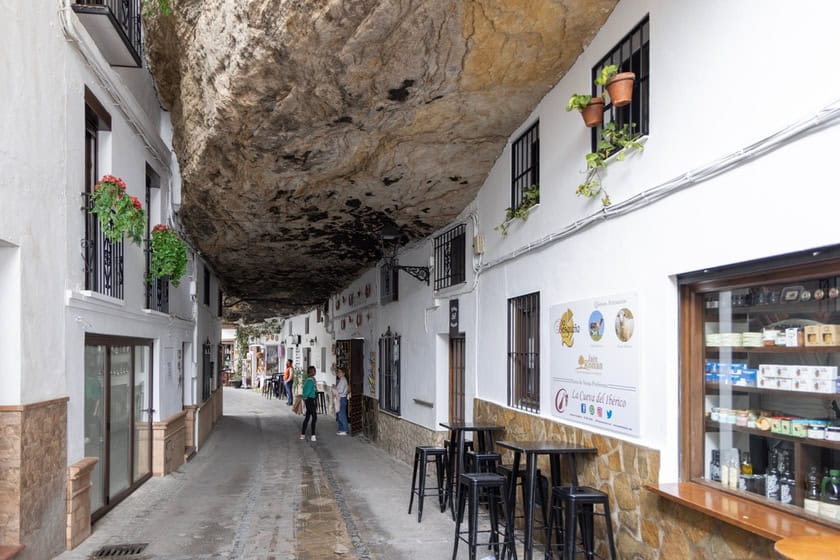
After just a few steps, you will find yourself facing one of the most emblematic views of Setenil, which I already mentioned earlier when I described my very first drive into the town. Here, as the name of the street suggests (Calle Cuevas de la Sombra, meaning “Shadow Caves Street”), the road narrows even further, blocking the light still more.
In front of you, you will see an enormous mass of rock looming over the road, almost threatening to collapse over your head. The houses and cafés are literally wedged beneath the boulder, truly showing Setenil’s uniqueness, where rock becomes architecture.
Cueva Alta
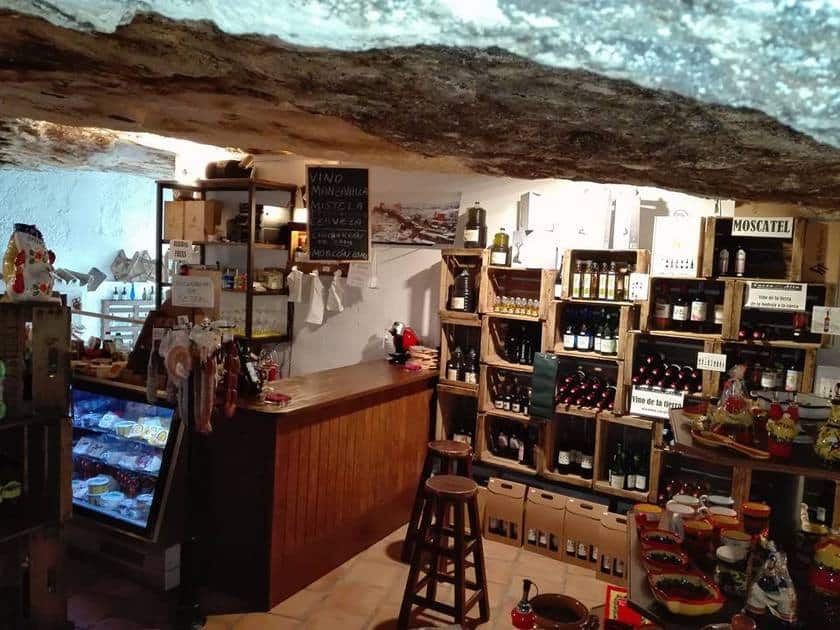
Another example? In the nearby Calle Cantareria Alta (literally a 5-minute walk up from the Shadow), you’ll find the famous Cueva Alta, a small, cool shop carved into the rock, with a natural ceiling. More than for souvenirs or tastings, it is worth going in to see up close how these cavities are still used in the village’s everyday life.
Calle Cuevas del Sol
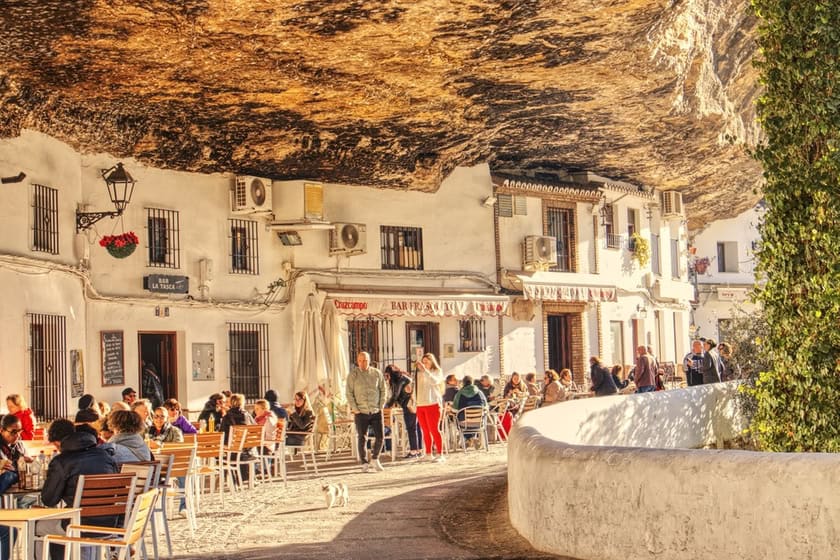
Go back down again and cross this bridge, finally letting yourself be surprised by the “bright side” of lower Setenil: Calle Cuevas del Sol. Here the atmosphere changes completely: the rock still takes centre stage, but it is bathed in sunlight, revealing a wide, lively street running alongside the river. The houses nestle beneath the rocky outcrops, but in a less oppressive way than on the shaded street.
Stopping here, in the most sociable spot in the village, is almost inevitable. Here you’ll find shops, bars and restaurants with little tables where you can sit and relax in the shade of the natural roof, like on a terrace overlooking the river. I treated myself to a break from the tiring ups and downs in the sun at Bar La Escueva, one of the most characteristic places, with rooms that delve evocatively into the rock.
Mirador del Carmen
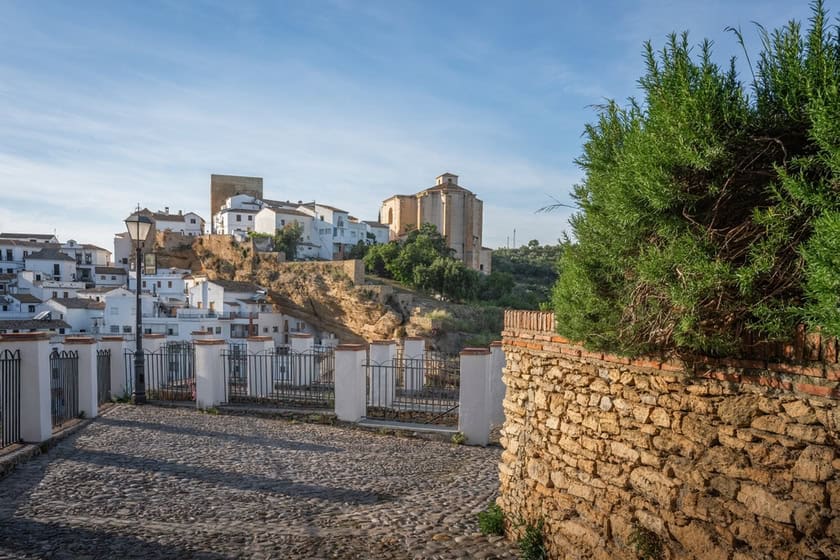
The route continues walking along the river, heading back towards the upper part. At this point, you’ll find a staircase that leads up to the Mirador del Carmen, one of the most beautiful viewpoints in the whole village, as well as my favourite. From here, you get a commanding view over Setenil, with its whitewashed houses and the cliff on which the castle and the Iglesia de Nuestra Señora de la Encarnación stand. There is also an installation bearing the village’s name, ideal for souvenir photos with a bit of a difference! On the right, you will also see Calle Jabonería, your next stop.
Calle Jabonería and back
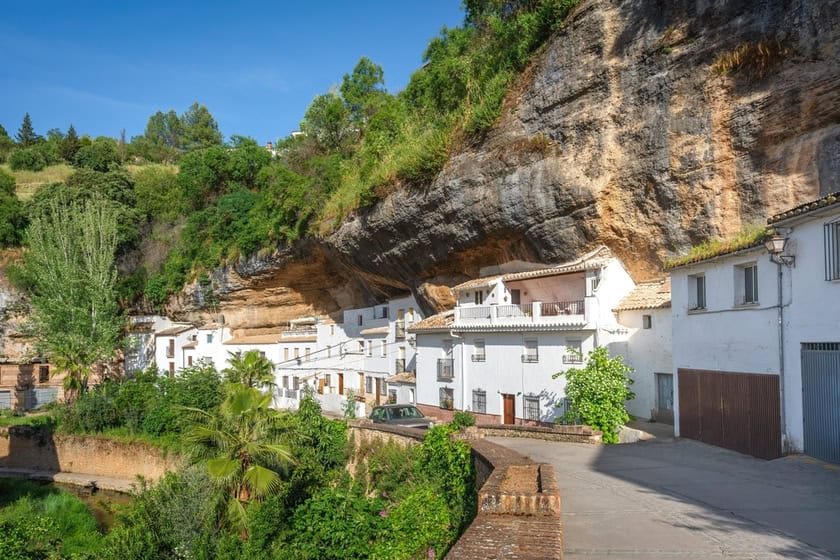
Descending from the Mirador del Carmen, after coming across the sign “Susúrrame al oído” (another stop on Setenil’s Ruta del Amor), you gradually enter Calle Jabonería, one of the most distinctive streets in the lower part of Setenil, which you may have seen from above at the Miradores de la Villa and del Carmen.
This street, which once housed activities linked to soap production, runs almost parallel to the río Trejo, between cave houses and white façades, and has a more intimate atmosphere than Calle Cuevas del Sol, while still retaining the same environmental features.
Return to the other side of the river via this bridge and begin the climb back up to the upper part via the aforementioned Calle Herrería. Before you turn into it, you will find the last stop on the Ruta del Amor on this route: the sign “Andábamos para encontrarnos” (“we were walking to meet each other”).
Map of the attractions in Setenil de las Bodegas
How much time is needed for the visit?
For this itinerary, 2 hours will be enough, but if you have more time available I encourage you to explore the village in depth, because there are also other places that deserve a certain amount of attention. An example? The viewpoints along Calle Ventosilla Alta and Calle San Sebastian. Your physical energy will certainly make a difference: the days can be very hot and, although you may find relief beneath the rocks or inside the cuevas, the constant ups and downs will test you a little.
What kind of temperatures should you expect?
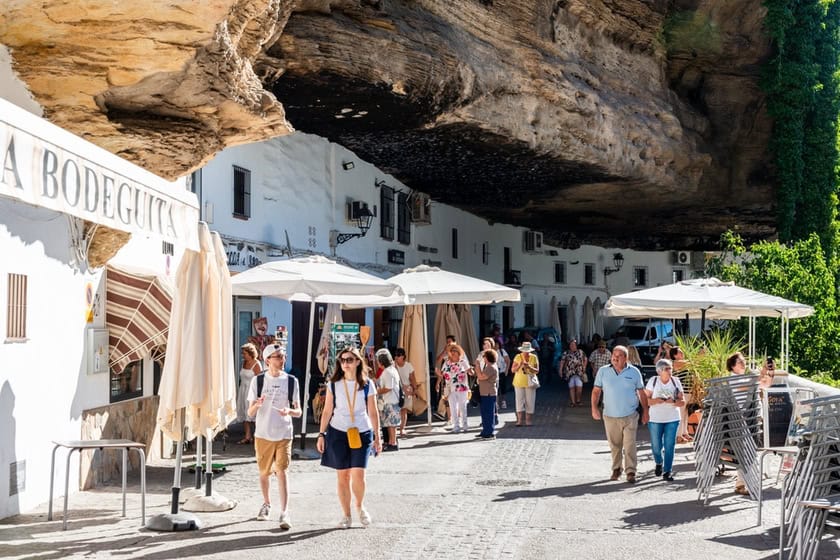
The question is a fair one! In Setenil de las Bodegas the climate is typically Andalusian (that is, hot and dry), but the streets under the rock and the carved-out spaces maintain much more stable temperatures than outside.
For your explorations up and down Setenil’s hill, the best times are spring and autumn, when temperatures generally stay between 15 and 28°C, allowing you to move around the village without the intense summer heat.
Where to stay?
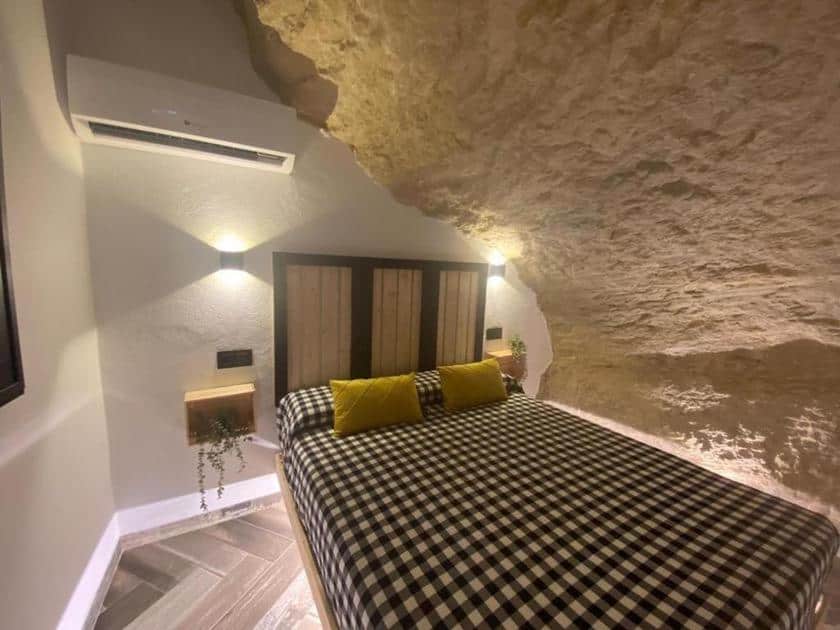
Not everyone spends a night in Setenil de Las Bodegas, seeing a visit to the village as nothing more than an intermediate stop between Malaga (or Cadiz) and Ronda. Moreover, the number of places to stay is not as high as in larger, more touristy cities. However, the idea of spending a night in one of the village’s cuevas could radically change your plans:
- Tajito Romano: small holiday home carved into the rock, which perfectly reflects the village’s typical style. It is located in the upper part towards Calle Ventosilla Alta. The rooms are well kept and welcoming, with a fitted kitchen and well-organised spaces despite the compact size.
- Casa Rural Bajo la Alcazaba: a structure similar to the previous one, but in a position closer to the Castle and Church area, so a little more convenient strategically (also because of its proximity to the car park). For a truly special stay…!
- Hotel Tugasa El Almendral: if, on the other hand, you are looking for a more traditional property outside the centre, this is the one for you. Nestled in the hillside landscape and around a 20-minute walk from the cuevas area, the hotel offers simple but spacious rooms, with a swimming pool, restaurant and full facilities.
Where to eat?
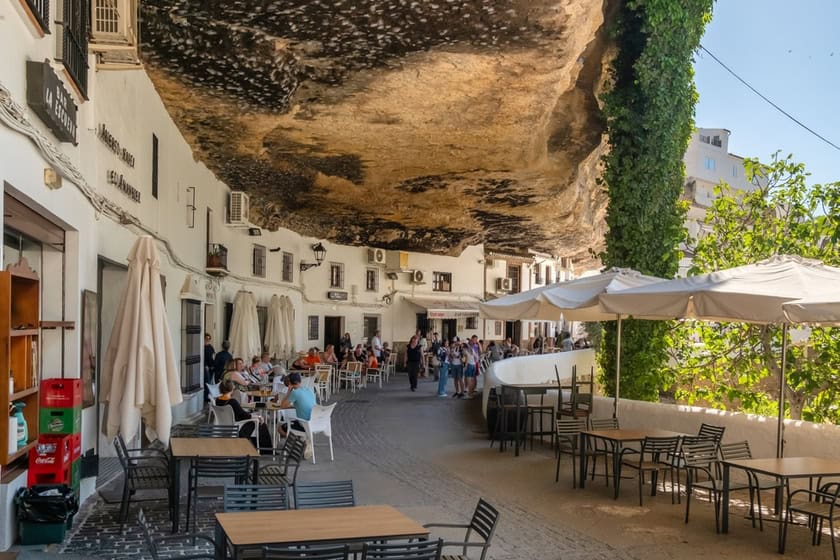
Here are a few places to stop for something to eat, starting with the one I chose during my short stay in the village:
- Bar La Escueva: located along Calle Cuevas del Sol, it is one of the village’s most iconic places, literally “built into” the rock. The menu is simple but typical, with Andalusian tapas such as ensaladilla, flamenquín and very good traditional dishes.
- Restaurante Casa Palmero: one of the most historic places in Plaza de Andalucía, where you can enjoy dishes of traditional Andalusian cuisine made with local produce and simple but hearty recipes. If a snack isn’t enough and you’d rather have a proper lunch, this might be the restaurant to choose.
- El Bandolero: it is set slightly away from the more touristy streets, in the Calle Cabrerizas area, and for that very reason it offers a calmer, more unusual atmosphere. The menu includes tapas, meat dishes such as rabo de toro and local specialities like migas, with good overall quality and genuinely generous portions.
