The writers Ernest Hemingway, Rainer Maria Rilke, James Joyce, Jorge Luis Borges and J. Ramón Jiménez were enraptured by the vertiginous beauty of Ronda and penned incredible words of love to it. Also Orson Welles, who said: “A man does not belong to the place where he was born, but where he chooses to die”. His ashes are in fact kept in Ronda.
I’ll say it here and now: an tour of Andalusia without a visit to Ronda is not a complete tour. Let’s be clear: the main cities of Andalusia each have their own inimitable charm and will probably take priority in your itinerary, but Ronda possesses a spirit that makes it unique in many respects: visiting it exponentially increases the quality and value of your holiday in Spain. For this reason we could not refrain from including it in our 5-day tour of Andalusia.
But where is Ronda? What to see in the city? What is it that makes it so special, so much so that it seems like a fantastical place sprung from the visionary pen of Tolkien or Lewis? How much time should you invest to visit it properly? I will answer all these questions in the way that comes most naturally to me, namely by sharing my experience and simulating a virtual tour (my own, from the various wanderings I’ve made there) into the heart of Ronda.
If you decide to make your way to this magical town, simply retrace this itinerary to see with your own eyes what it is that has prompted so many writers, poets and artists to sing of Ronda’s evocative grandeur, making it immortal.
But before I suggest to you what to see in Ronda, here are some answers to the most frequently asked questions:
Contents
Where is Ronda located?
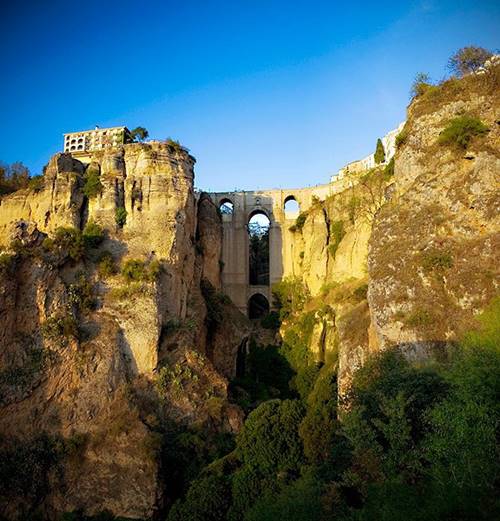
Ronda – a town perched on a crag, split in two by a deep, vertiginous gorge (El Tajo) carved by the Guadalevín stream and reunited by the famous, fairytale -like Puente Nuevo – It is located in the province of Málaga, in a hilly area between the Sierra de Grazalema and the Sierra de las Nieves.
From here begin the Málaga White Villages Route and the Cádiz White Villages Route, a scenic itinerary through the whitewashed villages hidden in the Sierra de Grazalema.
A visit to Ronda is a classic day trip for tourists holidaying on the Costa del Sol: it’s reachable in about an hour’s drive by car, taking the A-397 at San Pedro de Alcántara. Usually, this itinerary also includes a stop at the incredible Setenil de Las Bodegas.
The distance between Malaga and Ronda: how to get there?
The distance between Malaga and Ronda is about 100 km, and it takes an hour and a half to reach by car, which is by far the best way to cover the distance: it should also be noted that, besides the train (which can require changes with long waits in deserted little stations, like Bobadilla…) there are around ten coaches a day that serve it, but in that case a day trip may be a little too tiring. Ronda, moreover, is perfect as a stop to break up the journey from Seville to Malaga (and vice versa, of course): in the linked article you’ll find tips on how to organise an itinerary.
How long does it take to visit?
Chances are your tour of Andalusia will be subject to the tyranny of time, so you won’t be able to devote more than a day to Ronda: an understandable choice that will still be rewarded with a satisfying visit. However, the perfect way to get under the skin of this lovely Andalusian town is two days’ sightseeing, with an overnight stay in the area.
There are plenty of things to see in Ronda, and the town’s particular setting means you’ll need to expend a little more energy than you might expect, especially if you want to enjoy the best views over the town and the Puente nuevo.
What to see in Ronda? Let’s start the tour!
Whether you travel by train or by car, the train station will be your point of reference, and you can easily find parking nearby. Once you’ve parked, leave modern Ronda behind, which has nothing to offer: your destination is the Ciudad, Ronda’s old Moorish centre, where all its treasures are kept.
Plaza del Socorro
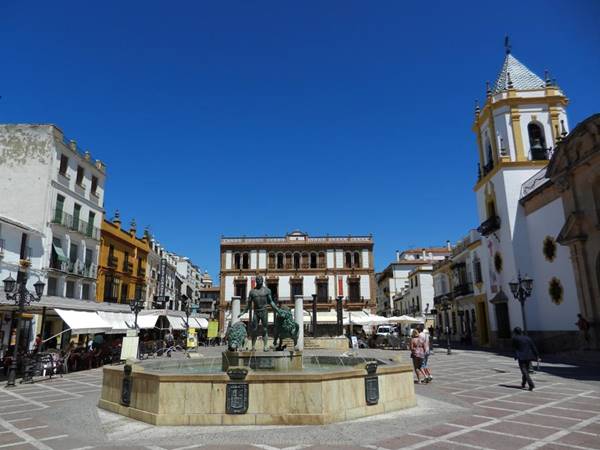
The best way to ease yourself gradually into Ronda’s atmosphere is to walk down Calle Espinel, the busy central shopping street (there’s a splendid shop selling wooden handicrafts) that leads directly to the first stop on our tour, the characteristic Plaza del Socorro, in the Mercadillo neighbourhood.
Here, in the evening, the locals gather to drink a vino tinto de Verano in one of the various bars: it is in this place that you begin to feel the atmosphere of Ronda.
Plaza de Toros in Ronda
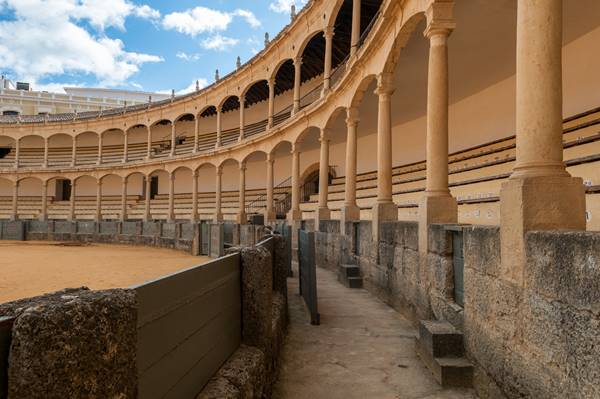
Let’s return to Calle Espinel and walk it to the end: ahead of us we’ll see the ancient Plaza de Toros di Ronda, one of Ronda’s most important sites. You may well wonder why, since every self-respecting Andalusian town has one… it’s simple: the Plaza de Toros of Ronda is, by history and tradition, one of the most important in all of Spain, as the Maestranza, the ancient order of horsemen that ennobled the tradition of the corrida, was founded here.
Don’t miss the chance to visit it: as well as entering the arena and peering from above into the stables where the bull is shut up (and mistreated, poor beast…) before being led into the ring, you can visit the museum set up in the heart of the building: you will find evidence of how the Ronda school of bullfighting – in the person of the celebrated bullfighter Pedro Romero, who practised here – was seminal for the spread of the corrida at the end of the eighteenth century. Distinguished spectators of Ronda’s bullfights (immortalised in photographs) included the writer Ernest Hemingway and the film director Orson Welles.
Alameda del Tajo and Mirador de Ronda
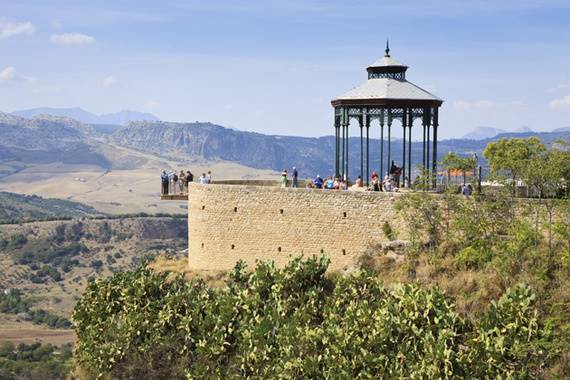
Leave the Plaza de Toros and take Calle Blas Infante: all of a sudden you’ll be just a few steps from the edge of a precipice.
Until now, Ronda may have seemed to you like a pretty, authentic Andalusian town, with its pleasant little square and the bullring… now you can see what its principal characteristic actually is: being a proud, elevated citadel that dominates the Serranía de Ronda, a green valley framed by rugged mountains in the distance.
Lean out from the Mirador de Ronda, admiring the panorama, then follow the paths of the Alameda del Tajo, a tranquil green space that offers further fine views over the surrounding countryside.
Puente Nuevo
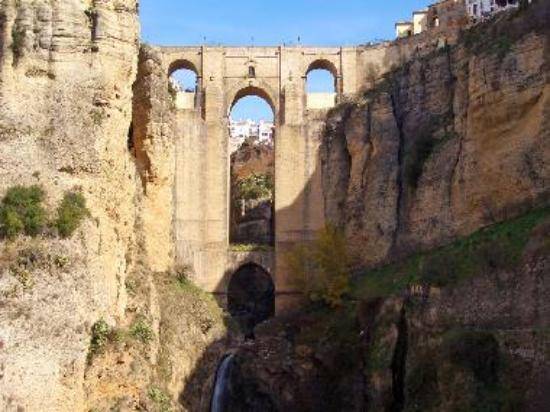
Let’s head back — the best is yet to come. Leaving the Plaza de Toro behind, we take Calle Virgen de la Paz, pass Plaza España – where the Parador de Ronda is located – and, in no time at all, we’ll be standing in front of Ronda’s symbol: the Puente Nuevo.
As we’ll see, this majestic 18th-century bridge is not the only one linking the two parts of the city, but it is certainly the most famous. Walk across it, and take the opportunity to lean over – if you don’t suffer from vertigo – to take a first look at just how impressive the chasm carved by the Guadalevín is.
Initially, you can enjoy the spectacle of the gorge and the bridge by crossing it and leaning out slightly from the terrace in front of the restaurant La Pilastra del Torero. Then continue your visit by taking Calle Cuesta de Santo Domingo, the road that runs along the top of El Tajo.
Attractions to visit along El Tajo
House and Mine of the Moorish King
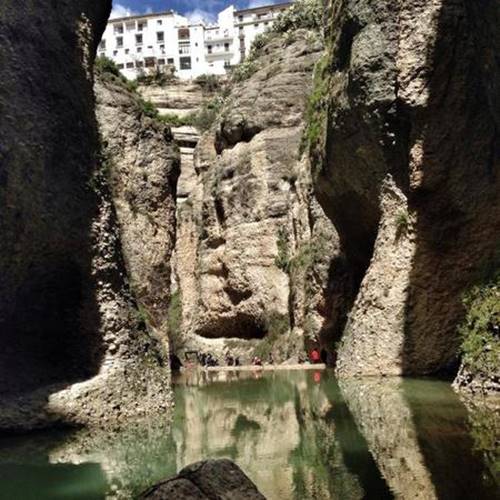
Walk along Calle Cuesta de Santo Domingo to the Casa del Rey Moro. Pay the admission fee (it’s worth it) and, after a quick look round the gardens (the house is in ruins), head to by far the most interesting attraction: the Mina del Rey Moro, a tunnel carved into the rock for defensive purposes.
You can descend the tall, uneven steps and reach the river level, with the chance to stroll a little in the heart of the mini-canyon. It’s a thrilling descent, but take care not to hurt yourself, as the tunnel is very damp and you may slip on the steps. As you might expect, the hard part is getting back up to the surface!
The two ancient bridges and the Arab Baths
What to see in Ronda after the Casa del Rey Moro? Continuing our tour, descending the Cuesta de Santo Domingo: we pass the Arco de Felipe V and find ourselves facing the Puente Viejo, one of the two ancient bridges that once connected the two banks of Ronda.
If we have a little time, we can cross it and venture along the terraced walkways of the Jardines de Cuenca, from which we can enjoy a hitherto unseen view of the Puente Nuevo from the opposite bank. Just below the Puente Viejo, the other bridge can be glimpsed — much older, dating from the fourteenth century: the Puente de San Miguel.
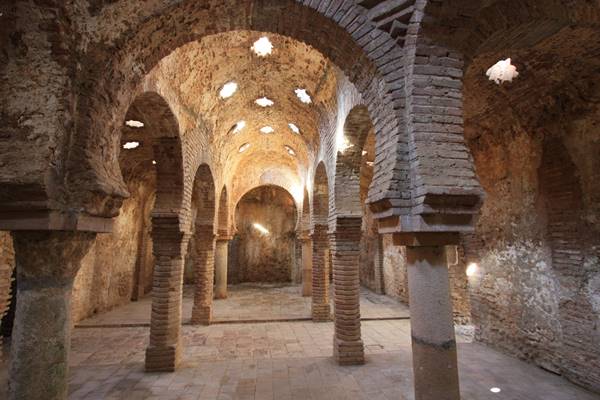
From here, continuing along Calle Molino de Alarcón, you arrive at the Baños Arabes, one of Ronda’s most hidden and fascinating spots. In this case, a visit is highly recommended: the barrel-vaulted ceiling is studded with star-shaped slits and, much like the Arab baths of Granada, the very ancient Moorish chambers are splendidly preserved. Much better than in Cordoba, for example.
The Ciudad: things to see
After exploring the long river, we return to the surface and make our way into the actual Ciudad, the heart of Ronda: what to see next?
Mondragón Palace
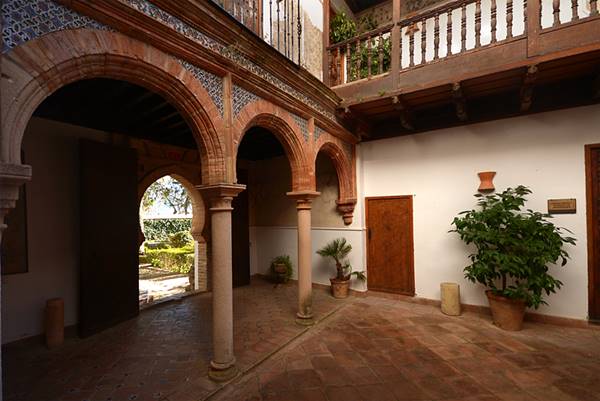
The first attraction to reach, in our view, is this marvellous 14th-century palace, the ancient and lavish residence of the Moorish kings and, subsequently, of the Reyes Católicos.
The Palacio de Mondragón (Plaza de Mondragón) is today home to a civic museum, but it contains some truly fairy-tale Moorish patios, and a garden that offers a lovely panorama of the entire Serranía de Ronda.
Parish Church of Santa María la Mayor
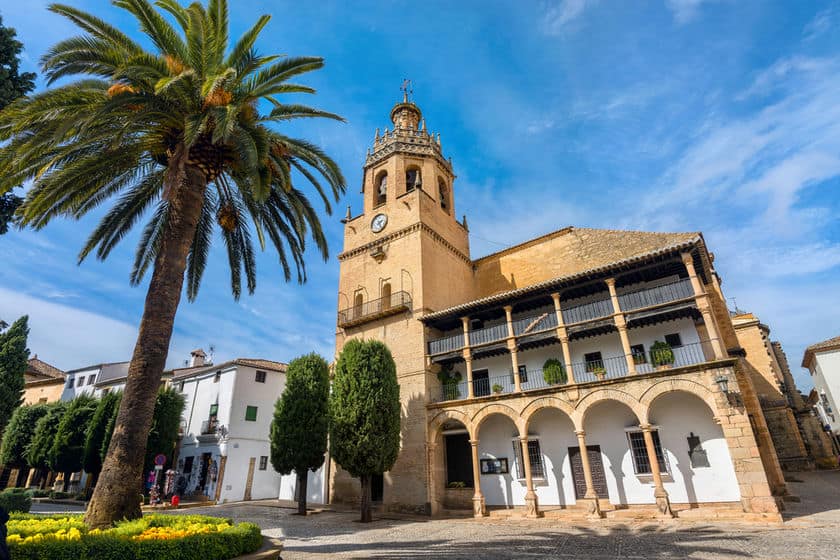
After wandering through the mysterious and evocative white alleys of the Ciudad, you arrive in the splendid and tranquil Plaza Duquesa de Parcent, the nerve centre of old Ronda. After having rested under the orange‑tree‑lined paths of the small Andalusian‑style park at the centre of the square, visit the Parroquia Santa María la Mayor, an ancient mosque, now Ronda’s cathedral. The massive bell tower was built, as is customary, in place of the old minaret, and inside the mihrab can still be seen.
Barrio de San Francisco
Having passed Plaza Duquesa de Parcent, we head towards the exit of the Ciudad and on into the Barrio de San Francisco, a neighbourhood of Ronda not particularly interesting, except for two reasons:
- The visit to the imposing Puerta de Almocábar, an ancient Arabesque gateway into the city. It’s worth going there, even though the area is a little busier with traffic.
- If you fancy a walk, you can head down for about a kilometre from the Puerta along Carretera de los Molinos. From this peripheral road a number of footpaths climb up that lead to spectacular viewpoints offering views of El Tajo and the Puente Nuevo from below — by far the best vantage point, in my view. You’ll know you’ve reached the right spot when you come to the ruins of ancient walls.
Here then is what to see in Ronda, a city full of secrets that must be seen and experienced to be understood: when you finally arrive, you will immediately grasp what it means for a city to be rooted in memory even before you have been there, for Ronda will captivate you with its charm as a fantastical, timeless place.
Where to eat
Pop in for a classic tapas tasting at the excellent De Locos Tapas, right beneath the walls and beside the Puerta de Almocábar (Plazuela Pons Sorolla), or let yourselves be pampered by the tasty, refined dishes at the restaurant Las Maravillas, on the busy, commercial Carrera Espinel (no. 12), a stone’s throw from the Plaza de Toros. Alternatively, if you’re very hungry head to Casa Maria in Plaza Ruedo Alameda: the fixed‑price menu at €30 is an adventure worth trying in the heart of properly prepared Spanish cuisine.
Where to stay in Ronda?
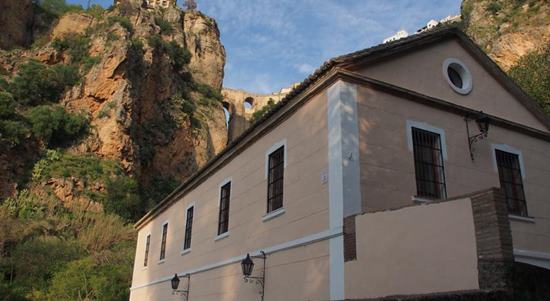
If you can’t find accommodation in the Ciudad, which is clearly the first choice, you can opt to stay in one of the many hotels that line the area around the Alameda del Tajo, the Plaza de Toros and Plaza del Socorro.
One of the best places to stay in Ronda, for us, remains the Hotel Montelirio, with a panoramic terrace and all the comforts. Also not to be overlooked is the more spartan Albergue Los Molinos, which sits at the foot of El Tajo and offers dormitory rooms at a good price, as well as a splendid view of the Puente Nuevo from below.
