The city of the Alhambra is one of the Andalusian destinations where the climate is most surprising. The geographical position of Granada and the morphological characteristics of the land on which it stands significantly affect its weather as well. If you are planning a broader tour of Andalusia, it’s worth taking the general conditions of the region into account, but if your focus is Granada and its immediate surroundings, reading this article will let you set off with a few important climate-related precautions.
Contents
The climate of Granada
Strangely enough, Granada has a climate tending towards continental, with a greater temperature range between summer and winter, as well as between night and day, than other main Andalusian destinations. These conditions are due to its hilly location (700 m above sea level) and, above all, to the proximity of the Sierra Nevada mountain massif. The mountains lie to the south of Granada and separate it from the Mediterranean coast, thus preventing the sea from moderating the climate.
For the same reason, precipitation is fairly limited and rarely exceeds 400 mm per year: the mountain chain blocks much of the Mediterranean rain-bearing disturbances, so if it rains in Granada it is usually because of those Atlantic systems that manage to reach the city.
Despite its latitude, Granada’s climate is paradoxically much more similar to the climate of Madrid than to that of the other major cities in southern Spain. Both summers and winters, however, have less extreme temperatures compared with the Spanish capital, but in some months of the year visiting the city may be less advisable than in others.
Granada’s location should not be considered negative for the reasons mentioned above: while it is true that the climate in some months is not ideal in the city, those are the same months when conditions are optimal for visiting the nearby natural areas: the mountains of the Sierra Nevada and the sea of the Costa Tropical. All in all, Granada has something good to offer at any time of year.
Granada in spring
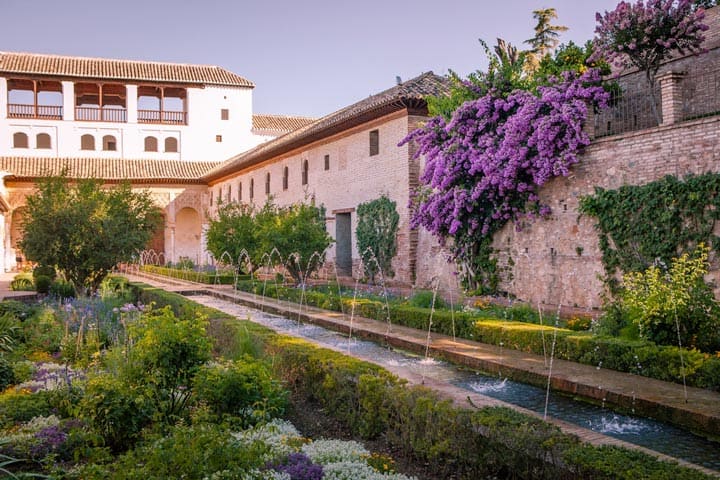
Spring in Granada is mild, but it is also the wettest time of the year. Given that the average is one week of rain per month, there’s a 25% chance you’ll need an umbrella, particularly in April. Bear in mind, however, that rain in Granada isn’t monsoonal and is generally manageable; in fact, it’s well worth risking a few drops to visit the city in months with more favourable temperatures. As mentioned, Granada’s climate, while essentially temperate, shares some characteristics with a continental climate — chief among them the seasonal temperature variation. The shoulder seasons are therefore the ideal time to avoid enduring extremes of heat and cold.
The month of March in Granada brings winter to a close with rising average temperatures, usually already above 10°. Night-time lows rarely fall much below 5°, while daytime highs comfortably exceed 15°, often hovering around 17-18°. The month of April is the wettest of the year, but an average temperature above 13° confirms it as one of the best months for getting around the historic centre on clear days (which still account for three quarters of the month).
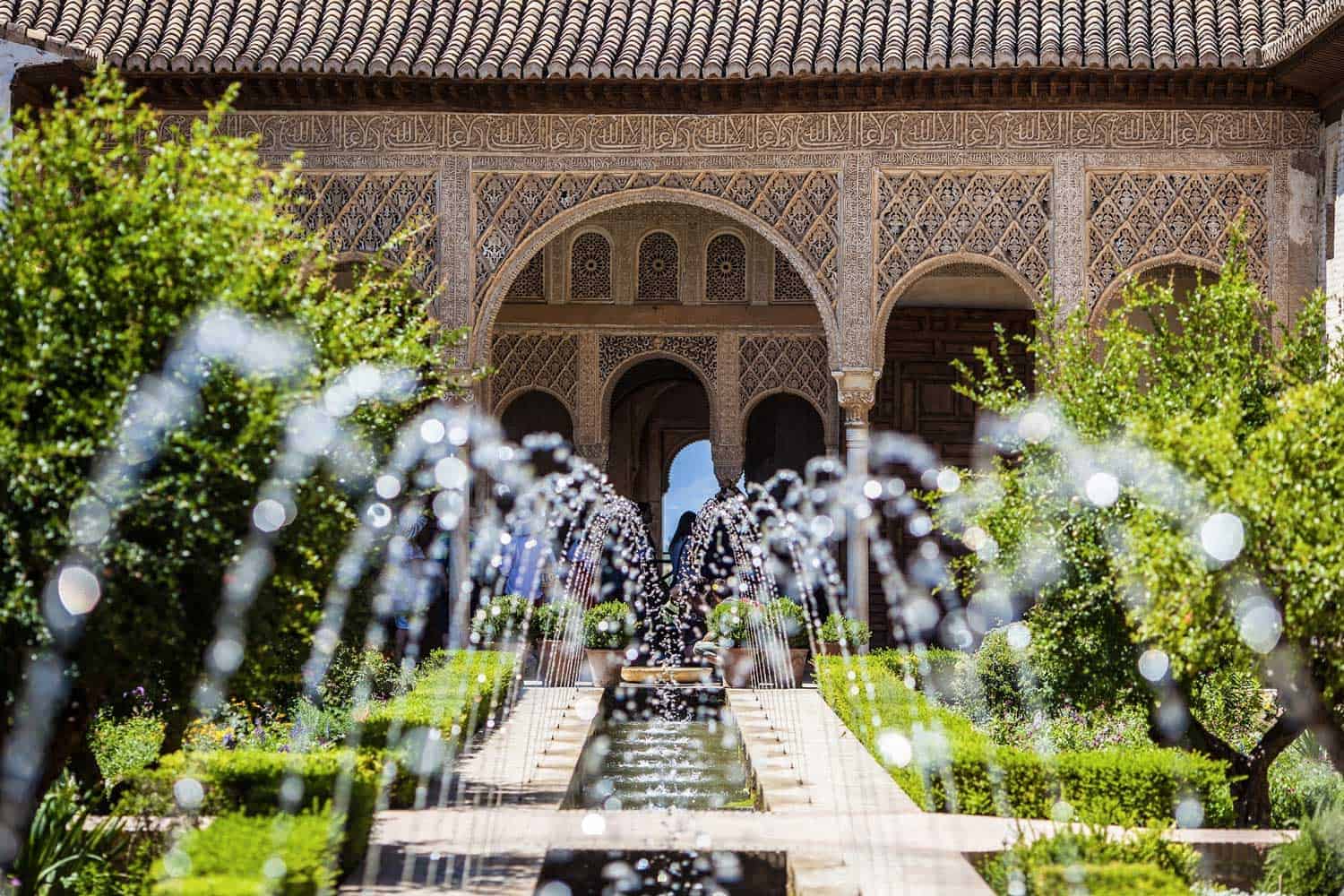
May is perhaps the best month of the year to visit Granada: the average number of rainy days is only 5 throughout the month and the temperature is ideal for exploring the city. At night the mercury hardly ever falls below 10° and by day you move between 20 and 25°: warm enough to spend the days pleasantly outdoors, but without the searing summer heat. With layered clothing, the whole spring period is recommended for the city. Moreover, this is also the season when the Generalife gardens are at their most florid: an aspect definitely not to be underestimated. In May, you may also come across the evocative Corpus Christi procession, a religious observance that in Granada becomes almost a tourist attraction.
Granada in summer
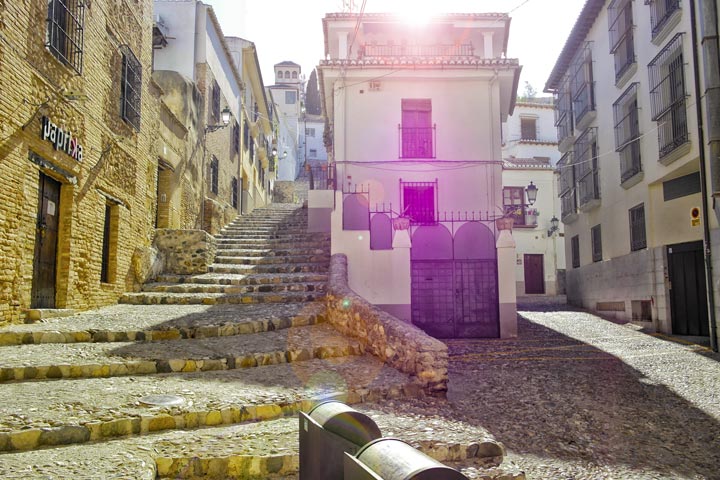
Contrary to what the calendar says, June is already fully a summer month; in fact, in some years even May has been considered summer by Granada’s residents. The sun on June afternoons warms the city’s streets to well over 30°C and almost always above 25°C. Even the nights are pleasant, with lows around 14–15°C.
July and August, although among the months with the highest tourist numbers, would not be the most advisable if one considered only the climate. The average number of rainy days per month, which is 2 in June, tends towards zero in the following two months. The lack of weather systems causes temperatures to rise sharply, with an average in both months consistently above 25°. The central hours of the day commonly reach 30-35° (with peaks exceeding 40°) and it can therefore be tiring to get around the streets of the city centre if you are not prepared. Even if you are not by the sea, therefore, a good hat and some sun cream might come in handy.
Settembre has average temperatures almost identical to June and can be regarded as a bona fide summer month: furthermore the last weeks of summer are the best time to extend the journey to the coast, where the August bustle begins to subside, yet the sea is still decidedly warm. Precisely the hot months, although not the most suitable for visiting the city, should be kept in mind if you want to combine a seaside break with an excursion to the Sierra Nevada. Moreover, in Granada’s centre, even though it is muggy at midday, once the sun goes down the streets fill with people, bars start dishing up tapas served with cold beer and every neighbourhood takes on a new face and renewed vitality.
The natural surroundings and the evening nightlife are therefore two excellent reasons to stay in Granada even in summer. It is no coincidence that the spectacular Festival Internacional de Música y Danza de Granada takes place at this very time.
Granada in autumn
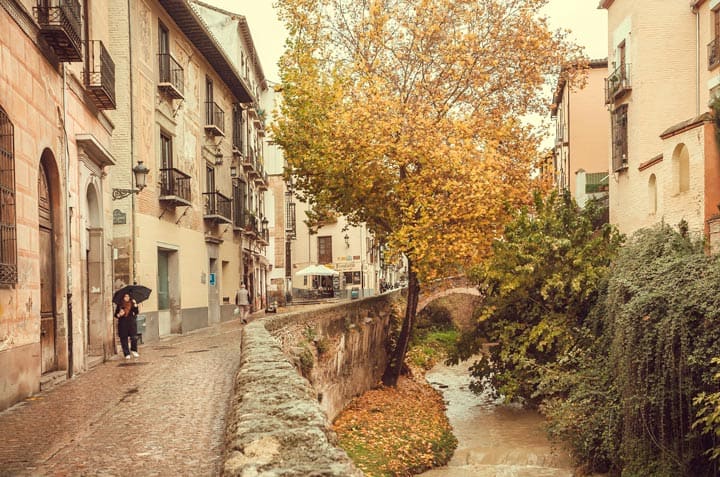
What was said about spring also applies to autumn: the shoulder seasons are the best for visiting Granada.
October is the autumn counterpart to May: 5 days of rain on average, minimum temperatures above 10° and maximums below 25°: ideal for spending many hours outdoors without risking fainting in the scorching sun. Even November, climatically speaking, is an excellent choice. Temperatures already fall quite noticeably compared with the previous month and you need to bring some warmer clothing, but average temperatures remain above 10° and there are fewer than seven days of rain in the whole month.
Compared with spring, autumn has only one drawback: you miss the blossom. The Alhambra and the Generalife, the city’s main attraction, are at their most enchanting in spring, thanks to the flowering of their gardens. That said, this does not mean they aren’t worth visiting at other times of the year! In fact, as the photo above shows, the colours of autumn make Granada even more beautiful!
Granada in winter
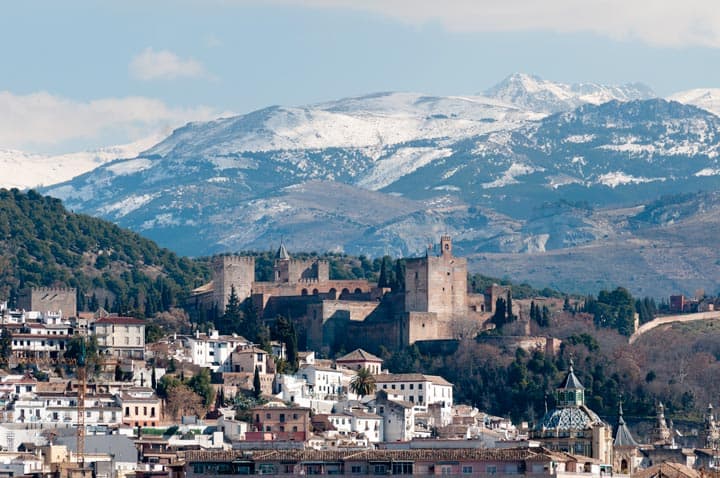
The semi-continental nature of Granada’s climate means that December can already be considered a winter month. Temperatures fall sharply and in the pre-Christmas period it is difficult to rise much above 12-13° in the warmest hours, while at night the thermometer registers on average 3-4°. After April, December is the second rainiest month of the year, although it rarely exceeds 7 days of rain a month. At this time Atlantic disturbances arrive to bring rain to the streets of Granada, but they are almost always light showers.
Rain continues in January and February, but it is never very heavy. Temperatures, however, do fall, especially at night. The thermometer often reads 2–3 °C on winter nights, with lows that can even drop below zero. Temperatures of −11 °C and −9 °C were recorded in 2005 and 2012, but in recent years such cold records seem increasingly unlikely. Daytime highs, by contrast, are never very low, averaging around 11–12 °C in January and about 14 °C in February. These figures emphasise the notable temperature swing between day and night that characterises the city.
If you want to visit Granada in winter, I recommend setting off with fairly warm clothing, as spells of intense cold can be sudden and unpredictable. It is very rare to see snow in the city itself, but it is normal — and very enchanting — to find it on the nearby peaks of the Sierra Nevada, which not for nothing boast Spain’s most important ski slopes.
The climate around Granada: from the Sierra Nevada to the Tropical Coast
Many tourists stop in Granada only long enough to visit the Alhambra and the city centre, looking at the Sierra Nevada only from afar, as a backdrop for their photographs. Reading our article on excursions on the Sierra Nevada, you will have realised how many opportunities these mountains offer, in every season. In contrast to the city, visiting the mountain peaks is recommended in the opposite seasons. If spring and autumn are to be preferred for visiting the historic centre because of the milder temperatures, they are at the same time the least suitable periods for going into the mountains, where the greater likelihood of rain can be a hindrance not to be underestimated.
In summer the dry, warm climate makes it possible to exceed even 3,000 metres without major problems (obviously, warmer clothing is needed at those altitudes), whereas in winter the snow that covers the bare peaks is a spectacle well worth seeing up close. The ski lifts offer skiing enthusiasts the chance to enjoy these mountains in a sporting way, but all you need is a pair of boots and perhaps the desire to hire a sledge to spend a sunny winter’s day in the midst of a breathtaking landscape. Even in this case, warm clothing is essential, because dipping below zero here is the norm.
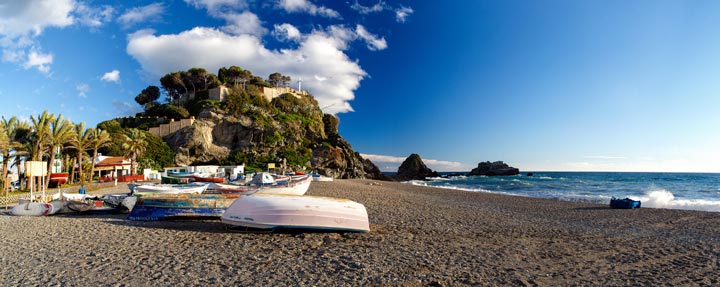
If you read our article on the beaches of Granada you will have realised that the Costa Tropical is well worth a visit, even (or especially) if, rather than travelling throughout Andalusia, you are opting for a short trip to Granada and its surroundings. It goes without saying that if you want a beach holiday, the summer months are the best time to visit the coastal towns and spend your days soaking up the sun by the sea. A wise choice also because, compared with the city, the sea breeze makes the climate in this area much more pleasant and less scorching than in the area 80km from the coast where the provincial capital is located. The same moderating effect of the Mediterranean means the coastal climate is also milder during winter.
If you plan a drive from Granada to the coast, or a day trip to a village easily reached by bus (such as Nerja in the province of Málaga), you will be surprised by the sun that even in winter pleasantly warms the seafront. I recall a trip to Nerja at the end of February, when the temperature difference compared with Granada was clear: while in the city a down jacket was essential, on the beach at midday it felt divine (not in swimwear, of course!).
The best time to visit Granada
If the only deciding factor is the climate, the answer is simple: May and October are the months to favour and, in general, the shoulder seasons are the most suitable. Most visitors, however, do not stop in Granada alone and this will probably be your case too, so I recommend studying the climatic characteristics of the other provinces carefully before making your choice, also using our article with advice on when to go to Andalusia.
If, instead, your itinerary involves travelling only in the immediate vicinity of Granada, visiting the nearby mountainous or coastal natural areas, you will find that the height of summer and winter could be the most suitable options. Precisely because of this variety, Granada proves to be one of the Spanish cities that is always worth visiting, regardless of the season: the important thing is to set off with suitable clothing.
