Planning an itinerary along the Costa del Sol you won’t find just beaches and fun. Scattered across the province of Malaga there are also several interesting towns to visit, such as Benalmádena, where you’ll come across one of the most curious and bizarre places in all of Andalusia.
I’m referring to the Castillo de Colomares, which is not one of the many historic Andalusian castles, but an extravagant building where you can clamber up fairy-tale turrets, peer out from decorated little windows and lose yourself in secret passageways. In short, a place that might seem inspired by some fantastical tale, yet is the product of the unconventional ideas of a doctor with a passion for history.
If you’re looking for a charming yet highly photogenic attraction that is about history and also appeals to children if you’re travelling with your family, then this should be at the top of your list of things to do in this part of Andalusia.
Contents
What is the Castillo Monumento Colomares?
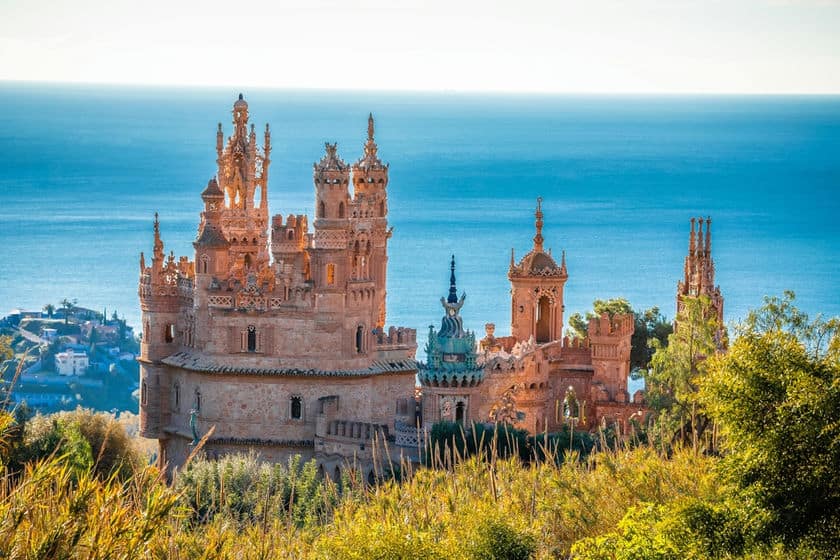
At a glance you might mistakenly think the Castle of Colomares (more precisely Castillo Monumento Colomares) is a historic building, even if not particularly old, when in fact it was built only between 1987 and 1994. But who built it and why? The idea for the project came from Dr Esteban Martín y Martín, a Spanish surgeon who, after working in the United States for a long period, returned to Spain and bought a property on which to build the house where he would spend his final years.
In view of the approaching 1992, he decided to celebrate the 500th anniversary of the discovery of America in a unique way: by building a monument dedicated to Christopher Columbus that would not be a mere statue, but a proper castle. Thus the doctor-artist, together with two bricklayers, began the construction of what would become the largest monument in the world dedicated to Christopher Columbus. Even the very name of the castle evokes the 15th-century traveller: Colomares is, in fact, nothing more than a fusion of the words Colón (Christopher Columbus’s surname in Spanish) and Mares (the seas the explorer sailed).
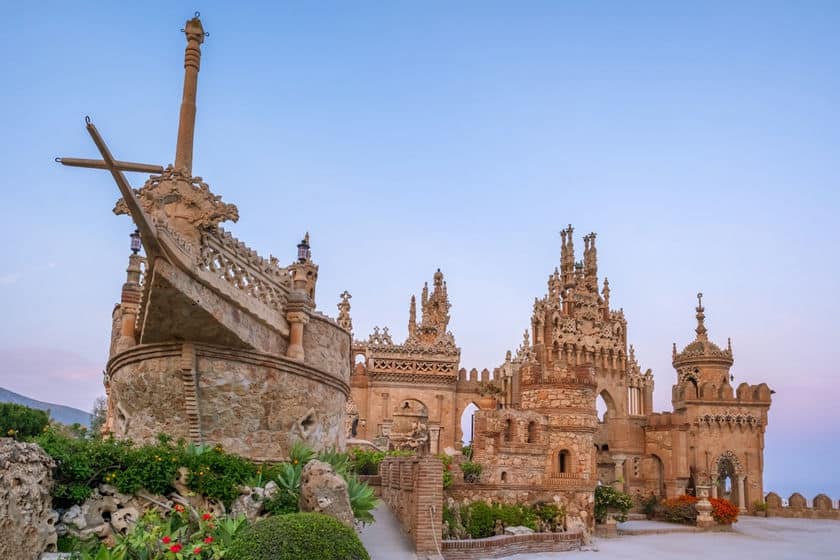
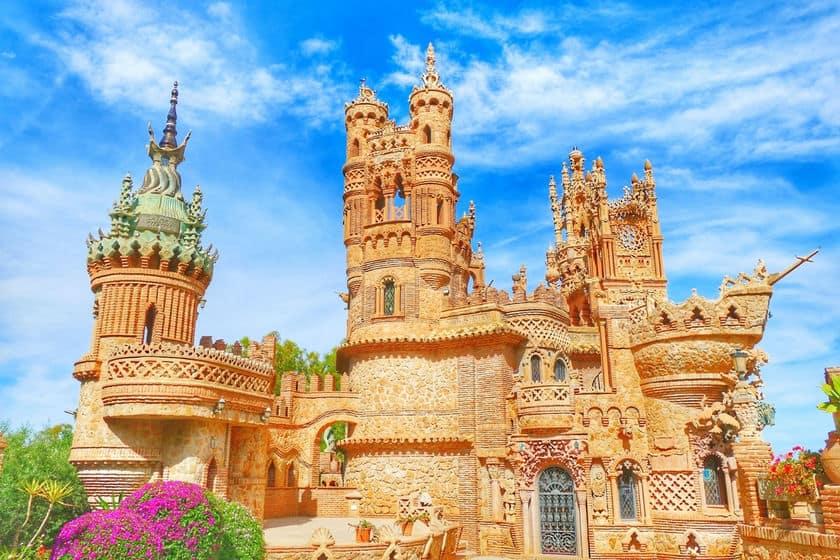
It is, in fact, a little castle built in numerous different architectural styles, including neo-Romanesque and neo-Byzantine, neo-Gothic and neo-Mudéjar. As I said, it is dedicated to Christopher Columbus and his voyage to the Indies that led him to discover the New World, which is why the central architectural motifs of this quirky structure depict the three caravels. On the main façade the Pinta is depicted, supported by the horse Pegasus. La Niña, meanwhile, is in the upper part of the structure, beneath the arch of La Rábida (the monastery where Columbus was hosted on his arrival from Portugal). The Santa Maria is further away from the other two because she sank off Santo Domingo.
There is also a Chinese pagoda to recall that Columbus’s aim was to reach Asia. All around, you can notice numerous religious references — to Christianity, Judaism and Islam — which highlight how religious, and cultural dialogue in general, was fundamental during the age of great explorations. Among the most distinctive parts of the structure is the chapel dedicated to Saint Elizabeth of Hungary (or Saint Elizabeth of Thuringia, as she is also known), which, at just 1.96 m², is the smallest consecrated church in the world! There is also an empty mausoleum, which symbolises Christopher Columbus’s fifth voyage — the one to Eternity — after the four voyages he made across the ocean.
How to organise your visit
Now that I’ve explained what this quirky castle is, aren’t you keen to visit it? Here’s how to do it!
Guided tour of the Castillo de Colomares
Location and how to get there
The Castillo de Colomares is located outside the centre of Benalmádena, in the residential area to the north-west of the town. The exact location is this and, if you arrive by car, you can park here.
To get there by public transport, you can take a bus – line M-103, M-112, M-121 or M-126 – and get off at the “Las Mimosas” stop, which is about a 10-minute walk from the castle. These buses can be taken either from the central area of Benalmádena’s harbour (from where the journey takes around 30 minutes) or from outside the “Benalmádena-Arroyo de La Miel” train station (around a 15-minute journey).
By public transport you can also easily get there from Torremolinos: some of the buses mentioned above (such as the M-121 and M-126) do in fact also run from there before passing through Benalmádena and reaching the castle. If, instead, you are based in Malaga and want to go and see it, don’t worry: you can visit it from the city too. You have two options: the first is to take the C1 Cercanías train to “Torremuelle” and then walk for about half an hour; the second is to get to Benalmádena (for example on the same train to the aforementioned “Benalmádena-Arroyo de La Miel” station) and from there continue with the bus I mentioned earlier.
Opening times
Colomares Castle is open at different times depending on the time of year:
- Spring:
- Monday: closed
- Tuesday to Sunday from 10:00 am to 8:00 pm.
- Summer:
- Monday: closed
- Tuesday to Sunday from 10:00 am to 2:00 pm and from 5:00 pm to 9:00 pm.
- Autumn and winter:
- Monday: closed
- Tuesday to Sunday from 10:00 am to 6:00 pm.
Admission tickets
The ticket costs €3.50 for adults and €2.50 for children and pensioners. You can buy the ticket directly at the entrance, without needing to book it in advance. For groups (minimum 25 people) wishing to take a guided visit, you must contact the ticket office in advance by telephone or email (contacts on the official website). If, however, you would like explanations during the visit, you can join a guided tour. In this case you will need to book it online beforehand.
Where to stay in the area
Looking for accommodation in Benalmádena is a good choice because, as well as being able to visit this attraction and the rest of the town easily, you’ll have access to the area’s beaches and be in a strategic position halfway between Málaga and Marbella. To stay in the area, you can also decide to stay in Torremolinos or look for a hotel in Fuengirola.
