After letting yourselves be enchanted by the historic centre of Malaga, taking a pleasant stroll from the Alcazaba up to the Gibralfaro Castle, stepping back in time with a visit to the Roman Theatre and, why not, enjoying a bit of relaxation on the La Malagueta beach, wouldn’t it be time for a little shopping and some “city” relaxation? Whether you’re after simple souvenirs or personal items — clothes, shoes, fragrances or bags — shopping in Malaga has a very specific meaning: Calle Larios e Plaza de la Constitución.
Contents
Strolling through this part of the city you will be overwhelmed by the number of shops, boutiques and shopping arcades, so much so that you may be distracted from the historical importance and the architectural value of this street.
So let’s take a slightly closer look at those aspects of Calle Larios and of Plaza de la Constitución that tourists don’t usually know about, and which would be worth bearing in mind during long shopping sessions in Málaga.
Calle Larios in Malaga: one of Spain’s most exclusive calles!
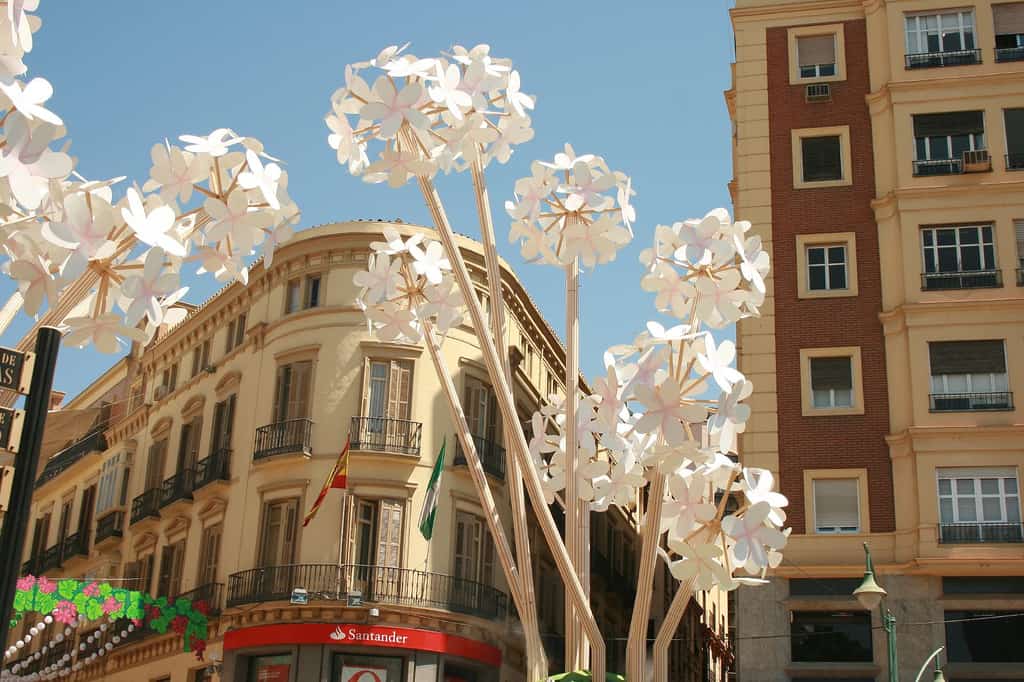
Calle Larios – in full Calle Marqués de Larios – is considered one of Spain’s most elegant streets, so much so that it ranks fifth in the list of the country’s most expensive streets (for the curious, in first place is Portal de Ángel in Barcelona, second is Calle de Preciados in Madrid, followed by Calle de Serrano, also in Madrid, and by Paseo de Gracia in Barcelona).
To give an idea, rent per square metre costs €1,860 a year. At European level, Calle Larios is among the 50 most expensive streets on the continent. On 14 December 2002 it was made completely pedestrianised and, as a result, a regeneration plan for the entire historic centre of Malaga was launched.
This important street is named after Manuel Domingo Larios y Larios, the second Marquess of Larios, whose imposing statue (sculpted in 1899 by Benlliure) stands right at the start of the street, at the junction with the Alameda Principal.
Interesting facts about Calle Larios
To give you an idea of how expensive Calle Larios is, bear in mind that half the buildings are owned by the Marchioness de Paul (who frequently does business with the Larios family), and the other half belong to the descendants of José Quesada. 90% of the buildings on this street are let to major brands at an average price of over €20,000 per shop.
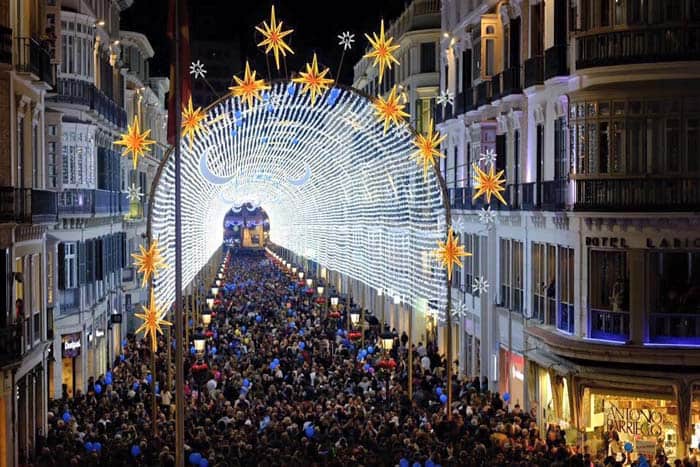
Architecturally, the buildings that frame Calle Larios reflect the style of the Chicago school, with rounded corners and a constant quest for symmetry. This rounded approach to the buildings proved, at the time, practical in other respects too, since, in the absence of sanitation facilities, it allowed the sea breeze to move more freely and to cleanse the air.
During the Christmas period Calle Larios attracts attention for its decorations and lighting, becoming one of the most spectacular areas of Malaga, as well as the centre of Christmas shopping. In summer, however, when the heat becomes unbearable, it is covered with white tarpaulins.
Every year, this street is one of the focal points of the Festival de Cine de Málaga, when it is decked out with a film-themed display complete with a red carpet. Furthermore, in August it becomes the beating heart of the Feria de Málaga, an event highly anticipated by locals and visitors alike. In September Calle Larios hosts Malaga Fashion Week and its 350-metre high-fashion catwalk (the longest in Europe).
A very brief historical note on Calle Larios
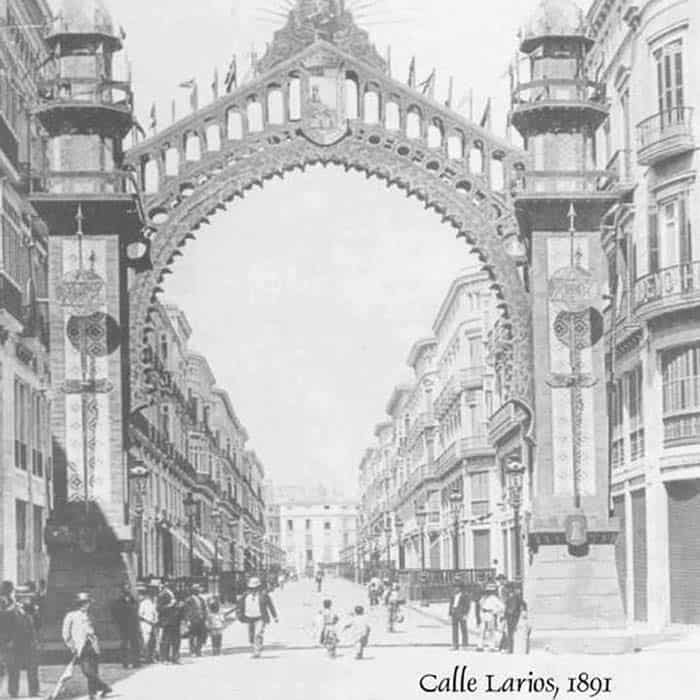
The road named after the Marquis was inaugurated on 27 August 1891; no member of the Larios family could attend the inauguration, as no descendants remained in Málaga. During the 1868 revolution La Gloriosa, in fact, a group of workers rose up against the Larios family (who drove much of Málaga’s economy in the 19th century), surrounding the nobles’ house and forcing them to flee from the roof and emigrate from Spain.
In 1931, with the proclamation of the Second Republic, the street was renamed Calle 14 de Abril because the new regime did not wish to uphold the privileges associated with noble titles; after the Spanish Civil War, however, the street was restored to its original name.
Plaza de la Constitución: so much history in one square!
Where Calle Larios ends begins Plaza de la Consitución, the city’s quintessential public and political space since the 15th century. Situated in the heart of the historic centre, this square still serves as the focal point of the social and cultural activities in which citizens take part, as well as the venue for the city’s best-known traditional events.
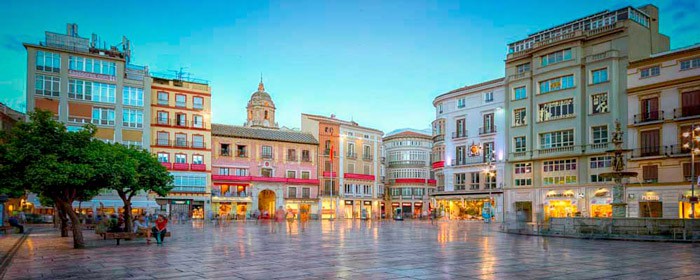
Plaza de la Constitución somewhat reflects the historical and political changes the city of Malaga has undergone. Over time, in fact, it has been called by different names depending on the prevailing political and governmental influences; originally it was known as Plaza de las Cuatro Calles or Plaza Pública and in 1812, with the advent of the first democracy, it took the name Plaza de la Constitución. Afterwards, however, it continued to change names: Plaza de la Libertad, Plaza de la República Federal, Plaza 14 de Abril, Plaza José Antonio Primo de Rivera, before reverting to its current name.
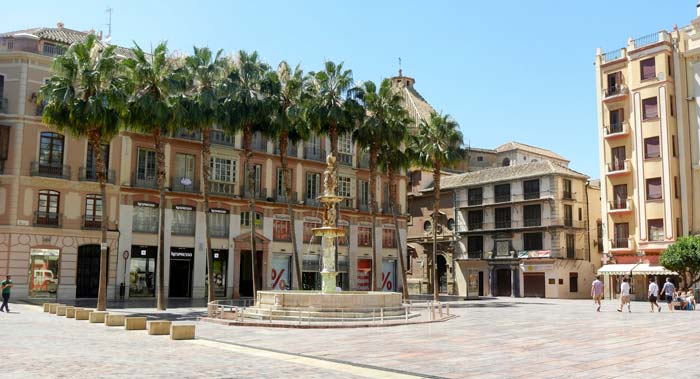
The square has always housed a number of notable historic buildings, such as the Casa del Governatore, the prison, the Court and, until 1869, the Comune di Malaga.
In the 19th century Plaza de la Constitución underwent numerous changes, many historic buildings were demolished and replaced by shopping arcades such as the Pasaje de Heredia and the Pasaje Chinitas. Among the historic buildings still present in the square are the Casa del Consulado and the Old Jesuit College.
Interesting facts about Plaza de la Constitución: the Fuente de Genova
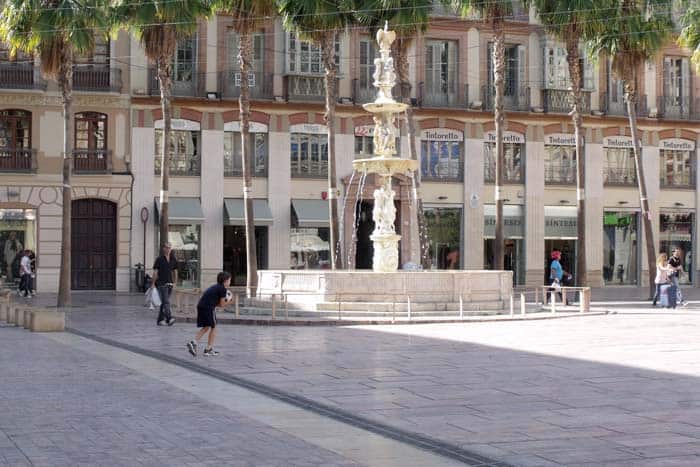
Plaza de la Constitución is home to the imposing Fuente de Génova (also called the Fuente de Carlos V), a large sixteenth-century marble fountain, brought to Málaga only a century later, which is thought to come from the city of Genoa. After spending some time beside the pond of the Parque de Málaga, the fountain was moved to Plaza de la Constitución in 2002, replacing the Fuente de las Tres Gitanillas, which is now located on Avenida de Andalucia.
The curious thing is that, unlike most fountains situated in the main squares around the world, the Fuente de Génova is not in the centre of the square but on the side, at the junction with Calle Especería. This choi
Such a singular choice was deliberately made to facilitate the numerous celebrations that take place in Plaza de la Constitución throughout the year. It is here, in fact, that the official grandstand is erected for Semana Santa and the tents of the Feria de Málaga. Moreover, the square serves as a central location for many stages of the celebration of the Carneval.
Now that you know a bit more about Calle Larios and Plaza de la Constitución, you can enjoy your shopping trip!
