Among the many attractions to visit in Malaga during a tour of Andalusia, there is one particularly evocative site you absolutely must not miss: the Roman Theatre of Malaga. This place, in fact, is the oldest monument in the city, as well as one of the few Roman ruins that can still be admired in Andalusia.
Due to its significance, in 1972 the Roman Theatre of Malaga was declared a Site of Cultural Interest, and today it attracts not only tourists but also scholars and archaeologists from around the world, keen to discover the history of this place and to admire the artefacts unearthed after all this time: the Roman Theatre survived centuries of history buried beneath debris and rubble before being uncovered in 1951 by some workmen.
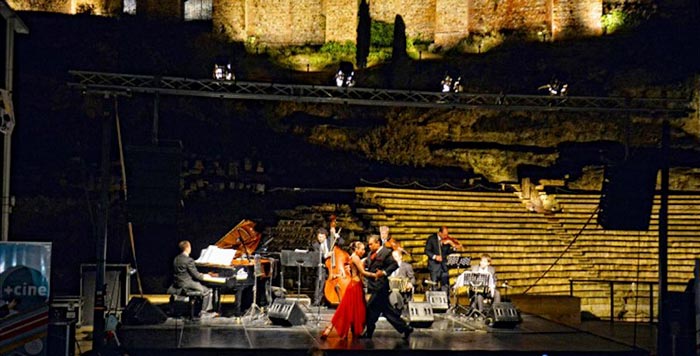
Over time, as we shall see, the theatre has also reclaimed its ancient role as a performance space: in short, if you are visiting Malaga, the Roman Theatre is without doubt one of those stops you simply cannot miss, not only for its historical and cultural value, but also because it could offer you a marvellous evening accompanied by a theatrical performance in an atmospheric, timeless setting.
Here is all the useful information for visiting the monument.
Contents
The structure of the theatre
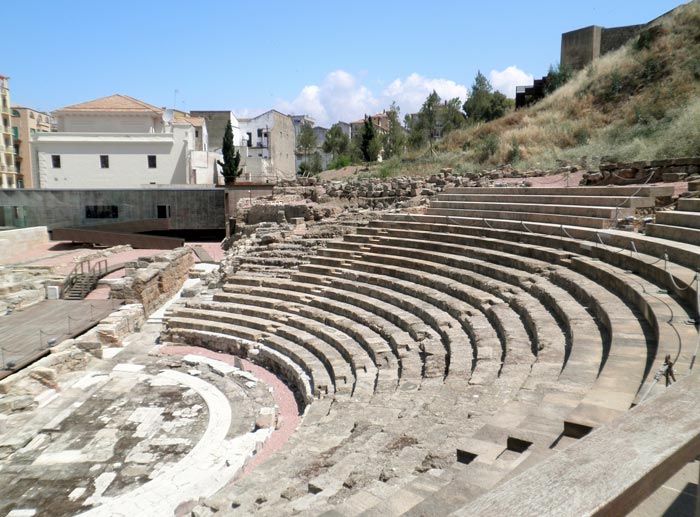
The plan of the amphitheatre appears to have remained almost intact. It is divided into three parts: the Cavea, the Orchestra and the Proscenium. The Cavea is the semicircular area reserved for spectators; it extends over three tiers and is itself divided into three corridors (Inma Cavea, Media Cavea and Sunma Cavea), reaching a structure with a radius of 31 metres and a height of 16 metres.
The Orchestra lies between the Cavea and the Proscenium and, in addition to housing the musical orchestra, in earlier times was the area reserved for the most important spectators. The Proscenium (that is, the stage) is slightly raised above the Orchestra to give spectators a better view.
All in all, thanks to the archaeological work it has been possible to recover an important performance space, so that today – as mentioned earlier – the Malaga amphitheatre can accommodate up to 200 spectators during theatrical performances.
The Centro de Interpretación de Teatro Romano in Malaga
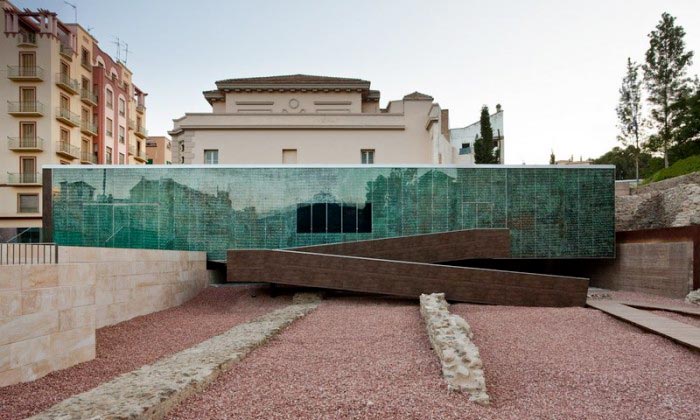
In 2010 the Centro de Interpretación de Teatro Romano was built, with the aim of promoting knowledge of the precious Roman‑era monument. The building is shaped like a rectangular prism, designed by Antonio Tejedor and constructed in steel, iron and glass.
This centre serves as one of the gateways to the theatre and as a sort of prelude to what you are about to visit, offering an interesting and comprehensive overview of the Roman world, especially through original documents found during the excavations that brought the theatre to light, and also presenting interactive exhibits that illustrate the site’s restoration process.
History
The Roman Theatre dates back to the 1st century BC, when the Roman emperor Caesar Augustus had it built at the foot of Mount Gibralfaro. During the city’s Arab rule, the Theatre was used as a quarry during the construction of the Alcazaba. Today it is possible to note that many of the missing parts of the amphitheatre (especially a large number of columns) form part of the foundations of the Arab fortress.
The Roman Theatre remained hidden from the world for a very long time and only in 1951, after almost 17 centuries since its stage was closed, were its ruins brought to light. The remains of this theatre were discovered during the creation of the gardens of the Casa della Cultura; the project was put on hold so excavations could begin and this unique example could be returned to the world.
Between 1958 and 1984, the Roman Theatre of Malaga hosted numerous theatrical performances, especially during warm summer evenings. It then underwent restoration work that lasted a full 27 years, and only in 2011 did it resume functioning as a performance space.
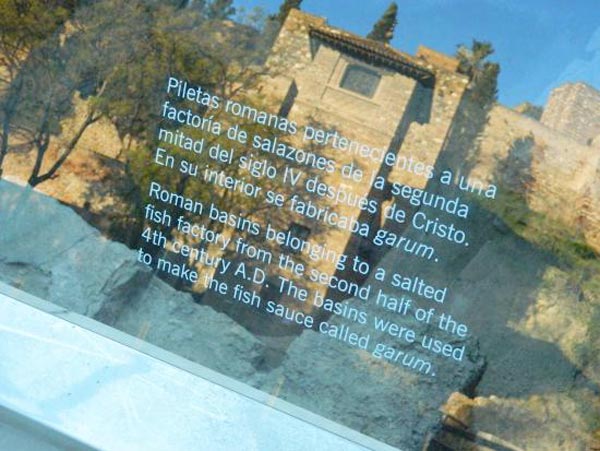
In front of the theatre there is also a crystal pyramid (which vaguely resembles a miniature Louvre): it was designed to show a glimpse of the underground excavations, which reveal the ancient presence of farms specialised in the production of garum, a fish sauce.
The Festival of Roman Theatres of Andalusia
Every year, during the summer months from June to August, the amphitheatre hosts the Festival dei Teatri Romani di Andalusia, whose programme includes theatrical performances that take place, as well as in Malaga, in the Roman theatres of the ancient city of Italica (near Santiponce, in the province of Seville) and of Baelo Claudia (near the beach of Bolonia).
The Festival was organised for the first time in 2013, and has since aimed to highlight the Roman past of the cities that host it. It mainly involves the staging of classical works such as The Odyssey, Oedipus Rex, and The Golden Ass, but also features traditional local music and dance like flamenco, as well as genuine local artistic projects.
Useful information for visiting the Roman Theatre
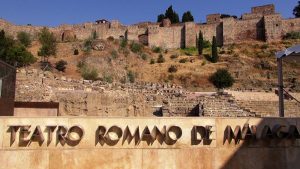
Do pay close attention to the theatre’s opening times and the days it’s closed: you might have to make do with seeing the theatre only from the outside (which is still a lovely sight, as you can see from the previous photos).
Opening times and tickets
The Roman Theatre of Malaga is open from Tuesday to Saturday from 10:00 to 18:00; it is closed on Mondays, while on Sundays and public holidays it can be visited from 10:00 to 16:00. It remains closed on 1 and 6 January, 1 May, and 24, 25 and 31 December.
Entrance to the Theatre is completely free: there are no tickets to obtain in advance or tours to purchase.
How to get there
The Roman Theatre of Málaga is located in Calle Alcazabilla, at the foot of Gibralfaro hill and the huge walls surrounding the Alcazaba of Málaga. We are therefore right in Málaga’s historic centre, close to all the city’s main attractions, such as the Picasso Museum and the Cathedral.
The best advice is always to get there on foot, because there is no better way to get to know a city like this than by exploring it as you walk. However, if you are staying far from the centre, you can reach the Roman Theatre of Málaga by taking any bus that stops at Plaza de la Merced or Plaza de la Victoria.
Where to stay near the Theatre
As usual, we invite you to follow our advice on where to stay in the centre of Malaga, so you don’t risk ending up too far from the main sights.
