Although embraced by the surrounding buildings, the Cathedral of Malaga asserts its majesty before your eyes, leaving you speechless: after all, among the many things to see in Malaga this is certainly one of the most important. The Catedral de Nuestra Señora de la Encarnación (Cathedral of Our Lady of the Incarnation) was begun in the early 16th century to a design by the architects Diego de Siloé, Pedro Lopez, Enrique Egás and Diego de Vergara. It combines various architectural styles, perfectly in harmony with one another, making the building a unique work of imposing beauty.
If you love the Gothic-Renaissance style, this cathedral will enchant you. The baroque facade and the domes are distinctive features of this splendid church. In this article I’ll give you a comprehensive overview of the church, offering some practical information for your visit, and I won’t fail to tell you a little about this monument’s particular history.
Contents
The cathedral’s exterior
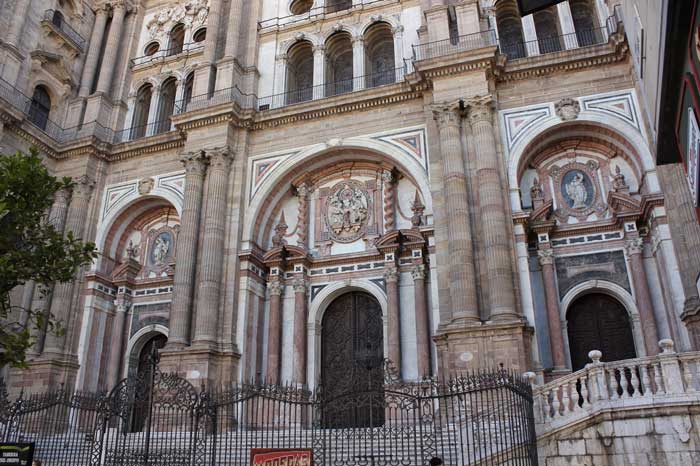
If you prefer not to enter the church, do pause to observe the façade of Malaga Cathedral with its baroque decorations and its symmetries. On Calle Cister we find the north façade, also called the Puerta de las Cadenas. On Calle Postigo de los Abades we find the south façade, also known as Puerta del Sol.
The two symmetrical doors are the work of Maestro Josè de Bada. The main façade, located at Calle Molina Lario 9, is in the baroque style and is built slightly set back from the two towers, as if they were embracing and protecting it.
Tall columns divide the façade into three parts, the central one larger than the flanking sections. Each of the three in the upper part is characterised by a trifora (a triple‑arched window) and above it a central window with two oval windows. In the lower part of the façade, above the three imposing doors, there are large medallions depicting the two patron saints of Malaga, Saint Cyriacus and Saint Paula, with the Incarnation at the centre.
The interior of the Cathedral
Let’s discover together the interior of the Cathedral of Malaga. The Latin cross plan comprises three aisles of equal height, almost 42 metres. Coloured stained-glass windows let in the light that illuminates the church’s interior. The vaults are magnificent and perfectly harmonious, despite having been completed some 200 years apart: the first phase dates from the 16th century while the second from the 18th century.
The earlier work iconographically represents the theological and cardinal virtues, while the 18th-century work is characterised by depictions of archangels and saints. Among these, I suggest you admire the vault above the choir with the archangels Saint Michael and Saint Raphael.
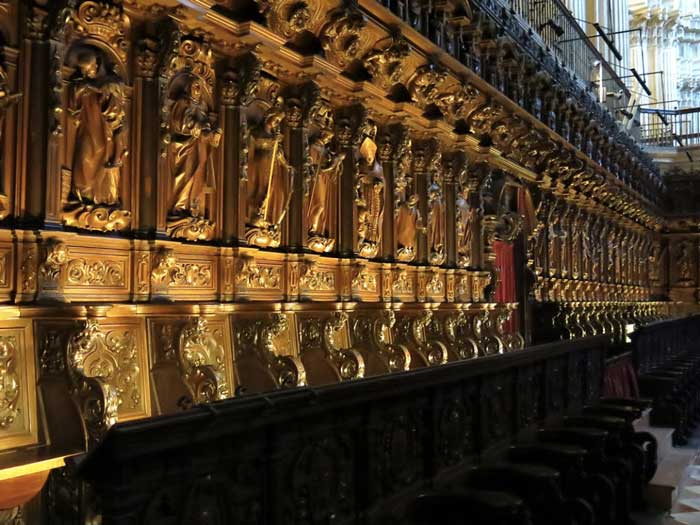
It is precisely the work of the choir that deserves a special mention: indeed, the Cathedral choir represents one of the most significant sculptural examples of Spanish Baroque art. A huge work of the late 16th and early 17th centuries, it is made from precious woods such as mahogany and cedar, probably brought from the Americas.
The sculptural skill is owed first to Luiz Ortiz de Vargas, then to José Micael Alfaro and, finally, to Pedro de Mena, who contributed 40 sculptures to complete the work.
The construction of Malaga Cathedral: a never-ending story
The cathedral stands on an ancient mosque, called Mezquita Aljama, of which, however, unlike in many other Andalusian cities, we have no visible remains. Certainly the idea and layout of the patio with orange trees still present today to the side of the church date back to the garden the mosque must have had, which the Tunisian Ibn Batouta describes in a 14th-century document. Thanks to other documents of the time we discover that the mosque must have had 113 columns of marble and precious stones and no fewer than five aisles to the right and left of the main nave.
Work to build the cathedral began in 1528 and it was inaugurated on 30 August 1588, even though construction was not yet complete: work continued on its realisation until 1680, when a severe earthquake damaged much of the church. At the beginning of the eighteenth century restoration and completion work resumed under the supervision of José de Bada and, after his death, Antonio Ramos. In 1762 the church reopened for worship, while Master Ramos sought to finish the works despite some disagreements and severe financial constraints.
Twenty years later, in 1783, the works were definitively halted. A glimmer of hope for the inhabitants of Malaga came in 1862 when Queen Isabella II decided to visit Andalusia and to stop in Malaga. She visited the cathedral but, despite requests and hopes, at the end of the visit no works to complete the Cathedral of Malaga were commissioned by the Spanish royals. The church is affectionately known today as La Manquita (La Monchetta).
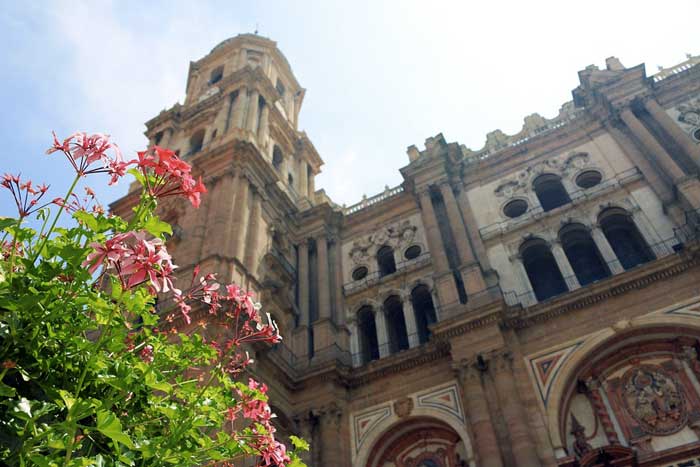
Indeed, the north tower rises to no less than 84 metres, making the cathedral the second-tallest church in Andalusia after the Giralda of Seville, while the south tower remains unfinished. Seen from the outside, this absence is clearly visible and this magnificent Renaissance monument rightly earns the nickname of a ‘monca’ construction.
Prices, opening hours and useful tips for visiting the Manquita
The Cathedral of Malaga is located in the historic centre, a stone’s throw from another important monument like the Alcazaba: if you’re out for a stroll you’ll find it easily. If you want to be absolutely sure you don’t miss it, here’s the address: Calle Molina Lario, 9.
Ticket Prices
- Entrance to the Cathedral:
- Adults: €10
- Seniors over 65: €9
- Students aged 18–25: €7
- Young people aged 13–17: €6
- Children up to 13 and people with disabilities: free
- Groups, minimum 15 people: €7
- Students under 12 in groups: €4
- Roof access:
- Adults: €10
- Seniors over 65: €9
- Students aged 18–25: €7
- Young people aged 13–17: €6
- Children up to 13 and people with disabilities: free
- Groups, minimum 15 people: €7
- Students under 12 in groups: €4
- Entrance to the cathedral + roof:
- Adults: €15
- Seniors over 65: €13
- Students aged 18–25: €10
- Young people aged 13–17: €9
- Children up to 13 and people with disabilities: free
- Groups, minimum 15 people: €10
- Students under 12 in groups: €8
Currently, visits to the Cathedral roof are suspended due to restoration work (at least until 2027)
While the idea of charging a €10 entrance fee per person to enter a church is debatable, if you love art I strongly recommend paying it, as the cathedral’s interior is magnificent. Try to visit in the central hours of the day, both to get some relief from the summer heat and because for much of the day the lighting comes from natural sunlight streaming through the magnificent tall stained‑glass windows. At sunset, before they switch the lights on, visibility inside the church is therefore reduced. Also remember that we are in Spain, so during the lunch break you will probably find fewer people and can fully enjoy every corner of the cathedral.
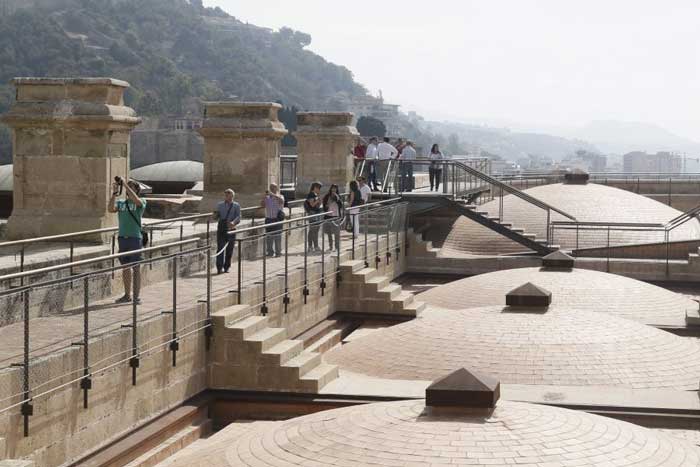
With the combined ticket you’ll have the chance to see the interior of the cathedral and to go up onto the roof. From the north tower you climb around 200 steps to reach a height of almost 50 metres. The view from the cathedral roofs is breathtaking. You can also choose to buy just access to the roof without the cathedral visit for €6 during the day and €10 for the evening visit. After sunset the city lights up and seeing it from above is a sight to behold.
With either the cathedral admission ticket or the combined ticket, the audio guide is included and you also have free access to Ars Malaga, a museum of sacred art with a section devoted to African artefacts and an exhibition area for art collections. The museum is located in Plaza Obispo, right in front of the Cathedral.
There is also the option of taking a guided tour: the price is, of course, higher, but it includes skip‑the‑queue entry and, above all, a local guide who provides plenty of information about the cathedral.
Guided tour of the Cathedral and the historic centre of Malaga
Opening hours
The Cathedral of Malaga and the roof are open at the times listed below. Please bear in mind that tourist visits are not permitted during liturgical celebrations. In addition, every morning from 08:30 to 09:00 (on Sundays until 09:30) there is a short period during which admission is free.
- Cathedral:
- Monday to Friday from 10:00 am to 6:30 pm
- Saturday and days before public holidays from 10:00 am to 6:00 pm
- Sundays and public holidays from 2:00 pm to 6:00 pm.
- Roof:
- Monday to Saturday, access is available at 11:00 am, 12:00 noon, 1:00 pm, 2:00 pm, 4:00 pm, 5:00 pm and 6:00 pm.
- On Sundays, access is available at 4:00 pm, 5:00 pm and 6:00 pm.
Tips on where to stay
As usual, for specific advice on where to stay, see my dedicated article. As with the Alcazaba, the best neighbourhood to stay in to have everything within easy reach is the Centro.
Tips on where to stay in Malaga
In conclusion, if you’re on holiday in Malaga and having fun on the beaches of Malaga, definitely make time for a visit to the Manquita: it will bring you that peace and serenity that only the beauty of art can give.
